The First-Ever WordPress.com Growth Summit Is Coming, and You Won’t Want to Miss It

Join us for The Official WordPress.com Growth Summit on August 11-13! At our first-ever virtual conference you will learn how to build and grow your site, from start to scale. Are you a blogger looking for ways to drive traffic and get more visitors? Are you a small business that would like to start selling more products and services on your site? Are you an artist or creator who would like to learn how to share your work? The WordPress.com Growth Summit will cover these topics (and many more) and provide indispensable advice to help you succeed.

The goal of this event is to inspire, connect you with the tools you need, and help you build your community. Sessions will take place across three tracks: blogging, business, and creative. You can take sessions on any or all tracks, and they’ll focus on four main topic areas: 

Site Structure & Design: Make your website look its best.Content: Create great content to help your website grow.Marketing: Grow your audience and reach.Making Money: Monetize and scale your website.

Each day includes sessions with industry and business leaders, successful bloggers, and creatives, who will join WordPress.com experts for engaging talks and hands-on demonstrations to help your site grow. Hear from speakers like…

Deb Perelman, creator of Smitten Kitchen.Business strategist Tina Wells.Chris Coyier, web developer and CSS expert.Amy Chan, founder of Renew Breakup Bootcamp.Industry experts from companies including Google, Sandwich, Looka, ShipBob, and WordPress.com.

You’ll also have the opportunity to connect directly with our Happiness Engineers to ask your most pressing support questions. 

To stay accessible to a global audience, we’ll hold the event twice, with live sessions in all regions:

Americas, Europe, Middle East, and Africa — August 11-12, 2020

15:00 – 20:00 UTC

Asia Pacific — August 12-13, 2020

02:00 – 07:00 UTC

Want to learn more about the event and to take advantage of the early-bird pricing (available through July 31)?

Take me to The WordPress.com Growth Summit!

 
Quelle: RedHat Stack

Rethinking application modernization for CIOs

The current global crisis has only reinforced what was already true for many IT organizations—that they must increase agility and accelerate innovation to better serve customers and prevent future disruptions. But for many, maintenance of legacy IT systems has inhibited change and consumed disproportionate amounts of budget. In fact, a recent McKinsey study of enterprises found that legacy systems account for 74% of an organization’s IT spend while continuing to be a drag on innovation.Today’s crisis has only increased the urgency with which organizations must modernize their applications in the cloud. By embracing public cloud technologies, organizations can reduce infrastructure costs and management overhead while increasing agility, scalability, and security. But change is not easy, and determining the right path forward can be challenging when critical systems are on the line.At Google Cloud we’ve developed a number of best practices through our work with organizations of all sizes that we’re sharing in our new whitepaper, the CIO Guide to Application Modernization. In it, we share our insights on everything from modernizing your first applications all the way to transforming your entire software delivery strategy with a product delivery model. Getting started with application modernizationMost application modernization starts with evaluating your existing applications. By streamlining your existing application portfolio, you can improve efficiency, reduce complexity, and lower your Total Cost of Ownership (TCO). In our guide, we describe how to reorient your roadmap for application modernization through the lens of business services rather than applications.Designing, building, and using your new application platformYour digital transformation journey will begin to generate value even in its early phases.. Focusing on low-hanging fruit early means every new capability improves the organization’s ability to enhance business services to provide better value. In our guide, we’ll introduce you to what our Devops Research and Assessment (DORA) calls “The J-Curve of Transformation” which can help you determine the right path forward.Adopting a new product delivery modelUltimately, any changes to your organization’s IT structure must deliver value to your customers. In our guide, we share how we can help you reorient your IT organization to adopt a product-based model for delivering business capabilities quickly, efficiently and securely. Whether you’re an enterprise trying to untangle the challenges of a legacy Java environment or looking to adopt modern development principles, we’re here to support your transformation. Download the guide to view our in-depth recommendations and start your application modernization journey today.
Quelle: Google Cloud Platform

Traffic Director and gRPC—proxyless services for your service mesh

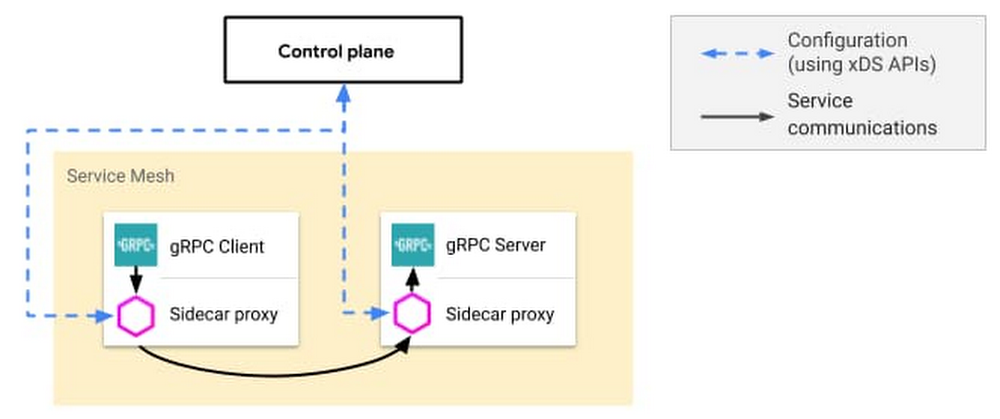
Lot of organizations turn to service mesh because it solves tedious and complicated networking problems, especially in environments that make heavy use of microservices. It also allows them to manage application networking policies, like load balancing and traffic management policies, in a centralized place. But adopting a service mesh has traditionally meant (1) managing infrastructure (a control plane), and (2) running sidecar proxies (the data plane) that handle networking on behalf of your applications.Illustrative service mesh with sidecar proxies configured by a control planeWe built Traffic Director, a Google Cloud-managed control plane, to solve that first barrier to service mesh adoption—you shouldn’t need to manage yet another piece of infrastructure (the control plane). Today, we’re happy to share a new approach to solving the second problem—you shouldn’t need to manage a fleet of sidecar proxies. With Traffic Director support for proxyless gRPC services, you can bring proxyless gRPC applications to your proxy-based service mesh or even have a fully proxyless service mesh.A service mesh with proxyless gRPC applications configured by Traffic DirectorTraffic Director support for proxyless gRPC servicesTraffic Director’s support for proxyless gRPC services is built on a simple idea: if Traffic Director can configure sidecar proxies to do load balancing on behalf of a gRPC client, why not have it just configure the gRPC client directly?gRPC, as you may know, is a high performance and feature-rich open-source RPC framework that underpins many of the Google Cloud Platform (GCP) services that you use every day. GCP uses it in the Google Cloud client libraries, which you use to reach services like Cloud Storage, Cloud Pub/Sub and many others. gRPC handles connection management, bidirectional streaming, and other critical networking functions. In short, it’s a great framework for building microservices-based applications.But, out of the box, gRPC only provides DNS-based name resolution and simple load balancing. For service mesh functionality (for example, dynamically discovering the backends for a service or global proximity-based load balancing), customers have traditionally turned to sidecar proxies. These sidecar proxies deliver powerful service mesh capabilities… but they’re also an additional piece of infrastructure to manage.gRPC + xDSTo make proxyless gRPC possible, we added xDS API support to the most recent version of gRPC. The xDS APIs are the same open source APIs used by the popular Envoy proxy. They enable xDS control planes (such as Traffic Director) to configure gRPC clients with service information such as endpoint address, health status, priority (based on proximity and capacity) and which policies to use when calling out to the service.Traffic Director provides endpoint information for a multi-regional service. Traffic is prioritized to the nearest healthy instances that have capacity, and can fail over automatically to other regions.Additionally, we added support for GCP-managed native gRPC health checks for your gRPC applications. Traffic Director collects data from these health checks and uses it to determine the health status of a service’s endpoints (as shown in the image above).These additions enable you to get the benefits of a service mesh without having to deploy sidecar proxies alongside your gRPC applications.Getting started with proxyless gRPCWe want to make it as easy as possible for you to get access to the benefits of service mesh. A big part of that is reducing the need for additional infrastructure. And the process of getting started with proxyless gRPC is easy too:Update your gRPC application to the latest versionUse the new `xds` gRPC name resolverAdd a small bootstrap fileConfigure services and policies in Traffic DirectorMore broadly, you can think of proxyless gRPC services as another way of deploying services in your service mesh (similar to services based on sidecar proxies). Traffic Director allows you to deploy both proxy-based and proxyless gRPC services in a service mesh.Traffic Director supports service mesh deployments that include both proxyless and proxy-based gRPC applicationsWe fully expect that customers will run service meshes that include both deployment models. We’ve even made it possible for a single gRPC client to call some services via the proxyless route and others via a sidecar proxy.When to deploy Traffic Director with proxyless gRPC servicesWe see three main use cases for the proxyless gRPC approach—simplified gRPC adoption (thanks to a managed networking experience), high performance services in a service mesh, and bringing service mesh to environments where you can’t add sidecar proxies.Managed networking for simplified gRPC adoptionWe talk to customers all the time who are considering adopting gRPC as part of their efforts to modernize their application stack. The benefits of gRPC are clear but, on its own, gRPC doesn’t solve problems like client-side load balancing, service discovery and global failover. Traffic Director’s support for proxyless gRPC services was built to solve these needs, thereby making it easier to adopt gRPC as part of a modernized deployment.Resource efficiency and performanceProxies consume resources and those may start to add up as you scale to hundreds or thousands of proxies. Plus, high-performance applications may find it difficult to meet performance targets when sending requests through multiple sidecar proxies (client sidecar proxy, server sidecar proxy, and back again for request/response exchanges).In our testing, we’ve found that proxyless gRPC can save on networking-related CPU costs compared to sidecar proxies. Benchmarks have shown that introducing sidecar proxies introduces latency due to additional network hops. The proxyless approach promises savings on both of these dimensions. Finally, we believe that this performance gain will be important for emerging use cases, such as service mesh deployments for telco network functions and 5G/edge computing.Service mesh for environments where you can’t add sidecar proxies.We’ve talked to customers who can’t necessarily add sidecar proxies to deployments. Some managed compute environments don’t let you spin up multiple processes (one for the application, one for the proxy) or make changes to an instance’s network stack (for example, using iptables). In such cases, proxyless gRPC applications provide a great way to get the benefits of service mesh.What’s next?Enterprise networks are heterogeneous. We built Traffic Director to be flexible so that we can support deployment options that meet your needs. Supported deployment options include Envoy sidecar proxies, Envoy middle/gateway proxies (including our Internal HTTP(S) Load Balancer, which uses Traffic Director under the hood) and, now, proxyless gRPC applications.This initial release is focused on service discovery and load balancing. We know that service mesh promises a lot more than that—layer 7-based traffic management and security, for example—but we’re excited about this first step. The traffic management capabilities that we’re announcing today, alongside new GCP-managed gRPC health checks, are just one step in making it easy to bring service mesh to your gRPC applications.We hope you’ll join us and check out the setup guides for Traffic Director with proxyless gRPC services on Compute Engine and Google Kubernetes Engine. To learn more and see Traffic Director’s support for proxyless gRPC services in action, watch our breakout session NET206 on NextOnAir, starting July 28, 2020.
Quelle: Google Cloud Platform

Deliver hybrid cloud capabilities with the next generation of Azure Stack HCI

Customers are increasingly moving their workloads to the cloud to save money, increase efficiency, and to innovate. At the same time, some workloads need to remain on-premises for compliance, latency, or other business and technical reasons. As organizations look for cost-effective solutions that bring hybrid capabilities to their datacenter while being able to use existing skills and investments, we are committed to giving them more choice and the best solution for their hybrid needs.

Customers have been using Azure Stack solutions to meet their hybrid needs across datacenters, remote offices, and edge locations. Customers have choice and flexibility for running hybrid applications with Azure Stack Hub that is Azure consistent and can be run connected or disconnected, high-performance virtualization on-premises with Azure Stack HCI or an Azure managed appliance that provides intelligent compute and artificial intelligence (AI) at the edge with Azure Stack Edge.

Today, we’re delivering the next generation of Azure Stack HCI, an Azure service that combines the price-performance of hyperconverged infrastructure (HCI) with native Azure hybrid capabilities, all while letting enterprises leverage existing skills.

Azure hybrid by design

The new Azure Stack HCI solution is an Azure service, giving customers the latest security, performance, and hybrid enhancements. It delivers an integrated management and operations experience with Azure allowing customers to manage Azure Stack HCI deployments and Azure resources, side-by-side, right from the Azure portal. Customers can monitor multiple clusters at scale and even view and manage virtual machines (VMs) running on Azure Stack HCI taking advantage of Azure Arc.

IT administrators can also use a new deployment wizard to quickly setup an Azure Stack HCI cluster and connect to Azure and take advantage of Azure Stack HCI native integration with core Azure services such as Azure Backup, Azure Security Center, and Azure Monitor, so customers can easily take advantage of Azure hybrid management capabilities.

Enterprise-scale and great price-performance

We give customers the flexibility to run small deployments, like remote and branch offices, or scale to datacenter grade deployments. The flexible per core subscription model enables customers to optimize cost based on their needs. For example, in a branch-office scenario, an 8 core server with less than 16 VMs, the upfront cost for Azure Stack HCI is 2.5 times less than other HCI solutions in market today.

In addition, the new Azure Stack HCI includes no cost Extended Security Updates (ESU) for Windows Server 2008 VMs running on it.

We want to help customers save money while delivering great performance. Early benchmarking shows Azure Stack HCI input/output operations per second (IOPs) in the 13 million+ range, and over one million requests/sec for TPC-c SQL server workloads—both in line with industry leading performance demonstrated with the first-generation Azure Stack HCI.

We also included new features, such as Stretch Cluster, which delivers native high availability (HA) and disaster recovery, so you can extend a cluster from a single site to multiple sites easily.

Familiar management and operations

IT teams can build on their knowledge and familiarity of Azure, Windows Server, and Hyper-V to run and operate Azure Stack HCI. Customers can use familiar tools such as Windows Server Admin Center or Azure portal to manage and monitor resources in your deployment. Management tasks are completely scriptable using the popular cross-platform Windows PowerShell framework.

Choice of hardware and deployment options

We are working with partners to bring Azure Stack HCI to a broad range of validated hardware solutions that meet our customer needs. These validated solutions are based on standardized reference architecture that are supported by Microsoft and our hardware partners.

To improve customer experience, we are bringing Azure Stack HCI integrated systems as a new purchasing option. Integrated systems offer an appliance-like deployment experience, for the quickest time-to-value with factory preinstalled bits enabling easy deployment, integrated updates across the full stack of firmware, drivers, agents, and the operating system, and many more unique capabilities.

Lenovo is one of the first partners that are bringing Azure Stack HCI integrated systems to market with their innovation on hardware and customer experience and we are truly excited with this partnership.

“Lenovo and Microsoft's long-time partnership continues to grow—together we are elevating our mutual customers’ experience by bringing Azure Stack HCI to our award-winning Server and Software-Defined portfolios, including our ThinkAgile MX1021 edge server platform. The combination of our technologies will further accelerate customers' modernization of their IT and journey to the hybrid cloud, leveraging hybrid capabilities with the seamless integration of Azure.” —Kamran Amini, Vice President and General Manager, Datacenter Infrastructure and Software-Defined Solutions, Lenovo Data Center Group

Intel is another partner that has long history of partnership with Microsoft, and investment in our mutual customers journey to the cloud and hybrid capabilities.

“We’re seeing an increased urgency for digital transformation, and technology is playing a critical role in helping customers find the resilience and reimagination required to navigate a time of disruption. Azure Stack HCI takes advantage of the latest technologies from Intel’s broad portfolio, so customers can quickly modernize their infrastructure. Customers can quickly adapt in a dynamic world and have cloud efficiency for on-premises workload, while getting the flexibility, performance, and scale they trust from Microsoft and Intel.” —Jason Grebe, Corporate Vice President, General Manager, Cloud Enterprise Solutions Group at Intel

We are also offering the flexibility of running Azure Stack HCI on existing hardware if it matches our validated node solution. We believe this is an important new change for customers to get the most value out of their current hardware investment.

Modernize your datacenter

Azure Stack HCI can be used across a variety of use cases to modernize datacenters with high-density virtualization and storage. This is an ideal solution for organizations that want to reduce their datacenter costs especially for legacy hardware or SAN environments with modern hyperconverged infrastructure through both the savings in OPEX and efficiencies gained by centrally managing from Azure.

Banks, retail stores, factory floors, and edge locations can leverage the broad choices of hardware available from small systems to server class hardware to run solutions like virtual desktop infrastructure (VDI) or high performance SQL environments supported by a single control plane for fleet and cluster management through Azure.

Get started

We are excited about these big changes to Azure Stack HCI, and we want you to try it today. Visit Azure Stack HCI solutions and provide us with feedback while in preview to continue to bring you the best hybrid approach in the industry.
Quelle: Azure

Introducing the Microsoft Azure Well-Architected Framework

As the technology requirements of your business or practice grow and change over time, deploying business-critical applications can increase complexity and overhead substantially. To help manage this ever-growing complexity, we are pleased to announce the introduction of the Microsoft Azure Well-Architected Framework. Following industry standards and terms, the Azure Well-Architected Framework provides a set of Azure architecture best practices to help you build and deliver great solutions.

The Azure Well-Architected Framework is divided into five pillars of architectural best practices: cost management, operational excellence, performance efficiency, reliability, and security. These pillars help you effectively and consistently optimize your workloads against Azure best practices and the specific business priorities that are relevant to you or your customers' cloud journey.

Get started with the Azure Well-Architected Framework:

Read the framework content, reference material, and samples available in the Azure Architecture Center.
Take the Azure Well-Architected Review on Microsoft Assessments.
Learn how to Build great solutions with the Microsoft Azure Well-Architected Framework on MS Learn.

Here is how each of these modalities can help you improve your workloads and grow your business.

Get started

Designing and deploying a successful workload in any environment can be challenging. This is especially true as agile development and DevOps/SRE practices begin to shift responsibility for security, operations, and cost management from centralized teams to the workload owner. This transition empowers workload owners to innovate at a much higher velocity than they could achieve in a traditional data center, but it creates a broader surface area of topics that they need to understand to produce a secure, reliable, performant, and cost-effective solution.

As an example, consider a Dev/Test workload that you’ve deployed as a simple proof of concept to measure the feasibility of Azure. If you’ve never had to manage the security, cost, performance, and reliability constraints for a workload, how do you ensure that your proof of concept is valid? How do you know you’re even asking the right questions or reviewing the metrics that you have available? The Azure Well-Architected Framework helps you make all the appropriate considerations for your workload.

For existing workloads, an additional tool that aligns with the Azure Well-Architected Framework is Azure Advisor. The guidance provided by Azure Advisor helps you pinpoint specific resources in your application that can be improved across the five pillars. Additionally, recommendations are prioritized according to our best estimate of significance to your environment, and you can share them with your team or stakeholders.

Review your workloads consistently

The Azure Well-Architected Review is designed to help you evaluate your workloads against the latest set of Azure best practices. It provides you with a suite of actionable guidance that you can use to improve your workloads in the areas that matter most to your business. Every customer is on a unique cloud journey, so we designed the Azure Well-Architected Review to be tailored to an individual company’s needs. You can evaluate each workload against only the pillars that matter for that workload, so when evaluating one of your mission-critical workloads, you might examine reliability, performance efficiency, and security first and then later come back and look at the other pillars to improve your operational efficiency and cost footprint.

 
As you complete the assessment, you're provided a score for each pillar that you chose to evaluate and an aggregate score across the entire workload. You also receive a set of actionable recommendations that you can follow to better align the workload with your business priorities.

At the current pace of technical innovation, having a well-architected workload is a moving target. As best practices and technology evolve, business priorities change, or other factors shift, what was best for your workload may move right along with it. To continuously meet these targets and requirements, update your process to regularly review and monitor your or your customers' most important workloads to ensure that they're reliable, secure, and operating as expected.

Learn how to build great solutions

At Build 2020, we introduced the Build great solutions with the Microsoft Azure Well-Architected Framework learning path, which you’ll find helpful if you’re new to building solutions in the cloud or prefer a more interactive experience. This learning path consists of six modules: an overview of the framework along with one module for each pillar that provides a high-level conceptual overview without getting bogged down in the specific details of workload optimization.


Next steps

For a quick introduction to the Azure Well-Architected Framework please visit us at this session, or explore one of the modalities that we’ve detailed above.

We’re rapidly iterating to build out Azure Well-Architected across each of the channels we’ve detailed. If you have feedback, please reach out to us via GitHub, Facebook, and Twitter.
Quelle: Azure

Build safer, more resilient workplaces with IoT solutions

We are coming together as a global community, looking for opportunities to act or perform small steps that drive change for the better. Many parts of the world are still in the first stage of responding, actively working through the immediate crisis with urgency. While other areas have started on recovery, looking at how to restart the economy, provide stability, and most importantly bring together our society. Amidst these goals are also questions, how do we make it safe for people to connect in person? To have a meal with friends, travel to see loved ones, or function as a community?

Top of mind for many organizations, and a theme prevalent at Microsoft’s inaugural virtual Inspire conference this week: how do we make it safe for people to return to the workplace? And how can the Internet of Things (IoT) play a role in supporting these phases of responding, recovering, and rebuilding?

Digital capabilities enabling business resilience

The COVID-19 outbreak has been a reminder of how interconnected humanity is globally—and how resilient the human spirit can be. But it has also shown that businesses using technology to stay connected have been more resilient than others.

In the world of IoT, we have the ability to transform analog and digital feeds, to reason over data and respond immediately. The response is important. In today’s increasingly connected world, we have seen organizations and industries respond to market demands and needs by putting technology at the center of their business. But more importantly, we are also seeing customers use technology built on the Microsoft platform to develop their own unique digital capabilities.

As we see these organizations build out their own digital capabilities—most recently with a focus on coming out stronger from this global outbreak—it is those that are able to quickly adapt to the changes around them that emerge resilient. At Microsoft, we built an edge and cloud methodology grounded by the principles of trust, responsibility, and inclusiveness. And organizational resilience is built upon cloud-enabled technologies that offer on-demand tools tailored to your needs, enable productivity enhancement, drive cost savings, and so much more.

Innovations leading the way to safer workplaces

It has been energizing to see the innovative strides being made by our partners and customers. To see how they are investing in digital capabilities and addressing our global challenge. And this use of technology has helped many of our customers as they were forced to adapt to new ways in an accelerated fashion. What would have taken years has happened in mere weeks.

As we enter this phase of recovery, many of our partners are using IoT solutions to solve the question of how we enable safer workplaces. Microsoft’s role as a platform provider is to empower our partner ecosystem with platforms upon which to build solutions to meet the evolving needs of their customers.

Employee health testing

One of the first areas we have come to re-examine as part of this global outbreak is how sick you should be before you avoid the workplace. We have also shown ourselves time and time again in the past few months that you do not need to be in the office to be productive, efficient, and connected.

However, as some of us slowly return to work in office or factory environments, we are all sensitive to how others around us are feeling. IoT partners are building solutions on the Microsoft platform to monitor public health in public spaces, including business offices. These IoT solutions use connected devices—such as thermal imaging cameras for temperature monitoring, smart sensors for promoting social distancing, and hand sanitizer dispensers to encourage recommended hygiene—and turn the data gathered at the intelligent edge into valuable insights that can help manage how people are interacting with their environment.

Employee wellbeing, proximity, and contact

With the return to work, we anticipate how our work environments are structured will change. From office layouts and break rooms to the normal business handshake, some level of social distancing will be part of our daily routine.

Microsoft partners have developed IoT solutions that use proactive monitoring and real-time alerts to track employee proximity and ensure a safe, healthy working environment is being promoted. Microsoft partners have architected contactless UI systems that help minimize potential exposure by reducing touchpoints throughout the day.

Workplace sanitization

Even with reduced touchpoints and increased distancing, workplace sanitization will be more important than ever. BrainLit's BioCentric Lighting™ (BCL) system is a dynamic, self-learning, IoT-based system that delivers disinfection through ultraviolet light in unoccupied spaces, to promote health and well-being and help kill viruses without disrupting business operations. This solution leverages Azure Sphere, which connects the BrainLit devices directly to the cloud for complete Azure-based security and the latest OS and app updates, ensuring an up-to-date and scientifically based lighting and disinfection system.

Just as important as hygienic workspaces will be, so will the use of personal protective equipment (PPE) as we return to work. Partners have built solutions with the Azure intelligent edge to increase visibility of adherence to face mask policies, so safety violations and concerns can be quickly addressed, and a safe work environment maintained.

The role of security in digital capabilities

With solutions like the above, we are capturing more and more data that is used to generate valuable insights and contribute to a safer, healthier workplace for our employees. Yet a key part of this conversation is the importance of building all these solutions on a foundation of security. Especially as we move to a more connected world where we realize our potential to work from anywhere, it is more essential than ever to also protect our companies and our employees from a cybersecurity perspective.

From democratized data to digitized processes, companies must ensure the necessary security practices and procedures are in place to manage disparate technologies and various attack vectors. Plus, with attackers becoming increasingly creative in how they try to infiltrate IoT deployments by identifying security weaknesses, building security into every part of your IoT platform helps minimize risks to your private data, business assets, and brand reputation.

As companies build out their digital capabilities, they must be thoughtful and implement security by design. It requires that protection be built-in at each stage of your solution’s deployment—including your cloud services and devices—and that security weaknesses are minimized where they exist. And it requires using technology built on decades of experience to make your threat detection and response smarter and faster with AI-driven security signals that modernize your security operations.

Just as critical is protecting people’s privacy, especially as companies focus on digital technologies used for tracking, tracing, and testing to fight the global outbreak. Here at Microsoft, we believe privacy and ethical concerns must be considered as we move forward to use data responsibly in creating safer workplaces. We have seven privacy principles that we believe everyone should consider using to ensure people are in control of their data and understand how it will be collected and used—from providing appropriate data safeguards to deleting data as soon as it’s no longer needed.

Learn more about creating safer workplaces

In this increasingly connected world, it is thrilling to see the variety of IoT solutions and devices that exist to help generate valuable insights. Yet these same solutions don’t always have the necessary digital capabilities due to legacy, inflexibility, or the need for human intervention to respond. The result of this is we fail to act on the very insights presented to us.

Now, more than ever, we can’t afford to fail. But even more importantly, we can’t afford to not act. The decisions we make now as individuals, leaders, societies, organizations, and countries will have both an immediate and long-lasting impact. And the decisions we don’t make—even more so.

As companies look to reopen, how they bring together technology and people will play a key role in creating safer, more resilient workplaces. And companies that enhance their digital capabilities, so they can act more quickly and make informed decisions, will be able to successfully navigate future changes and uncertainties.

Contact iotcovidsupport@microsoft.com to discuss how IoT solutions built on Azure can help you to return to the workplace safely.


Microsoft does not create technologies related to contact tracing, exposure notification, and case management and does not imply or expressly represent any vetting or endorsement of contact tracing, exposure notification, or case management technologies.
Quelle: Azure