Panfrost: Freier Mali-Treiber unterstützt Gnome auf Bifrost-GPUs
Der freie Linux-Treiber Panfrost macht schnelle Fortschritte, so dass damit nun auch Wayland Compositors auf Bifrost-GPUs laufen. (Linux, Linux-Kernel)
Quelle: Golem

Der freie Linux-Treiber Panfrost macht schnelle Fortschritte, so dass damit nun auch Wayland Compositors auf Bifrost-GPUs laufen. (Linux, Linux-Kernel)
Quelle: Golem

Eine Verbraucherschutzorganisation hat bei Herstellern nachgefragt, aber nur von wenigen Angaben zur Support-Dauer von smarten Kühlschränken erhalten. (Smart Home, Verbraucherschutz)
Quelle: Golem

Das Realme X3 Superzoom hat eine starke Ausstattung, der Preis ist dafür relativ niedrig. Das dürfte auch am verwendeten Snapdragon 855+ liegen. (Realme, Smartphone)
Quelle: Golem

Eine Schwachstelle im UPnP-Standard ermöglicht Netzwerk-Scans und DDoS-Angriffe. Bis alle Hersteller Updates bereitstellen, dürfte es lange dauern. (UPnP, Sicherheitslücke)
Quelle: Golem
piotrminkowski.com – Although Kubernetes is a great solution for managing containerized applications, scaling and automating deployment, a local development on it may be a painful experience. A typical workflow includes …
Quelle: news.kubernauts.io
banzaicloud.com – Routing traffic from external sources towards internal services deployed to a Kubernetes cluster is a very common requirement. There are several ways to do that, but most common is to use the Service…
Quelle: news.kubernauts.io

Make money while you build an engaged following for your website: use the WordPress.com Premium Content block to create monthly and yearly paid memberships that give followers access to the premium content of your choice – text, photos, videos, and more. You can now automatically deliver your new premium posts right to subscribers’ inboxes as a paid newsletter!
Anything that you can publish on a WordPress.com site with a block can become part of your premium content offering. Summer recipes, podcasts, fitness instruction videos, photography portfolios, music samples, access to digital downloads, poetry, political remarks — people on WordPress.com include all of that and more in Premium Content blocks, and they make money for sharing their expertise.
Premium Content block examples
Premium Content memberships also offer you a new way to engage your most engaged fans. Create membership tiers with different costs and content access levels. Craft targeted messaging for each one. Want to send special emails and offers or ask for suggestions about what kind of content you might create next? You control what content and messaging goes to your paying members via Premium Content blocks.
You focus on creating amazing content. We’ll handle the credit and debit card payment processing, reporting, and providing the right access for paying members to view your premium content or get your newsletters.
Launch your first membership
To use Premium Content blocks, you’ll need a WordPress.com website with any paid plan — Personal, Premium, Business, or eCommerce.Create a new page or post, and add a Premium Content block.
To set up your first paid membership or subscription, create a Stripe account (if you don’t have one already). Stripe is the company we’ve partnered with to process credit and debit card payments in a safe, secure, and speedy way.
Set the cost of the membership and decide whether people will pay monthly or yearly. Want to offer multiple kinds of memberships with access to different kinds of content? Add separate Premium Content blocks for each one to create multiple membership options.
Add content that’s included with this particular membership to the Premium Content block. You’ll add content using blocks, and can add as many blocks within the Premium Content block as you like.To let followers opt into receiving new premium content via email, turn on the “Posts via email” option in your paid membership plan settings. Your membership payments are processed by a WordPress.com feature called Recurring Payments, which powers seamless credit and debit card processing for the Premium Content block.
And just like that, you’re a membership organization! Share your new membership offerings with your network — social media, email, and word of mouth are all great places to start — and start building your following along with your stable, recurring revenue.
Quelle: RedHat Stack
Building and maintaining a compliance program can be complex and challenging. It requires implementing policies, operational and physical security controls, and various reporting mechanisms. We know our customers have to manage a wide variety of regulatory and industry-specific compliance requirements, and Google Cloud is committed to being a partner in your compliance journey. To help you manage your compliance initiatives, today we’re announcing an updated Compliance Resource Center. It provides on-demand access to helpful resources to support your compliance efforts, verify technical compliance and control requirements, and help you understand region- and industry-specific regulations. Compliance Resource Center can help you: Learn more about industry-specific compliance requirements and how we support compliance needs for Retail,Education, Media & Entertainment, Government & Public Sector, Financial Services, and Healthcare & Life SciencesQuickly download compliance evidence via Compliance Reports Manager, which provides access to documentation such as our ISO/IEC certificates, SOC reports, self-assessments, and cloud control to requirement mappingsObtain an insider view into Google Cloud’s security, risk, and compliance practices via our Data Protection and Compliance pageGet answers to the most frequently asked questions forFIPS 140-2,FedRAMP,PCI,HIPAA,ISO 27001, andISO 27018Navigate directly to region-specific compliance offerings pagesUnderstand the products and services we offer to help support your specific compliance needsAccess information on the tools, guidance, and legal commitments we provide to help our customers align with laws, regulations, alignments, and frameworks that may not require formal certification or attestationCompliance Resource Center is part of our ongoing commitment to make Google Cloud the most trusted and transparent cloud provider. As the global regulatory landscape evolves, we’ll continue to update Compliance Resource Center to make sure we support your compliance needs, whatever they may be. To learn more about our most up-to-date compliance offerings, please check out our compliance offerings page.
Quelle: Google Cloud Platform
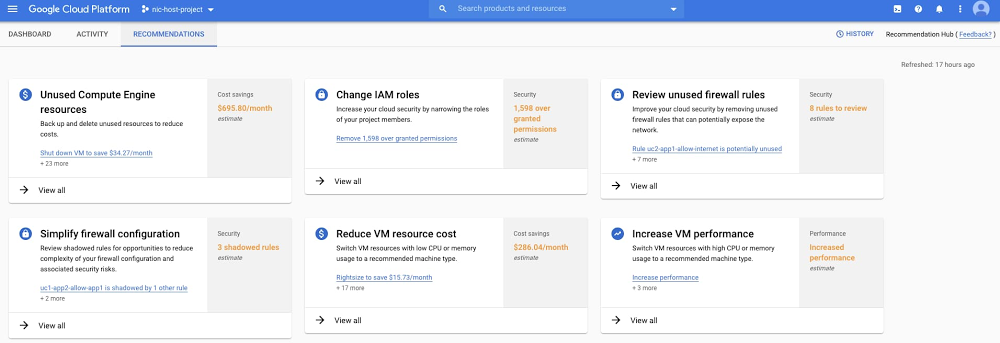
As a cloud project owner, you want your environment to run smoothly and efficiently. At Google Cloud, one of the ways we help you do that is through a family of tools we call Recommenders, which leverage analytics and machine learning to automatically detect issues and present you with optimizations that you can act on. With Recommenders, our goal is to suggest quick, easy ways to optimize your cloud for price, performance, and security. Several Recommenders are already generally available, including VM Recommenders, Firewall Insights and IAM Recommender. In fact, there are many teams at Google Cloud who are working to build Recommenders that help you improve your cloud. But, we want to make sure it’s effortless and simple for you to find and take action on those recommendations. That’s why we’re also releasing the beta of our new Recommendation Hub, which highlights proactive recommendations in one place for you to view and act on. Recommendation Hub is vital to bringing all of these optimization efforts together for you to see and take action on. Not only does the Hub capture the most impactful opportunities in your projects, but it also helps guide you across Google Cloud in general. Whether it’s networking, security, compute and storage resources, cost and billing, or Anthos, the Recommendation Hub will give you the tools you need to prioritize, analyze, and act on all of these valuable insights and recommendations.Click to enlargeRecommendation Hub and Recommenders are also part of a bigger initiative at Google Cloud to use machine learning and analytics to help you make better decisions, drive down costs, and automate your operations. There will be more announcements on that soon, but for now, let’s explore some of the Recommenders currently available for you to use.Optimize resources for cost and performance with VM RecommendersThere will come a day when you might need to scale your virtual machine (VM) instances up or down. For that, we’ve got two types of Recommenders available: one to help you optimize your VMs for cost and performance, and a second to help you identify and delete (or back up) your unused VMs and persistent disks (PD) to avoid paying for resources you don’t use. All of this helps you properly balance your performance and cost based on your unique situation. One customer, VuClip, decided to experiment with the Idle VM Recommender and is now making it a key part of how they optimize their cloud environment: “We were in the midst of a hackathon recently, and we decided to test out Google Cloud’s Idle VM Recommender. We quickly learned that we had over 200 VMs that were sitting idle, but ultimately costing us money, that we wouldn’t have otherwise known about. The real bonus was that it only took a matter of seconds for Google Cloud to shine light on these idle VMs.” – Hrushikesh Kulkarni, Associate Director of Technology, VuClipSecure your network with Firewall InsightsFirewall rule management is a constant challenge for security and network engineers. Firewall configuration can grow in complexity as more accesses are added over time, making it really hard to maintain. Firewall Insights, now in beta, is a new tool that helps secure your cloud environment by detecting and providing easy remediation options for a number of key firewall issues, including:Shadowed rules that can’t be reached during firewall rule evaluation because they overlap with higher-priority rulesUnnecessary allow rules, open ports and IP rangesSudden hit increases on firewall rules (and a drill down into the source of the traffic) that signal an emerging attackRedundant firewall rules, which can be cleaned up to reduce the total firewall rule countDeny firewall rules with hit counts from sources trying to access unauthorized IP ranges and portsFlowmon, a company that develops network performance monitoring and network security products, has been using Firewall Insights to gain new insights into its existing firewall rules:“Firewall Insights has already proven to be an extremely valuable tool. With barely any effort, it gives us precise knowledge about what our firewall rules are actually doing. Through that, we’re able to optimize all of our firewall rules quickly and easily.” – Boris Parák, Cloud Product Manager, FlowmonFor more information on using Firewall Insights (which is also available in Network Intelligence Center), please reference our documentation or check out this video:Lock down unwanted access with IAM RecommenderIn addition to firewall rules, permissions play another crucial role in your overall security posture. WithIAM Recommender, you can remove unwanted access to Google Cloud resources with smart access control recommendations. IAM Recommender uses machine learning to automatically detect overly permissive access and help security teams figure out what permissions their project members really need. Not only does this help establish least-privilege best practices and reduce your organization’s security risks, but also prevents accidental changes to your data and cloud infrastructure. Here’s a video to show you how it works:Many more Recommenders coming soonWe’re busy building more Recommenders which will appear in Recommender Hub. Here are a few that you can expect to see within the next few months: Cost and performanceCompute Engine cross-family recommendations: Select the optimal VM family for your workload (e.g., memory-optimized).Committed Use Discount (CUD) maximizer: Keep your cloud costs on budget by making sure you utilize your discounts to the fullest. SecurityGKE RBAC: Assess and remove over-granted permissions.Security keys: Protect high-risk users against phishing by implementing phone-as-a-security-key.Reliability, availabilityCompute Engine predictive auto-scaling: Reduce latency and costs by scaling compute proactively.VPN tunnel: Proactively detect overutilized tunnels to prevent network packet loss.With Recommenders, we’re trying to take the guesswork and toil out of keeping your cloud running optimally. To learn more about how Recommenders can help you, please check out our upcoming session “Cloud is Complex. Managing it Shouldn’t Be” during our Next OnAir digital event.
Quelle: Google Cloud Platform
Last month brought new and continued challenges around the world, and new ways technology can help meet them. Top posts in May on the Google Cloud blog covered news on productivity, G Suite, and much more. Here’s what you missed. Understanding cloud infrastructure to serve more people fasterThis post goes in-depth on how our Technical Solutions Engineers (TSE) team solved the case of a Google Cloud customer support ticket. Along the way to find the missing DNS packets, you’ll get a look at how support teams evaluate and troubleshoot on the way to finding a solution for customer issues, and what you can do to help fix issues if they occur.In May, we introduced Google Cloud VMware Engine, designed to make it easy to migrate or extend your on-prem workloads to Google Cloud. VMware Engine lets you run your workloads natively in a dedicated VMware environment in Google Cloud, so you don’t have to change any of your tools, processes, or policies.Mark your calendars for Google Cloud Next ‘20: OnAir from July 14 to September 8, where you’ll be able to access developer programs, keynotes, and hundreds of sessions—all free of charge. Each week you’ll find programming on a different topic, including infrastructure, security, app modernization, and cloud AI. Register and get more details on speakers and topics now.Making it easy to get started with G SuiteG Suite Essentials launched last month, giving groups and teams a faster, easier way to get started with G Suite. G Suite Essentials includes premium video conferencing with Google Meet, real-time collaboration and content management with Google Docs, Sheets, Slides, and Drive, and enterprise-grade security and reliability. It’s great for teams that aren’t ready to replace their current email or calendar tools, and it’s completely free through September 30. Doing more with what you haveFor many businesses, using their resources wisely has become especially important over the past few months. This post on understanding the principles of cloud cost optimization offers an overview of cost optimization concepts, tools, and tips on prioritizing your cost optimization projects. That’s a wrap for May. Stay tuned to what’s new in cloud on Twitter.
Quelle: Google Cloud Platform






