Huawei: Samsung hat Halbleiterfertigung ohne US-Beteiligung
Der Fokus rein auf europäische und japanische Zulieferer für die Halbleiterfertigung könnte sich lohnen. (Halbleiterfertigung, Prozessor)
Quelle: Golem

Der Fokus rein auf europäische und japanische Zulieferer für die Halbleiterfertigung könnte sich lohnen. (Halbleiterfertigung, Prozessor)
Quelle: Golem

Die Schulen haben nur Förderanträge für 5,7 Prozent des Geldes aus dem Digitalpakt gestellt. (Digitalisierung, Internet)
Quelle: Golem
medium.com – This GitHub repository provides a demonstration of how a Tekton pipeline can be used in tandem with a service mesh to deploy workloads in a canary rollout with only a couple of commands. With the Git…
Quelle: news.kubernauts.io

Mit Münzen und Bärenfallen kämpfen wir im Taktikspiel Desperados 3 gegen Banditen – ab und zu greifen wir auch zum Revolver. Von Peter Steinlechner (Strategiespiel, Spieletest)
Quelle: Golem
thenewstack.io – The Google Cloud Platform formally launched Anthos at Cloud Next 2019. Anthos is one of the rare technologies from Google to attain general availability (GA) status in such a short time. Despite beco…
Quelle: news.kubernauts.io
containo.us – Here Kevin Crawley, Developer Advocate, introduces the fundamentals of tracing and metrics, how they work, and what benefits and limitations you can expect when making the decision to instrument your…
Quelle: news.kubernauts.io
medium.com – The serverless computing model allows you to build and run applications and services without having to worry about infrastructure or servers. It eliminates infrastructure management tasks such as ser…
Quelle: news.kubernauts.io
Cloud Data Fusion is a fully managed, cloud-native data integration service that helps users efficiently build and manage ETL data pipelines. It’s powered by the open source project CDAP.How Cloud Data Fusion worksMany enterprises have data integration pipelines that take data from multiple sources and transform that data into a format useful for analytics. Cloud Data Fusion is a Google Cloud service that lets you build out these pipelines with little to no coding. One way of configuring these pipelines is via the UI. While using the UI is a visually intuitive way to architect pipelines, many organizations have requirements to automate deployments in production environments. A manageable way is to do this via infrastructure as code. Terraform, an infrastructure as code tool managed by Hashicorp, is an industry-standard way of spinning up infrastructure. While CDAP makes authoring pipelines easy, automating deployments with the CDAP REST API requires some additional work. In this blog, we’ll explain how to automate deployments of various CDAP resources in infrastructure as code with Terraform, leveraging useful abstractions on the CDAP REST API built into the community-maintained Terraform CDAP provider. This post highlights further abstractions open-sourced in the Cloud Foundations toolkit modules. Creating a Cloud Data Fusion instanceYou can create a Cloud Data Fusion instance with the datafusion module. This shows the module’s basic usage:The name of the instance, project ID, region, and subnetwork to create or reuse are all required inputs to the module. The instance type defaults to enterprise unless otherwise specified. The dataproc_subnet, labels, and options are also optional inputs. Deploying prerequisites for a private IP CDF instanceMany use cases need to have a connection to Cloud Data Fusion established over a private VPC network, as traffic over the network does not go through the public internet. In order to create a private IP Cloud Data Fusion instance, you’ll need to deploy specific infrastructure. Specifically, you’ll need a VPC network, a custom subnet to deploy Dataproc clusters in, and IP allocation for peering with the Data Fusion tenant project. VPC can be deployed via the use of the private network module. Additionally, if you’re using Cloud Data Fusion version 6.1.2 or older, the module can create the SSH ingress rule to allow the Data Fusion instance to reach Dataproc clusters on port 22. Here’s a snippet showing the basic usage of the module:The module requires several inputs: the Data Fusion service account, private Data Fusion instance ID, VPC network to be created with firewall rules for a private Data Fusion instance, the gcp project ID for private Data Fusion setup, and the private Data Fusion instance ID. Output from this module are the IP CIDR range reserved for the private Data Fusion instance, the VPC created for the private Data Fusion instance, the subnetwork created for Dataproc clusters controlled by the private Data Fusion instance, and the VPC created for the private Data Fusion instance. Configuring a namespaceNamespaces are used to logically partition Cloud Data Fusion instances. They exist in order to achieve pipeline, plugin, metadata, and configuration isolation during runtime, as well as to provide multi-tenancy. This could be useful in cases where there are different sub-organizations all in the same instance. Thus, each namespace in an instance is separate from all other namespaces in the instance, with respect to pipelines, preferences, and plugins/artifacts in the instance. This CDAP REST API Document shows the API calls needed to perform different operations on namespaces. Check out a Terraform example of the namespace.In this module, you have to provide the name of the namespace you’d like to create, as well as the preferences (any runtime arguments that are configured during runtime) to set in this namespace.Deploying a compute profileIn Cloud Data Fusion, compute profiles represent the execution environment for pipelines. They allow users to specify the required resources to run a pipeline. Currently, Cloud Data Fusion pipelines primarily execute as Apache Spark or MapReduce programs on Dataproc clusters. Compute profiles can manage two types of Dataproc clusters: ephemeral clusters and persistent clusters. Ephemeral clusters are created for the duration of the pipeline, and destroyed when the pipeline ends. On the other hand, persistent clusters are pre-existing, and await requests for data processing jobs. Persistent clusters can accept multiple pipeline runs, while ephemeral clusters are job-scoped. Ephemeral clusters include a startup overhead for each run of the pipeline, since you need to provision a new cluster each time. Ephemeral clusters have the advantage of being a more managed experience, and don’t require you to provide SSH keys for communication with the cluster, since these keys are generated automatically by the CDAP service. This CDAP REST API document shows the API calls needed to perform different operations on compute profiles. We have written a Terraform module so you can deploy a custom compute profile, allowing you to configure settings such as the network and compute service accounts—settings that are not configurable in the default compute profile.In this example, the name of the profile and the label of the profile are required inputs.The module allows for many more optional inputs, such as name of the network, name of the subnetwork, or name of the service account to run the Dataproc cluster on. It also allows you to provide the namespace to deploy the profile in, as well as the account key used for authentication.Deploying and updating a pipelineA pipeline can be deployed using the pipeline module. The name, namespace, and the path to an exported pipeline (the json_spec_path) are required as inputs. This can be obtained by clicking on Actions>Export after the pipeline is deployed on the Data Fusion UI.These CDAP documents explain the nuances of a pipeline.As mentioned earlier, the namespace is required for achieving application and data isolation. Finally, since the path to the exported JSON pipeline contains a hard-coded reference to the checkpoint directory of the instance on which it was authored, the json_spec_path must be without the checkpoint key. The checkpointDir key must be removed from the config block of exported pipeline JSONs. On a new instance, when this key is missing, it gets inferred to the correct checkpoint bucket. Checkpointing must be used in CDAP real-time apps, since they won’t start the Spark context because they do not respect the disableCheckpoints key of the pipeline config. Find more details on this. A common way to remove this checkpoint key is to use a jq command. CheckpointDir keys are generated in a JSON file whenever Apache Spark is run. A challenge faced here is that the checkpointDir key must manually be removed from the JSON. The key must be removed, since it will be hard-coded to the checkpointDir from the Cloud Data Fusion instance from which it was exported. This could cause issues if the instances are different environments (i.e., prod and dev). This key must be absent to infer the correct checkpoint bucket in a new instance.Here’s a snippet of the cdap_application resource:To update an already deployed pipeline, simply make a pull request on the repository. This will stop this run on Terraform apply. Additionally, Terraform will add plugin resources for new versions of a plugin required by this pipeline. Since applications are immutable, when pipelines are updated, they should be treated as a new pipeline (with a versioned name).Streaming program runA program run is when the pipeline is passed in runtime arguments and run, after it is deployed. Streaming pipelines can be managed as infrastructure as code due to the fact that they are long-running infrastructure, as opposed to batch jobs, which are manually scheduled or triggered. These CDAP documents explain the relevant API calls to perform operations, such as starting and stopping programs, as well as starting and checking the status of multiple programs.Here’s an example of the cdap_streaming_program_run resource:The name of the app, name of the program, any runtime arguments, and type (mapreduce, spark, workers, etc.) are required. The namespace is optional (if none provided, default is used), and the cdap run_id is computed. A challenge of the automation is that real-time sources do not support variable configurations at runtime, also known as macros. This means that an additional hard-coded application that achieves the functionality of a macro must be written for every run. This is achieved by rendering the JSON file as a template file (at Terraform apply time) to substitute runtime arguments there.Try running Cloud Data Fusion via the modules provided. As a reminder, step number one is to create a Cloud Data Fusion instance with the datafusion module. Our team welcomes all feedback, suggestions, and comments. To get in touch, create an issue on the repository itself.
Quelle: Google Cloud Platform
Earlier this year, we added a Dashboard API to Cloud Monitoring, allowing you to manage custom dashboards and charts programmatically, in addition to managing them with the Google Cloud Console. Since then, you’ve asked us to provide more sample dashboard templates that target specific Google Cloud services. Many of you have also asked us to provide a Terraform module to help you set up an automated deployment process.Today, we are excited to share our newly created GitHub repository with more than 30 dashboard templates to help you get started. These templates currently cover compute, storage, data processing, networking, database, tooling, and our microservice demo application. The Terraform module for this API is available on GitHub as well. Using the sample dashboardsTo help you understand the intent of each dashboard sample, there is a README file in each folder that summarizes the content and metrics used.Please note that while putting these sample dashboards together, we made assumptions and aggregated some of the data based on specific use cases. For example, for CPU utilization and memory usage, the dashboard is by default unaggregated. For network egress and ingress, the widgets on the dashboard are aggregated by sum to reflect the intent to capture total bytes. In addition, a single dashboard can have multiple charts for different services. It allows you to quickly have a holistic view for the state of your workloads by grouping related services.For instance, the dataprocessing-monitoring.json template creates a dashboard that provides a view for the data processing pipeline metrics from multiple data analytics services.To use these dashboard templates, you can check them out from the GitHub repo, use the gcloud CLI, Terraform, or Deployment Manager to deploy the samples to your project using the following steps:1. Check it out from GitHub. You can do that in Cloud Shell by clicking on this button:2. Use the gcloud monitoring dashboards create command to create a dashboard. Make sure you replace the [file-name.json] with the path in the command:gcloud monitoring dashboards create –config-from-file=[file_name.json]For example:3. You can also use Terraform to deploy the dashboards. There is a script under the terraform folder that uses the dashboard module to demonstrate this step.4. Alternatively, you can use Cloud Deployment Manager to deploy the dashboards using the scripts under the dm folder.With these capabilities, it’s easier to integrate dashboard development and deployment into an automated pipeline. For instance, you can check your dashboard JSON files into a Git repository, and updates to the repository can trigger a Cloud Build process and automatically deploy the changes to Cloud Monitoring. Over time, we hope to improve this template library, and here are a few things we are focusing on:Covering more Google Cloud servicesExtending our dashboard templates to cover multiple services under one dashboardProviding built-in filters and aggregation capabilities to help you slice and dice your data so that you can have more insightPlease let us know if you have comments or feedback by creating issues in the repo. We welcome and encourage you to contribute and improve the new templates with us!
Quelle: Google Cloud Platform
Of all the sessions from DockerCon LIVE 2020, the Best Practices + How To’s track sessions received the most live views and on-demand views. Not only were these sessions highly viewed, they were also highly rated. We thought this would be the case based on the fact that many developers are learning Docker for this first time as application containerization is experiencing broad adoption within IT shops. In the recently released 2020 Stack Overflow Developer Survey Docker ranked as the #1 most wanted platform. The data is clear…developers love Docker!
This post begins our series of blog articles focusing on the key developer content that we are curating from DockerCon. What better place to start than with the fundamentals. Developers are looking for the best content by the top experts to get started with Docker. These are the top sessions from the Best Practices + How To’s track.
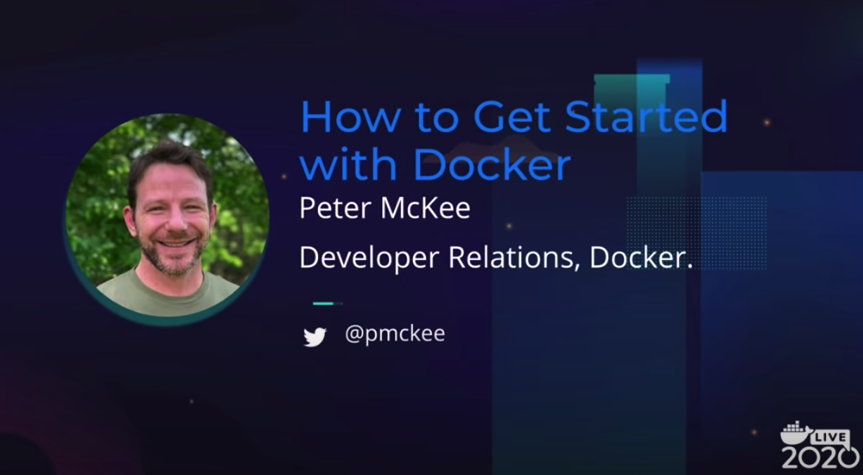
How to Get Started with DockerPeter McKee – Docker
Peter’s session was the top session based on views across all of the tracks. He does an excellent job focusing on the fundamentals of containers and how to go from code to cloud. This session covers getting Docker installed, writing your first Dockerfiles, building and managing images, and shipping your images to the cloud.
Build & Deploy Multi-Container Applications to AWSLukonde Mwila – Entelect
Lukonde’s excellent session was the second most-viewed DockerCon session. Developers are looking for more information on how to best deploy their apps to the cloud. You definitely want to watch this session as Lukonde provides not only a great overview but gets into the code and command line. This session covers Docker Compose as well as how to containerize: Nginx server, React app, Node.js app, and a MongoDB app. He also covers how to create a CI/CD pipeline and how to push images to Docker Hub.
Simplify All the Things with Docker ComposeMichael Irwin – Virginia Tech
Michael is a Docker Captain and a top expert on Docker. He focuses this session on where the magic happens with Docker: Docker Compose. It’s the magic that delivers the simplest dev onboarding experience imaginable. Michael starts with the basics but quickly moves into several advanced topics. The section on how to use Docker Compose in your CI/CD pipelines to perform automated tests of your container images is a real gem!
How to Build and Test Your Docker Images in the CloudPeter McKee – Docker
This is another awesome session by Peter. He focused this talk on how to automate your build pipeline and perform continuous testing. With a focus on the fundamentals, Peter explains continuous integration (CI) and how to setup a CI pipeline using Docker Hub’s Webhooks, AutoBuilds, AutoTests and GitHub Actions. This is a great overview and primer for developers looking to start using Docker Hub.If you are ready to get started with Docker, we offer free plans for individual developers and teams just starting out. Get started with Docker today.
The post DockerCon 2020: Top Rated Sessions – The Fundamentals appeared first on Docker Blog.
Quelle: https://blog.docker.com/feed/






