Anthos: one multi-cloud management layer for all your applications

When we first introduced Anthos in 2018, some observers described it as a way to modernize legacy applications. Simply drop your legacy on-prem application into a container, and you were on your way to cloud! But since becoming generally available last April, our customers tell us Anthos is how they want to deploy, manage and optimize all their applications—legacy as well as cloud-native. It doesn’t matter who wrote the applications or where they run, applications managed by Anthos run on an infrastructure layer that’s been abstracted, and have access to high value services that let them run efficiently and securely, without fear of lock-in or needless complexity.  Anthos, in other words, is about much more than one-off application modernization; it’s about how you can build, deploy and operate applications efficiently in an increasingly hybrid and multi-cloud world. Along the way, Anthos lets you automate your infrastructure and save money by optimizing your cloud costs and reducing management overhead—wherever your applications may be.  Multi-cloud made possibleMulti-cloud, our customers tell us, is the world they want to live in. Today, enterprises have applications in a variety of locations, and they want the freedom to keep them there—or move them in the future—in response to any number of factors. Those factors can include cost, uptime, compliance requirements, latency considerations, or proximity to other services, just to name a few. Taken together, these are ways to reduce business risk—but it’s only possible if applications are portable.But before Anthos, multi-cloud was complicated and expensive. You had to find and train technical staff knowledgeable about your different cloud APIs and services, and applications that you designed for one environment didn’t easily translate or port to another, creating silos and limiting multi-cloud’s impact. Multi-cloud also frees customers to future-proof the the applications they build. They don’t necessarily know where they’ll build their next app, just that they will. In other words, they want to be able to build anywhere, and for the applications they create to be portable, so they can avoid being locked in.Consistency as the greatest common denominatorAnthos makes multi-cloud easy thanks to its foundation of Kubernetes—specifically the Kubernetes-style API. Using the latest upstream version as a starting point, Anthos can see, orchestrate and manage any workload that talks to the Kubernetes API—the lingua franca of modern application development, and an interface that supports more and more traditional workloads.Then, Anthos goes on to empower developers with the latest cloud technologies. Integrations with offerings like Cloud Code let developers automate the test and release software faster, and with a higher degree of quality. Cloud Run for Anthos lets them build elastic services that run anywhere, and Config Connector lets them natively access any cloud resource including VMs—all in a uniform way. Whatever technology it was that brought them to Anthos, the systems they build on Anthos today will be consistent across whatever environments they deploy to tomorrow, all while reducing costs and improving developer velocity.  Security, visibility and scaleAnd while this Kubernetes consistency may be what makes multi-cloud possible, Anthos’ benefits don’t end there. Other Anthos components deliver capabilities that other platform providers simply don’t offer. Customers tell us they want to set up security policies that they can automatically enforce across all their environments, so they can audit and govern their environment, and demonstrate compliance with policy-driven controls. Leveraging the Anthos outcome-focused configuration model, for example, Anthos Config Manager allows you to define policies about how and where a workload can run—and ensure that it continues to run in that way—across all your Anthos deployments.They also want better visibility into their applications. Anthos Service Mesh is a managed service that provides security and observability for applications running in an Anthos-managed system—the performance, service level objectives, the events, the network traffic—helping you exert fine-grained control of that traffic while removing some of the difficult and undifferentiated work of upgrades and patching.Finally, customers want to do this without spending more money. In fact, they’re looking to Anthos to help them save money. As a managed, programmatically-addressed software layer, Anthos reduces operational overhead with its built-in state automation, and increases developer productivity by optimizing the developer tool chain. And going forward, it will accelerate savings even more, by freeing organizations from legacy software license costs.Toward Anthos everywhereWith this visibility into the actual and desired states of your multi-cloud infrastructure—and the ability to enforce the desired state—Anthos lets you optimize your environment, helping you meet your cost, uptime, performance and security goals. Armed with the operational data that Anthos provides, you can decide how to manage applications based on things like performance and latency needs, or perhaps an outage at one of your locations. This is the promise of multi-cloud, and one of Anthos’ many unique benefits. Customers tell us that what Anthos can do is so transformational, that they want us to extend Anthos to more kinds of applications. Why limit modern application deployment, management, and control to new applications? We agree and we’re working hard to help bring Anthos to every application running everywhere. Until then, you can learn more about how Anthos can positively impact your bottom line by reading the latest Total Economic Impact report written by Forrester Research.
Quelle: Google Cloud Platform

Enhanced models and features now available in new languages on Speech-to-Text

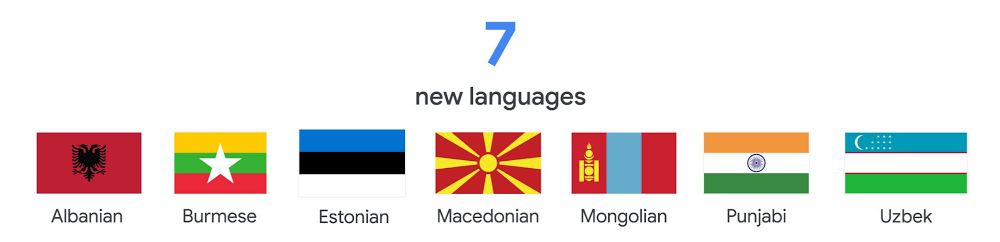
From call analytics to automated video subtitles, speech interfaces are changing the way people interact with their surroundings and enabling new business opportunities. Speech recognition technology is at the heart of these transformations and is bringing these ideas to life. At Google Cloud, we’re committed to ensuring that this exciting technology is as inclusive as possible. With that in mind, we’re announcing new features, models, and languages for our speech-to-text system as we strive to make our products and features more widely available and useful for more organizations across the globe.Google Cloud Speech-to-Text is an API that allows users to submit short, long, or streaming audio that contains speech and receive back the transcription. We have long been recognized for our industry-leading speech recognition quality, and our capabilities power thousands of different solutions, including Contact Center AI and Video Transcription.Our updates include seven brand new languages, expansion of the enhanced telephony model to three new locales, speech adaptation for 68 new locales, speaker diarization to 10 new locales, and automatic punctuation to 18 new locales. These advancements bring our speech technology to over 200 million speakers for the first time, and unlock additional features and improve accuracy for more than 3 billion speakers globally.Expanding language supportSince introducing Speech-to-Text, we have continuously strived to bring high-quality speech recognition to more languages. Today, we are expanding the wide array of supported languages from 64 to 71 (120 to 127 in total locales) with seven new languages: Burmese, Estonian, Uzbek, Punjabi, Albanian, Macedonian, and Mongolian.Sourcenext, the maker of portable voice translator Pocketalk, is one of the organizations taking advantage of Google Cloud Speech-to-Text’s comprehensive language support.“The extensive language capabilities of Google Cloud Speech-to-Text has made our product, Pocketalk, possible,” said Hajime Kawatake, Operating Officer, Technology Strategy, Sourcenext Corporation. “The sheer breadth of languages offered increases the quality of product as our customers are able to receive the highly accurate and reliable speech to speech translations anywhere in the world.” Enhanced telephony modelsIn April 2018, Google launched the enhanced telephony model for US English to provide the highest quality transcription for customers with less than pristine audio data from phone and video calls. At the time, it performed 62% better on telephony than our base models, and now it’s helping Contact Center AI transform call center experiences for customers and agents. Today, Speech-to-Text is releasing support for three new locales: UK English, Russian, and US Spanish.One of the first users of these features is Voximplant, a cloud communications platform with a number of enterprise customers in Russia, that instantly realized the exceptional accuracy of the new telephony models.“We partnered with Google Cloud because we wanted to innovate our voice platform with Google’s AI technology,” said Alexey Aylarov, CEO, Voximplant. “Since we often receive audio from low bandwidth telephone networks, the enhanced telephony models have been a game-changer, delivering increased accuracy in both person-to-person and person-to-virtual agent conversations. We are delighted to see Google Cloud’s commitment to bringing high-quality models to even more users and locales.” Speech adaptationSpeech adaptation allows users to customize Google’s powerful pre-built speech models in real time. With speech adaptation, you can do things like recognize proper nouns or specific product names. You can also give the API hints about how it wants information returned, greatly improving the quality of speech recognition for their specific use cases.Today we’re making our latest evolution of this technology, boost based speech adaptation, available in 68 new locales. Boosting gives users granular control over how much to influence the speech model towards their most important terms. We’re also adding more of our popular numeric classes in a number of new languages. To see what classes are supported in each language, take a look at our class support documentation. Boost based adaptation is available in 68 new locales:FrenchGermanSpanishJapaneseMandarinSee the full listSpeaker diarizationDiarization is the ability to automatically attribute individual words and sentences to different speakers in an audio file, allowing users to understand not just what was said but who said it. This helps our users easily add subtitles or captions to audio or video, in addition to many other use cases. Today users can do this in 10 new locales:UK EnglishSpanishJapaneseMandarinSee the full listAutomatic punctuationPunctuation is a key enabler for accurate transcription, helping users increase the accuracy of speech translation in both languages. Automatic punctuation provides users with transcripts that attempt to mimic how a given user might have written down what they said. This helps improve transcript readability and can make dictation a breeze. We’re announcing support in 18 new locales:GermanFrenchJapaneseSwedishSee the full listThese new languages and features will help billions of speakers across the world use our voice-based interfaces and high-quality speech recognition. Are you ready to innovate in how you manage speech and transform your organization with Speech-to-Text? Check out our product page or contact sales today.
Quelle: Google Cloud Platform

Last month today: February in Google Cloud

February on Google Cloud brought a bevy of news and tips, covering cloud migrations, hardware, certifications and more. Here’s what was most popular last month. New tools, use cases in cloudHedera’s Hashgraph is a public distributed ledger technology (DLT) optimized for high volume transactions. In a fast-moving industry, Hedera developed a DLT designed to bring fast, inexpensive transactions for enterprise use. To do so, the company uses Google Cloud’s premium network tier, our low-latency global fiber network. Developers can then build decentralized apps on Hedera. Last month, Hedera chose Google Cloud as a preferred cloud provider for its public testnets and Hedera Consensus Service ecosystem. Google Cloud’s acquisition of Looker became final last month, as we join together to bring customers a comprehensive analytics solution that integrates and visualizes insights at every layer of their business. Google Cloud and Looker together can help address the data analytics and business intelligence of enterprises. In addition, Google Cloud and Looker share a common philosophy around delivering open solutions and supporting customers wherever they are—be it on Google Cloud, in other public clouds, or on-premises. A new addition to our general purpose VMs became available last month: The N2D family, built atop 2nd Gen AMD EPYC™ Processors, are a great option for both general-purpose workloads and those that need high memory bandwidth. Workloads that need a balance of compute and memory, like web apps and databases, can benefit from the performance, price, and features of N2D.Cloud school is in sessionThe Data Engineering on Google Cloud learning path is newly updated, reflecting the need for deeper training and skills in this evolving discipline. You’ll find new course content including introductions to Data Fusion and Cloud Composer, plus more labs on BigQuery and Bigtable streaming. Other courses round out this new path, which covers the primary responsibilities of a data engineer.Supporting systems betterThough there’s a trend toward microservices these days, plenty of businesses still run monolithic—single-tiered—software applications that they need to maintain. Google’s site reliability engineering (SRE) team offered tips on scaling these apps and maintaining their reliability for users. You’ll find notes on typical challenges, plus some common best practices to keep in mind.There are also still plenty of mainframe systems running these days. Google Cloud acquired Cornerstone Technology last month to better help customers migrate those workloads. Mainframe architectures have helped companies run mission-critical workloads for decades, but they can hold developers back from using new technologies to innovate. Cornerstone’s experience and capabilities can make the mainframe-to-Google Cloud move easier.That’s a wrap for February. Till next time, stay up to date on our Twitter feed.
Quelle: Google Cloud Platform