Create deployment pipelines for your GKE workloads in a few clicks

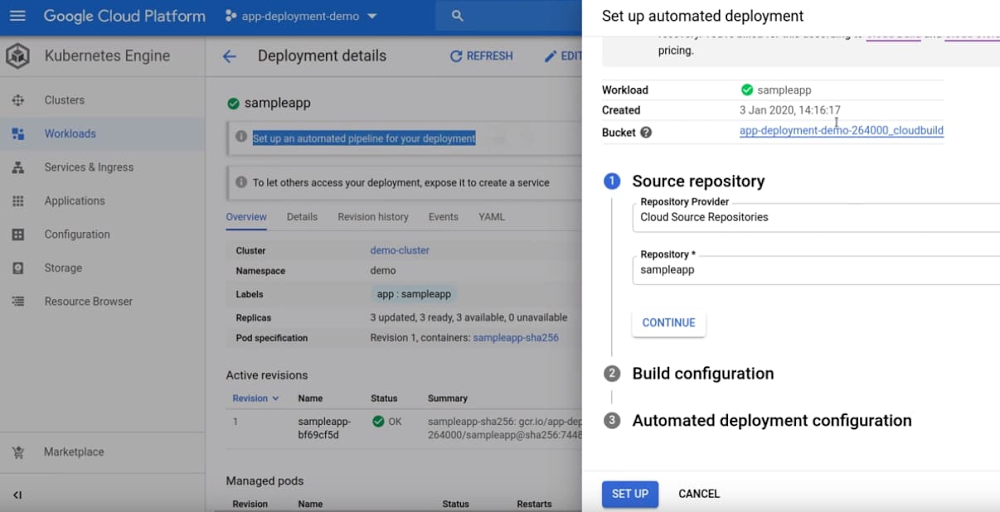
With Kubernetes becoming the de facto standard for container orchestration, many development teams are looking to build, test, and deploy code quickly in a frictionless manner to Kubernetes. Traditional continuous integration and continuous delivery (CI/CD) tools not designed for cloud-native environments often fall short as developers spend many hours looking for best practices to automate deployments, scaling pipelines, and worrying about other implementation details. For teams just getting started with Kubernetes, a bunch of time-consuming error-prone chores further complicate these efforts. These steps include creating configuration files for the application, setting up a CI/CD server, ensuring configuration files are updated, or deploying images with correct credentials to a Kubernetes cluster. Not surprisingly, it’s easy to get frustrated. You’d rather spend time writing code, than worrying about these steps or what the right pipeline looks like for a specific environment. And even when CI/CD pipelines are set up, they are way too complex, and scripts keep being added over time. To help you overcome these problems with continuous delivery, we’re pleased to announce an automated deployment feature that lets you create continuous delivery pipelines for Google Kubernetes Engine (GKE) in a few clicks. Without worrying about implementation details, you can now deploy changes to GKE faster and hassle-free. These pipelines implement out-of-the-box best practices that we’ve  learned at Google for handling Kubernetes deployments, thereby further reducing the overhead of setting up and managing pipelines. Automated deployment for GKE is powered by Cloud Build, an industry-leading cloud-native CI/CD platform that allows pipelines to scale up and down without having to pre-provision servers or pay in advance for additional capacity. Cloud Build also provides pipelines with baked-in security and compliance enhancements to meet specific workflow and policy needs. And unlike with continuous delivery features that you’ll find in traditional CI/CD tools, with automated deployment for GKE, you no longer have to manage, update, or improve the pipeline. All changes and updates are handled automatically in the background. The pipelines run automatically whenever changes are made to the source code, allowing you to deploy new features and fixes quickly and reliably. And with preview deployments, whenever you open or update a pull request, a version of the application with the suggested code change is deployed, so you can quickly validate if the change behaves as expected. Unused preview deployments are automatically cleaned up, freeing up resources.Create your first first pipeline in a few clicksTo get started with automated deployment, simply choose the source repository, build configuration, and YAML file specifying Kubernetes configuration. You can either use your own existing YAML or leverage Google recommended YAML.  1. Select the source2. Select the build configuration3. Choose the Kubernetes YAML—bring your own YAML or use the one Google Cloud provides4. Link workload revisions to Cloud Build for traceability and debuggingHow automated deployment can helpHere are some other benefits that you get from automated deployments:Recommended Kubernetes configuration: Automated deployment suggests the Kubernetes YAML to be used to deploy your application. You no longer have to fine-tune the configuration by hand.Hassle-free continuous delivery setup: Configure all the steps required for an automated deployment pipeline—a connection to your source code repository, the conditions under which to trigger the pipeline, and the steps to build and deploy your containerized application—with a couple of clicks in a single flow.Reduced CI/CD maintenance: Because continuous delivery pipelines run in Cloud Build, you don’t have to spend time installing and maintaining your own CI/CD system.End-to-end traceability: Workloads deployed using automated deployment can be linked to the pipeline and source code commit that created them. Using Binary Authorization, you can create secure software supply-chain policies that only allow workloads deployed using continuous delivery pipelines.“Shift left” with preview deployments: Quickly test whether your application is working as intended before merging code changes, to ensure issues are identified as early as possible in the development process.You can start using automated deployment feature today in the Google Cloud Console. To learn more about how to set up your first automated deployment pipeline and deploy it  to GKE, check out the documentation, or watch the video below:
Quelle: Google Cloud Platform

Architecting multi-region database disaster recovery for MySQL

Enterprises expect extreme reliability of the database infrastructure that’s accessed by their applications. Despite your best intentions and careful engineering, database errors happen, whether that’s machine crashes or network partitioning. Good planning can help you stay ahead of problems and recover more quickly when issues do occur.This blog shows one approach of deploying a database architecture that implements high availability and disaster recovery for MySQL on Compute Engine, using regional disks as well as load balancers.Any database architecture must provide approaches to tolerate errors and recover from those errors quickly without losing data. These approaches are expressed in RTO (recovery time objective) and RPO (recovery point objective), which offer ways to set and then measure how long a service can be unavailable, and how far back data should be saved.After a database error, a database must recover as fast as possible with an RTO as small as possible, ideally in seconds. There must be as little data loss as possible—ideally, none at all. The desired RPO is the last consistent database state.From a database architecture and deployment viewpoint, this can be accomplished with two distinct concepts: high availability and disaster recovery. Use both at the same time in order to achieve an architecture that’s prepared for the widest range of errors or incidents.Creating a resilient database architectureA high-availability database architecture has database instances in two or more zones. If a server on a zone fails, or the zone becomes inaccessible, the instances in other zones are available to continue the processing. The figure below shows two instances, one in zone zn1, and one in zone zn2. The load balancer in front supports directing traffic to a healthy database instance available for read and write queries.A disaster recovery architecture adds a second high-availability database setup in a second region. If one of the regions becomes inaccessible or fails, the other region takes over. The figure below shows two regions, primary and DR. Data is replicated from the primary to the DR region so that the DR region can take over from the latest consistent database state. The load balancer in front of the regions directs traffic to the region in charge of the read and write traffic. Here’s how this architecture looks:In addition to the database instance setup, a regional disk is deployed so that data is written simultaneously in two zones, proving fail-safe in the event of zone failure. This is a huge advantage of Google Cloud, allowing you to skip MySQL-level replication within a region. Each write operation to disk is done in two zones synchronously. When the primary instance fails, a standby instance is mounted with regional persistent disk(s), and the database service (MySQL) is then started using the same. This brings the peace of mind of not worrying about replication lag or database state for high availability.From a disaster recovery process view, the following happens over time during a failure situation:Normal steady state database operationA failure happens and a region becomes unavailable or the database instance inaccessibleA decision must be made to fail over or not (in case there is the expectation that the region becomes available soon enough or the instance becomes responsive again)DNS is updated manually, therefore it redirects application traffic to a second regionFallback to the primary region after it becomes available again is optional, as the second region is a fully built-out deploymentFrom a high-availability process view, the following happens over time during a failure situation:Normal steady state database operationDatabase instance fails or becomes unavailableLaunch the standby instanceMount regional SSD and start databaseAutomatic redirection of application traffic to the standby via load balancerAfter the failed or unavailable instance becomes available again, a fallback can take place or notThe database architecture shown demonstrates a highly available architecture supporting disaster recovery. With regional disks and load balancers, it is straightforward to provide a resilient database deployment.Find out more about load balancers and regional disks. Check out general HA and DR processes and detailed steps in the initial part of the reference guide. Try it out to become familiar with the architecture as well as the two major failover processes.
Quelle: Google Cloud Platform

Security: Das Intel-ME-Chaos kommt

Bis zum Chaos sei es nur eine Frage der Zeit, schreiben die ME-Hacker. Intel versucht, das zu verschweigen, und kann das Security-Theater eigentlich auch gleich sein lassen. Ein IMHO von Sebastian Grüner (Intel, Sicherheitslücke)
Quelle: Golem

IoT Signals healthcare report: Key opportunities to unlock IoT’s promise

The cost of healthcare is rising globally and to tackle this, medical providers, from hospitals to your local doctor’s office, are looking to IoT to streamline processes and minimize costs. Few industries stand to gain more from emerging technology. And in few industries the stakes are higher because, in healthcare, incremental efficiencies can make the difference between life and death.

The International Data Corporation (IDC) expects that by 2025 there will be 41.6 billion connected IoT devices or ‘things,’ generating more than 79 zettabytes (ZB) of data.i In the healthcare industry, IoT has emerged as a valuable tool to help ensure quality and better patient care. IoT is used to manage everything from chronic diseases to medication dosages to medical equipment—situations where security flaws in devices are potentially life-threatening. By helping to reduce human error, improve safety conditions, increase staff satisfaction, and make organizations more efficient, IoT can ultimately improve health outcomes.

Insights from new IoT Signals Healthcare report

Today we're launching a new IoT Signals report focused on the healthcare industry that provides an industry pulse on the state of IoT adoption. This research enables us to better serve our partners and customers, as well as help healthcare leaders develop their own IoT strategies. We surveyed 152 decision-makers in enterprise healthcare organizations across multiple countries to deliver an industry-level view of the IoT ecosystem, including adoption rates, related technology trends, challenges, and benefits of IoT.

What the study found is that while IoT has had broad adoption in healthcare (89 percent) and is considered critical to success, healthcare organizations are still challenged by security, compliance and privacy concerns, as well as skills shortages. To summarize the findings:

IoT is helping healthcare organizations become safer and more efficient. With the sensitive and highly regulated nature of healthcare work, leveraging IoT for patient monitoring, quality assurance, and logistical support is quite prevalent. IoT is helping organizations ensure quality in these areas while improving patient care.
To expand IoT implementations, organizations must tackle regulatory and compliance challenges. Healthcare organizations must continue to keep patient information private and comply with evolving regulatory standards while proving the return on investment of IoT. Overcoming barriers around evolving data regulations is key for healthcare organizations, and many are adopting numerous standards. Over 8 in 10 have adopted either HL7, DICOM, or CMS Interoperability, with HL7 FHIR and DICOM being the most common.
IoT talent shortages exist. Getting IoT off the ground is a challenge for any company, given technology challenges, long-term commitments, and the investment required. It’s doubly so for healthcare organizations that lack talent and resources. In fact, 43 percent of those surveyed cited lack of budget and staff as roadblocks to success, with 34 percent specifically concerned about a lack of skilled workers and technical knowledge. Furthermore, 25 percent said a lack of resources and knowledge were key factors in their ability to scale, and in proof-of-concept failures.
The future of IoT in healthcare will extend beyond patient care, with strong growth in optimizing logistics and operations. While IoT usage for patient care will continue to grow and remain a top use case in the future, decision-makers see strong potential to leverage IoT more to support the logistics and operational side of their organizations. Significant IoT growth is expected in facilities management and staff tracking. Decision-makers also anticipate improved safety, compliance, and efficiency through increased IoT implementation within supply chain management, inventory tracking, and quality assurance as patient care catches up with traditional IoT scenarios like manufacturing, logistics, supply chain, and quality.

Microsoft is leading the charge to address these IoT challenges

There are many ways in which healthcare organizations can benefit by leveraging the Azure IoT platform to connect and control devices:

Simplify patient monitoring while reducing healthcare costs. Continuous monitoring of assets connected to healthcare applications, including battery life and general health of devices, allows providers to deliver personalized patient care anytime, anywhere and equips their care team with a near real-time view of the patient’s health and activities.
Optimize medical equipment utilization. Medical staff can avoid equipment downtime and misplacement, and allocate more time for patients, when they connect and track machines, supplies, and other assets through the cloud and monitor their usage for optimal deployment.
Proactively replenish supplies. Healthcare facilities can better ensure safety and efficacy through cold chain tracking to monitor, maintain, and automate life-saving vaccine storage and distribution by connecting devices to the cloud and proactively replenishing contents.

Across all these applications, we see common benefits provided by cloud computing, including:

Greater trust around the security of health data.
Near infinite scale for storing and processing large amounts of data.
Increased speed in gaining access to new tools, more storage space, or greater computing power.
Economical use of resources.
Scaling up and down as demand fluctuates in terms of, for instance, natural disasters.

Our commitment

We are committed to helping healthcare customers bring their visions to life with IoT, and this starts with simplifying and securing IoT. Our customers are embracing IoT as a core strategy to drive better patient outcomes and we are heavily investing in this space, committing $5 billion in IoT and intelligent edge innovation by 2022 and growing our IoT and intelligent edge partner ecosystem to over 10,000.

Our vision is to simplify IoT, enabling every business on the planet to benefit. We have the most comprehensive portfolio of IoT platform services and are pushing to further simplify IoT solution development with our scalable, fully managed IoT app platform Azure IoT Central. Solution builders are accelerated from proof of concept to production using IoT Central application templates like our healthcare template for continuous patient monitoring. We work hard to ensure healthcare organizations have a robust talent pool of IoT developers, providing free training for common application patterns and deployments through our IoT School and AI School.

Security is paramount for healthcare customers. Azure Sphere takes a holistic security approach from silicon to cloud, providing a highly secured solution for connected microcontroller units (MCUs,) that go into devices ranging from connected home devices to medical and industrial equipment. Azure Security Center provides unified security management and advanced threat protection for systems running in the cloud and on the edge. Azure Sphere combined with a real-time operating system (RTOS) delivers a better together solution that can help real-time medical apps improve the performance in IoT medical devices, including medical imaging systems, by ensuring they meet data regulation requirements.

Finally, we’re helping our healthcare customers leverage their IoT investments with AI and at the intelligent edge. Azure IoT Edge enables customers to distribute cloud intelligence to run in isolation on IoT devices directly and Azure Stack Edge builds on Azure IoT Edge and adds virtual machine and mass storage support.

When IoT is foundational to a healthcare organization’s transformation strategy, it can have a significant positive impact on patient care, safety, and the bottom line. We're invested in helping our partners, customers, and the broader industry to take the necessary steps to address barriers to success and invent with purpose.

Read the full IoT Signals healthcare report and learn how we're helping healthcare providers embrace the future and unlock new opportunities with IoT.

i Worldwide Global DataSphere IoT Device and Data Forecast, 2019–2023, (Doc #US45066919), May 2019.
Quelle: Azure

Reimagining healthcare with Azure IoT

Providers, payors, pharmaceuticals, and life sciences companies are leading the next wave of healthcare innovation by utilizing connected devices. From continuous patient monitoring, to optimizing operations for manufacturers and cold-chain supply tracking for the pharmaceutical industry, the healthcare industry has embraced IoT technology to improve patient outcomes and operations.

In our latest IoT Signals for Healthcare research, we spoke with over 150 health organizations about the role that IoT will play in helping them deliver better health outcomes in the years to come. Across the ecosystem, 85 percent see IoT as “critical” to their success, with 78 percent planning to increase their investment in IoT technologies over the next few years. Real-time data from connected devices and sensors provides benefits across the health ecosystem, from manufacturers and pharmaceuticals to health providers and patients.

For health providers, IoT unlocks efficiencies for clinical staff and equipment:

Reduces human error.
Ensures regulatory compliance when exchanging patient health data across systems.
Coordinates the productivity of medical professionals across clinical facilities.

For manufacturers, IoT creates new digital feedback loops connecting their employees, facilities, products, and end customers. Real-time data can help:

Reduce costly downtime with predictive maintenance.
Improve sustainable practices by reducing waste and ensuring worker safety.
Contribute to improved product quality and quantity.

For the pharmaceutical industry, IoT provides greater traceability for inventory along a supply chain:

Improved visibility into environmental conditions.
Reduced costly inventory spoilage.
Increased control against theft or counterfeiting.

For end patients, IoT can improve health outcomes with continuous patient monitoring:

Reduces the need for unnecessary readmissions.
Improves treatment success rates by providing continuous data to care professionals.
Personalizes care based on patient needs.

In this blog, we’ll cover how our portfolio can support different IoT solution needs for software developers, hardware developers, and healthcare customers. We’ll also cover new product updates for healthcare solution builders, review a sample solution architecture, and showcase two case studies that illustrate different approaches for building innovative healthcare solutions. To further explore applications of IoT in healthcare and customer case studies, head to our IoT in Healthcare page.

Building healthcare IoT solutions with Azure IoT

As Microsoft and its global partners continue to build solutions that empower healthcare organizations around the world, a key question continues to face IoT decision makers: whether to build a solution from scratch or buy an existing solution that fits their needs.

From ensuring device-to-cloud security with Azure Sphere to providing multiple approaches for device management and connectivity with Platform as a Service (PaaS) options or a managed app platform, Azure IoT provides the most comprehensive IoT and Edge product portfolio on the market, designed to meet the diverse needs of healthcare solution builders.

Solution builders who want to invest their resources in designing, maintaining, and customizing IoT systems from the ground up can do so with our growing portfolio of IoT platform services, leveraging Azure IoT Hub as a starting point.

While this approach may be tempting for many, often solution builders struggle when growing their pilot into a globally scalable IoT solution. This process introduces significant complexity to an IoT architecture, requiring expertise across cloud and device security, DevOps, compliance, and more. For this reason, many solution builders might be better suited for starting with a managed platform approach with Azure IoT Central. Using more than two dozen Azure services, Azure IoT Central is designed to continually evolve with the latest service updates and seamlessly accompany solution builders along their IoT journey from pilot to production. With predictable pricing, white labeling, healthcare-specific application templates, and extensibility, solution builders can focus their time on how their device insights can improve outcomes, instead of common infrastructure questions like ingesting device data or ensuring disaster recovery.

New tools to accelerate building a healthcare IoT solution

Over the past year, we’ve been working hard to create new tools to make IoT solution development easier for our healthcare partners and customers:

Azure IoT Central app templates.
Internet of Medical Things (IoMT) Fast Healthcare Interoperability Resource (FHIR) Connector for Azure.

To help you put all of these tools together, we’ve also published a reference architecture diagram for continuous patient monitoring solutions.

Continuous patient monitoring reference architecture

Azure IoT Central app templates

Last November, we announced the first IoT Central healthcare application template, designed for continuous patient monitoring applications. In-patient monitoring and remote patient monitoring are top of mind for many healthcare organizations; monitoring is the number one application of IoT in healthcare today, according to our survey of health organizations (mentioned above).

Application templates help solution builders get started even faster by providing scenario-specific resources such as:

Sample device operator dashboards.
Sample device templates.
Preconfigured rules and alerts.

An IoT device operator might set alerts to be notified when patient devices have low battery levels or exceed a certain threshold of temperature, so that they can take timely action to prevent devices losing connectivity, being damaged, or losing battery. Furthermore, the application template has rich documentation detailing integration with the Azure API for FHIR, ensuring scalable compliance with the HL7 FHIR standard (more on this in the next section).

Outside of using existing App Templates, solution builders can also leverage the “Custom App” option to build IoT applications for other healthcare scenarios as well.

IoMT FHIR Connector for Azure

Interoperability continues to be a huge challenge and critical for most healthcare organizations looking to use healthcare data in innovative ways. Microsoft proudly announced the general availability of our own FHIR server offering, Azure API for FHIR, in October 2019. We are now further enriching the FHIR ecosystem with the IoMT FHIR Connector for Azure, a connector designed to ingest, transform, and store IoT protected health information (PHI) data in FHIR compatible format.

Innovative healthcare companies share their IoT stories

In addition to rich industry insights like those found in IoT Signals for Healthcare and our previously published stories from Stryker, Gojo, and Wipro, we are releasing two new case stories. They detail the decisions, trade-offs, processes, and results of top healthcare organizations investing in IoT solutions, as well as the healthcare solution builders supporting them. These case studies showcase different approaches to building an IoT solution, based on the unique needs of their business. Read more about how these companies are implementing and winning with their IoT investments.

ThoughtWire and Schneider Electric leverage IoT for hospital operations

Clinical environments are managed by traditionally disconnected systems (facility management, clinical operations, inventory management, and more), operated by entirely separate teams. This makes it difficult to holistically manage and optimize clinical operations. Schneider Electric, a global expert in facilities management, partnered with ThoughtWire, a specialist in operations management systems, to deliver an end-to-end solution for facilities and clinical operations management. The joint Smart Hospital solution uses Azure’s IoT platform to help hospitals and clinics reduce costs, minimize their carbon footprint, and promote better staff satisfaction, patient experiences and health outcomes.

“We don’t just want to understand how the facility operates, we want to understand how patients and clinical staff interact with that infrastructure,” says Chris Roberts, Healthcare Solution Architect at Schneider Electric. “That includes everything to do with patient experience and patient safety. And when you talk about those things, the clinical world and the infrastructure world start to merge and connect. Working with ThoughtWire, we bridge the gap between those two worlds and drive performance improvements.”

To learn more, read the case study here.

Sensoria Health creates a new gold standard for managing diabetic foot ulcers

Diabetic Foot Ulcers (DFUs) are the leading cause of hospitalizations for diabetics, with a notoriously high treatment failure rate (over 75 percent), and an annual cost of $40 billion globally. To improve treatment success, Sensoria partnered with leading diabetic foot boot manufacturer, Optima Molliter, to create the Motus Smart Solution. The solution enables clinicians to remotely monitor patients wearing removable offloading devices (casts) when they leave the clinic and to track patient compliance against recommended care plans, enabling more personalized–and more impactful–care.

Sensoria turned to Azure IoT Central to develop a solution that would handle device management at scale while ensuring compliance in storing and sharing patient data. They leveraged the Continuous Patient Monitoring app template as their starting point to quickly design, launch, and scale their solution. With native IoMT Connector for FHIR integration, the template ensures that patient data is ultimately stored and shared in a secure and compliant format.

As stated by Davide Vigano, Cofounder and CEO of Sensoria, “We needed to quickly build enterprise-class applications for both doctors and patients to use with the device, send data from the device in a way that would help people remain compliant with HIPAA and other similar privacy-related legislation around the world, and find a way for the device’s data to easily flow from clinician to clinician across the very siloed healthcare industry. Using Azure IoT Central helped us deliver on all those requirements in a very short period of time.”

To learn more, read the case study here.

We look forward to seeing healthcare organizations continue to innovate with IoT to drive better health outcomes. We’ll continue to build the tools and platforms to empower our partners to invent with purpose.

Getting started

Explore other case studies and applications of IoT in healthcare.
Check out the IoMT FHIR Connector for Azure.
Try out the IoT Central Continuous Patient Monitoring template.

Quelle: Azure
Data agility and open standards in health: FHIR fueling interoperability in Azure

Data agility in healthcare; it sounds fantastic, but there are few data ecosystems as sophisticated and complex as healthcare. The path to data agility can often be elusive. Leaders in health are prioritizing and demanding cloud technology that works on open standards like Fast Healthcare Interoperability Resources (FHIR) to transform how we manage data. Open standards will drive the future of healthcare, and today, we're sharing the expansion of Microsoft’s portfolio for FHIR, with new open-source software (OSS) and connectors which will help customers at different stages of their journey to advance interoperability and secure exchange of protected health information (PHI):

FHIR Converter: Transform legacy health data into FHIR.
FHIR Tools for Anonymization: Enables secondary use of FHIR data.
IoMT FHIR Connector: Ingest, normalize, and transform data from health devices, the Internet of Medical Things (IoMT), into FHIR.
Power BI FHIR Connector: Connect FHIR APIs to the Power BI platform for analytics and visualization.

Enabling health data to work in the open format of FHIR enables us to innovate for the future of health. The Microsoft Azure API for FHIR was released to general availability in November 2019, and Azure was the first cloud with a fully-managed, enterprise-grade service for health data in the FHIR format. Since then, we’ve been actively working with customers so they can easily deploy an end-to-end pipeline for PHI in the cloud with the added security of FHIR APIs. From remote patient monitoring or clinical trials in the home environment to clinics and research teams, data needs to flow seamlessly in a trusted environment. Microsoft is empowering data agility with seamless data flows that leverage the open and secure framework of FHIR APIs.

Transform data to FHIR with the FHIR Converter

Health systems today have data in a variety of data formats and systems. The FHIR Converter provides your data team with a simple API call to convert data in legacy formats, such as HL7 V2, in real-time and convert it into FHIR. The current release includes the ability to transform HL7 V2 message utilizing a set of starting templates, generated on mappings defined by the HL7 community, but allows for customization to meet each organization’s implementation of the HL7 V2 standard using a simple Web UI. The FHIR Converter is designed as a simple, yet powerful, tool to reduce the amount of time and manual effort required in data mapping and exchange of data in FHIR.

Enable secondary use of FHIR data

The power of data organized in the FHIR framework means you can manage it more efficiently, particularly when you need to make data available for secondary use. Using FHIR Tools for Anonymization, your teams can leverage techniques, including de-identification through redaction or date-shifting for extraction, and exchange of data in anonymized formats. Because FHIR Tools for Anonymization is open source, you can work with it locally or with a cloud-based FHIR service like the Azure API for FHIR.

FHIR Tools for Anonymization enables de-identification of the 18 identifiers per the HIPAA Safe Harbor method. A configuration file is available for customers to create custom templates that meet their needs for Expert Determination methods.

Ingesting PHI data with FHIR, the Internet of Medical Things (IoMT)

Today’s healthcare data is not limited to patient charts and documents, it is expanding rapidly to include device data captured both inside and outside the clinician’s office. Customers can already use the powerful Azure IoT platform to manage devices and IoT solutions, but in the health industry, we need to pay special attention to managing PHI data from devices.

The IoMT FHIR Connector for Azure has been specifically designed for devices in health scenarios. Developed to work seamlessly with pre-built Azure functions and Microsoft Azure Event Hubs or the Microsoft Azure IoT platform, the IoMT connector ingests streaming data in real-time at millions of events per second. Customized settings allow developers to manage device content, sample data rates, and set the desired capture thresholds. Upon ingestion, device data is normalized, grouped, and mapped to FHIR that can be sent via FHIR APIs to an electronic health record (EHR) or other FHIR service. Supporting the open standard of FHIR means the IoMT FHIR Connector works with most devices, eliminating the need for custom integration for multiple device scenarios.

To enhance scale and connectivity with common patient-facing platforms that collect device data, the IoMT FHIR Connector is also launching with a FHIR HealthKit framework to quickly bring Apple HealthKit data to the cloud. 

Fueling data visualization in Power BI with real data

Customers love the rich data visualizations in Power BI that help everyone make decisions based on facts, not instinct. The Power BI Connector enables our health customers to light up robust tools for data visualization, analytics, and data exploration in Power BI using data in the FHIR format. With the control of FHIR APIs from an FHIR endpoint that uses the open standards, you still maintain flexibility and control data access allowing you to define user access as needed. Whether you need consistent event tracking or patient management reporting for your care teams, research tools and self-serve exploration for your clinical research teams, or predictive analytics and systems efficiency for your operations teams, the connection of FHIR and Power BI provides a powerful new tool for health organizations.

Check out the new FHIR tech

Microsoft is committed to data agility through FHIR. We believe FHIR is the fuel for innovation in healthcare and life sciences, and we’re excited to see what you build with it. The future of health is ours to create and we are excited to be at the innovation forefront of that journey with you.

We’d love to hear from health developers about the new FHIR products rolling out. Check out the OSS releases in GitHub.
Quelle: Azure






