Tech Preview: Get visibility into your OpenShift costs across your hybrid infrastructure

Do you know if your OpenShift project is currently on budget? If you deploy more containers right now or if OpenShift dynamically increases capacity, would that put your project in the red? 
Red Hat is introducing a new cost management SaaS offering that is included at no additional charge with your Red Hat OpenShift Container Platform subscription. Cost management is an OpenShift Container Platform service that is currently available in Technology Preview. The service, which customers access from cloud.redhat.com/beta, gives you visibility into your costs across on-premises and cloud environments. 
With cost management for OpenShift, you can easily aggregate costs across hybrid cloud infrastructure (on-premises, Amazon Web Services, Azure, with more cloud platforms on the roadmap) and track budget requirements.

 
It’s easy to get started with AWS and Azure – just configure your cloud account to provide the required information and add it as a source for cost management. A unique benefit to Red Hat’s service is can also add your on-premises environments if you’re running OpenShift Container Platform 4.3 with metering. For more details, see the “Getting Started with Cost Management” guide.
Once you have your sources set up, you may want to take cost management to the next level with more advanced features. Cost models allow you to apply markup ratios to reflect the real costs of running an environment.
But one of the most powerful features is the use of tagging to map charges to projects and organizations. Tags are used for many things, not just cost management, and your organization may already have a taxonomy for tagging and/or naming. Our own cost management product manager, Sergio Ocón-Cárdenas, wrote a blog with some best practice guidelines for tagging, so take a look at that before jumping into the documentation for “Managing cost data using tagging.”
As I mentioned, cost management is still Tech Preview which means we’re providing early access to a feature that is not supported through normal channels. We are giving you the ability to test functionality and provide feedback during the development process. So give cost management a try, and if you have any questions or suggestions, please email costmanagement@redhat.com.
The post Tech Preview: Get visibility into your OpenShift costs across your hybrid infrastructure appeared first on Red Hat OpenShift Blog.
Quelle: OpenShift

Google Cloud Security – continuing to give good the advantage

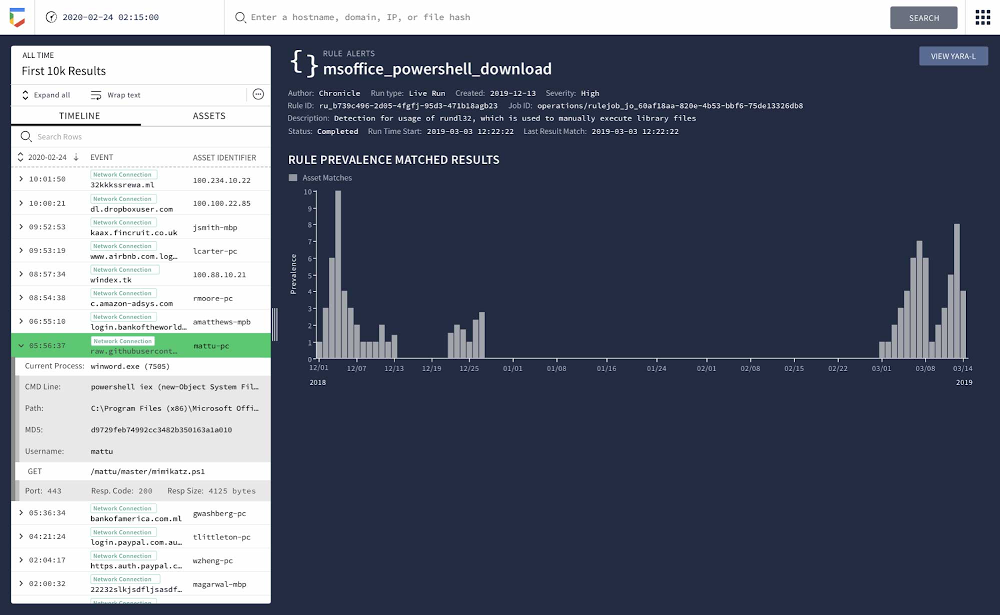
Cloud security is a top enterprise IT priority as organizations modernize their critical business systems both in-place and in the cloud. Our mission is to provide advanced security solutions that help give good the advantage, starting from building the most secure cloud platform to products that bring the power of Google’s global infrastructure and threat intelligence directly to your data centers.Today at the RSA Conference we’re introducing new capabilities that offer security wherever our customers’ systems and data may reside, including threat detection and timeline capabilities in Chronicle, threat response integration between Chronicle and Palo Alto Networks’ Cortex XSOAR, and online fraud prevention services. New advanced threat detection and automatic timelines in ChronicleDetection rule to find a PowerShell downloadChronicle launched its security analytics platform in 2019 to help change the way any business could quickly, efficiently, and affordably investigate alerts and threats in their organization. At RSA this year, as part of Google Cloud, we’ll show how customers can detect threats using YARA-L, a new rules language built specifically for modern threats and behaviors, including types described in Mitre ATT&CK. This advanced threat detection provides massively scalable, real-time and retroactive rule execution.We’re also introducing Chronicle’s intelligent data fusion, a combination of a new data model and the ability to automatically link multiple events into a single timeline. Palo Alto Networks, with Cortex XSOAR, is our first partner to integrate with this new data structure to enable even more powerful threat response. We’ll be demonstrating this integrated capability in the Google Cloud/Chronicle booth at RSA.“Cortex XSOAR offers automated enrichment, response and case management to enterprise-wide threats,” said Rishi Bhargava, VP, Product Strategy at Palo Alto Networks. “The integration with Chronicle’s new detection capabilities and event timelines, across months or years’ of data, enhances that response and enables comprehensive threat management for our mutual customers.”Prevent fraud and abuse with reCAPTCHA Enterprise and Web RiskTo protect your business, you need to protect your users. To help, we’re announcing the general availability of reCAPTCHA Enterprise and Web Risk API. These products are underpinned by two Google security technologies that have been protecting billions of web users and millions of websites for more than a decade—reCAPTCHA and Google Safe Browsing. reCAPTCHA Enterprise helps protect websites from fraudulent activities like scraping, credential misuse, and automated account creation. Protecting the web from bots has become increasingly important with the rise of threats like credential stuffing attacks, where malicious actors can test large volumes of breached passwords against legitimate sites. reCAPTCHA Enterprise recently added a new wave of commercial-grade bot defense capabilities to help ensure that a login attempt is being made by a legitimate user and not a bot. Google Nest is using reCAPTCHA Enterprise to help prevent automated attacks by actors seeking to obtain unauthorized access to accounts and devices.Overview of reCAPTCHA Enterprise protectionsUsing Web Risk API, enterprise customers can enable client applications to check URLs against Google’s constantly updated lists of unsafe web resources to prevent access to or inclusion of malicious content. Web Risk API alerts on, and includes information about, more than a million unsafe URLs that we keep up-to-date by examining billions of URLs each day in Google Safe Browsing.Web Risk API and reCAPTCHA Enterprise are now both globally generally available and can be purchased separately. Google Cloud security in 2020 and beyondWhen it comes to security, our work will never be finished. In addition to the capabilities announced today, we’ll continue to empower our customers with products that help organizations modernize their security capabilities in the cloud or in-place. To learn more about our entire portfolio of security capabilities, visit us at booth #2233 Moscone South, and check out our Trust & Security Center.
Quelle: Google Cloud Platform

Migrate your Microsoft SQL Server workloads to Google Cloud

Enterprise database workloads are the backbone of many of your applications and ecosystems. Also, guaranteed availability is critical when choosing a cloud provider. Many enterprises built their mission-critical applications on Microsoft SQL Server 2008, and it’s common still to run into older versions of SQL Server as you’re working toward modernizing your on-prem environments. According to Business insider, 60% of Microsoft users still use SQL Server 2008, which reached its end of life in July 2019. This provides the opportunity for many of you to find a place to host your SQL Server 2008 instances on newer technology with less operational burden. We’re announcing that Cloud SQL for SQL Server is generally available globally. This means that Cloud SQL now helps you keep your SQL Server workloads running by providing a 99.95% uptime service-level agreement (SLA), which is consistent with the other Cloud SQL database engines. Cloud SQL for SQL Server is fully managed and compatible with SQL Server 2017. Now you can migrate your critical production SQL Server workloads to Google Cloud and rely on the service’s stability and reliability.  We hear from enterprise companies how important the ability to migrate to Cloud SQL for SQL Server is to their larger goals of infrastructure modernization and a multi-cloud strategy. On-premises applications like HR, finance, and payroll often depend on these legacy databases to keep running. Customers often cite the challenge of wanting to maintain compatibility with these existing systems and datasets, while also streamlining deployments and scale-out at a fraction of the overhead. Migrating these instances to Cloud SQL for SQL Server can save costs and maintenance time and improve efficiency and speed. Getting started migrating SQL Server 2008The migration for Microsoft SQL Server 2008 to Cloud SQL for SQL Server can be achieved in a simple five steps. For details, check out the full migration guide: SQL Server 2008 R2 server to Cloud SQL for SQL Server. 1. Create a Cloud SQL for SQL Server instance2. Create a Cloud Storage bucket3. Back up your Microsoft SQL Server 2008 database4. Import the database into Cloud SQL for SQL Server5. Validate the imported dataIf you’re working with newer versions of SQL Server, check out the SQL Server 2017 to Cloud SQL for SQL Server migration guide.Since the launch of Cloud SQL for SQL Server, we’ve heard your feedback and have continued to improve the performance and durability of the service. We expect to continue our rapid pace of innovation and feature releases to meet our customers’ needs and address feedback. Cloud SQL for SQL Server has proven itself as a key component when migrating existing enterprise applications and infrastructure.We’re continuing to rapidly improve Cloud SQL for SQL Server to meet all of your cloud database needs. Stay tuned for features in development that can help with Active Directory integration, online migrations, and more options for replicas and machine types. See what Google Cloud can do for youSign up for a $300 credit to try Cloud SQL and the rest of Google Cloud. You can start with inexpensive micro instances for testing and development. When you’re ready, scale them up to serve performance-intensive applications. Enjoy your exploration of Google Cloud and Cloud SQL for SQL Server.
Quelle: Google Cloud Platform