When to use Azure Service Health versus the status page

If you’re experiencing problems with your applications, a great place to start investigating solutions is through your Azure Service Health dashboard. In this blog post, we’ll explore the differences between the Azure status page and Azure Service Health. We’ll also show you how to get started with Service Health alerts so you can stay better informed about service issues and take action to improve your workloads’ availability.

How and when to use the Azure status page

The Azure status page works best for tracking major outages, especially if you’re unable to log into the Azure portal or access Azure Service Health. Many Azure users visit the status page regularly. It predates Azure Service Health and has a friendly format that shows the status of all Azure services and regions at a glance.

The Azure status page, however, doesn’t show all information about the health of your Azure services and regions. The status page isn’t personalized, so you need to know exactly which services and regions you’re using and locate them in the grid. The status page also doesn’t include information about non-outage events that could affect your availability. For example, planned maintenance events and health advisories (think service retirements and misconfigurations). Finally, the status page doesn’t have a means of notifying you automatically in the event of an outage or a planned maintenance window that might affect you.

For all of these use cases, we created Azure Service Health.

How and when to use Azure Service Health

At the top of the Azure status page, you’ll find a button directing you to your personalized dashboard. One common misunderstanding is that this button allows you to personalize the status page grid of services and regions. Instead, the button takes you into the Azure portal to Azure Service Health, the best option for viewing Azure events that may impact the availability of your resources.

In Service Health, you’ll find information about everything from minor outages that affect you to planned maintenance events and other health advisories. The dashboard is personalized, so it knows which services and regions you’re using and can even help you troubleshoot by offering a list of potentially impacted resources for any given event.

Service Health’s most useful feature is Service Health alerts. With Service Health alerts, you’ll proactively receive notifications via your preferred channel—email, SMS, push notification, or even webhook into your internal ticketing system like ServiceNow or PagerDuty—if there’s an issue with your services and regions. You don’t have to keep checking Service Health or the status page for updates and can instead focus on other important work.

Set up your Service Health alerts today

Feel free to keep using the status page for quick updates on major outages. However, we highly encourage you make it a habit to visit Service Health to stay informed of all potential impacts to your availability and take advantage of rich features like automated alerting.

Set up your Azure Service Health alerts today in the Azure portal. For more in-depth guidance, visit the Azure Service Health documentation. Let us know if you have a suggestion by submitting an idea here.
Quelle: Azure

Using Metrics to Guide Container Adoption, Part I

Earlier this year, I wrote about a new approach my team is pursuing to inform our Container Adoption Program. We are using software delivery metrics to help keep organizations aligned and focused, even when those organizations are engaging in multiple workstreams spanning infrastructure, release management, and application onboarding. I talked about starting with a set […]
The post Using Metrics to Guide Container Adoption, Part I appeared first on Red Hat OpenShift Blog.
Quelle: OpenShift

Announcing Azure Databricks unit pre-purchase plan and new regional availability

Azure Databricks is a fast, easy, and collaborative Apache Spark based analytics platform that simplifies the process of building big data and artificial intelligence (AI) solutions. Azure Databricks provides data engineers and data scientists an interactive workplace where they can use the languages and frameworks of their choice. Natively integrated with services like Azure Machine Learning and Azure SQL Data Warehouse, Azure Databricks enables customers to build an end-to-end modern data warehouse, real-time analytics, and machine learning solutions.

Save up to 37 percent on your Azure Databricks workloads

Azure Databricks Unit pre-purchase plan is now generally available—expanding our commitment to make Azure the most cost-effective cloud for running your analytics workloads.

Today, with the Azure Databricks Unit pre-purchase plan, you can start unlocking the benefits of Azure Databricks at significantly reduced costs when you pre-pay for Databricks compute for a one or three-year term. With this new pricing option, you can achieve savings of up to 37 percent compared to pay-as-you-go pricing. You can learn more about the discount tiers on our pricing page. All Azure Databricks SKUs—Premium and Standard SKUs for Data Engineering Light, Data Engineering, and Data Analytics—are eligible for DBU pre-purchase.

Compared with other Azure services with reserved capacity pricing, which have a per hour capacity purchase, this plan allows you to pre-purchase DBUs that can be used at any time. You also have the flexibility to consume units across all workload types and tiers.

Azure Databricks is offered as a first party Azure service. You can pre-purchase Databricks compute either from your Azure prepayment or existing payment instruments.

Azure Databricks is now available in South Africa and South Korea

Azure Databricks is now generally available in additional regions—South Africa and South Korea. These additional locations bring the product worldwide availability count to 26 regions backed by a 99.95 percent SLA.

Driven by the motto of innovation and accessibility, we aim to ensure that we build a cloud infrastructure to serve the needs of customers globally. Stay updated with the region availability for Azure Databricks.

Organizations also benefit from Azure Databricks' native integration with other services like Azure Blob storage, Azure Data Factory, Azure SQL Data Warehouse, Azure Machine Learning, and Azure Cosmos DB. This enables new analytics solutions that support modern data warehousing, advanced analytics, and real-time analytics scenarios.

Get started today

Getting started with DBU pre-purchase is easy, and is done via the Azure portal. For details on how to get started, see our documentation. For more information on discount tiers, please visit the pricing page.
Quelle: Azure

Azure and Informatica team up to remove barriers for cloud analytics migration

Today, we are announcing the most comprehensive and compelling migration offer available in the industry to help customers simplify their cloud analytics journey.

This collaboration between Microsoft and Informatica provides customers an accelerated path for their digital transformation. As customers modernize their analytics systems, it enables them to truly begin integrating emerging technologies, such as AI and machine learning, into their business. Without migrating analytics workloads to the cloud, it becomes difficult for customers to maximize the potential their data holds.

For customers that have been tuning analytics appliances for years, such as Teradata and Netezza, it can seem overwhelming to start the journey towards the cloud. Customers have invested valuable time, skills, and personnel to achieve optimal performance from their analytics systems, which contain the most sensitive and valuable data for their business. We understand that the idea of migrating these systems to the cloud can seem risky and daunting. This is why we are partnering with Informatica to help customers begin their cloud analytics journey today with an industry-leading offer.

Free evaluation

With this offering, customers can now work with Azure and Informatica to easily understand their current data estate, determine what data is connected to their current data warehouse, and replicate tables without moving any data in order to conduct a robust proof of value.

This enables customers to get an end-to-end view of their data, execute a proof of value without disrupting their existing systems, and quickly see the possibilities of moving to Azure.

Free code conversion

A critical aspect of migrating on-premises appliances to the cloud is converting existing schemas to take advantage of cloud innovation. This conversion can quickly become expensive even in proof of values.

With this joint offering from Azure and Informatica, customers receive free code conversion for both the proof of value phase and when fully migrating to the cloud, as well as a SQL Data Warehouse subscription for the duration of the proof of value (up to 30 days).

Hands-on approach

Both Azure and Informatica are dedicating the personnel and resources to have analytics experts on-site helping customers as they begin migrating to Azure.

Customers that qualify for this offering will have full support from Azure SQL Data Warehouse experts. They will help with the initial assessment, executing the proof of value, and provide best practice guidance during migration.

Everything you need to start your cloud analytics journey

Get started today

Analytics in Azure is up to 14 times faster and costs 94 percent less than other cloud providers, and is the leader in both the TPC-H and TPC-DS industry benchmarks. Now with this joint offer, customers can easily get started on their cloud analytics journey.

Register for the Azure and Informatica webinar to learn more about this offer.
Sign up for a free Informatica: Cloud Data Warehouse Modernization on Azure workshop.

Quelle: Azure

A CIO's guide to the cloud: hybrid and human solutions to avoid trade-offs

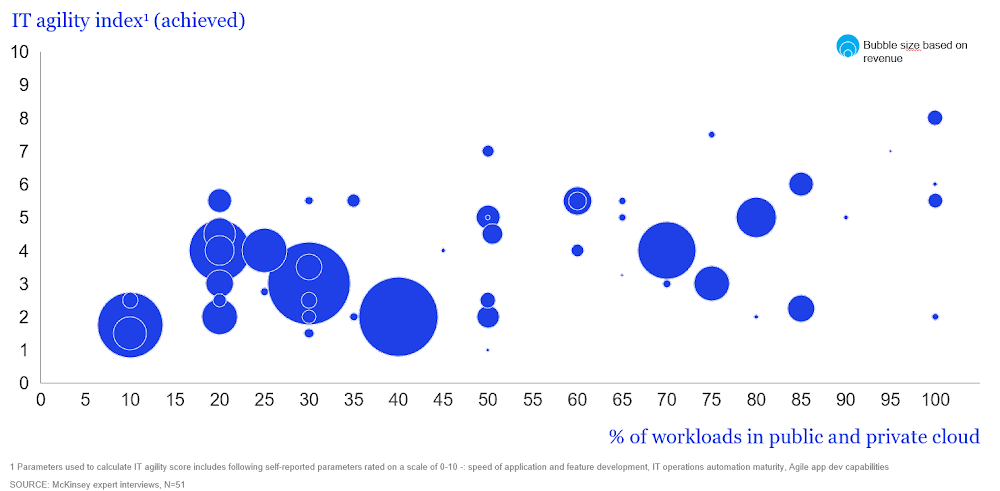
What do CIOs and CTOs deliver for the company? If you said “technology,” that’s just the beginning. According to their research, McKinsey found that 85% of CIOs and CTOs interviewed in the spring of 2019 said they were essential for at least two of the three most common CEO priorities—revenue acceleration, improved agility and time to market, and cost reduction.IT modernization – including migrating to the cloud – is key to business growth and agility. Yet, according to a recent McKinsey study, 80% of CIOs report that regardless of their level of cloud migration, they still haven’t reached their projected agility and business benefits. Sometimes, this is because of issues like training and skills gaps in the IT workforce. Surprisingly often though, the barrier to reaching the goals is based on trade-offs that CIOs themselves feel they must make to strike a balance between the perfect and the possible.But what if you could have it all without the trade-offs? As Will Grannis, Managing Director of the CTO Office at Google, and Arul Elumalai, Partner at McKinsey & Company discussed in our recent digital conference, many of the compromises CIOs make can be avoided with new technology, modern architectures and by encouraging a transformation mindset across the business. In interviews, CIOs explained how they’ve leveraged the best of the cloud without compromising on security, agility, and flexibility. Here’s how these leaders avoid three of the top perceived trade-offs—both with technology and by transforming their operating model.Trade-off #1: Developer agility vs. control and governanceMoving to the cloud offers new opportunities for speed, but 69% of organizations indicate that stringent security guidelines and code review processes can slow developers significantly. One CISO of a multinational company mentioned that cloud development was so fast that they had to institute manual checks on their developers’ code. So much for agility. To overcome this trade-off and maintain both speed and security, some respondents found success in DevOps, hiring security-experienced talent and introducing automation for security and quality. Building in security into the CI/CD pipeline and increasing automation don’t just eliminate the tradeoff, they result in higher quality and faster innovation.At Google Cloud, we’ve also observed that customers with strong DevOps practices have increased speed-to-market and product/service quality. From our own journey, we’ve learned seven critical lessons essential to adopting a DevOps model, ranging from taking up small projects and embracing open source to building an overall DevOps culture.Trade-off #2: Single-vendor benefits vs. freedom from lock-inCIOs perceive benefits to using the fewest number of clouds, specifically avoiding introducing multiple systems that require their teams to develop and maintain multiple skillsets. Unfortunately, 83% of the CIOs interviewed said that while they would prefer fewer clouds, the potential financial and technical lock-in drives them to multiple providers. Successful CIOs said that they can avoid lock-in pitfalls not just with contractual guardrails and executive and board education, but with evolving hybrid cloud technologies that provide additional choices. Hybrid cloud platforms based on containers can further mitigate the risk of using a single cloud vendor. The key to successful hybrid architectures is the infrastructure abstraction and portability that containers create for them, enabling disparate environments to work together. This notion has been at the heart of our strategy at Google Cloud with Anthos, which provides an abstraction layer and an application modernization platform for hybrid and multi-cloud environments. Enterprises can use Anthos to modernize how they develop, secure, and operate hybrid-cloud environments and enable consistency across cloud environments.Trade-off #3: Best-of-breed tools vs. standardization and familiarityOptimizing tool chains for different environments can improve productivity, but many CIOs believe that this means reduced functionality and tools. While 77% of CIOs said they had to standardize to the lowest common denominator, some have found a better solution. Rather than giving up the languages, libraries, and frameworks that their teams prefer, effective leaders said that they found success by investing in training programs to upscale talent and adopting new open and vendor-agnostic solutions. Architectures that are based on open-source components have been the keys that helped remove this tradeoff, and eliminate the notion of a lowest common denominator. This is why we have built Anthos on open-source components like Kubernetes, Istio and Knative. Anthos gives your business the choice you need. With the ability to create code that works in most environments using the tools, languages, and systems you prefer, you can do more without major changes to how you work.Regardless of your current cloud adoption level, check out “Unlock business acceleration in a hybrid cloud world” to discover more about McKinsey’s findings, including how CIOs drive agility, methods to make trade-offs unnecessary, and how to prepare your team for the cloud. Then, stay tuned for subsequent posts that  take a closer look at how hybrid solutions and strategies can help CIOs drive a transformation mindset across the business—without compromising on security, agility, and flexibility.
Quelle: Google Cloud Platform