Raumfahrt: Stratolaunch hebt wohl vorerst nicht mehr ab

Nach dem ersten erfolgreichen Flug konnte das Unternehmen Stratolaunch keine Aufträge für das Trägerflugzeug erhalten. Mittlerweile plant das Unternehmen laut internen Quellen, die Operation einzustellen und erwägt Strategien, aus dem Geschäft auszusteigen. Der Flieger bleibt dafür im Hangar. (Flugzeug, Technologie)
Quelle: Golem

Demonstrating our commitment to protecting user privacy and student data

Assessing third-party vendors for security risks and data privacy policies is a crucial responsibility of any higher education institution, and this can be a time-consuming and burdensome task for campus IT professionals. To help ease these challenges, the higher education information security community, EDUCAUSE, Internet2, and the Research & Education Networks Information Sharing & Analysis Center (REN-ISAC) created the Higher Education Cloud Vendor Assessment Toolkit (HECVAT). Today we’re demonstrating our core commitment to protecting user data, documenting our extensive platform security capabilities by completing this comprehensive security assessment for Google Cloud Platform (GCP) and G Suite.Google and a team of campuses recently completed the NET+ service validation to launch a NET+ GCP offering which provides Internet2 higher education members key enhancements to our standard GCP education terms. As part of that rigorous peer-driven review, four universities examined multiple components of GCP, including security, identity management, networking, accessibility, and legal terms, to validate its capabilities. By completing the HECVAT process, we’ve strengthened our support for EDUCAUSE, Internet2, the REN-ISAC, and the global research community.The HECVAT self-assessments for GCP and G Suite cover our existing certifications (from the ISO 27000 standards, for example) and compliance with industry standards and detail authentication, data encryption methods, disaster recovery plans, and more. By completing this rigorous self-survey, we’re demonstrating our commitment to transparency and documenting the strict security protocols built into our infrastructure.“The Higher Education Cloud Vendor Assessment Tool (HECVAT) was created by a Higher Education Information Security Council working group, in collaboration with campus participants, EDUCAUSE, Internet2, and REN-ISAC, to help institutions rapidly assess cloud services and reduce the resources needed for assessments,” said Nick Lewis, Program Manager for Security and Identity at Internet2. “Google’s adoption of HECVAT as part of the Internet2 NET+ Google Cloud Platform offering assures campuses of Google’s ongoing commitment to higher education’s unique security needs, advanced higher education information security, and supporting collaborative work.”You can find Google’s HECVAT self-assessments on REN-ISAC’s Cloud Broker Index. To learn more about how HECVAT works, read the recent blog, What’s Next for HECVAT, from EDUCAUSE.
Quelle: Google Cloud Platform

Thinking about cloud security? Join us for a new round of Google Cloud Security Talks

As more and more organizations migrate to the cloud, it’s vital to understand the resources at your disposal to protect your users, applications, and data. To help you navigate the latest thinking in cloud security, we hope you’ll join us for the Google Cloud Security Talks, a live online event on June 10.You’ll get a variety of expert insights on some of the most pressing cloud security topics, on Google Cloud and beyond, including:Security essentials in the cloudEnabling BeyondCorp in your organization todayProtecting yourself from bleeding edge phishing and malware attacksBest practices around shared securitySolving security use-cases in G SuiteA deep dive into Cloud Security Command CenterUnifying user, device, and app management With Cloud IdentityPreventing data exfiltration on GCPYou can view the full agenda and register for the event at no cost to you on our website. We hope you can join us!
Quelle: Google Cloud Platform

Scan BigQuery for sensitive data using Cloud DLP

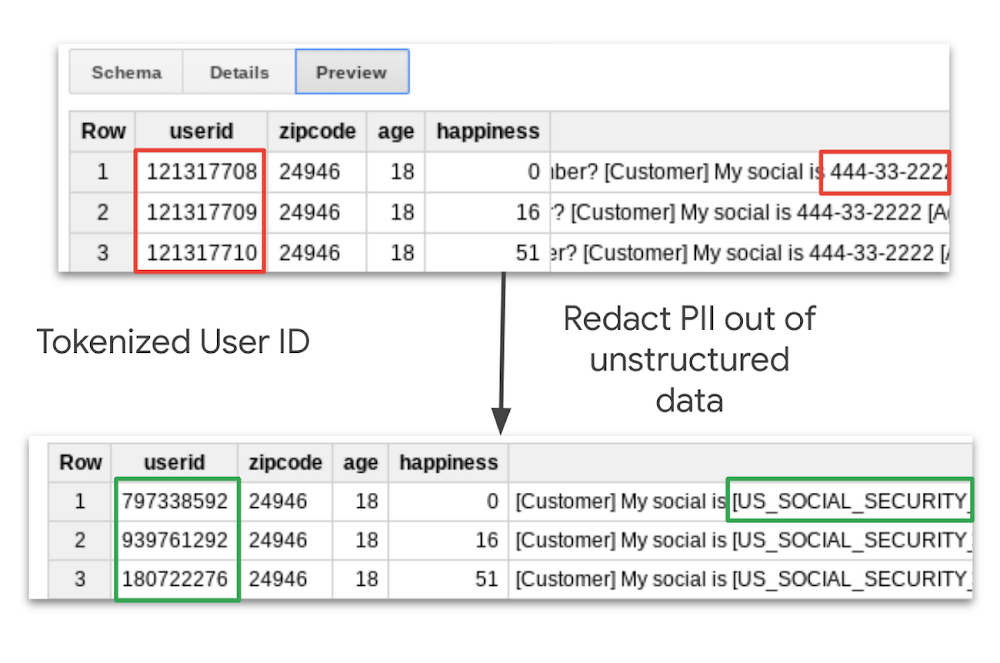
Preventing the exposure of sensitive data is critically important for many businesses—particularly those that operate in industries with substantial compliance needs, such as finance and healthcare. Cloud Data Loss Prevention (DLP) can help meet those needs and protect sensitive data through data discovery, classification, and redaction. But in some cases, you might need more awareness and quick access to Cloud DLP capabilities in the context of other GCP services such as BigQuery. Today, we’re making it easier to discover, and classify sensitive data in BigQuery with the Scan with DLP button. This new feature makes it possible to run DLP scans with just a few clicks, directly from the BigQuery UI.Cloud DLP in actionHere’s what you can do:Detect common sensitive data types such as credit card numbers or custom sensitive data types to highlight intellectual property or proprietary business information.Create triggers for automatic Cloud DLP scan scheduling.Publish Cloud DLP scan findings to BigQuery and Cloud Security Command Center for further analysis and reporting.De-identify and obfuscate sensitive data.Use the Cloud DLP UI (Beta) to create, manage, and trigger DLP scans across multiple GCP services, such as BigQuery, Cloud Storage, and Datastore.Scan a subset of your entire dataset using the sampling feature to keep your Cloud DLP costs under control.Today, BigQuery customers can start using Cloud DLP to scan for sensitive data with a few clicks, following these simple steps:1. Browse to a particular BigQuery table and choose Scan with DLP from the Export menu.2. Complete the Cloud DLP scan job creation with a click, or specify custom configurations such as information types to scan, sampling versus full scanning, post-scan actions, and more.3.Once a Cloud DLP scan is completed, you will receive an email with links to the scan details page where you can analyze findings and take further actions.You can also quickly scan your other cloud-based data repositories with the Data Loss Prevention (DLP) user interface, now available in beta. Through this new interface, you can run DLP scans with just a few clicks—no code required, and no hardware or VMs to manage. Get started today in the GCP console.To learn more, check out our Cloud DLP documentation.
Quelle: Google Cloud Platform