How Tieto's APIs give European banks a competitive edge

Editor’s note:Today we hear from Tieto, a leading Nordic software and services company serving customers through smart adoption of technology and data use. Tieto offers services to businesses, consumers, and citizens in the Nordics and beyond with a global team of 15,000 employees in almost 20 countries.Although we’re the largest system integrator in the Nordics, we also develop our own products, including our lending and leasing platform that we sell to retail banks across Europe. To compete with a burgeoning population of fintech startups, banks increasingly want to offer their customers a wide variety of customized services—whether their own or something provided by a third party. We want to make it easier for them to integrate with those third-party services and reap all the benefits. So it made sense for us to implement an API platform as a mid-layer between our platform and all the third-party integrations that a bank would want. We chose Google Cloud and the Apigee API management platform to make it easier for developers to find and consume the APIs that are available at our open banking API hub.Gaining a competitive edge with ApigeeWe chose Apigee for several reasons. Most importantly, we felt that Apigee offers better and more cost-effective service and support than other products we evaluated. On the technical side, the possibility of running both cloud and on-premises deployments gives us maximum flexibility for our customers, some of whom still run on-prem. We also really appreciated Apigee’s banking proxy with pre-developed API feeds.Our first API-based solution is what we refer to as an interim credit platform. This means that we originate or underwrite a loan, administer it, and, if that credit turns bad, we manage the non-performing loan. We handle the entire credit lifecycle from origination to administration to collections (if necessary). From the retail bank customer’s perspective, they log in to their own bank’s mobile or web application and apply for credit, pay, and manage their loans entirely from their bank’s front end. In fact, they are really interacting with the Tieto solution for the entire life of the credit relationship.We’re using the Apigee developer portal for our team of about 10 internal developers. We have  approximately 120 customers using between 20 and 50 APIs each, depending on individual needs for integrating with brokers, CRMs, ERPs, fraud detection systems, government reporting, and European open banking requirements. We like how Apigee works as a tool for monitoring traffic; it gives us visibility into things like the sales performance of individual brokers. And from a cybersecurity perspective, we are confident that the integrations we do through Apigee meet the highest security standards.Monetizing open banking APIsGoing forward, we want to help our bank customers monetize through the Apigee platform. We’re convinced that even though it’s early days for open APIs in the banking industry,  most of our customers want to these capabilities. For the most part, banks haven’t started to monetize their APIs yet, but we predict that they’ll want to do so very soon. For us to be positioned to support our customers as they move from open APIs towards monetization is key.We’ve had feedback from banks that have used other API platforms and have found that Apigee’s monetization capabilities are much more complete than what they’ve seen in other products. This becomes especially relevant when we talk about a common European model of multiple retail banks in one group that share a centralized IT function. With Apigee they are able to easily manage cost splits between the various banks in a group by looking at API calls, which isn’t always the case with competing API management platforms.In the next nine months the European open banking regulations are set to be enforced, and we are helping our customers meet this important deadline. Aside from satisfying the regulatory requirements, we are seeing a lot of innovative applications as people start realizing the possibilities of APIs and begin taking advantage of their capabilities.For instance, beyond meeting account information requirements, we expect to see true open banking happening on API platforms that will flow data from different endpoints, no matter where you’re accessing it from. If a customer is applying for a credit card, we’ll see his or her account information coming through from his or her bank, which would then flow to a credit agency for scoring, and so on. This means that the quality of the data will be much higher because it’s coming from already validated sources, rather than being self-entered by customers each time they make an application. With banking data being truly free and open, it’s going to be interesting to see how the market will develop.To learn more about Apigee, visit our website.
Quelle: Google Cloud Platform
More choice, less complexity: New Compute Engine pricing options on tap

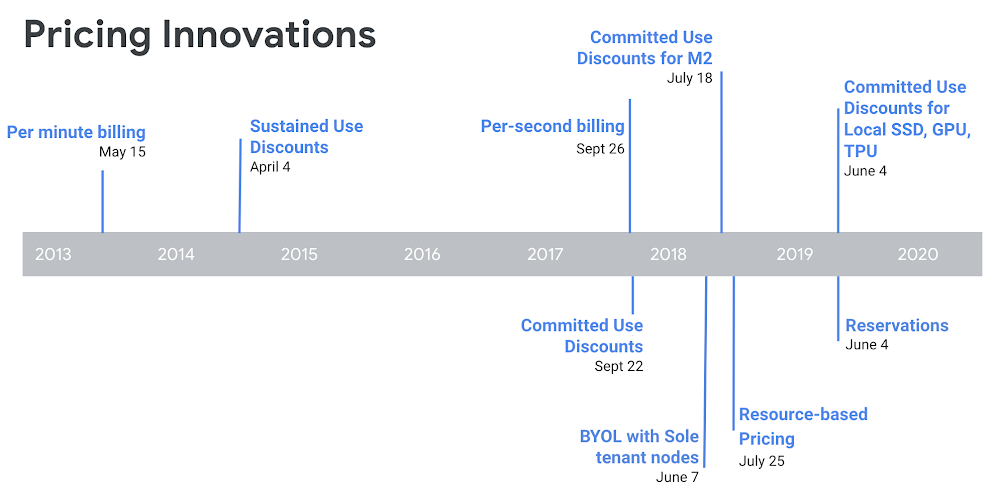
At Google Cloud, we believe cloud pricing should be simple, fair and transparent. You shouldn’t need an advanced degree in finance to get the most out of your cloud investment, and you definitely shouldn’t have to worry about your cloud provider covering up costs under layers of complexity.Today, we’re taking simple, fair and transparent pricing for our Compute Engine service even further with the following announcements:We are extending committed use discounts to support GPUs, Cloud TPU Pods, and local SSDs. Committed use discounts are ideal for predictable, steady-state usage. Now you can purchase a specific number of GPUs, TPU Pods or local SSD storage for up to 55% off on-demand prices. At the same time, you have total control over the instance types, families and zones to which you apply your committed use discounts. Committed use discounts are available in all Compute Engine regions and support our wide selection of GPUs, including NVIDIA Tesla K80, P4, P100, and V100 GPUs, as well as all available slice sizes of Cloud TPU v2 Pods and Cloud TPU v3 Pods.We now support capacity reservations for Compute Engine. Reservations allow you to reserve resources in a specific zone to use later. Reservations help ensure you have compute capacity available when and where you need it and are especially useful for anticipated spikes, say, during the holidays, when performing backup and disaster recovery, or for planned organic growth. You can create or delete a reservation at any time. Reservations consume resources just like normal VMs, so any existing discounts you may have (e.g., sustained use discounts and committed use discounts) apply automatically. Even as we add more functionality, getting the lowest billing remains simple and fair in Google Cloud.Committed to pricing innovationWe have been committed to delivering simple, fair and transparent pricing for Compute Engine since it first launched in 2013. We were the first to offer per-minute and per-second billing, and simple fixed pricing with preemptible VMs. We were also the first to let you pick exactly how much RAM and vCPUs you need with custom machine types. We introduced committed use discounts, which reward steady-state, predictable usage in a way that’s easy-to-use and accommodates a variety of applications. Most recently, we were the first to introduce resource-based pricing, which lets you see exactly what you’re paying for — from vCPUs and RAM to GPUs or premium OS licenses. We are still the only cloud provider to automatically lower the price of your compute resources when you use them for a significant portion of the month, even without a long-term commitment with our sustained use discounts.Get started todayWe will continue to introduce discounts and pricing options that are flexible and predictable—so you don’t have to get that advanced finance degree. We won’t make you choose from thousands of SKUs, or worse, hide costs in confusing and hard-to-use bundles. To learn more about how to lower your cloud costs and reserve compute resources, check out our committed use discount and capacity reservation pages.
Quelle: Google Cloud Platform

Pod Evictions based on Taints/Tolerations

Red Hat OpenShift 4 is making an important and powerful change to the way pod evictions work. OpenShift has transitioned from using node conditions to using a Taint/Toleration based eviction process, which provides individual pods more control over how they are evicted. This new capability was added in Kubernetes 1.12 and enabled in OpenShift 4.1 […]
The post Pod Evictions based on Taints/Tolerations appeared first on Red Hat OpenShift Blog.
Quelle: OpenShift

Ask Me Anything – “Network” with teams from Azure Networking!

Which 3rd party devices are supported for connecting to Azure VPN Gateway? Can I connect to multiple sites from the same virtual network? Ask these questions and more during the next Ask Me Anything (AMA) session via Twitter on Tuesday, June 11, 2019 from 10:00 AM to 11:30 AM Pacific Time.

This is your opportunity to ask questions about our products, services, or even the team, directly to members of these teams:

Azure Application Gateway
Azure DNS
Azure ExpressRoute
Azure Traffic Manager
Azure VPN Gateway

Tell us about your experiences, we want your valuable insights into how we can improve the service.

To get involved, follow @AzureSupport on Twitter and send a tweet with the hashtag  "#AzNetworkingAMA". Then during the event, members from the product teams will start answering your questions.

How it works

AMA stands for Ask Me Anything, which is a less formal way to get answers to your questions directly from the engineers and product managers. It’s an opportunity for a live conversation with the experts who are responsible for building and maintaining Azure services.

During the live session, you can ask questions by tweeting at @AzureSupport  with the hashtag #AzNetworkingAMA. Your question can span multiple tweets by replying to first tweet you post with this hashtag.

If I’m in a different time zone, no problem. Start tweeting your questions in advance and we’ll answer during the event.

You really can ask anything you’d like, but here’s a list of question ideas to get you started:

What’s the difference between App Gateway and VPN Gateway?
Can I delegate an Azure DNS subdomain?
What features are currently planned or in development?
What is the difference between App Gateway and Azure Load Balancer?
How much do I get charged for App Gateway?
Why should I use the V2 SKU of App Gateway vs the V1?
How does App Gateway compare with Azure Front Door?
Can I use App Gateway for purely “private” (not internet facing) applications?
Which protocols are supported on Azure VPN Gateway?

The Azure Networking AMA is a great way for you to get inside the minds that build the products you love, and continues our series of AMAs that connect customers directly with developers. To learn more about some of our previous AMAs, you can read about the Azure Backup AMA and the Azure Integration Services AMA.

Get out and tweet @AzureSupport.
Quelle: Azure





