Azure SQL Database Edge: Enabling intelligent data at the edge

The world of data changes at a rapid pace, with more and more data being projected to be stored and processed at the edge. Microsoft has enabled enterprises with the capability of adopting a common programming surface area in their data centers with Microsoft SQL Server and in the cloud with Azure SQL Database. We note that latency, data governance and network connectivity continue to gravitate data compute needs towards the edge. New sensors and chip innovation with analytical capabilities at a lower cost enable more edge compute scenarios to drive higher agility for business.

At Microsoft Build 2019, we announced Azure SQL Database Edge, available in preview, to help address the requirements of data and analytics at the edge using the performant, highly available and secure SQL engine. Developers will now be able to adopt a consistent programming surface area to develop on a SQL database and run the same code on-premises, in the cloud, or at the edge.

Azure SQL Database Edge offers:

Small footprint allows the database engine to run on ARM and x64 devices via the use of containers on interactive devices, edge gateways, and edge servers.
Develop once and deploy anywhere scenarios through a common programming surface area across Azure SQL Database, SQL Server, and Azure SQL Database Edge
Combines data streaming and time-series, with in-database machine learning to enable low latency analytics
Industry leading security capabilities of Azure SQL Database to protect data-at-rest and in- motion on edge devices and edge gateways, and allows management from a central management portal from Azure IoT.
Cloud connected, and fully disconnected edge scenarios with local compute and storage.
Supports existing business intelligence (BI) tools for creating powerful visualizations with Power BI and third-party BI tools.
Bi-directional data movement between the edge to on-premises or the cloud.
Compatible with popular T-SQL language, developers can implement complex analytics using R, Python, Java, and Spark, delivering instant analytics without data movement, and real-time faster insights

Provides support for processing and storing graph, JSON, and time series data in the database, coupled with the ability to apply our analytics and in-database machine learning capabilities on non-relational datatypes.

For example, manufacturers that employ the use of robotics or automated work processes can achieve optimal efficiencies by using Azure SQL Database Edge for analytics and machine learning at the edge. These real-world environments can leverage in-database machine learning for immediate scoring, initiating corrective actions, and detecting anomalies.

Key benefits:

A consistent programming surface area as Azure SQL Database and SQL Server, the SQL engine at the edge allows engineers to build once for on-premises, in the cloud, or at the edge.
The streaming capability enables instant analysis of the incoming data for intelligent insights.
In-Database AI capabilities enables scenarios like anomaly detection, predictive maintenance and other analytical scenarios without having to move data.

Train in the cloud and score at the edge

Supporting a consistent Programming Surface Area across on-premises, in the cloud, or at the edge, developers can use identical methods for securing data-in-motion and at-rest while enabling high availability and disaster recovery architectures equal to those used in Azure SQL Database and SQL Server. Giving seamless transition of the application from the various locations means a cloud data warehouse could train an algorithm and push the machine learning model to Azure SQL Database Edge and allow it to run scoring locally, giving real-time scoring using a single codebase.

Intelligent store and forward

The engine provides proficiencies to take streaming datasets and replicate them directly to the cloud, coupled with enabling an intelligent store-and-forward pattern. In duality, the edge can leverage its analytical capabilities while processing streaming data or applying machine learning using in-database machine learning. Fundamentally, the engine can process data locally and upload using native replication to a central datacenter or cloud for aggregated analysis across multiple different edge hubs.

Unlock additional insights for your data that resides at the edge. Join the Early Adopter Program to access the preview and get started building your next intelligent edge solution.
Quelle: Azure

Scale globally, get four nines availability with new Cloud Bigtable capabilities

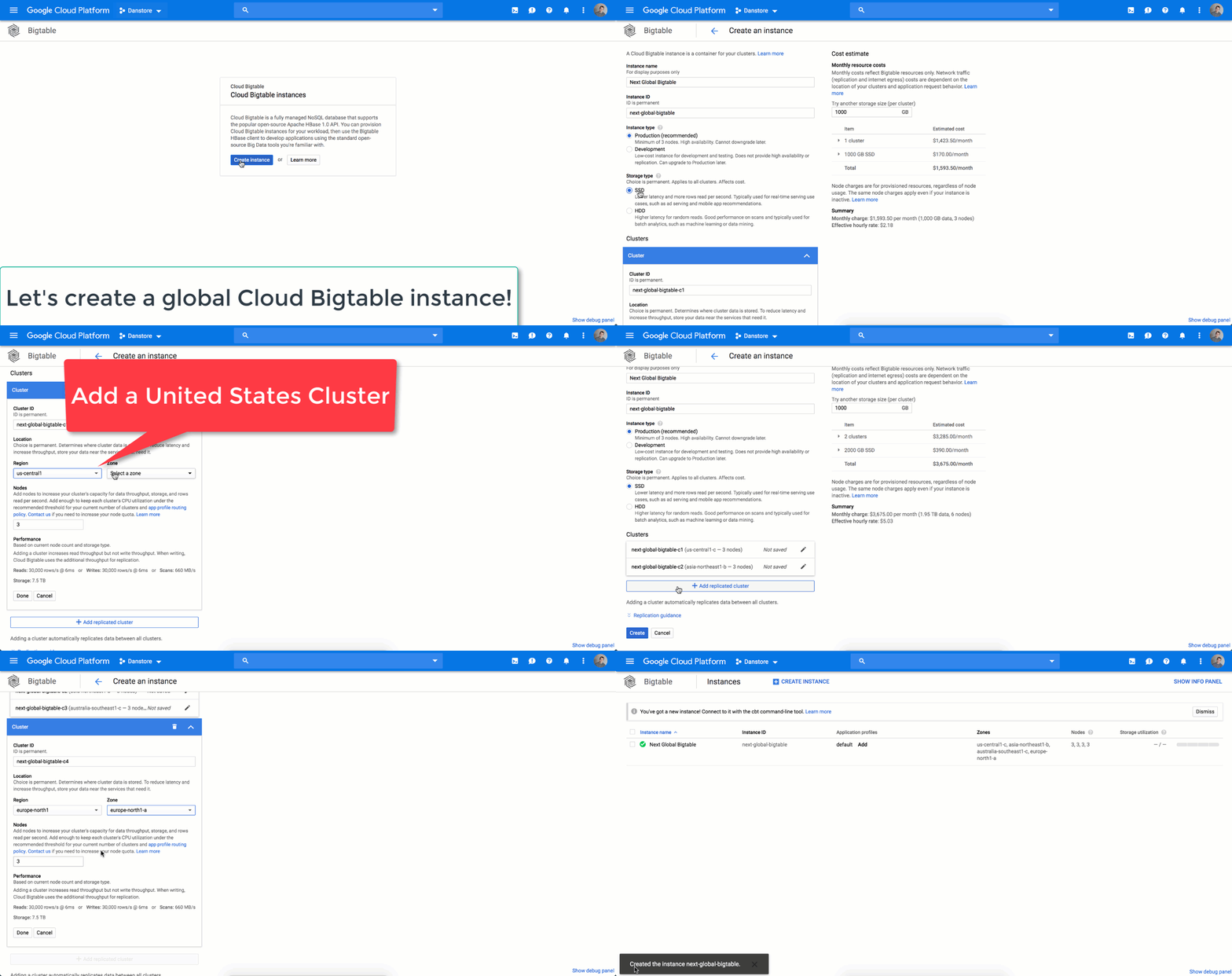
We’re very happy to announce that global replication is now generally available to all Cloud Bigtable users, following last month’s beta launch. This global, multi-region replication allows users to replicate data across up to four clusters worldwide, in any region in which Cloud Bigtable is available.Cloud Bigtable is a highly scalable, fully managed NoSQL database service for use cases from gigabytes to petabyte scale, where throughput, low-latency data access and reliability are critical. Replicated Cloud Bigtable instances can provide higher availability and resilience in the event of zonal failures. With this launch, we’ve also increased the SLA on availability for Cloud Bigtable instances to 99.99% with replication (using a multi-cluster routing policy) and 99.9% otherwise.We’ve heard some great insights from initial adopters since the beta launch. One of the key advantages of global replication is that you can better serve a global audience—reducing latency when serving data to your customers, no matter where they are in the world. Spotify serves music lovers across the world and they were keen to take advantage of this expanded replication capability.“Spotify is a global business with a global user base. Being able to provide a great audio experience to our users is a key priority for us,” said Niklas Gustavsson, chief architect at Spotify. “With Cloud Bigtable clusters in Asia, Europe, and the United States, we’re able to get low-latency data access all over the world, enabling Spotify to provide a seamless experience for our users. We’re also pleased with the continuous collaboration and deep engagement with Google’s product teams to accelerate both our businesses.”How multi-region replication worksIt’s super easy to get started. Add a cluster to your Cloud Bigtable instance at any time, and we’ll automatically replicate the data. Cloud Bigtable supports multi-primary replication, so every cluster accepts both reads and writes. Each cluster can also be scaled independently, allowing you to provision for exactly what you need in each zone or region.During Next ’19, the Cloud Bigtable and Cloud Networking teams shared how Cloud Bigtable takes advantage of Google’s extensive global network to make multi-region replication possible. You can check out the session recording for more details.Using Cloud Bigtable replication in productionExamples of workloads in financial services, advertising, and IoT show the wide variety of use cases that replication can help support.Availability is critical for many of our users, especially those in regulated industries like financial services and healthcare. Cloud Bigtable replication provides resilience in the event of zonal or regional failures, and can play a critical role in your disaster recovery strategy.Multi-region replication allows our AdTech users to locate their data close to their customers and to ad exchanges. This makes it easier to reduce end-to-end request latencies for ad bidding and personalization services, where custom advertisements and page content is served to website visitors in real time.Finally, customers use replication to separate data ingest from analysis. Cloud Bigtable replication allows you to collect data from geographically dispersed sources and perform centralized analysis in a separate cluster, without impacting data collection. This strategy can be particularly helpful for IoT workflows, fraud detection, and personalization.To get started with Cloud Bigtable replication, create an instance and configure one or more application profiles to use in your distributed application. Or, simply add a cluster to an existing instance and we’ll replicate your data automatically.And, we invite you to join the GCP Launch Announcements community, a customer-only forum where you’ll be the first to know when important GCP product updates and features are announced. Sign up here.
Quelle: Google Cloud Platform

Azure.Source – Volume 82.

What a great week we had at Build 2019! We all had tremendous fun meeting developers, talking about new technologies, and sharing our vision for the future. Plus, the weather was nearly perfect, and attendees had time to see some sights and sample Seattle’s terrific restaurant scene.
Quelle: Azure

Requesting and installing Let’s Encrypt Certificates for OpenShift 4

Overview Red Hat OpenShift uses certificates to encrypt the communication with the Web Console as well as applications exposed as Routes. Without any further customization the install process will create self-signed certificates. While these work they usually trigger severe security warnings about unknown certificates in Web Browsers when accessing either the Web Console or any […]
The post Requesting and installing Let’s Encrypt Certificates for OpenShift 4 appeared first on Red Hat OpenShift Blog.
Quelle: OpenShift