Optimize your organization’s cloud journey with a Cloud Center Of Excellence

The cloud has become a foundational part of the business and digital transformation journeys of many organizations. The Google Cloud Professional Services team has learned through working with our customers that a Cloud Center of Excellence (COE) is one of the ways that enterprises can get to the cloud faster and maintain stronger alignment between their business strategy and cloud investments.A Cloud COE can help accelerate cloud adoption benefits in a number of ways including:Driving momentum across the organizationDeveloping reusable frameworks for cloud governanceManaging cloud knowledge sharing and learning initiativesOverseeing cloud usage and plans for scaleAligning cloud offerings to the larger organizational strategyFurther, we’ve observed that successful Cloud COE teams exhibit many of the following characteristics:Multidisciplinary: Members of the team reflect the diverse perspectives of the stakeholders in the organization.Empowered: Team members have decision-making authority without need for higher-level sign-off.Visionary: They take a multi-project viewpoint to understand repeatability and long-term benefits or goals for the organization.Agile: The team understands how to deliver short-term wins such as short development cycles and an iterative approach to building products.Technical: The Cloud COE should include experienced individuals with a history of architecting and building past solutions within the organization.Integrated: Individual members come from existing areas of the business to allow for easy integration into existing teams and organizational constructs.Hands-on: The group includes individuals who are able to do the hands-on work needed to build and test cloud solutions.Google Cloud Professional Services is excited to release a new whitepaper that can help guide your organization through the process of building a Cloud COE to meet your needs both now and in the future. “Building a Cloud COE” is closely aligned with the Google Cloud Adoption Framework and is a practical guide for organizations looking to build or evolve their Cloud COE.To learn about how to build a Cloud Center of Excellence, download the whitepaper for practical guidance and strategies.
Quelle: Google Cloud Platform

Mirantis Introduces Bring-Your-Own-Distribution Support for Kubernetes

The post Mirantis Introduces Bring-Your-Own-Distribution Support for Kubernetes appeared first on Mirantis | Pure Play Open Cloud.
The company will offer SLA-backed support to enterprise development teams that choose to work with conformant and vendor-neutral distributions of Kubernetes
KubeCon Europe, Barcelona, Spain, May 22, 2019 — Today, Mirantis announced Mirantis
Enterprise Support for Kubernetes, a “Bring-Your-Own-Distro” (BYOD) support offering for brownfield Kubernetes implementations.
“The idea of monetizing open source software through an opinionated, pre-packaged distribution is a construct of the IT-driven world that we lived in 20 years ago,” said Boris Renski, Mirantis co-founder and CMO. “Today we live in the developer-driven world and Kubernetes is built for developers first, and IT second. Developers don’t need a third party vendor to push a pre-packaged, opinionated Kubernetes their way. All they need is occasional high-quality support from open source software experts. This is what we aim to deliver with BYOD Kubernetes support.”
The new support option enables customers to use any conformant Kubernetes distribution and complementary technology, as long as it complies with general constraints outlined in the Mirantis service agreement.
BYOD support is a precursor to the Kubernetes-as-a-Service (KaaS) software that Mirantis will be demonstrating at KubeCon, currently in beta. Mirantis KaaS can be used to orchestrate brownfield K8s clusters and will address key challenges with running Kubernetes on-premises with pure open source software, including:
Distribution-agnostic K8s cluster management capabilities utilizing Cluster API and Kubespray, with self-service API and web-based UI;
Control and delegate access to K8s clusters and namespaces using existing Identity Providers with IAM integration based on Keycloak
Backend-agnostic Load Balancing and Storage capabilities for K8s through integration with OpenStack Octavia and Cinder APIs
Native integration with Istio service mesh and Harbor image registry
About Mirantis
Mirantis helps enterprises and telcos address key challenges with running Kubernetes on-premises with pure open source software. The company employs a unique build-operate-transfer delivery model to bring its flagship product, Mirantis Cloud Platform (MCP), to customers. MCP features full-stack enterprise support for Kubernetes and OpenStack and helps companies run optimized hybrid environments supporting traditional and distributed microservices-based applications in production at scale.
To date, Mirantis has helped more than 200 enterprises and service providers build and operate some of the largest open clouds in the world. Its customers include iconic brands such as Adobe, Comcast, Reliance Jio, State Farm, STC, Vodafone, Volkswagen, and Wells Fargo. Learn more at www.mirantis.com.
###
Contact information:
Joseph Eckert for Mirantis
jeckertflak@gmail.com
The post Mirantis Introduces Bring-Your-Own-Distribution Support for Kubernetes appeared first on Mirantis | Pure Play Open Cloud.
Quelle: Mirantis

Forseti intelligent agents: an open-source anomaly detection module

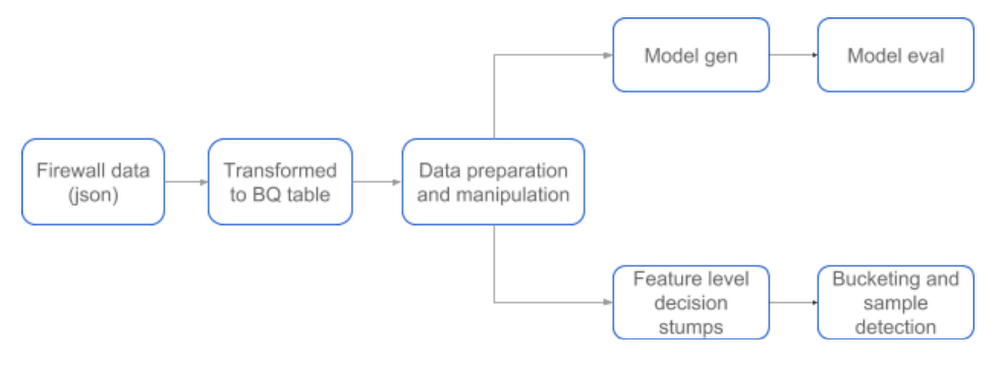
Among security professionals, one way to identify a breach or spurious entity is to detect anomalies and abnormalities in customer’ usage trend. At Google, we use Forseti,a community-driven collection of open-source tools to improve the security of Google Cloud Platform (GCP) environments. Recently, we launched the “Forseti Intelligent Agents” initiative to identify anomalies,  enable systems to take advantage of common user usage patterns, and identify other outlier data points. In this way, we hope to help security specialists for whom it’s otherwise cumbersome and time-consuming to manually flag these data points.Anomaly detection is a classic and common solution implemented across multiple business domains. We tested several machine-learning (ML) techniques for use in anomaly detection, analyzing existing data that had been used to create firewall rules and identify outliers. The approach, the results of which you can find in this whitepaper, was experimental and based on static analysis.At a high level, our goal is to use Forseti inventory data to achieve the following:Detect unusual instances between snapshots.Alert users of unusual firewall rules, provide comparisons with what expected behaviors.Provide potential remediation steps.Below is our solution. Note that it uses static data for now, but we can transform it to use dynamic data, if needed.The Forseti intelligent agents workflowTo build this solution, we took a multi-phase approach that imported firewall data into a BigQuery table, prepared and manipulated the data, then generated and evaluated a model. At the same time, we engaged in “feature-level decision stumps” (i.e., decision trees built after considering one feature as the label and all the rest as regular features) and performed bucketing and sample detection. Figure 1 is a high level depiction of our initial workflow. For pre-processing we experimented with approaches such as penalizing the subnet with a wider range. We also looked at Supernets, an example of which is depicted below.Some of these flattened firewall rules that we used to train the model can be depicted as follows:Then, for unsupervised learning, we experimented with techniques including  k-means clustering, decision stumps, and visualization in low-dimensional space.Feature weights for both principal components:Based on these results, we looked at a normal organization with thousands of firewall rules, and examining the points and clusters to the right, found some of the following anomalies (marked in RED below):*Model output has been anonymized for privacy and security.We conducted these experiments with firewall rules to prototype different approaches. You can read these approaches in detail in the whitepaper.A next step to follow up on this framework would be to use semi-supervised learning. Using some of the data points that our models can confidently flag as anomalous would also help in generating annotated data for such detailed analysis. Since we only used firewall rules in this initial study, as a next step, we plan to use other features such as hierarchical location of the firewall rules and network-related metadata.If you’re interested in contributing to the Forseti intelligent agents initiative, you can play around with any sample inventory data (or even your own), helping us generate broader anomaly detection mechanisms. By enlisting the community’s help with intelligent agents, we hope to continue to expand the Forseti toolset to help ensure the security of your cloud environment.For more details about this initiative, check out the solution here.Joe Cheuk, Cloud Application Engineer; Praneet Dutta, Cloud Machine Learning Engineer; and Nitin Aggarwal, Technical Program Manager, Cloud Machine Learning contributed to this report.
Quelle: Google Cloud Platform

Gamification: Amazon verpackt öde Arbeit als Spiel

Wettrennen mit Drachen oder Burgen bauen – statt Turnschuhe, Bücher oder Computerkabel in Kisten einzusortieren: Amazon probiert laut einem Medienbericht in einigen seiner Versandzentren aus, ob die Arbeit mit Spielinhalten weniger langweilig gestaltet werden kann. (Amazon, Jeff Bezos)
Quelle: Golem

Securing the pharmaceutical supply chain with Azure IoT

You’re responsible for overseeing the transportation of a pallet of medicine halfway around the world. Drugs will travel from your pharmaceutical company’s manufacturing outbound warehouse in central New Jersey to third-party logistics firms, distributors, pharmacies, and ultimately, patients. Each box in that pallet – no bigger than the box that holds the business cards on your desk – contains very costly medicine, the product of 10 years of research and R&D spending.

Oh, and there’s a catch – actually several. You will need to ensure compliance with a long list of requirements from temperature and vibration to whether the box has been opened. The box must be kept at a stable temperature of between 2-8 degrees Celsius the whole journey. Additionally, the box is as vulnerable to shock as a Faberge egg. And the contents of each box can easily be faked. And another catch: your company isn’t in the global logistics business, and you lose oversight of those boxes of precious medicine as soon as they leave your freight bay in New Jersey.

IoT opens a new era for secure, smart cold chain asset management

It used to be that the only solution available for you to monitor and manage your cold chain was for your freight technicians to toss a data logger in the center of each outbound pallet and hope for the best. The shipment was passed from the third-party logistics firm to distributors, to warehouses, past freight forwarders, onto last-mile distribution, and finally on to the pharmacy and patients. Your visibility was minimal while your exposure to drug waste or potential counterfeiting was high.

Microsoft and Wipro envisioned a better solution. One that that would help ensure the cold chain was maintained from production to delivery to customers. And one that would limit issues like counterfeiting.

We worked with a top 20 global pharmaceutical company to develop Titan Secure, a digital supply chain and anti-counterfeiting platform. The platform was built with Microsoft Azure Internet of Things (IoT) technologies. See the Titan Secure reference architecture below to learn more.

“Azure IoT technology enabled us to develop a real-time IoT solution that provided the alerts and analytics needed to maintain the cold chain and decrease counterfeiting costs for pharmaceutical customers,” explained Sujan Thanjavuru, Head of Life Sciences Strategy & Transformation, Wipro, Ltd. “We worked with our customer to customize the sensors and develop a user interface that made it easy for managers to understand the state of their pharma shipments in real time. The result was an easy-to-use dashboard that provided valuable insights.”

“Azure IoT brings greater efficiency and reliability to customer value chains with world-class IoT and location intelligence services,” added Tony Shakib, IoT Business Acceleration Leader, Microsoft Azure.

Imagine a future with reduced counterfeit drugs and cold chain product wastage

Fast forward: imagine you’ve implemented Titan Secure from Wipro. Now, your outbound freight technician slaps a small, flexible bluetooth low energy (BLE) beacon sensor onto each box of medication, which is paired with the FDA and EMA-compliant serial number and barcode. The sensors measure temperature, humidity, shock, vibration, and tamper data. They generate geospatial alerts in real time in the event of a temperature excursion or potential counterfeiting attempts. The information is stored in and displayed from Azure. Data is transferred on the backend using Microsoft blockchain, but shipping operators don’t need to know what that means to use it. On an easy-to-use, interactive map and dashboard, technicians can easily track each individual box of your company’s product as it’s shipped from your outbound warehouse all the way to the pharmacy. Your managers receive an alert when a shipment is predicted to get too hot, so that you can call the third party and fix the problem before the shipment has to be destroyed. Once you notice tampering within one of your shipments, you’ll find out quickly what’s happened and how many boxes have been affected.

Manage your cold chain in real-time

What does this mean for your company? Wipro’s Thanjavuru explained, “Pharmaceutical companies can now digitally transform their cold chain management. They can monitor temperature and telemetry data through the entire product journey, view analytics and alerts within the Titan Secure dashboard for visibility including anti-counterfeiting support, and – with cloud connectivity – information about the shipment is available in near real-time.”
Quelle: Azure