What’s cooler than being cool? Ice cold archive storage

Storage provides the foundation for enterprise infrastructures, and that’s particularly true with cloud, where readily available data storage that’s cost-efficient is a must. At Google Cloud, we think you should have a range of straightforward options to store your data and reliably access it when and how you need it, with the performance you need.However, moving your data to the cloud isn’t a one-size-fits-all process. We develop storage tools for flexibility, so you can make moving to cloud as seamless as possible. Here’s what we’re announcing:Introducing a new archive class for Cloud Storage (coming soon)Making Cloud Filestore generally available with higher throughputRegional Persistent Disks generally available next weekBucket Policy Only and V4 signature support for Cloud Storage are now in betaCloud IAM roles now generally available for Cloud Storage Transfer ServiceStorage that’s optimized for your businessHaving the right storage for all your types of data can add efficiency and performance, plus save your business money. We’re pleased to announce some new options for your data storage needs to grow with you over time.Introducing a new class of storage for data that’s ice cold  We will be rolling out an entirely new archive class of Cloud Storage designed for long-term data retention. Available later this year at price points starting from $0.0012 per GB per month ($1.23 per TB per month), the archive class is intended for data that would probably otherwise be stored in tape archives. Unlike tape and other glacially slow equivalents, we have taken an approach that eliminates the need for a separate retrieval process and provides immediate, low-latency access to your content. Access and management are performed via the same consistent set of APIs used by our other storage classes, with full integration into object lifecycle management so that you can tier cold objects down to optimize your total cost of ownership. Data in Cloud Storage is always redundantly stored across availability zones with 11 9’s annual durability. As with other storage classes, your data stored in the archive class in multi-regional locations is stored geo-redundantly to maximize durability and availability. Contact sales to plan your archive migrations.Making Cloud Filestore generally available with higher throughputMany traditional applications require shared file storage. We’re pleased to announce the general availability of Cloud Filestore, our managed file storage system that’s built for high performance. Cloud Filestore’s premium instances will now provide increased read performance up to 1.2 GB/s throughput and 60k IOPS. Customers have been using Cloud Filestore when they need to collaborate on shared files, or need a high-performance cache, or have to move an application that uses file semantics to the cloud. Create a file share now and learn more in the documentation.Regional Persistent Disks are generally available next weekRegional Persistent Disk provides active-active disk replication across two zones in the same region. Regional Persistent Disks deliver durable storage that is synchronously replicated across zones and are a great option for high-performance databases and enterprise applications that also require high availability. You don’t have to worry about manually replicating your data across different zones in a region. Learn more in the documentation.Of course, a primary benefit of moving to the cloud is the performance improvement. You can add control and protection over your cloud workloads and get the performance improvement benefits. We’ve increased the throughput limits per instance for Google Persistent Disk Standard to 240 MB/s for writes, and 240 MB/s for reads. If you’re running throughput-driven workloads on GCP, you can now benefit from 33 percent higher per-instance throughput limits for Persistent Disk Standard. Learn more in the documentation.The number of Persistent Disks that can be attached to a VM has increased to 128. Now, all machine types with at least one vCPU will be allowed to attach up to 128 Persistent Disks. Shared-core and burst machine types will be limited to 16. Learn more in the documentation.Adding more safeguards for cloud data storageWe protect cloud data throughout its lifecycle, and we’re always working to add even more safeguards to cloud storage.   Bucket Policy Only for Cloud StorageHaving the right set of controls for the cloud also means adding security controls at the right level to help carry policies and governance into your cloud infrastructure. You can now manage permissions centrally and uniformly. Bucket Policy Only for Cloud Storage (now in beta) lets you enforce Cloud Identity and Access Management (IAM) policies at the bucket level for consistent and uniform access control for your Cloud Storage buckets. Administrators can also ensure that all newly created buckets utilize Bucket Policy Only through a new organization policy setting. Enforcing uniform Cloud IAM policies at the bucket level can help prevent accidental public exposures of your organization’s objects. Learn more in the documentation.V4 signature support for Cloud StorageV4 signatures (now in beta) provides improved security and enables customers to access multiple object stores using the same application code. In addition to the obvious security gains, this also greatly simplifies multi-cloud and hybrid cloud deployment and adoption for our customers. In addition to HMAC keys, V4 signed requests are also supported for Google RSA keys. Learn more in the documentation.  Cloud IAM roles now available for Cloud Storage Transfer ServiceIn addition, Custom Cloud IAM roles and permissions in Cloud Storage Transfer Service are now generally available. This allows security and IT administrators to use Cloud IAM permissions for creating, reading, updating, and deleting transfer jobs. These permissions can be assigned directly to individual users or to specific roles.Whatever your workload, from backing up an image archive to crunching a genome, we’ve got you covered with cloud storage tools and services that make it easy to migrate and run on GCP.
Quelle: Google Cloud Platform
Enterprise databases, managed for you

Moving to the cloud doesn’t have to mean starting over. At Google Cloud, we’re committed to giving our customers choices in how you run your enterprise workloads. No matter where your users are and how much data you have, it should be easy and straightforward to manage, move and access that data when you need it.Whether it’s transactional, operational or analytical, the data your business gathers and stores can create new opportunities. And when you’re running your workloads with managed database services, you can focus your attention on what that data can do for your business, not the underlying infrastructure.We’re pleased to announce some new products and features to help you manage enterprise workloads in the ways you’re used to, and make your data work for you. These are in addition to our newly announced open-source partnerships to bring you the options you want.Here’s what we’re announcing today:Cloud SQL for Microsoft SQL Server (sneak preview)CloudSQL for PostgreSQL, now with version 11 supportCloud Bigtable multi-region replication now availableIntroducing Cloud SQL for Microsoft SQL ServerMicrosoft SQL Server is ubiquitous for many enterprises, and later this year you’ll be able to bring your existing SQL Server workloads to GCP and run them in a fully managed database service. We’re making it easier for everything you use today on-prem to just work as expected when you move to the cloud. With this new option, you will be able to run fully managed SQL Server without worrying about VM operations or tedious tasks such as backups, replication, patches, and updates. Enterprise customers will be able to lift and shift existing SQL Server workloads without changing apps and use that data with a variety of services that GCP offers, like BigQuery for analytics, AI, and machine learning. Now, in addition to being able to deploy SQL Server on Google Compute Engine(bring your own license or buy licenses from Google), you’ll have the option to use fully managed SQL Server on GCP.  Cloud SQL for PostgreSQL now supports PostgreSQL version 11Cloud SQL for PostgreSQL became one of the fastest-growing databases on GCP after it became generally available last year. We’ve heard you want the latest version, so we are pleased to announce PostgreSQL version 11 support, which includes useful new features like partitioning improvements, stored procedures, and more parallelism.Bringing Cloud Bigtable multi-region replication to general availabilityWhen you’re running workloads in the cloud, you want the flexibility to make your data available across a region or worldwide as demanded by your app. Cloud Bigtable is our NoSQL key-value and wide-column database service that can scale up to handle petabyte-size enterprise workloads. Generally available replication features in Cloud Bigtable now make it easy to globally distribute data, so you can:Serve global audiences with lower latency by bringing data that’s generated in any region, such as personalized recommendations, closer to the users wherever they areAggregate data ingested from worldwide sources (such as IoT sensor data) to a single location for analytics and machine learningIncrease the availability and durability of your data beyond the scope of a single regionIsolate batch and serving workloadsEvery cluster in a replicated instance accepts both reads and writes, providing multi-primary replication with eventual consistency. You can set up replication automatically by adding one or more Cloud Bigtable clusters, whether on the same continent or halfway around the world. Check out the overview for more information.Managed cloud database services can make it easier for you to operate your business and focus on data, not infrastructure. Find more about GCP databases here.
Quelle: Google Cloud Platform

Unlocking the power of AI with solutions designed for every enterprise

Many enterprises see the value in applying AI and machine learning to their business challenges, but not all have the necessary resources to do it. Where should your organization begin if you don’t already have a team of data scientists, or if your team is fully committed to other tasks? Businesses need a quick and easy way to bring AI to their organizations.From the beginning, our goal has been to make AI accessible to as many businesses as possible. For example, last year we introduced Cloud AutoML to help businesses with limited ML expertise start building their own high-quality custom models. We also introduced BigQuery ML, which put the power of predictive analytics in reach of millions of users—even those without a data science background. And we’ve seen some amazing growth in demand for these services.Today, we’re excited to announce a number of new solutions that provide an easy way to use AI to address common business challenges—such as analyzing documents, forecasting inventory and demand, or managing multiple customer service touchpoints such as chatbots, phone, and e-mail.Here’s what’s new:Document Understanding AI (beta)Contact Center AI (beta)Google Cloud for Retail:Vision Product Search (GA)Recommendations AI (beta)AutoML Tables (beta)Unlock insights from documents with Document Understanding AI—now in betaMost companies have billions of documents—and moving that information into digital or cloud-native solutions where it can be easily accessed and analyzed can involve many hours of manual entry. These businesses need a way to automate this work as well as archive documents from multiple content sources into one cloud-based system.Today we’re announcing Document Understanding AI, in beta, offering a scalable, serverless platform to automatically classify, extract, and enrich data within your scanned or digital documents. By turning your documents into structured data, Document Understanding AI can help automate document processing workflows. This means you can take advantage of the facts, insights, relationships and knowledge hidden in your unstructured documents and start making data-driven business decisions faster and more accurately. For instance, customers that use custom document classification have achieved up to 96% accuracy. Document Understanding AI easily integrates with technology stacks from partners and third parties—Iron Mountain, Box, DocuSign, Egnyte, Taulia, UiPath, and Accenture are already using it today.”As the world’s leading information management provider, Iron Mountain scans over 627 million pages every year as part of our digital transformation solutions. Google Cloud’s Document Understanding AI helps us identify form fields, text passage, tables and graphs, as well as customer-specific keyword matching, for customized workloads,” says Jim O’Dorisio, Senior Vice President for Emerging Commercial Solutions, Iron Mountain. “Document Understanding AI provides a foundation to help us deliver a far more valuable set of services to our customers—assisting them in automated data understanding, enabling compliance, business value, and delivering peace of mind.”Improve customer care with Contact Center AI—now in betaLast year we introduced our first AI solution, Contact Center AI to help businesses build modern, intuitive customer care experiences with the help of AI. Since then, Google Cloud customers have chosen to run substantial customer service workloads on Contact Center AI implementations built by partners like Cisco, Five9, Genesys, Mitel, Twilio, and Vonage.Today, we’re announcing that Contact Center AI is now in beta. Contact Center AI builds on Dialogflow Enterprise Edition and provides key capabilities for your Contact Center—Virtual Agent, Agent Assist, and Topic Modeler—which are also available today in beta. The updates to our voice models, for example, make it easier for customers to have conversations with virtual agents. We’ve also made improvements to Agent Assist to quickly help surface useful content for live agents as they assist customers.We’re also thrilled to welcome new partners to the Contact Center AI program including 8×8, Avaya, Salesforce, and Accenture. Together, we’ll integrate these partner services with Google’s world-class speech recognition, synthesis, natural language understanding, and agent assist to improve the contact center experience.Chris McGugan, Avaya’s Senior Vice President, Solutions and Technology explains, “We continue to expand our AI-enabled solutions as well as our cloud offerings for customers ranging from small-medium business to the largest global enterprises, and our ongoing collaboration with Google Cloud is providing additional capabilities to augment the innovation. By bringing these innovations to market for Avaya customers and partners, we enable them to make every customer interaction more meaningful and insightful, and more productive for their businesses. Avaya is also very encouraged by the enthusiastic response we have received from customers, analysts, and industry partners alike.”Helping more retailers take advantage of AIWhether they need to predict demand or provide automated product recommendations, retailers often have business challenges that can benefit greatly from AI. Google Cloud for Retailenables retailers to quickly take advantage of AI for retail-specific specific use cases.And Vision Product Search, now generally available, makes it possible for retailers to build visual search functionality into their mobile apps, allowing customers to photograph an item and get a list of similar products from the retailer’s catalog. Recommendations AI, in beta, helps retailers provide personalized 1:1 recommendations to drive customer engagement and growth. It has generated up to 40 percent increases in recommendation-driven revenue and up to 5 percent increases in total revenue per session. Lastly, AutoML Tables, in beta, makes it possible for retailers to automatically build and deploy state-of-the-art machine learning models on structured data, reducing the total time required for modeling from weeks to days. This means they can easily leverage their enterprise data to predict outcomes that can help maximize their revenue, optimize their product portfolios, and better understand their customers.To learn more, read our retail solutions blog post.Continuing to bring AI to everyoneToday’s announcements build on our goal of making AI accessible to every business, wherever they may be in their AI journey. As applied machine learning serves more industries, our goal is to provide more packaged solutions as well as the best-in-class AI tools you need to deploy and customize solutions to suit your business or industry. To learn more about the full breadth of machine learning on Google Cloud, visit our website.
Quelle: Google Cloud Platform

Making Google Cloud the best place to run your Microsoft Windows applications

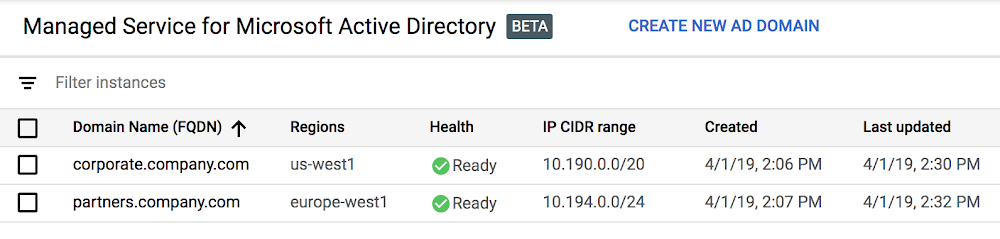
Since launching Google Compute Engine in 2015, we have been focused on building a cloud on which you can run all your applications—including Microsoft applications. Today, we’re excited to announce new features and services to help your Windows workloads take advantage of GCP’s leading infrastructure, data analytics and open-source innovations.These enhancements make it a great time to start moving your enterprise Windows workloads to Google Cloud and take advantage of its leading performance and technological innovation, while preserving investments in software licenses. Our infrastructure becomes your infrastructure, and our innovation becomes your innovation.Bring your own licensesFor your Microsoft workloads, in addition to purchasing on-demand licenses from Google Cloud, you now have the flexibility to bring your existing licenses to GCP. Using sole-tenant nodes you can launch your existing Windows workloads onto physical Compute Engine servers dedicated exclusively to you. With sole tenants, you have visibility into the underlying characteristics of your machine to determine license usage for your reporting and compliance needs.A seamless migrationWe’re also making it easier for you to migrate Microsoft workloads into GCP. Velostrata, our streaming migration tool, will be updated in a couple of weeks to give you the ability to specifically tag Microsoft workloads that require sole tenancy, and to automatically apply existing licenses. This is in addition to all the other Velostrata migration capabilities, such as built-in testing, instance rightsizing recommendations, post-migration rollback when needed, and booting apps in the cloud in as little as a few minutes. Best of all, you can take advantage of Velostrata to migrate your VMs or servers at no cost.Active Directory, made easierBut just because you’ve decided to migrate Microsoft workloads into GCP doesn’t mean you need to do everything all at once. If you use Microsoft Active Directory (AD) to manage users and access to traditional applications, you’ll soon be able to use Managed Service for Microsoft Active Directory (AD), a highly available, hardened Google Cloud service running Microsoft AD, that helps you to manage your cloud-based AD-dependent workloads, automate AD server maintenance and security configuration, and connect your on-premises AD domain to the managed service.Managed Service for Microsoft AD admin experienceSign up to be notified when Managed Service for Microsoft AD becomes available in beta, and learn more about other identity and access management enhancements that we announced this week.Managing Microsoft SQL Server for youWe want to make running Microsoft applications on GCP as easy for you as possible. As such, we’ve expanded Cloud SQL, our fully managed relational database server, to support Microsoft SQL Server. Currently in alpha, you can now choose to run SQL Server yourself on Google Compute Engine, or let us manage it for you on Cloud SQL, where we’ll take care of backups, replication, patches and updates.Your future on Google CloudIT organizations comes in all shapes and sizes, and there’s no end to the variety of the workloads you run. Whatever your environment looks like, we believe that it can benefit from the Google Cloud’s advanced infrastructure and innovation. Click here to learn more about running your Windows workloads on GCP.
Quelle: Google Cloud Platform




