Amazon RDS Performance Insights unterstützt jetzt auch Gegenkennzahlen für Aurora PostgreSQL

Amazon RDS Performance Insights, eine erweiterte Funktion zur Überwachung der Datenbankleistung, unterstützt nun zusätzliche Gegenkennzahlen auf Amazon Aurora mit PostgreSQL-Kompatibilität. Mit Gegenkennzahlen können Sie das Performance Insights Dashboard so anpassen, dass es bis zu 10 zusätzliche Diagramme anzeigt, die eine Auswahl von Dutzenden von Leistungskennzahlen für Betriebssysteme und Datenbanken darstellen. Diese Informationen können mit der Datenbankbelastung korreliert werden, um Performance-Probleme zu identifizieren und zu analysieren.
Quelle: aws.amazon.com
Amazon RDS für PostgreSQL unterstützt die neuen Zwischenversionen 10.6, 9.6.11, 9.5.15 und 9.4.20

Nach der jüngsten Ankündigung von durchgeführten Updates an der PostgreSQL-Datenbank haben wir Amazon RDS for PostgreSQL aktualisiert, um die PostgreSQL-Zwischenversionen 10.6, 9.6.11, 9.5.14 und 9.4.20 zu unterstützen. Dieses Release behebt PostgreSQL-Sicherheitsschwachstellen, die im aktuellen Neben-Release der PostgreSQL-Community enthalten sind, und enthält zusätzliche Bugfixes und Verbesserungen.
Mit diesem Update wird in PostgreSQL 10.6 eine neue Funktion zur eingeschränkten Passwortverwaltung eingeführt. Mit Hilfe eines neuen Parameters und einer speziellen Rolle können Sie die Änderungen des Passworts von Datenbankbenutzern auf die Mitglieder der Rolle beschränken und so eine bessere Kontrolle über die Passwortverwaltung auf der Clientseite ermöglichen (z.B. Ablaufanforderungen, Komplexitätsanforderungen). In PostgreSQL 10.6 und 9.6.11 wurde das logische Dekodierungs-Plugin wal2json aktualisiert. Amazon RDS für PostgreSQL erleichtert die Einrichtung, den Betrieb und die Skalierung von PostgreSQL-Implementierungen in der Cloud. Weitere Informationen zu Upgrades für Ihre Datenbank-Instances finden Sie im Amazon RDS-Benutzerhandbuch. Unter Amazon RDS für PostgreSQL – Preise finden Sie Informationen zu Preisen und zur regionalen Verfügbarkeit.
Quelle: aws.amazon.com

Amazon WorkDocs Tasks hilft bei der Erstellung und Verwaltung von Aktionselementen

Ab heute können Sie mit ‘Tasks‘ Ihre Aktionselemente in Amazon WorkDocs ganz leicht überprüfen. Mit Amazon WorkDocs Tasks können Sie noch ausstehende, zugewiesene oder erledigte Aktionselemente an einem zentralen Ort überprüfen. Neue Aufgaben können Sie manuell erstellen, indem Sie auf den Tab "Aufgaben" in der oberen Navigationsleiste klicken oder, wenn Sie andere Benutzer zur Mitarbeit an Ihrer Datei einladen, auf "Feedback anfordern" klicken. Zu den diesbezüglichen Aufgabenstellungen gehören die Versendung von Inhalten zur Überprüfung, die Anforderung des Zugriffs auf eine Datei, die Übertragung der Inhaberschaft an einer Datei und Handlungsaufforderungen an den Administrator Ihrer Website. Amazon WorkDocs Tasks kann Ihnen und Ihren Teams bei der effizienteren Zusammenarbeit helfen, indem es wichtige Aktionselemente für den Tag hervorhebt.
Um Ihre Aufgaben zu sehen, können Sie in Ihrem Browser auf Amazon WorkDocs zugreifen und in der oberen Navigationsleiste auf "Aufgaben" klicken. Unter dem Tab "Aufgaben" können Sie die Liste "Meine Aufgaben" überprüfen, in der die Ihnen zugeordneten Aktionselemente aufgeführt sind, unter "Gesendete Aufgaben" die von Ihnen an Dritte zugewiesenen Punkte und unter "Archiv" die vollständige Liste der abgeschlossenen Aufgaben.
Amazon WorkDocs Tasks ist ab sofort für alle Kunden von Amazon WorkDocs verfügbar. Für die Aktivierung sind keine Benutzer- oder Administratoraktionen erforderlich. Erfahren Sie mehr über WorkDocs oder melden Sie sich noch heute für eine 30-tägige Testversion an.  
Quelle: aws.amazon.com

Die AWS IAM-Konsole ist jetzt auf Deutsch, Portugiesisch, Spanisch, Italienisch und traditionellem Chinesisch verfügbar

Die AWS Identity and Access Management (IAM)-Konsole unterstützt jetzt fünf neue Sprachen: Deutsch, Portugiesisch, Spanisch, Italienisch und Chinesisch (Traditionell). Kunden, die es vorziehen, die IAM-Konsole in diesen Sprachen zu verwenden, können die Sprache über die Sprachauswahl in der IAM-Konsolenfußzeile auswählen.  
Quelle: aws.amazon.com

Top 5 Blog Post of 2018: Play with Kubernetes

All this week, we have been bringing you the top 5 blog posts of 2018. Now for #3 on top 5 list – our blog post on Play with Kubernetes. Following the success of Play with Docker, earlier this year, we gave you the ability to learn Kubernetes from the convenience of our training site. Continue reading to learn more…
 
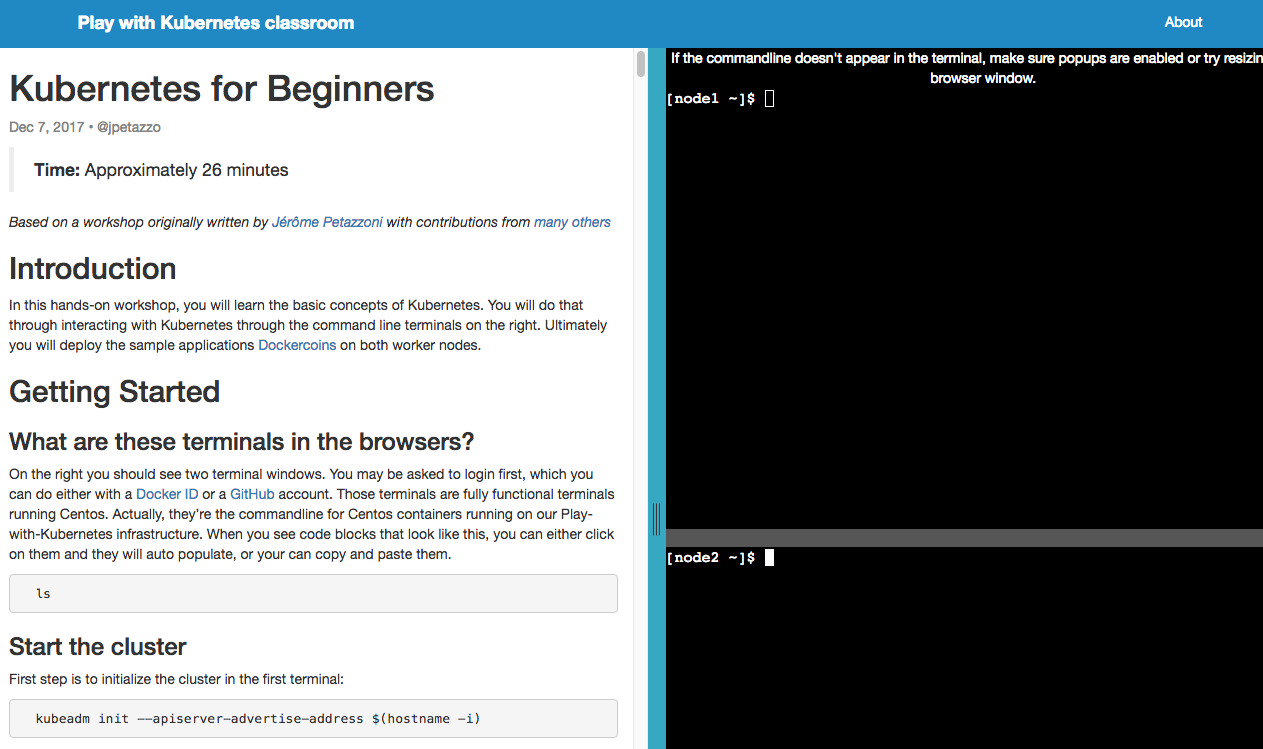
Every month for the last year, thousands of people have used Play with Docker and the accompanying hands-on Play with Docker Classroom training site. These sites allow you to use and learn Docker entirely within your own browser, without installing anything. Last summer, we quietly launched the companion site Play with Kubernetes, to give people a full command line while learning Kubernetes on the command line. And today we’re launching a new Kubernetes training site, the Play with Kubernetes Classroom.
The Play with Kubernetes Classroom is a workshop environment just like the Play with Docker Classroom. We currently have an extensive Kubernetes workshop originally based on Jérôme Petazzoni’s Container Training Kubernetes workshop. But instead of doing it all locally or setting up VMs in the cloud, you can now run through the workshop entirely in the browser.

Like the Play with Docker Classroom, we’ll be curating contributions of additional labs from the community. So give Kubernetes in your browser a try, and then come on over to the Play with Kubernetes repository to share your own tutorials with the community.

Check out the Play with Kubernetes Classroom
Try Kubernetes in Docker Enterprise Edition

Try Kubernetes in the browser with https://training.play-with-kubernetes.comClick To Tweet

The post Top 5 Blog Post of 2018: Play with Kubernetes appeared first on Docker Blog.
Quelle: https://blog.docker.com/feed/

With IBM Cloud, Avetta Global gives organizations the freedom to innovate

Traditional, on-premises infrastructure can hold businesses back. Costly, inflexible and difficult to maintain, on-premises hardware is often a drain on limited internal resources, particularly for smaller organizations.
This is why Avetta Global is on a mission to move its clients’ systems to the IBM Cloud, freeing them from the hassle of having to manage their own infrastructure.
Making IT disappear
Avetta Global has long promoted the value of cloud computing, helping companies such as urban ad provider Alchemy Media make the move to cloud. Like many businesses, Alchemy Media wanted to spend less time managing its IT infrastructure and more time innovating.
Alchemy Media approached us because they wanted our help making their IT systems “invisible.” We get this kind of request all the time. Clients come to us because they don’t want to have to think about infrastructure or networking. They want us to take care of it.
Alchemy struggled with network bandwidth issues, which meant that remote users couldn’t access important line-of-business (LOB) applications hosted at the head office. We stabilized and rationalized the on-premises systems to solve the immediate issue and recommended cloud computing as the best way forward.
A new approach
At the time, Avetta Global was working with a major public cloud provider to host systems for its clients. But when a trusted partner advised looking at IBM Cloud instead, we were blown away.
For us, IBM Cloud was a total no-brainer. A lot of public clouds seem to have thrown together a stack of open source tools, but the IBM Cloud is very well constructed from a network engineer’s perspective and really easy to navigate. We saw right away how simple it would be to extend Alchemy’s infrastructure into the IBM Cloud.
Avetta Global migrated Alchemy’s systems from eight physical servers to five IBM Cloud bare metal servers running VMware vSphere. Avetta used VMware vSphere vMotion to virtualize the existing servers and migrate them to the new virtual network non-disruptively and in a matter of days.
Users were none the wiser. In fact, Alchemy only realized the migration had happened when the old servers were rolled out of the office. We see that as a job well done.
Win-win with IBM Cloud
For Alchemy, the pressure’s off. The company gained a stable, security-rich platform for its LOB applications that delivers the high level of performance needed to support operations. Critically, migrating from on-premises servers to IBM Cloud bare metal servers means that Alchemy no longer needs to worry about infrastructure. Instead, the media agency can focus all its efforts and resources on business innovation.
As the cloud service provider, switching to the IBM Cloud saves us time and effort around day-to-day infrastructure management. The bare metal servers are extremely reliable and very easy to use, which keeps administration to a minimum. Hosting client systems on the IBM Cloud means that there’s not actually that much for us to do. Once we’ve architected something that fits the client’s requirements, the cloud infrastructure is fairly low maintenance.
Alchemy is reporting better performance, better availability and lower IT costs. They’re very impressed with their IBM Cloud service; and, if our clients are happy, we’re happy.
Since selecting IBM as our preferred cloud provider, Avetta Global has been officially recognized as an IBM Cloud Star Partner. This means that our company has the skills, expertise and resources required to meet the IBM strategy for success.
Having the IBM seal of approval gives both our existing and prospective clients a huge confidence boost in our services. We’re already looking forward to what our partnership with IBM brings in the years to come.
Read more about how Avetta Global helped Alchemy Media transform its IT in the case study.
The post With IBM Cloud, Avetta Global gives organizations the freedom to innovate appeared first on Cloud computing news.
Quelle: Thoughts on Cloud






