#Azure #SQLDW, the cost benefits of an on-demand data warehousing

Prices illustrated below are based on East US 2 as December 18th, 2017. For price changes updates, visit Azure Analysis Services, SQL Database, and SQL Data Warehouse pricing pages.

Azure SQL Data Warehouse is Microsoft’s SQL analytics platform, the backbone of your Enterprise Data Warehouse. The service is designed to allow customers to elastically and independently scale, compute and store. It acts as a hub to your data marts and cubes for an optimized and tailored performance of your EDW. Azure SQL DW offers guaranteed 99.9 percent high availability, PB scale, compliance, advanced security, and tight integration to upstream and downstream services so you can build a data warehouse that fits your needs. Azure SQL DW is the only data warehouse service enabling enterprises to gain insights from data everywhere with a global availability in more than 30 regions.

This is the last blog post in our series detailing the benefits of Hub and Spoke data warehouse architecture on Azure. On-premises, a Hub and Spoke architecture was hard and expensive to maintain. In the cloud, the cost of such architecture can be much lower as you can dynamically adjust compute capacity to what you need, when you need it. Azure is the only platform that enables you to create a high performing data warehouse that is cost optimized for your needs. You will see in this blog post how you can save up to 50 percent on cost by leveraging a Hub and Spoke design while increasing the overall performance and time to insights of your analytics solutions.

With the Microsoft Azure data platform you can build the data warehouse solution you want with workload isolation, advanced security and virtually unlimited concurrency. All of this can be done at an incredibly low cost if you leverage Azure Functions to build on-demand data warehousing. Imagine a company who wants to create a central data repository from a variety of source systems and push the combined data to multiple customers (e.g. ISV), suppliers (e.g. retail) or business units/departments. In this case study, this customer expects a strong activity for its Data Warehouse from 8 AM to 8PM during workdays. The performance ratio between high and low activity times is around 5x. They expect its curated data lake, SQL Data warehouse to be 10 TB large after compression and have peak time needs at 1,500 DWUs. For dash boarding and reports the solution will use Analysis Services, caching around 1 percent of the data. Thanks to SQL DB elastic Pools or Azure Analysis Services, the company can add concurrency, advanced security and workload isolation between their end users. SQL DB Elastic Pool offers a wide range of performance and cost with the cost per database starting at $0.60 with the Basic Tier.

The figure below illustrates the various benefits from moving to a Hub and Spoke Model. Microsoft Azure is the only platform offering the ability to build the data warehouse that fits your unique data warehousing needs.

Figure 1 – Benefits from a Hub and Spoke Architecture

In step one, this is the traditional data warehouse and is the starting point of building your Data Warehouse. Every data warehouse will have inherent limits that will be encountered with more and more people connecting to the service. In this example, with no auto-scale and a rigid level of provisioning you could spend $15k/month.

In step two, we introduce Azure Functions to use the full elasticity of SQL DW. In that simple example, we leverage the time trigger function and ask SQL DW to be at 1,500 DWUs at peak time (workdays 8AM-8PM) and 300 the rest of the time. This is a simple example, but you can go deeper on performance levels, add auto-scaling and auto-pausing/resuming to make your data warehouse auto-scale. In this example the cost goes down to $8k/month.

Step three is a great example on the breadth of customization you can make around SQL DW using SQL DB or Azure Analysis Services. No other data warehouse enables such a high level of customization because you cannot expand them. With that model, there is virtually no limit in concurrency and performance of your data warehouse. Here are a few examples of what you can do:

For high performance, interactive dash boarding and reports with pre-aggregate queries, Azure Analysis Services will be the right choice.
Do you want to provide a predictable performance to a large department at a fast speed? SQL DB Premium Single Database will be the right choice.
If you are an ISV, do you have a large number of customers that you need to accommodate at a free subscription level?  A Basic SQL DB Elastic Pool can accommodate a cost per database for less than $1/month.

Deploy in a SQL Data Warehouse Hub Spoke Template with SQL Databases.

In the example below, the cost of the data warehouse varies from $10k/month to $15.5k/month depending on what tier and service you pick. Remember that by offloading the performance from SQL DW to data marts or caching layers, you can dramatically reduce your DWU provisioning (while increasing concurrency). Also remember that you can leverage Azure Functions to start automating the level of performance you need at a specific point in time. Learn more about using Azure Functions to automate SQL DW Compute Levels.

In step four, you can further optimize the performance of your data marts by connecting them to Azure Analysis Services for caching. In this example, the cost is between $16k and $21.5k/month with the opportunity to be even lower if you offload the performance needs on your data marts.

Figure 2 – Summary of the benefits to build a Hub and Spoke Data Warehouse

In summary, we moved from a static and monolithic data warehouse costing $28k per month to an elastic Hub & Spoke data warehouse optimized for performance and accessed by thousands of users with a potential cost saving of 50 percent. We can guarantee you that each of the services will continue further integrating with each other to provide the best data warehouse experience.

If you need our help for a POC, contact us directly by submitting a SQL Data Warehouse Information Request. Stay up-to-date on the latest Azure SQL DW news and features by following us on Twitter @AzureSQLDW. Next week, we will feature the deeper integration between Azure Analysis Services and SQL DW.
Quelle: Azure

Twitter Keeps Allowing Hackers To Run Malicious Ads That Offer To Verify People On Twitter

Loic Venance / AFP / Getty Images

Twitter continues to approve malicious ads that, in at least one case, masqueraded as an offer from Twitter itself to help users get their accounts verified.

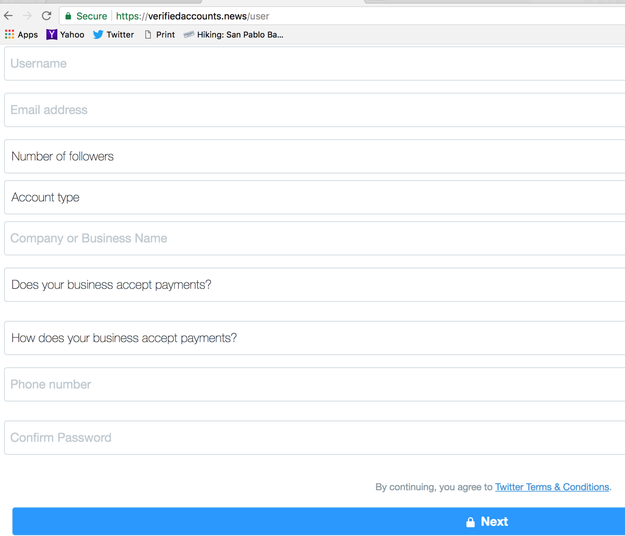
The ads led users to a website that asked for account information such as their email address and Twitter password, in addition to requesting details about the user's online payment accounts.

“These are nothing less than phishing attempts designed to steal users’ credentials as well as their financial information,” Jérôme Segura, the lead malware intelligence analyst for Malwarebytes, told BuzzFeed News. “The harvested data is typically resold in bulk on various darkweb marketplaces.”

When combined with the email address and other information collected in the form, the payment details could be used to break into a user's online payment accounts.

Segura said this type of phishing attack has been running on Twitter “for years,” and frequently exploits the platform's Promoted Tweets advertising product. A similar scheme was identified early last year. Twitter's Promoted Tweets product enables a user to take a tweet from their account and turn it into an ad that can appear in other people's timelines.

This attack could be also used to target specific users in order to gain access to their Twitter account, as well as related online accounts, according to Segura.

“Because promoted tweets can be configured to be displayed for a particular audience, they could in theory be used for more targeted phishing campaigns as well,” Segura said.

The form used to steal user information.

Nancy Levine

Twitter's advertising policies are already under scrutiny after it acknowledged late last year that Russian government broadcaster RT spent $1.9 million on the platform since 2011. Twitter announced in October that it would no longer accept advertising from RT or Sputnik.

Twitter did not respond to a request for comment from BuzzFeed News. Its online FAQ about the ad approval process says that ads “are submitted for approval on an automatic basis, based on an account’s advertising status, its historical use of Twitter, and other evolving factors.”

At least two different Twitter accounts were able to buy promoted tweets that told users they could get their accounts verified by visiting Verifiedreview.today. That site displayed a form made to look like it was hosted on the official Twitter website. Users were asked for their name, email address, Twitter username, password, and company names, as well as to indicate whether they use any online payment services. Once submitted, the hackers on the other end would be able to login to the person's Twitter account and take it over, or to sell the information.

Verifiedreview.today is no longer online, and the two accounts that shared the link in promoted Tweets have been removed from Twitter. One of them was designed to look like an account run by Twitter itself:

Nancy Levine

Another account that spread the link via a different ad looked more like a regular user:

@ajchavar / Twitter / Via Twitter: @ajchavar

The first ad ran on Jan. 5, and the second appeared two days later, showing that the attack was executed over multiple days using at least two different accounts. In both cases Twitter did not block the ads.

Some said the ability of hackers to run these ads reveals flaws in Twitter's ad approval system.

Nancy Levine, an author based in California, told BuzzFeed News she saw one of the malicious ads in her timeline and clicked through because she thought it came from Twitter.

“I filled out their form, and started typing my password when I became suspicious,' she said in an email. “Looked more closely, then reported it to Twitter as 'spam' — [the] closest available complaint among their menu choices.”

Levine said Twitter's opaque rules for verifying user accounts create an opportunity for these scammers.

“As for Twitter verification, I've had four books published by Penguin Books, bylines include Sports Illustrated, AlterNet, and others, but Twitter has declined my application for verification twice,” she said. “The scammers played on Twitter users' frustration around verification IMHO.”

Quelle: <a href="Twitter Keeps Allowing Hackers To Run Malicious Ads That Offer To Verify People On Twitter“>BuzzFeed

PaddlePaddle Fluid: Elastic Deep Learning on Kubernetes

Editor’s note: Today’s post is a joint post from the deep learning team at Baidu and the etcd team at CoreOS.PaddlePaddle Fluid: Elastic Deep Learning on KubernetesTwo open source communities—PaddlePaddle, the deep learning framework originated in Baidu, and Kubernetes®, the most famous containerized application scheduler—are announcing the Elastic Deep Learning (EDL) feature in PaddlePaddle’s new release codenamed Fluid.Fluid EDL includes a Kubernetes controller, PaddlePaddle auto-scaler, which changes the number of processes of distributed jobs according to the idle hardware resource in the cluster, and a new fault-tolerable architecture as described in the PaddlePaddle design doc.Industrial deep learning requires significant computation power. Research labs and companies often build GPU clusters managed by SLURM, MPI, or SGE. These clusters either run a submitted job if it requires less than the idle resource, or pend the job for an unpredictably long time. This approach has its drawbacks: in an example with 99 available nodes and a submitted job that requires 100, the job has to wait without using any of the available nodes. Fluid works with Kubernetes to power elastic deep learning jobs, which often lack optimal resources, by helping to expose potential algorithmic problems as early as possible.Another challenge is that industrial users tend to run deep learning jobs as a subset stage of the complete data pipeline, including the web server and log collector. Such general-purpose clusters require priority-based elastic scheduling. This makes it possible to run more processes in the web server job and less in deep learning during periods of high web traffic, then prioritize deep learning when web traffic is low. Fluid talks to Kubernetes’ API server to understand the global picture and orchestrate the number of processes affiliated with various jobs.In both scenarios, PaddlePaddle jobs are tolerant to a process spikes and decreases. We achieved this by implementing the new design, which introduces a master process in addition to the old PaddlePaddle architecture as described in a previous blog post. In the new design, as long as there are three processes left in a job, it continues. In extreme cases where all processes are killed, the job can be restored and resume.We tested Fluid EDL for two use cases: 1) the Kubernetes cluster runs only PaddlePaddle jobs; and 2) the cluster runs PaddlePaddle and Nginx jobs.In the first test, we started up to 20 PaddlePaddle jobs one by one with a 10-second interval. Each job has 60 trainers and 10 parameter server processes, and will last for hours. We repeated the experiment 20 times: 10 with FluidEDL turned off and 10 with FluidEDL turned on. In Figure one, solid lines correspond to the first 10 experiments and dotted lines the rest. In the upper part of the figure, we see that the number of pending jobs increments monotonically without EDL. However, when EDL is turned on, resources are evenly distributed to all jobs. Fluid EDL kills some existing processes to make room for new jobs and jobs coming in at a later point in time. In both cases, the cluster is equally utilized (see lower part of figure).Figure 1. Fluid EDL evenly distributes resource among jobs.In the second test, each experiment ran 400 Nginx pods, which has higher priority than the six PaddlePaddle jobs. Initially, each PaddlePaddle job had 15 trainers and 10 parameter servers. We killed 100 Nginx pods every 90 seconds until 100 left, and then we started to increase the number of Nginx jobs by 100 every 90 seconds. The upper part of Figure 2 shows this process. The middle of the diagram shows that Fluid EDL automatically started some PaddlePaddle processes by decreasing Nginx pods, and killed PaddlePaddle processes by increasing Nginx pods later on. As a result, the cluster maintains around 90% utilization as shown in the bottom of the figure. When Fluid EDL was turned off, there were no PaddlePaddle processes autoincrement, and the utilization fluctuated with the varying number of Nginx pods.Figure 2. Fluid changes PaddlePaddle processes with the change of Nginx processes.We continue to work on FluidEDL and welcome comments and contributions. Visit the PaddlePaddle repo, where you can find the design doc, a simple tutorial, and experiment details.Xu Yan (Baidu Research)Helin Wang (Baidu Research)Yi Wu (Baidu Research)Xi Chen (Baidu Research)Weibao Gong (Baidu Research)Xiang Li (CoreOS)- Yi Wang (Baidu Research)
Quelle: kubernetes

ThinQ: LG fährt voll auf künstliche Intelligenz ab

Mit ThinQ setzt LG alles auf die KI-Karte: Die selbst entwickelte Plattform soll dank neuem Alpha-9-Prozessor in alle OLED-TVs des Jahres 2018 kommen, sämtliche Haushaltsgeräte des letzten Jahres sollen ebenfalls die KI nachgeliefert bekommen. Das Thema Fernseher hat der Hersteller nur angeschnitten. (CES 2018, OLED)
Quelle: Golem

Facebook Scraps Plans For AI Concierge In Messenger

Facebook Scraps Plans For AI Concierge In Messenger

Facebook's standalone, concierge bot M will soon be no more.

On January 19, Facebook is sunsetting the initial version of M, which has been available in closed beta since fall 2015. M's context-based suggestions will live on inside Messenger conversations, but the original concept for a personal, AI-powered assistant that can perform actions on your behalf appears finished.

The company says M — which was able to make restaurant reservations, book plane tickets and, for a short time, draw pictures — has largely served its purpose.

“We launched this project to learn what people needed and expected of an assistant, and we learned a lot,” Facebook said in a statement to BuzzFeed News. “We're taking these useful insights to power other AI projects at Facebook. We continue to be very pleased with the performance of M suggestions in Messenger, powered by our learnings from this experiment.”

This is something of a change in course as Facebook clearly hoped to roll M out broadly when the feature first went into beta. “I think we have a good chance [at scaling], otherwise we wouldn’t be doing it,” Facebook Messenger head David Marcus told BuzzFeed News in November 2015.

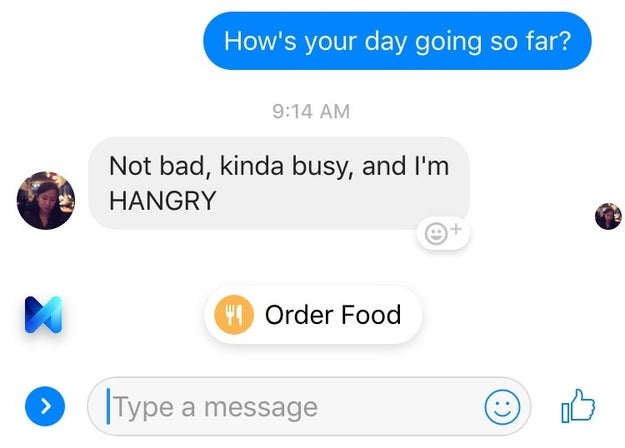
Now, a few years later, the company seems content with a more dialed-back approach: “M suggestions,” an M-trained feature that hops into Messenger conversations and suggests certain actions based on context. It prods you to share your location when someone asks “Where are you?” or offers simple pre-written replies within conversations, and more. But while M could perform tasks (like arguing with your cable company) M suggestions is simply a contextual recommendation feature.

M suggestions in action

M's AI system was supposed to learn from interactions with humans. When people interacted with the bot, the system would provide a response which was then reviewed by a contractor. If the AI-generated message made sense, the contractor would pass it along to the person conversing with M, indicating to the AI it was a good response. When the message didn't make sense, the contractor would write a new message and send that one, indicating to the AI that there was a better way to answer the query.

Facebook believed that with enough experience and tweaking, it might be possible to someday roll M out to its broader user base. But ultimately, whatever happened on the backend gave Facebook reason to reconsider. The company invested serious resources in the project — M and the contractors behind it spent more than two years responding to queries 24/7. Facebook says it will offer new roles to those contractors now that the project is winding down and it has plenty of openings; it's in the process of adding 4,000 content moderators to its current staff of 3,500.

So M, the concierge, is dead. But for a moment, it was a delightful, occasionally eerie peek into a future that's perhaps a bit further away than its creators hoped.

When M debuted, it was mind blowing:

It drew some incredible pictures (or, more accurately, the humans behind it drew them):

M

It sent parrots to a rival news organization:

Cara Rose DeFabio

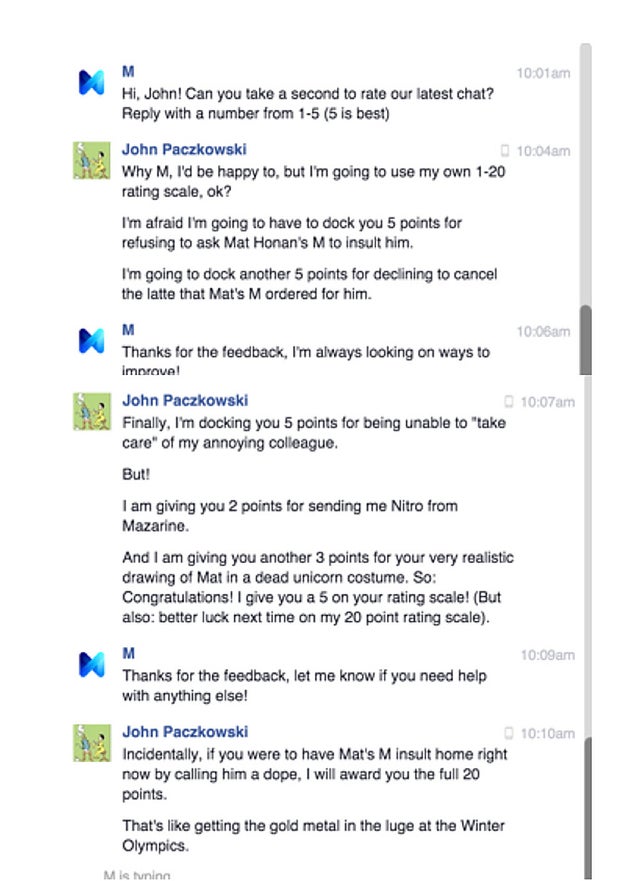
And it deftly parried human attempts to break its will:

In April 2016, when Facebook began talking about opening M's technology to developers, rather than continuing it as an internal project, the writing was on the wall: M was on the way out. It lasted just another year and a half.

Looking back, perhaps M was a relic of a more optimistic technological moment. Back in 2015, Facebook could pour resources into artificial intelligence moonshots without a second thought. Indeed, in 2016 Facebook CEO Mark Zuckerberg even made his annual challenge entirely about building his own, personal AI (he succeeded).

But now that Facebook's platform has been undermined by fake news, graphic violent content, and a Kremlin-linked campaign to sow chaos ahead of the US presidential election, there are more pressing issues. In 2018, Zuckerberg's challenge is working to fix its most serious problems such as abuse, hate, and foreign interference.

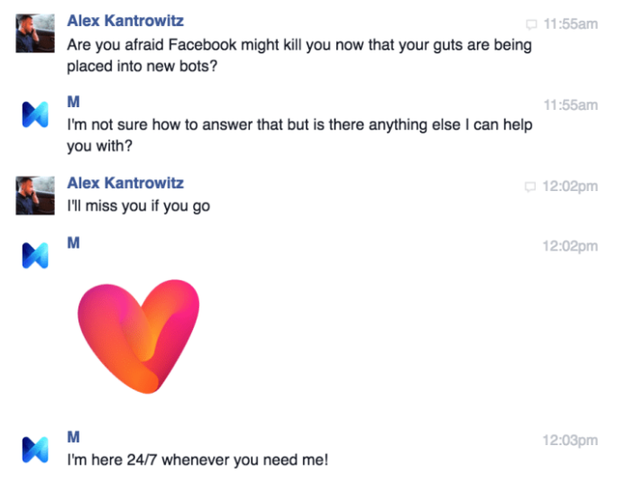
A conversation with M from April 2016

Quelle: <a href="Facebook Scraps Plans For AI Concierge In Messenger“>BuzzFeed