Containers will Drive Massive Shift in How Companies do Business
Quelle: Mirantis
Quelle: Mirantis

Mit seinen neuen Low-Profile-Switches will Cherry flachere Tastaturen bei gleichbleibendem Keyfeel ermöglichen. Mit einer um 35 Prozent geringeren Höhe ist der neue Switch erstaunlich kompakt und bietet dabei sogar noch die Möglichkeit einer LED-Beleuchtung. Ein Hands on von Tobias Költzsch (CES 2018, Eingabegerät)
Quelle: Golem

Today we are excited to announce the expansion of our partnership with the availability of Docker Enterprise Edition (EE), our container management platform on the Cisco Global Price List (GPL) and the release of the latest Cisco Validated Design (CVD):
Cisco UCS Infrastructure with Contiv and Docker Enterprise Edition for Container Management.
Now customers can purchase Docker EE directly from Cisco and their joint resellers to jumpstart their new year’s resolution for a more modern application architecture, reduce IT costs and redirect saving to innovation projects. And with our latest CVD for Cisco UCS compute infrastructure with secure container networking fabric, Contiv, we’ve provided a roadmap on how to get started so customers and partners can gain a faster, more reliable and predictable implementation of Docker EE.
For enterprises looking to use Docker’s container management platform but not sure where to start, we can help you take the first step. The Migrating Traditional Applications (MTA) Program, designed for IT operations teams, helps enterprises modernize existing legacy .NET Windows or Java Linux applications without modifying source code or re-architecting the application in just five days with Docker and Cisco Advanced Services. The results have been incredible, with customers saving over 50% on infrastructure costs and using those saving to unlock innovative IT projects. What are you waiting for? Let us help you get started with Docker EE today.
For Cisco resellers looking to deliver Docker EE to your customers, we can help you get started and get trained, go to Cisco Sales Central.
For more information on Docker EE and Cisco Solutions:
Watch the webinar: Docker and Cisco – Integrated Container Solutions for the Enterprise
Contact sales to learn more about getting started with your MTA pilot
Cisco now reselling Docker Enterprise Edition #DockerEE #dockerClick To Tweet
The post Cisco Now Reselling Docker Enterprise Edition appeared first on Docker Blog.
Quelle: https://blog.docker.com/feed/

Your business and your data are unique. For that reason, your enterprise architecture must also be tailored to fit the exact needs of your business. When data is involved, you want choices, not tradeoffs. More importantly, you want your solutions to build upon and complement one another.
For most companies, the variety of data sources and where that data should be stored are top priorities. You can’t afford to keep the data in silos or leave certain data untouched just because of its type or where it happens to sit. You need the flexibility to access all your data and place it in the optimal location.
Typically, the solution to this problem has been the public cloud. But what if you also have sensitive data that, due to company mandates or external regulations, needs significant levels of protection? You don’t want to trust the safety of that data to anyone else, preferring instead to take control and choose the level of security for yourself. This is where on-premises solutions have often come into play.
Ultimately, you want choice in flexibility and security without making sacrifices. You want to benefit from the best of both options as well as exceptional performance. At the intersection of these needs is the private cloud. Private clouds offer flexibility, just like public clouds, but they sit behind your firewall, giving you more control. Instead of making a tradeoff, flexibility and security are provided in unison, giving you more choice when it comes to your data.
IBM has embraced the concept of private clouds because we recognize the uniqueness of each data-related business opportunity. IBM Cloud Private delivers the features that many have come to expect in public cloud architectures with shared-resource efficiencies, utility computing and flexible scalability that delivers better total cost of ownership (TCO) and simplicity of deployment. Private cloud also gives companies more options in security, compliance and infrastructure customization. In other words, IBM Cloud Private helps provide the flexibility and security you desire in concert with our other data-focused solutions.
For example, running IBM Db2 on IBM Cloud Private offers choice in terms of deployment flexibility and security without sacrifices. At its core, Db2 still maintains the performance that enterprise users have come to expect: it’s fast, always available, secure, and flexible. The built-in IBM BLU Acceleration MPP architecture supports in-memory speed to get insights to those that need it faster. Its compression technology increases performance while simultaneously reducing storage requirements and giving you the opportunity to reduce storage costs. None of those key features go away when Db2 is running on IBM Cloud Private, but enhancements are made in two areas.
Data management flexibility complemented by container technology
Db2 is extremely flexible on its own. Thanks to the common SQL engine it shares with the entire IBM family of hybrid data management offerings, you can use data of various types sitting in a multitude of on-premises and on-cloud locations. The Db2 deployment is also flexible thanks to its ability to be deployed within a container. This is where IBM Cloud Private’s additive effect comes into play. IBM Cloud Private is built with two of the most popular container technologies at its base: Kubernetes and Cloud Foundry. Deploying Db2 using these technologies opens up the ability to maximize performance and efficiency by more closely aligning usage with company needs.
IBM Cloud Private also opens up the possibility of optimizing your infrastructure costs by offering the right mix of transactional (IBM Db2) and data warehousing solutions (IBM Db2 Warehouse) that adhere to the software-defined architecture. This provides the flexibility of managing your infrastructure needs via simplified deployment and efficient management of the same.
Built-in security bolstered by your own firewall
The built-in security features of Db2 help you deliver the protection that your customers, industry regulations, and other stakeholders demand. It begins with strong encryption capabilities included, so you can address compliance concerns. Then it goes further to provide centralized key management to heighten security and ease of use. IBM Cloud Private enhances this level of security by providing more control. Since IBM Cloud Private sits behind your firewall, it is protected by the security features you have built and integrated over the life of your company. Perhaps most importantly, you get to decide what level of security you need and adjust as necessary. The choice is in your hands.
IBM Db2 running on IBM Cloud Private delivers on the idea of choice without tradeoffs, cloud flexibility with on-premises security. Using IBM Cloud Private takes the extraordinary performance, flexibility, and security customers are accustomed to with Db2 and improves them.
To learn more about IBM Cloud Private and all the ways in which Db2 can benefit from running on that platform, read our solution brief. You can also register to attend our webinar and hear from the experts.
The post Does your data deserve a private cloud? appeared first on Cloud computing news.
Quelle: Thoughts on Cloud
Success Bot Says
e0ne on #openstack-horizon [0]: amotoki runs horizon with django 2.0
tristianC on #rdo [1]: review.rdoproject.org is now running sf-2.7
mriedem on #openstack-nova [2]: nova merged alternate hosts support for server build
mriedem on #openstack-nova [3]: After a week of problems, finally got a volume multiattach test run to actually attach a volume to two instances without melting the world. o/
zaneb [4]: 14% reduction in Heat memory use in the TripleO gate from fixing https://bugs.launchpad.net/heat/+bug/1731349
Tell us yours in OpenStack IRC channels using the command “#success <comment>”
More: https://wiki.openstack.org/wiki/Successes
[0] – http://eavesdrop.openstack.org/irclogs/%23openstack-horizon/%23openstack-horizon.2017-12-18.log.html
[1] – http://eavesdrop.openstack.org/irclogs/%23rdo/%23rdo.2017-12-21.log.html
[2] – http://eavesdrop.openstack.org/irclogs/%23openstack-nova/%23openstack-nova.2017-12-22.log.html
[3] – http://eavesdrop.openstack.org/irclogs/%23openstack-nova/%23openstack-nova.2018-01-05.log.html
[4] – http://eavesdrop.openstack.org/irclogs/%23tripleo/%23tripleo.2018-01-09.log.html
Community Summaries
Technical Committee Status update [0]
POST /api-sig/news [1]
Release countdown [2]
Nova placement resource provider update [3]
Keystone team update [4]
Nova Notification Update [5]
TC report [6]
[0] – http://lists.openstack.org/pipermail/openstack-dev/2018-January/126178.html
[1] – http://lists.openstack.org/pipermail/openstack-dev/2018-January/126147.html
[2] – http://lists.openstack.org/pipermail/openstack-dev/2018-January/125996.html
[3] – http://lists.openstack.org/pipermail/openstack-dev/2018-January/126179.html
[4] – http://lists.openstack.org/pipermail/openstack-dev/2018-January/126188.html
[5] – http://lists.openstack.org/pipermail/openstack-dev/2018-January/126025.html
[6] – http://lists.openstack.org/pipermail/openstack-dev/2018-January/126082.html
Community Goals for Rocky
So far one goal has been proposed by Kendall Nelson for migrating to Storyboard. It was agreed to postpone the goal until the S cycle, as it could take longer than six months to achieve. There is a good backlog of goals [0], just no champions. It’ll be bad for momentum if we have a cycle with no community wide goal.
[0] – https://etherpad.openstack.org/p/community-goals
Full thread: http://lists.openstack.org/pipermail/openstack-dev/2018-January/126090.html
PTG Post-lunch Presentations
Feedback received from past PTG session(s) was the lack of situational awareness and missed opportunity for “global” communication at the event. In Dublin we’d used the end of the lunch break to for communications that could be interesting to OpenStack upstream developers and project team members. The idea is not to find a presentation for everyday, but if we find content that is generally useful. Interesting topics include general guidance to make the most of the PTG weeks (good Monday content), development tricks, code review etiquette, new library features you should adopt, lightning talks (good Friday content). We’d like to keep the slot under 20 minutes. If you have ideas please fill out this etherpad [0] in a few weeks.
[0] – https://etherpad.openstack.org/p/dublin-PTG-postlunch
Full thread: http://lists.openstack.org/pipermail/openstack-dev/2018-January/126102.html
Quelle: openstack.org

Die letzten 30 Jahre baute Cherry nahezu unveränderte Tastaturbausteine. Nun hat der Hersteller das "Cherry-Feeling" auf deutlich flachere Bauteile übertragen.
Quelle: Heise Tech News

In this blog post, I am going to share my experience on how I made my first contribution to ManageIQ, the upstream open source project for Red Hat CloudForms. The post explains how I encountered and investigated an issue, and finally fixed it thereby sending my first “Pull Request” to ManageIQ repository.
Issue
When an infrastructure provider like VMware is added to CloudForms/ManageIQ, a user/admin have an option to put host(s) into maintenance mode. The “Enter Maintenance mode” option is available in a dropdown list when “Power” button is clicked on the host summary page, as shown in below image,
The following image shows a host in maintenance mode from Red Hat CloudForms. The host goes into maintenance mode but never “exits” the mode when selecting “Exit Maintenance Mode”.
As see below, the request to exit maintenance mode was successfully initiated from CloudForms user-interface.
However, the host still remains into maintenance mode, and we can validate this state from the VMware vSphere client.
Now that we have identified the issue, we can look at its possible cause(s) by troubleshooting Red Hat CloudForms.
Debugging an issue
A good place to troubleshoot is to look into standard log files under /var/www/miq/vmdb/ on the CloudForms appliance. Below is short description of few important log files:
production.log: All user Interface activities from Operations as well as Service UI are logged here.
automation.log: As the name suggest, all automation logs are collected in this file.
policy.log: This is a good place to look for logs related to events and policies.
evm.log: This file also covers automation logs as well as everything else. This file can be large in size and probably the first log file to look for errors & warning messages.
As you can see below, the evm.log file contained warning messages every time “Exit Maintenance Mode” request is initiated,
[—-] W, [2017-12-20T16:32:02.557678 #2197:1090af0] WARN — : MIQ(ManageIQ::Providers::Vmware::InfraManager::HostEsx#exit_maint_mode) Cannot exit maintenance mode because <The Host is not powered ‘on’>
The log message clearly shows that the host attempts to exit maintenance mode but fails as it is not powered on. At this point, we can ask ourselves why is the task failing with this warning? Isn’t the host supposed to be in maintenance mode? We suspect something is not right with the logic behind this action. To dig deeper we can look into the host.rb file available at ManageIQ GitHub repository.
Looking at the logic in host.rb file, the method enter_maint_mode() is triggered when “Enter Maintenance Mode” request is made. This in-turns validates the maintenance mode using method validate_enter_maint_mode() which basically checks the power state of host using method validate_esx_host_connected_to_vc_with_power_state(). The arguments passed to this method are ‘on’ or ‘maintenance’.
A similar logic should be applied to the exit_maint_mode() method. However, the method calls validate_enter_maint_mode() instead of calling validate_exit_maint_mode(), which causes the issue. The validation fails as the host is in ‘maintenance’ mode and not in ‘on’ mode as we can see below,
A simple fix is to call validate_exit_maint_mode() instead of validate_enter_maint_mode() each time “Exit Maintenance Mode ” request is made. This fix should validate the host to exit maintenance mode successfully.
Test
To verify our analysis, We can replaced the validation method call from validate_enter_maint_mode() to validate_exit_maint_mode() and restart evmserverd on the appliance using,
systemctl restart evmserverd
This time the host successfully exits maintenance mode
CloudForms User Interface:
VMware User Interface:
Creating a Pull Request
A “Pull Request” is a way to propose a change in code on GitHub. For those who don’t have an GitHub account, you can create one by following https://github.com/join. Once the account is created we have to fork the repository by clicking “Fork” button as shown below,
Next step is to clone the repository to our local machine so that changes can be made. Click on “Clone or download” button to copy the https URL link.
We can clone the repository by using the command
git clone https://github.com/imaanpreet/manageiq.git
Once our clone is completed, we can create a new branch using,
git checkout -b validate_exit_maint_mode
Make required changes and commit the changes using,
git add app/models/host.rb
git commit
Once changes are committed, it is time to send back changes as “Pull Request”, this can be done by pushing changes to the newly created branch,
git push origin validate_exit_maint_mode
The process to create a pull request is documented here.
Conclusion
The Pull Request is merged in the manageiq repository and the bug is currently being worked on. This was a great experience and I enjoyed the process of debugging, investigating, and fixing a bug in ManageIQ. I hope sharing this experience in this article will be useful for other readers, and will encourage them to submit more Pull Requests.
Quelle: CloudForms

Rollende Kofferlautsprecher, aufgerollte Displays, unantastbare Terminals: Das c't- Redaktionsteam hat auf der CES viele Gadgets und neue Entwicklungen gesehen – was top war in Las Vegas und was nicht steht in unseren Tops & Flops.
Quelle: Heise Tech News

It’s called “tweetdecking.”
BuzzFeed News
Teens and twentysomethings with large Twitter followings are making thousands each month by selling retweets, multiple users who engage in the practice told BuzzFeed News.
The practice is known as “tweetdecking,” so named because those involved form secret Tweetdeck groups, which they call “decks.” Scoring an invite to join a deck usually requires a follower count in the tens of thousands.
Within these decks, a highly organized system of mass-retweeting exists in order to launch deck members' tweets — and paying customers' tweets — into meticulously manufactured virality.
Customers, which can include both individuals and brands, pay deck owners to retweet one or more of their tweets a specified number of times across deck member accounts. Some decks even allow customers temporary access to the deck, almost like a short-term subscription to unlimited deck retweets. Single retweets tend to cost around $5 or $10. Week- or monthlong subscriptions can cost several hundreds of dollars, depending on the deck's popularity.
People who run their own decks frequently make several thousands of dollars each month, multiple deck owners said.
“It’s the simplest thing ever, all you do is have your friends join and you have fun and tweet and make money,” Kendrik, aka @Simpnmild, an 18-year-old from Chicago who runs two of his own decks, said. “It’s the easiest thing ever. No hard work at all.”
As the owner of two decks with about 15 people in each, Kendrik works with all sorts of people and brands who want their tweets seen by the deck’s massive collection of followers. These customers pay a few hundred dollars to gain temporary access to the Tweetdeck so they can retweet themselves across several of the powerful deck accounts, pretty much ensuring it goes viral.
Kendrik said he makes between $3,000 and $5,000 a month doing this, and he pays members of his deck “based on who has the most page activity for the month” via PayPal.
And a 19-year-old named Lewie, aka @lxwie, who said he both runs a deck and is a member of another deck, said he makes between $2,000 and $3,000 each month.
“And here we are going viral daily,” said Lewie.
Deck members make less — but not insignificant — amounts of money. Several members of decks said they earn hundreds of dollars each month just for retweeting tweets onto their account.
Tweetdecking violates Twitter's spam policy, which does not allow users to “sell, purchase, or attempt to artificially inflate account interactions,” and many deckers get suspended as a result. Still, they often return with new accounts and get right back in the game.
So, who are these people forking over all this cash for a couple thousand retweets? They range from “small apps, a lot of grown people who want to make a presence on social media, and some teens who just want to go viral,” said Kendrik.
And go viral they do. If you've spent some much time on Twitter in the past year, you've probably seen a number of tweets that bizarrely have retweets into the tens or even hundreds of thousands. Many of these massively viral tweets come from decks — and most are plagiarized.

A tweet first posted in August 2017 that was “decked” by Kendrik the following December
Twitter: @NicholasPeters_ / Twitter: @SimpnMild
Plagiarized tweets have been a part of Twitter pretty much since people started making jokes on the site, particularly through popular “parody accounts” like @Dory and @GirlPosts, many of which are now run as full-fledged ad sales businesses.
But the rise of decks has changed the game, allowing pretty much anyone to break into the biz of stealing tweets for cash. Deck owners, members, and customers are all getting into it in order to increase their own following, and in turn, strengthen the deck's success and profitability.
Naturally, not everyone's so happy to see tweets getting stolen. Members of the self-proclaimed group “Trash Twitter,” a small collective of late-teens and early-twenties guys with popular accounts, have had their joke tweets stolen several times. Unlike the tweetdeckers, they haven't seen a dime from it, they said.
“Honestly, it sucks how they can just take full credit for our tweets, and get paid,” said Danyal, aka @TrashQuavo, an 18-year-old from the UK in the group. “Sometimes we would plan a tweet for days just for it to get stolen.”
“I tweet to have fun and give people a laugh,” one of the members, who goes by @TrashYeWest, said. “They just care about followers.”
@hotlinekream / Via Twitter: @hotlinekream
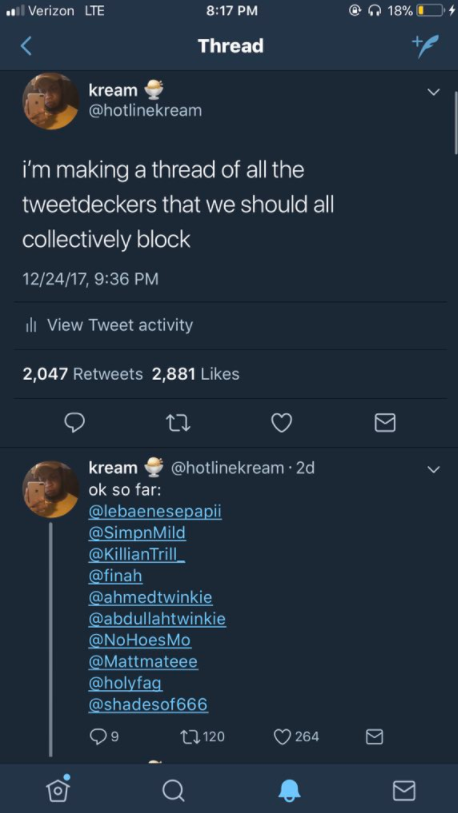
In December, 22-year-old Kareem Rose from Virginia, aka @hotlinekream, went viral when he tweeted a thread in which he called out dozens of deck accounts and urged people to block them.
“I was basically tired of seeing the same tweet go viral once a week by a different account,” Rose told BuzzFeed News. “Our timelines were basically getting overflowed with tweets we’ve seen before and it honestly made Twitter less enjoyable. Not only that, but we were tired of having our tweets stolen from the deck accounts and them getting the credit for it.”
As his thread gained traction (and, after he tweeted that he was doing an interview about it with BuzzFeed News), Rose said several of the tweetdeckers and their fellow deck members began harassing him.
They also began mass-reporting his account, a revenge tactic that trolls frequently use to try and get people's accounts locked or suspended. (A spokesperson for Twitter said that Twitter “does not automatically suspend accounts based on a large number of reports.”)
“I was told by multiple accounts that I was being mass-reported by nearly every tweetdecker,” said Rose. “I was also threatened to have my private information (address, social security, etc.) leaked, my Twitter account hacked, my family’s information leaked, and I was also threatened to have my name be put on pedophile forums.” (Fortunately, those threats were not acted upon, Rose said.)
Rose wound up deleting his thread due to the harassment — but his message persisted, because he and a bunch of his friends started the hashtags #TweetDeckIsOverParty, #TweetDeckWars2017, and #TakeBackOurTimelines2018.
And Rose isn't the only person who says he faced harassment when he spoke out against the tweetdeckers. Several “Trash Twitter” members said they've experienced it, too.
“If they don’t like you it’s an instant mass-report really,” Danyal said.

A tweet first posted by Danyal in May that was decked — by an account literally named @JackedYoTweets — just two hours later. The decked version got more than four times as many retweets.
A few tweetdeckers acknowledged that they steal tweets, and even agreed it's a problem. Most excused it by saying everyone does it, so what's the big deal?
“A lot of the content that deckers tweet are stolen like 90% of the time,” said one 20-year-old deck member, who goes by @broebong. “It's almost a plague now and I understand why people complain, because it really does get annoying to see the same tweets recycled over and over and never get new content or some type of originality.”
And of course, in the end, money is money.
“I'm just doing it because it's easy money and it makes people happy in the end,” said @broebong. “People will pay to have their stuff promoted to my audience and it's just extra money that I can put to savings.”
In spite of criticisms, many tweetdeckers remain staunchly defensive of the practice.
“Anyone that tries to explain what tweetdecking is always gets it wrong… When people say it's 'fake fame/clout' it's also false,” said Kendrik.
“Anything negative towards decks is always false.”
Quelle: <a href="Exclusive Networks Of Teens Are Making Thousands Of Dollars By Selling Retweets“>BuzzFeed

Ab dem 1. Juli 2018 gilt die deutsche LKW-Maut für alle Fahrzeuge ab 7,5 Tonnen und ist auch auf allen Bundesstraßen zu berechnen. Die entsprechende On-Board-Unit ist ab jetzt für den Einbau verfügbar.
Quelle: Heise Tech News






