Satwik Gade
In the summer of 2012, the boys in my WhatsApp group of school friends decided that they needed their own WhatsApp group — no girls allowed. The new group was — imaginatively — called “Guys Only”, and the display picture was a manly mug of lager.
The admin, S, an old schoolmate, said that he started the group because we needed a place where “men could be men”.
“I’d have inhibitions sharing a lot of this stuff in a mixed-gender group,” said S. “I don’t know, it’s just not the kind of stuff you discuss with girls around, you know?”
He started the group because we needed a place where “men could be men”.
The “stuff”, it turned out, was sexist jokes, and hardcore porn, and butt GIFs, and Deepika Padukone nip-slips, and memes that compared Sunny Leone’s bare breasts to alphonso mangoes in peak summer. “It’s cool to have a place to share these things where you know you are not going to be judged,” said S.
The Guys Only WhatsApp group of school friends isn’t the only all-male group I’m in. A couple of years ago, a half a dozen guys I went to college with started a similar group — “Bros” — where lewd jokes fly fast and thick, and “motherfucking bastard” is a term of endearment. Most men in my social circle — friends, cousins, uncles, and grandfathers— said that they’ve been in groups like these for years.
A cousin described how he was added to an all-male group full of office colleagues on the second day of a new job where men got their jollies by ranking female colleagues by ass size.
“I think it’s just a natural thing that happens when a group of guys gets together,” said M, another member of the Guys Only group. “I feel more free expressing myself if it’s just guys around. My perception of a hot model, for instance, might be seen as ‘objectification’ by girls, but I know most guys would be OK with it. It’s a kind of primal bonding that happens when men get together, and yeah, talking about women is a part of it.”
Gender segregation in real life isn’t something I was alien to growing up as a middle-class Marathi child in a middle-class Marathi neighborhood in 1990s India. In the co-ed school I attended, boys and girls mixed healthily in class, but would inevitably break off into single-gender groups at recess time.
And weddings and family gatherings would coalesce into distinct male and female clusters once initial pleasantries had been exchanged. The conversations were about as clichéd as you can imagine: The men discussed politics, and business, and real estate, and asked the little men in the group about their school grades. The women talked about ways to effectively juggle the house, kids, and their jobs, and asked the little women in the group how their dance classes were going. Men-only WhatsApp groups, thinks M, are simply digital manifestations of years of this kind of real-life social conditioning.
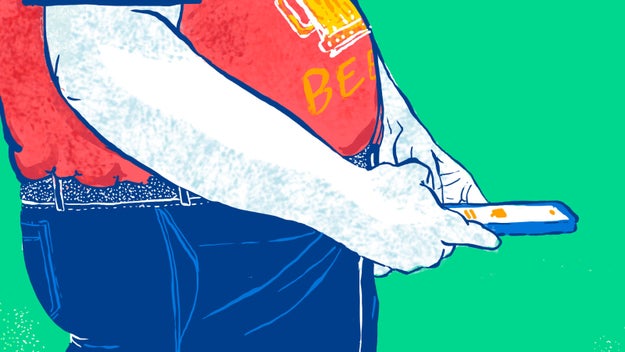
Bawdy jokes, GIFs and videos featuring women in various states of nakedness are the glue that binds everyone together.
The men I spoke to were in these groups for different reasons. An uncle pushing 50 said being in a group full of older, married men like himself made him “feel young” again and allowed him to just be “in a way I can never be around my wife and kids.” A cousin born at the beginning of the century snickered and said he’s in it for funny NSFW GIFs. Sure, men also talk about politics and their personal lives once in a while, but bawdy jokes, GIFs and videos featuring women in various states of nakedness are the glue that binds everything — and everyone — together.
“I’m with people I know, and I’m just sharing things on a screen with my buddies, and sometimes it makes them laugh or they get a kick out of it, and that’s a bit of validation,” said G, who is in the WhatsApp group of guys I went to college with. “It makes me lose my inhibitions. It’s my safe space.”
Paromita Vohra, a writer and filmmaker who runs Agents of Ishq, a platform that encourages Indians to talk openly about sex — something that is culturally brushed under the carpet — calls the ribald conversations in all-male WhatsApp groups a “performance of masculinity.” She likens the men in these groups to a bunch of bros standing at a bar and trying to fit into mainstream ideas of heteronormative maleness.
“You are performing for each other.”
“You are performing for each other,” she said. “And there are some folks who are performing louder than the others in the group. There’s always someone who is going to try and be the alpha. But everyone’s essentially trying to mirror established notions about what it means to be male to fit in.”
My friend S, the admin of the Guys Only group, agrees with Vohra. “I think…it’s true,” he said after a lot of hemming and hawing. “I think that objectifying a woman’s body, or cracking jokes about it in an environment where you get validation for doing it, makes us feel good about ourselves.”
There have been times that I’ve struggled to wrap my head around the dichotomy of my own school friends — perfectly normal guys with thriving careers and happy marriages — being so crass and misogynistic in the privacy of a WhatsApp group. But Nisha Susan, co-founder and editor of The Ladies Finger, an online feminist magazine, thinks I’m wrong.
“WhatsApp isn’t a place that’s divorced from real life,” she says. “And while equating what a man says on a WhatsApp group that he thinks is a safe space is not a predictor of whether he will grope a woman in public, you don’t have to wait for a man to grope a woman in public to say that he’s a sexist pig.”
“That’s harsh,” said S. “I’m certainly not condoning molesting women or thinking about them as sex objects when I share this stuff in a WhatsApp group. The truth is that in a closed environment like that, I don’t really think about these things before sharing them.”
If that excuse sounds familiar, it’s because it made headlines around the world last year. When a leaked 2005 video of Donald Trump telling “Access Hollywood” host Billy Bush to “grab [women] by the pussy” emerged a month before Trump was elected President of the United States, Trump issued an apology and dismissed the incident as “locker room talk.” This was, according to Trump, how men talked about women in safe, all-male spaces when women are well out of earshot. Forget people around you, even the President of the United States thinks this is OK.
“WhatsApp isn’t a place that’s divorced from real life.”
Sometimes, things go too far. A friend described how someone in an all-male WhatsApp group he was part of once Photoshopped faces of mutual female friends on comically obese naked female bodies. He protested furiously in the group, only to be told to “calm the fuck down, it’s just harmless fun.” He quit the group hours later.
“Patriarchy is not just about men and women,” says Vohra. “It’s about a certain notion of hierarchy, and those who don’t conform to stereotypical masculine ideas are always on the lower end of that pyramid.”
The lower end of the pyramid is where I have been placed in the Guys Only group ever since, a few years ago, I tried to shut shit down after someone shared a graphic joke that referenced a popular Bollywood actress’s “well-used booty.” Laughter emojis and homophobic slurs drowned out my protestations, and for weeks, I muted the group and ignored all the crap that piled up there.
Disturbing a WhatsApp group’s dominant dynamic in this way often has outsized consequences. Members of my family WhatsApp group — a hotbed of right-wing propaganda and fake news — for instance, casually label me “communist” for countering bullshit with facts.
And in social groups where masculinity is the prime currency, rocking the boat can make you an outcast. Feminist writer Lindy West, in a plea to her male friends to stand up for women in all-male spaces, recently wrote:
Our society has engineered robust consequences for squeaky wheels, a verdant pantheon from eye-rolls all the way up to physical violence. One of the subtlest and most pervasive is social ostracism — coding empathy as the fun killer, consideration for others as an embarrassing weakness and dissenting voices as out-of-touch, bleeding-heart dweebs (at best). Coolness is a fierce disciplinarian.
A result is that, for the most part, the only people weathering those consequences are the ones who don’t have the luxury of staying quiet. Women, already impeded and imperiled by sexism, also have to carry the social stigma of being feminist buzzkills if they call attention to it.
If calling out strangers on the internet makes you a “social justice warrior” or “feminazi”, calling out your own friends and family on WhatsApp makes you a “killjoy” and a “buzzkill”. Women, of course, know well what it is like to protest a line of humour and be asked to “lighten up” or “chill out” or “learn to take a joke”.
Women know well what it's like to protest a line of humour and be asked to “lighten up” or “chill out”.
But to anyone who believes in equality between the genders, there is genuinely no humour to be found in jokes that make oppressing or hating women the punchline. Every joke that relies on hitting or hating your wife reveals a marriage in which one member sees the other as inferior. Every punchline that hinges on stereotypes about female behaviour and sexualising women’s bodies reveals deep misogyny and disrespect for women you live with and work with.
Increasingly in India, coolness is becoming tied to progressivism. You see it in new-age comedians whose jokes punch against sexism and homophobia, rather than relying on them, and in Bollywood A-listers who push back against decades of nepotism.
In a time when it’s not cool to be openly sexist, some Indian men are retreating to the privacy of WhatsApp groups to validate their misogyny, just like we lower our voices and retreat to our living rooms to share our most bigoted thoughts.
If you’re in a group like this, maybe the most manly thing you can do is push back. Or get out.
Quelle: <a href="Inside The Testosterone-Soaked Culture Of India’s Guys-Only WhatsApp Groups“>BuzzFeed