Justin Sullivan / Getty Images
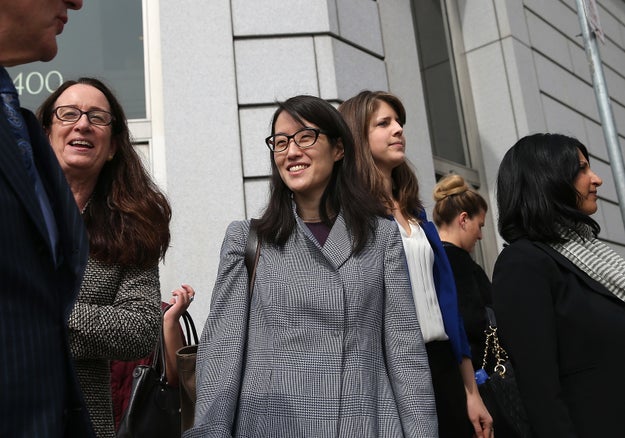
Ellen Pao, former interim CEO of Reddit, is today one of the most recognizable figures in Silicon Valley’s diversity movement. But this wasn’t exactly an early-career goal for the 47-year-old venture capitalist, now an investment partner at Kapor Capital and co-founder of the inclusion nonprofit Project Include. Once upon a time, Pao was working hard and making deals as a partner at the prestigious venture capital firm Kleiner Perkins Caufield & Byers. She shocked the industry when she filed a $16 million lawsuit against the firm, alleging she’d been discriminated against, then terminated, because of her gender. The high-profile case went to trial in 2015, and the tech industry followed it obsessively.
In airing her own experiences of discrimination in court, Pao unwittingly made herself into an authority on issues of diversity. She encouraged others to have frank conversations about the complicated dynamics of the workplace — who has power, how it is wielded, and how subtle biases play into professional interactions. Pao may have lost her case, but two years later, the tech industry is still facing a reckoning on issues of harassment and discrimination. In the past year, a wave of tech employees from Google, Uber, Magic Leap, SoFi, and various VC firms in the Valley have filed suits against their employers for sexual harassment or publicly detailed their own experiences about discrimination or unequal pay.
As a reporter covering Pao’s trial in 2015, I saw firsthand how reserved she came across in court. Her memoir, Reset, aims to finally blow open her side of the story. It’s not a perfect book, but it does reveal some details that haven’t surfaced in public before now.
1. In Pao’s early tech jobs in 2000s-era San Francisco, she came face to face with what she calls “the rise of the frat-bro startup culture.”
Pao writes:
…Ambitious, money-hungry people began turning their attention away from Wall Street and toward the tech sector, idolizing the rapid ascent to billionaire status of the Google founders. Almost overnight, it seemed to me, the amount of money and money types pouring in changed the vibe. Even the new rich people were different. Famous rich guy of the earlier era Bill Gates was known for working hard and then for doing good with his money. His goal was a PC on every desktop. Famous rich guy of the new era Mark Zuckerberg was known for spitefully attending a VC meeting in his pajamas. His goal was making it easier to find women to date. The newest crop of billionaire boys included Evan Spiegel, who sent crude emails about trying to get “sorori-sluts” drunk enough to have sex with his frat brothers, and about peeing on a classmate. His goal was to enable nude selfies with self-deleting photos.
After putting in her two weeks’ notice at the startup TellMe, Pao says she tried to report inappropriate behavior she’d observed, like a VP bragging about having a female job candidate sit on a beanbag chair in a short skirt, to an HR representative. That HR person then pushed her to sign an agreement not to sue — a tactic reminiscent of the nondisparagement agreements in widespread use at startups and tech companies today, which encourage employee silence around workplace abuses.
At another startup where she worked, Pao describes how an executive realized the team was using up a lot of bandwidth on the internet. Turns out, it was because someone had built a porn server using company resources. (We never do learn what happened to the employee who built the porn server, but for some reason Pao found the incident “dopey, but not terrible.”)
2. Pao talks about being awakened to the benefits of a religious perspective.
Pao was never particularly religious, she says in her memoir. But during a low point at the trial, she describes a feeling of purpose flooding through her during one of the breaks in a court hearing, which felt like a distinctly religious experience.
Pao writes:
That day [during the trial], I was completely worn out — emotionally, physically, and mentally. And so I straightened my shoulders, blocked out the noises, closed my eyes, and meditated right there, standing in the hallway. Within moments I sensed a flood of warmth through my whole body — just a cascade of what felt like fire but didn’t burn. It seemed, and may the atheists out there bear with me, distinctly like a religious experience. It wasn’t specifically Christian or Buddhist or anything else. But I realized, all of a sudden, I’d reached another level of understanding. I felt supported. I had my family. I had my friends. I’d been hearing from people all over the world about their own experiences of discrimination. I saw the purpose of it all.
3. Pao also describes the excesses she saw at Kleiner Perkins in detail.
She says Kleiner’s managing partners spent their own money on private jets — up to three planes each. (Some employees of a green-tech startup that legendary tech investor John Doerr had bet on were aghast when he traveled to a meeting in a private jet, while they carpooled.) Kleiner’s partners typically owned multiple properties: a vineyard in Napa, Neil Young’s old ranch, ski homes, apartments and houses in New York, Boston, San Francisco, and Los Angeles. One partner spent $250,000 to go to the Olympics in Canada as a VIP. And they also had bunkers stocked and ready in case the apocalypse ever hit. (Their theories for how the end would come: disease, robots, and the latest, a race war.)
4. Once, during the holiday season, Pao put together a joke slide show as a Christmas present for her mentor and boss, famed venture capitalist John Doerr. It was called “Asia 101.”
Pao says:
One slide showed a picture of me next to a picture of John’s former chief of staff Aileen (he was always calling me Aileen). Under Aileen’s picture, it said, “She used to spend 80 percent of your working day with you. She does not wear glasses.” Under my picture, it said, “She currently spends 80 percent of your working day with you. She does wear glasses.” John was also stumped by Indian names, so I made a slide with photos of our Indian partners Ajit, Vinod Khosla, Ram Shriram, and KR Sridhar. …
As a bonus, I even tried to help him stop calling our head of state “President Osama.”
Everyone found the slide show hilarious. But Pao says her victory was short-lived. The jokes seemed to give partners at the firm more leeway to be inappropriate. Then, years later, John dropped a cringe-worthy line at a conference: “We have two new partners who are so diverse, I have a challenge pronouncing their names.”
5. Pao says everyone points out the success of Mary Meeker, a former financial analyst turned venture capital at Kleiner Perkins and the so-called “Queen of the Internet,” to reject criticisms that the finance and VC worlds are biased against women. But ultimately, Pao says, Meeker is “a very special exception to a very entrenched rule.”
Pao explains that Meeker has never publicly or privately been an advocate for women. “She just has never talked about her gender.”
(Research shows some women may distance themselves from discussing diversity so that they don’t get distracted from what, to them, is the more important issue: how they do their jobs. But the other side of that coin could be negative: the research also shows some of those people may align themselves with those in power, at the expense of those who are facing discrimination — which could hinder progress for all.)
6. Some partners and employees at Kleiner Perkins resented having to attend a class about recognizing sexual harassment — and the firm was apparently obsessed with hiring 26-year-olds.
According to Pao:
We learned it was illegal to discriminate based on things like race, sex, or age.
“So we really want people who are twenty-six,” another managing partner stated, paying no attention to the seriousness of the discussion. “How can we hire more twenty-six-year-olds?”
The partners were always obsessed with twenty-six-year-olds. I think maybe it was because Larry Page and Sergey Brin of Google were around twenty-six when they met John [Doerr].
The [anti-harassment] trainer looked startled. “You can’t,” he responded. “In hiring you have to look for the best people. To discriminate on the basis of sex, race, or age just isn’t legal.”
“Okay,” the partners tried again. “But what about a twenty-six-year-old mindset? How do we guarantee they have that?”
“Uh, you can’t,” the trainer repeated.
Another time, Pao overheard straight-up racist jokes at the firm. She describes the way the company joked around while vetting a walkie-talkie startup:
“Hey Rodriguez,” Randy said in a horrible fake Mexican accent, “you got the drop for me?”
“Yeah, Shaniqua!” quipped Chi-Hua in his toughest voice.
And yet people wondered why no partner who might be named Shaniqua or Rodriguez ever worked there.
7. Kleiner Perkins hired a crisis-management PR firm that may have brought on troll farms to ruin Pao's reputation online.
As Pao writes:
In response to my suit, Kleiner hired a powerful crisis-management PR firm, Brunswick. On their website, they bragged about having troll farms — “integrated networks of influence,” used in part for “reputation management” — and I believe they enlisted one to defame me online. Dozens, then thousands, of messages a day derided me as bad at my job, crazy, an embarrassment. Repeatedly, Kleiner called me a “poor performer.” A Vanity Fair story implied that Buddy was gay, a fraud, and a fake husband.
8. At one point, Pao was so anxious about how the trial would play out that she put her will in order.
One night, I woke and sat straight up in bed, wondering if I could be putting myself in actual danger. I felt a certain compassion for my former colleagues — I had put them in a terrible fix. They certainly didn’t want to have their secret world and antiquated habits revealed to outsiders, and they clearly wanted this to go away. Yet I was refusing to settle and wouldn’t even share a number. They were, I could see, highly motivated to silence me. I couldn’t see them hiring someone to hurt me, but I also couldn’t see them allowing the case to go to a public trial. In an overabundance of caution, I went to an estate lawyer and made sure my will was in order, and then I put the fear out of my mind.
9. While working as interim CEO of the online community website Reddit, Pao used the metaphor of a “poltergeist” to describe the culture — “a magnetic core of old-timers with a strong, obstructionist culture that was a black hole for new initiatives and that spun out people they didn’t like.”
In response to Pao telling Reddit employees in the office to stop talking about penises, she says she got “a long, alternate-universe, poltergeist-y reply” from an employee (whom she did not name):
I think the conversation in the office today shouldn’t be characterized as penis jokes. There was an animated debate about penises and female breasts in the office today, but there was actually a ton of substance to the initial topic and the ensuing debate… The discussion touched on a ton of really interesting topics like cultural relativism, gender relativism, Egyptian hieroglyphics, perception, philosophy around absolute aesthetics, and even what constitutes a visual symbol. What’s remarkable about it is that I don’t think it ever really got into crude labeling or sexually charged discussion — we actually spent a good deal of time just talking about what body parts look like, visually. I think the reason the discussion actually got so many people going for so long was because there was depth to it. I think it would be fair to say this was a very different vibe from your typical brogrammer yammering…
You get the picture.
10. Pao also tried hard to undo Reddit’s problematic culture, including its encouragement of heavy drinking. But when Steve Huffman came back on as CEO, he promptly invited everyone to a bar to celebrate with drinks.
Writes Pao:
They described various things that had been going on at reddit for years. Others went to our HR person, who shared their stories with me: Ongoing harassment. Obscene recurring jokes. Inappropriate touching. All-male parties outside the office. A ridiculous number of messages to the team that included the word “boobs.” I began to think of myself as the new sheriff in town, and I made it clear to everyone that I wouldn’t tolerate inappropriate behavior.
After an underage employee got so intoxicated at a work event he was found wandering outside the office, Pao instituted a new rule where employees could only drink at events outside the office. “I was probably labeled a buzzkill for that decision, but I didn’t care,” she says.
That changed when Steve Huffman took over as permanent CEO in July 2015, according to Pao. “At the Yay-Steve celebration… people got, by all accounts, loaded,” writes Pao. “There was a lot of bad behavior. And a woman employee was groped.”
When the employee later complained to Steve Huffman, Pao says he dismissed it as hearsay. She reportedly asked him: “Do you know what hearsay means? It’s not hearsay if I’m telling it to you and it happened to me.”
11. Pao wrote a moving passage that explains why women are constantly cut out of workplace dynamics — which can apply not just to tech or VC, but universally.
The key part:
The system is designed to keep us out. These are rooms full of white heterosexual men who want to keep acting like rooms full of white heterosexual men, and so either they continue to do so, creating a squirm-inducing experience for the rest of us, or they shut down when people of color or women enter the room and resent having to change their behavior.
We are either silenced or we are seen as buzzkills. We are either left out of the social network that leads to power — the strip clubs and the steak dinners and the all-male ski trips — and so we don’t fit in, or our presence leads to changes in the way things are done, and that causes anger, which means we still don’t fit in. If you talk, you talk too much. If you don’t talk, you’re too quiet. You don’t own the room. If you want to protect your work, you’re not a team player. Your elbows are too sharp. You’re too aggressive. If you don’t protect your work, you should be leaning in. If you don’t negotiate, you’re underpaid. If you do negotiate, you’re complaining. If you want a promotion, you’re overreaching. If you don’t ask for a promotion, you get assigned all the unwanted tasks. The same goes when asking for a raise.
There is no way to win, and you’re subject to constant gas lighting. When you stand up for yourself, there are fifteen reasons why you don’t deserve what you’re asking for. You’re whining. You don’t appreciate what you have. There is this steady drumbeat of: We let you in here even though you don’t belong! Be grateful. Just drop it.
To be sure, Pao is a complicated figure in tech. Some have criticized her for not being the perfect character to champion the diversity cause. But her memoir makes one thing clear: These are her lived experiences, and her choice to share them affords us the privilege to learn from them.
Quelle: <a href="The 11 Things We Learned From Reading Ellen Pao’s New Memoir“>BuzzFeed