Here's A Letter Tech Companies Are Signing To Urge Trump To Protect Young Immigrants

In a letter circulated by the Silicon Valley lobbying group FWD.us, tech companies are voicing opposition to reports that President Trump will end an Obama-era program that allows young, undocumented immigrants to stay in the United States.

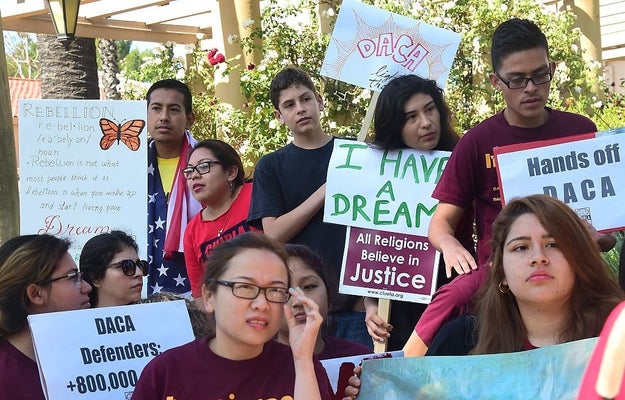
Frederic J. Brown / AFP / Getty Images

On Thursday, Fox News reported that Trump will end Deferred Action for Childhood Arrivals, the program also known as DACA, as early as Friday. Enacted by the Obama administration in 2012, the policy grants young immigrants who meet certain criteria a temporary reprieve from deportation. The reports are unconfirmed as of now.

But the news elicited strong criticism from tech companies, which say immigrants are a crucial part of their workforce. Uber and Microsoft publicly condemned the reported changes on Thursday. Meanwhile, FWD.us is collecting signatures on a letter that protests the potential move.

The letter has not yet been released, but BuzzFeed News obtained a current version of it. FWD.us declined to comment.

Open Letter from Leaders of American Industry

Since the country’s birth, America has been the land of opportunity – welcoming newcomers and giving them the chance to build families, careers, and businesses. In turn, our nation has been strengthened and fueled by the energy, drive, and passion of immigrants. As entrepreneurs and business leaders, we are concerned about new developments in immigration policy that threaten the future of Dreamers, young undocumented immigrants brought to America as children.

The Deferred Action for Childhood Arrivals (DACA) program, which allows nearly 800,000 Dreamers the basic opportunity to work and study without the threat of deportation, is in jeopardy. All DACA recipients grew up in America, registered with our government, submitted to extensive background checks, and are diligently giving back to our communities and paying income taxes. More than 97 percent are in school or in the workforce, 5 percent started their own business, 65 percent have purchased a vehicle, and 16 percent have purchased their first home. At least 72 percent of the top 25 Fortune 500 companies count Dreamers among their employees.

Unless we act now to preserve the DACA program, all 780,000 hardworking young people will lose their ability to work legally in this country, and every one of them will be at immediate risk of deportation. Our economy would lose $460.3 billion from the national GDP and $24.6 billion in Social Security and Medicare tax contributions.

Dreamers are vital to the future of our companies and our economy. With them, we grow and create jobs. They are part of why we will continue to have a global competitive advantage.

We call on President Trump to preserve the DACA program. We call on Congress to pass the bipartisan DREAM Act.

It’s the right thing to do for America.

In response to a query from BuzzFeed News, Lyft confirmed that co-founders Logan Green and John Zimmer have signed it. BuzzFeed News has learned that Uber has also signed it. Sources told BuzzFeed News that Google intends to sign it as well. This post will be updated with more names as they become public.

In a public statement, Uber said it opposes ending DACA.

“Dreamers grew up here, live here, and are contributing to our communities and our economy,” an Uber spokesperson said in a statement Thursday. “Their contributions make America more competitive and they deserve the opportunity to work, study, and pursue the American dream.”

So did Microsoft.

“DACA recipients bring a wide array of educational and professional backgrounds that enable them to contribute in crucial ways to our nation’s workforce,” said president Brad Smith in a blog post. “They are part of our nation’s universities and work in every major industry. They are artists, advocates and health care providers. They help meet the needs of our communities and our companies.

CEO Satya Nadella followed up with a more personal note on LinkedIn. “As I shared at the White House in June, I am a product of two uniquely American attributes: the ingenuity of American technology reaching me where I was growing up, fueling my dreams, and the enlightened immigration policy that allowed me to pursue my dreams,” he wrote.

This is a developing story. Check back for updates and follow BuzzFeed News on Twitter.

Quelle: <a href="Here's A Letter Tech Companies Are Signing To Urge Trump To Protect Young Immigrants“>BuzzFeed

Labor Board Files Complaint Against Tesla

Brendan Smialowski / AFP / Getty Images

In April, when Tesla employees interested in unionizing claimed the electric car company was illegally intimidating them, Tesla dismissed the allegations as “entirely without merit.”

But the National Labor Relations Board disagrees. On Thursday, the Oakland regional office of the NLRB filed a complaint against Tesla, having found merit in the employee’s charges of coercion and interference.

In February, the United Automobile Workers union filed four separate charges with the National Labor Relations Board alleging Tesla had illegally surveilled and coerced factory workers attempting to distribute information about the union drive.

The NLRB complaint filed Thursday provides further detail about what happened in February. It notes that security guards asked the employees distributing leaflets to produce employee ID badges, and told them to leave the premises. The complaint also cites Tesla’s confidentiality agreement, which says workers are prohibited from communicating with the media, sharing photos of their work facility on social media, or forward work emails to a personal account, among other things. It also names at least three individual Tesla managers or supervisors who personally “interrogated” employees about union activities or “attempted to prohibit” employees from discussing union activities.

As such, wrote NLRB regional director Valerie Hardy-Mahoney, the agency determined that Tesla “has been interfering with, restraining and coercing employees in the exercise of their rights.”

The board’s complaint isn’t the last word on the case. It will next be reviewed by an administrative law judge at a hearing. It could also be settled.

For its part, Tesla continues to say the union’s allegations are baseless.

“For seven years, the UAW has used every tool in its playbook: misleading and outright false communications, unsolicited and unwelcomed visits to the homes of our employees, attempts to discredit Tesla publicly in the media, and now another tactic that has been used in every union campaign since the beginning of time — baseless ULP [unfair labor practices] filings that are meant only to generate headlines,” a Tesla spokesperson wrote via email. “These allegations, which have been filed by the same contingent of union organizers who have been so outspoken with media, are entirely without merit.” (The full statement is published in full below.)

The workers who initially brought the charges are part of a unionization effort that calls itself Fair Future at Tesla. A spokesperson from that group provided a statement from some of the workers.

“I joined others in filing the charges for myself, but I also did it for my coworkers — they need to know we have rights, and that we can speak up about what we are seeing and experiencing,” said Tesla production associate Jonathan Galescu in a statement. “I want to thank the NLRB for hearing us and the UAW for having our backs as we continue our fight to address the issues on the shop floor and form our union.”

The NLRB case against Tesla is directly linked to the UAW’s attempt to form a union at Tesla’s Fremont, CA factory, where workers have publicly alleged long hours, low pay, and dangerous working conditions, resulting in frequent 911 calls and countless long term injuries.

The confidentiality agreement is a particular bone of contention; Tesla has insisted that the agreement it asks workers to sign — which prohibits them from sharing photos of Tesla’s facility or talking about work on social media, among other things — is typical of any tech company. But back in February, California lawmakers warned Tesla in a letter that its confidentiality agreement was overreaching, and could have a “a chilling effect on workers' ability to engage in protected activity,”

In May, Tesla replaced its head of human resources, part of a larger department shakeup that followed the union effort, allegations of dangerous working conditions, and potential labor law violations that occurred in the course of Tesla’s union drive.

Tesla CEO Elon Musk has pushed back against the allegations that the Fremont factory is unsafe, or that workers are paid less than those employed elsewhere in the auto industry; he’s also apologized to workers, reportedly spent time working next to them on the factory line, and offered to install free frozen yogurt machines throughout the plant.

But these are tough times at Tesla, with production of the latest car, the Model 3, ramping up to meet Musk’s stated goal of high production volume by September. In an earnings call earlier this month, Musk warned that the company would experience “at least six months of production hell.”

Tesla’s hearing at the National Labor Relations Board is scheduled for November 14.

Here's Tesla's full statement on the NLRB's complaint against it:

“As we approach Labor Day weekend, there’s a certain irony in just how far the UAW has strayed from the original mission of the American labor movement, which once advocated so nobly for the rights of workers and is the reason we recognize this important holiday. Faced with declining membership, an overwhelming loss at a Nissan plant earlier this month, corruption charges that were recently leveled against union leaders who misused UAW funds, and failure to gain traction with our employees, it’s no surprise the union is feeling pressured to continue its publicity campaign against Tesla. For seven years, the UAW has used every tool in its playbook: misleading and outright false communications, unsolicited and unwelcomed visits to the homes of our employees, attempts to discredit Tesla publicly in the media, and now another tactic that has been used in every union campaign since the beginning of time – baseless ULP filings that are meant only to generate headlines. These allegations, which have been filed by the same contingent of union organizers who have been so outspoken with media, are entirely without merit. We will obviously be responding as part of the NLRB process.”

Quelle: <a href="Labor Board Files Complaint Against Tesla“>BuzzFeed

What’s New in Docker Enterprise Edition Webinar Recap

The latest release of Docker Enterprise Edition (EE) allows organizations to modernize Windows, Linux, and Linux-on-mainframe applications—all with minimal disruption. The release also allows organizations to run containers at scale with advanced capabilities around secure multi-tenancy and policy-based automation.

In last week’s webinar, we walked through the key new features of this release and saw a demo of Docker EE in action. If you missed the webinar, you can watch it here:

Here are the top questions from the webinar:
Q: Can you provide more information about Windows support? Which version of Windows? Is this only available with Docker Enterprise Edition?
A: You can run Windows Docker containers either with Docker Community Edition for Windows (PC) which supports Windows 10 or Docker Enterprise Edition for Windows Server 2016 (including Nano Server). Docker EE Basic is included with the Windows Server 2016 license, and you also have the option to upgrade to EE Standard or EE Advanced for Windows Server 2016 to get complete lifecycle management capabilities, Docker Trusted Registry, and advanced security features like image signing and scanning.
Q: Is it possible to deploy the Windows containers on top of a native Linux host?
A: As a form of packaging an application, you can only deploy Windows containers on a Windows host as the application will need to access the underlying OS kernel and in this case, it would be a Windows OS kernel. With this release, it is possible to manage a Docker EE cluster that contains both Windows and Linux nodes as well as Linux on IBM Z nodes.
Q: Does Docker EE support legacy Windows applications?
A: The Docker engine runtime only works on Windows 10 and Windows Server 2016, but containerized Windows applications built on older stacks will still work as long as it is based on the same underlying kernel. As an example, .NET is backwards compatible allowing you to containerize a .NET 2.0 application. In the Linux world, the equivalent is running Ubuntu-based apps and RHEL-based apps on the same Docker host because it leverages the same underlying Linux kernel.
Q: Does image scanning look for known CVEs? Or do we have to provide scripts? Is that feature available in all plans?
A: Image scanning looks at the NIST CVE database of known vulnerabilities, but you can also add your own inputs from a .TAR file. Image scanning is available in Docker EE Advanced and does work for both Windows and Linux images.
Q: Is it recommended to run Dockerized e-commerce applications in production?
A: Many of our customers leverage Docker for production e-commerce apps. Docker works very well with Java and .NET/IIS apps.
Q: How many containers can run on a single Docker host?
A: It depends on a number of factors. It will depend on if you’re running bare metal or in a virtual machine, what resources are available (CPU/memory) and the size of the containers. If you’re dealing with larger monolithic apps or microservices, the size of your containers can vary greatly.
Q: The use case of modernizing traditional apps – does that mean rewriting the application or just containerizing the application as it is? If the latter, wouldn’t that go against the “theoretical” best practices of keeping containers small?
A: Docker supports the containerizing of applications as they are, meaning you can containerize a monolithic application without reworking the code. While the resulting container may be larger than a microservice, it will still receive some of the same benefits in terms of portability, easier maintenance and faster deployments. Organizations can also see significant cost savings from decreased infrastructure requirements. You can learn more about the core benefits of this by signing up here: https://www.docker.com/mta

What’s new in #Docker Enterprise Edition? @TechGalJenny recaps the latest featuresClick To Tweet

Dive Deeper with Docker Enterprise Edition:

Read more about Docker Enterprise Edition
Test drive Docker EE without installing any software
Watch this video series about the latest release of Docker EE
Register for other upcoming webinars

The post What’s New in Docker Enterprise Edition Webinar Recap appeared first on Docker Blog.
Quelle: https://blog.docker.com/feed/

After Harvey, Small Social Networks Prove Their Might

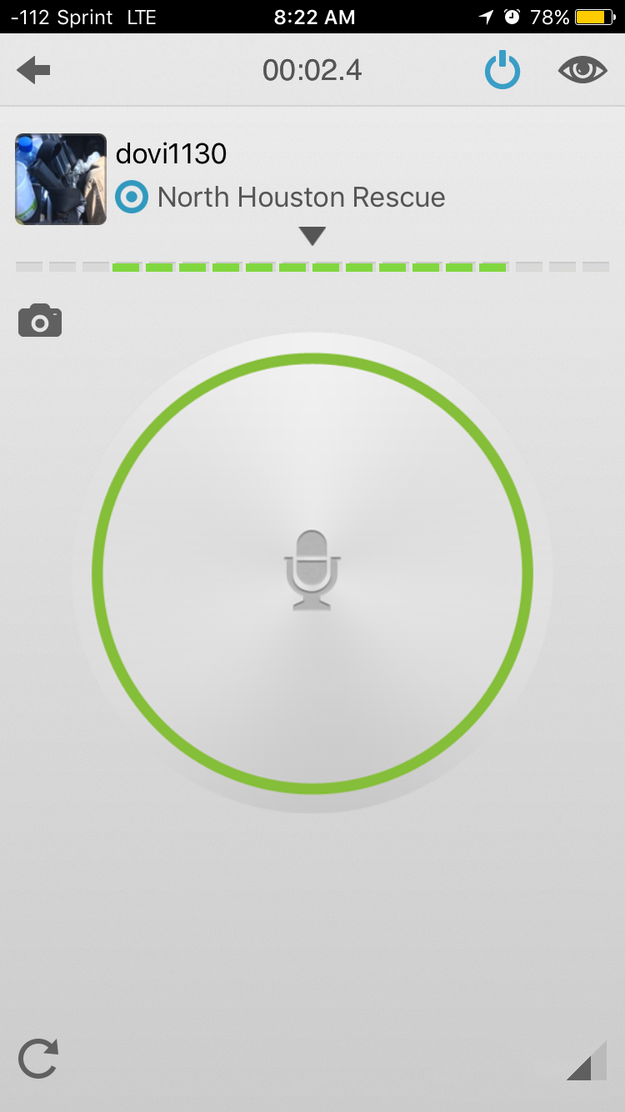
The North Houston Rescue Zello Channel

On Wednesday morning, with flood waters still rising in Houston, voices bubbled inside the relatively obscure walkie-talkie app Zello, coordinating a volunteer effort to get help to those in need.

“I have an 18-foot flat bottom aluminum boat, I need to know where to go this morning,” one member of the app’s 500-plus person North Houston Rescue channel told the group.

”Is there any need for a couple of jet skis and four guys?” another asked. Almost instantly and with calm precision, group administrators directed them to areas that could use their help.

In the aftermath of Hurricane Harvey — which has left thousands seeking shelter — small, locally oriented social networks like Zello are showing their strength as organizing tools. Though social networks are an imperfect substitute for rescue infrastructure, a listen into Zello, or a peek into Nextdoor (where neighbors are working to inform and help each other), or even a visit to Harvey-related Facebook groups shows why people are relying on these networks. They are focused, intensely local, and put critical information in front of the right audiences quickly with little distraction or noise.

“It’s not 911, but it’s pretty effective,” Zello CEO Bill Moore told BuzzFeed News. The app, used exactly like a Walkie Talkie, is filed with channels made up of dozens of members spread far apart, something the traditional devices cannot support.
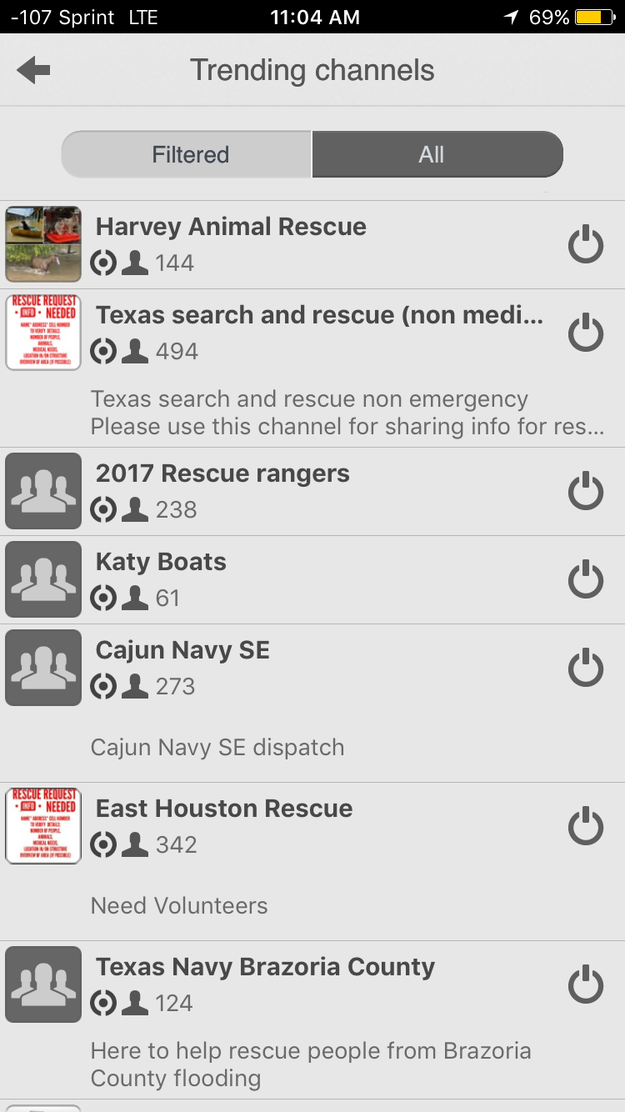
Harvey related channels dominate Zello's Trending section

Houston volunteer organizations seem to think so too. Houston-area app opens on Zello are up 600% compared to last week, with an average session time of more than 22 minutes, Moore said. The app’s new user registration in the Houston area is up 20 times over last week.

Moore said Zello is effective because it helps people convey a sizable amount of information, along with emotion and level of urgency, quickly — so responses come fast. “It’s a higher burden but because of that it’s pretty effective and it creates a level of trust.”

Zello is working so well that some people are using Facebook to direct people to the download the app. “I am overwhelmed and can't coordinate the amount of volume of requests for rescues….here is a better way… Download the Zello App,” Tricia Bell Montalbano, a Houston resident helping with the relief effort, wrote on Facebook this Monday. “There are boats and rescuers responding thru this app to help people. Please share so people know how to get people on a rescue list!!”

Houston-area residents are also flocking to neighborhood-based social app Nextdoor, using it to share updates with their neighbors and offer help. On Sunday, Houston resident Joseph Graham tweeted a screenshot from a Nextdoor community where one resident’s home was filling up with water. “A rescue is desperately needed,” the resident wrote. “Have been calling for help but can't get through.” Within an hour, a fellow Nextdoor member got them on a boat and they were off to safety.
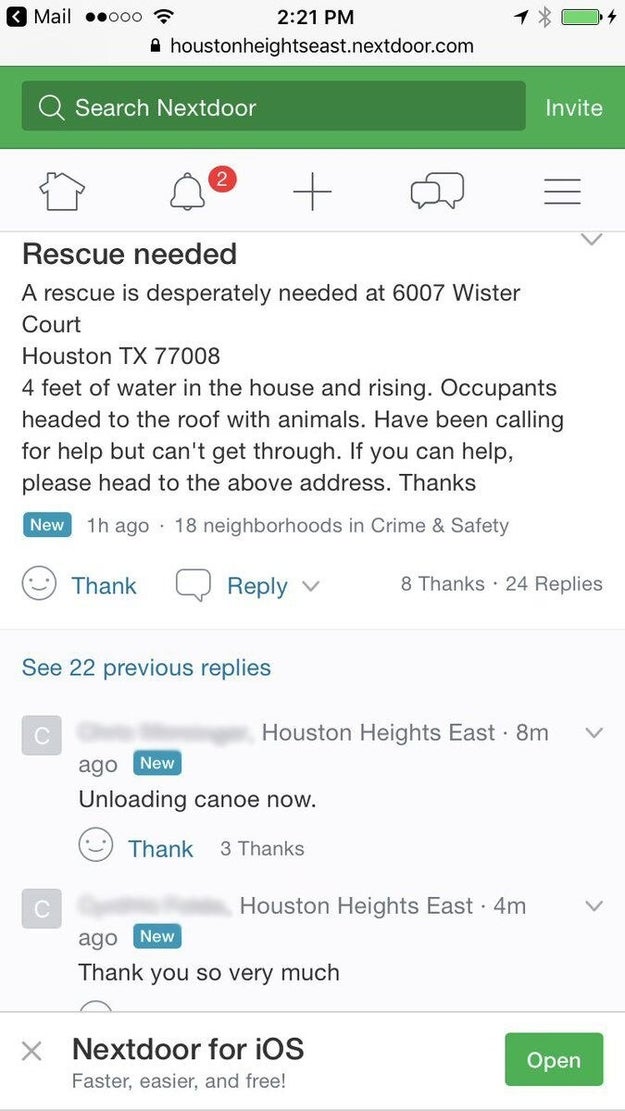
“That was one of several moments that made me tear up,” Graham, who lives in Houston's Historic Heights neighborhood, told BuzzFeed News. “We live in a big city, so it’s not super neighborly. When you’re online and everyone’s in need, everybody drops that big city mentality. It’s a very Houston moment, everybody dropping everything to help each other.”

Taylor Darnell, a resident of Houston’s East Downtown district, told BuzzFeed News that her Nextdoor community has featured running updates on flooded streets, volunteer requests, and places to give donations. She’s solicited donations inside Nextdoor herself, for a non-profit she runs that’s providing backpacks to students impacted by the storm. Darnell, an infrequent Nextdoor user before Harvey, said she regularly checks the app before other social platforms and the news. “Everyone that you’re connecting with is in a radius where the same thing that’s happening to you is most likely happening to them,” she said. “It helps a lot.”

Nextdoor has been proactive too. The company partnered with the National Weather Service months ago to distribute weather alerts. Before Harvey hit, he NWS used Nextdoor to notify Houston-area residents of the incoming storm, sending them information to prepare for it and take action when it arrived.
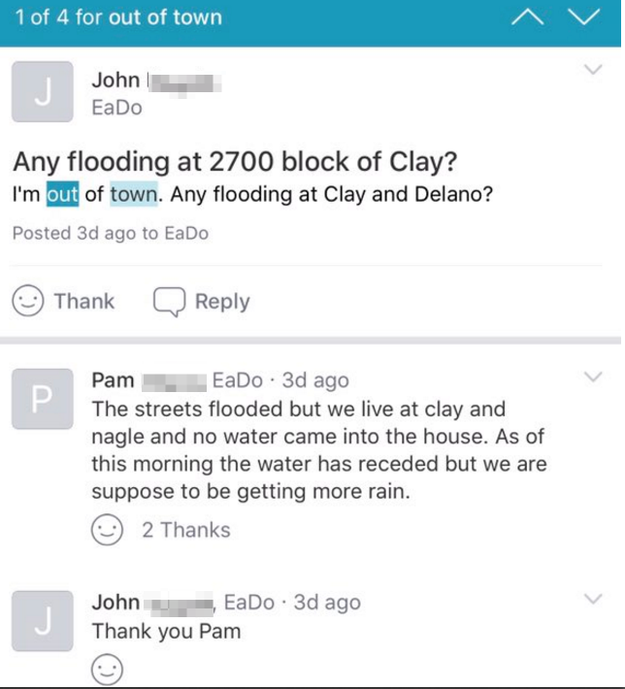
Requests for updates inside Taylor Darnell's Nexdoor community

Taylor Darnell

Member activity in the affected areas is five times greater than normal, Nextdoor told BuzzFeed News, and its membership in those areas is up 650%. Close to 100 local agencies are using Nextdoor to connect with residents in the affected areas, the company said.

Though Facebook is a major social platform of more than 2 billion members, its groups form individual mini-social networks of their own, operating outside the usual broadcast-style method of sharing content on the platform. And these groups have been active too, used to coordinate everything from animal rescue to boat dispatch.

Though small social networks have proven indispensable to some, they also come with risks. The hype around their utility can cause people to view them as a savior, even though they don't employ the tried and true methods of a system like 911.

There is also a risk of vigilantism. In Zello’s North Houston Rescue channel, for instance, the discussion Wednesday turned to looters after one member of the group suggested shooting them on sight. “Where are the looters located? We do have weapons on board,” one group member volunteered. Eventually, a trickle of group members insisted looters be left alone. And the topic was dropped.

“Oh, it’s used for bad, yes. Cartels, gangs, ISIS and others. Like any communications tool, it’s used for good and evil both,” Zello’s Moore said. “It’s a net positive but it’s not without risk. It doesn’t replace law.”

Lam Thuy Vo and Blake Montgomery contributed reporting to this story.

Quelle: <a href="After Harvey, Small Social Networks Prove Their Might“>BuzzFeed

Automation of Azure Analysis Services with Service Principals and PowerShell

Azure Analysis Services presents opportunities for the automation of administrative tasks including server provisioning, scale up/down, pause/resume, model management, data refresh, deployment, among others. This can leverage cloud efficiencies and helps ensure the repeatability and reliability of mission-critical systems. Such tasks can be performed in the Azure cloud using PowerShell in unattended mode. Services such as Azure Automation exist to support these processes. They should be executed using service principals for enhanced security and ease of management. Service principals are similar to on-premises service accounts, but for Azure. They use credentials in the form of an application ID along with a password or certificate. Model permissions are assigned to service principals through role membership like normal Azure Active Directory UPN accounts. The remainder of this post shows how to create a service principal to use with the Analysis Services cmdlets available in the SqlServer PowerShell module. Creation of service principals Learn more about how to create service principals in the Azure Portal, and how to create service principals in PowerShell either with a password or certificate. Role membership Once the service principal is created, its application ID can be assigned permissions in the Azure Analysis Services server or model roles using the following syntax. The example below adds a service principal to the server administrators group in SSMS. app:<app guid>@<tenant guid> The application can be selected in SSMS using the account picker by searching for its name. Execution of administrative tasks with PowerShell and service principals A pre-requisite to this section is to install the latest Azure.AnalysisServices and SqlServer PowerShell modules. Install-Module -Name Azure.AnalysisServices Install-Module -Name SqlServer The following example shows how to log in using a service principal application ID and password, and how to process (data refresh) a table in a model. Param ( [Parameter(Mandatory=$true)] [String] $AppId, [Parameter(Mandatory=$true)] [String] $PlainPWord, [Parameter(Mandatory=$true)] [String] $TenantId ) $PWord = ConvertTo-SecureString -String $PlainPWord -AsPlainText -Force $Credential = New-Object -TypeName “System.Management.Automation.PSCredential” -ArgumentList $AppId, $PWord Login-AzureAsAccount -Credential $Credential -ServicePrincipal -TenantId $TenantId -RolloutEnvironment “southcentralus.asazure.windows.net” Invoke-ProcessTable -Server “asazure://southcentralus.asazure.windows.net/myserver” -TableName “MyTable” -Database “MyDb” -RefreshType “Full” Note that the login cmdlet used is Login-AzureAsAccount, not Login-AzureRsAccount. The former should be used for Azure Analysis Services database-level operations such as those enabled by the Analysis Services cmdlets in the SqlServer PowerShell module. The latter should be used for Azure resource management operations such as those enabled by the AzureRM.AnalysisServices PowerShell module. The following example shows how to log in using a service principal application ID and self-signed certificate, and how to process (data refresh) a table in a model. Param ( [Parameter(Mandatory=$true)] [String] $AppId, [Parameter(Mandatory=$true)] [String] $CertThumbprint, [Parameter(Mandatory=$true)] [String] $TenantId ) Login-AzureASAccount -RolloutEnvironment “southcentralus.asazure.windows.net” -ServicePrincipal -ApplicationId $AppId -CertificateThumbprint $CertThumbprint -TenantId $TenantId Invoke-ProcessTable -Server “asazure://southcentralus.asazure.windows.net/myserver” -TableName “MyTable” -Database “MyDb” -RefreshType “Full”   Storing credentials and certificates in Azure Automation Credentials and certificates can be securely stored in Azure Automation and extracted for use in runbooks. Learn more about credential assets and certificate assets in Azure Automation.
Quelle: Azure