Why Augmented Reality Is About Take Over Your World

Why Augmented Reality Is About Take Over Your World

In a matter of hours, the world will be buzzing with talk of augmented reality. The technology, which places digital elements on top of the real world, has long been a clunky, hobbyist passion. But that’s about to change. In recent months, Apple and Google have released technology frameworks that do much of the heavy lifting for AR developers, helping them create applications they never could before. And tomorrow, the public will get a good look at the true scope of what these frameworks can help produce when Apple pulls the curtain back on the final version of iOS 11, and the first set of apps built with its ARKit framework along with it.

Though many AR developers are keeping their work under wraps until Apple’s big reveal, a small but fascinating Twitter account called @madewithARKit has been sharing a preview of what’s on tap. The account, which curates videos from still-unreleased AR apps, has featured a steady stream of intriguing AR use cases. One app it’s highlighted transforms your driveway into a virtual Tesla showroom, another turns your phone screen into an accurate tape measure, and one more lets you arrange virtual furniture in your living room to see how it would look in real life.

“It’s got all the makings of a platform shift.”

The excitement building in anticipation of these apps’ release harkens back to the early days of the iOS App Store, when Apple debuted a platform that developers quickly used to distribute their apps to hundreds of millions of people. It took some time for these developers to push out applications that changed the way people lived their daily lives, and some started out silly — fart apps and other goofy things. But the App Store eventually became a key channel through which major apps like Uber, WhatsApp, and Snapchat reached the masses. And similar hopes exist for ARKIt and Google’s rival, ARCore.

“It’s got all the makings of a platform shift,” David Urbina, who is building an augmented reality app called Neon using ARKit, told BuzzFeed News. “Apple is essentially turning a light switch on.”

@ARKitweekly / Twitter / Via Twitter: @ARKitweekly

Neon has a number of features that layer the digital world on top of the real one, including a friend locator that uses your phone’s camera display to place arrows above contacts within 100 meters. Before ARKit, Neon could only accurately locate your contacts if you stood still, so if you took a few steps, you’d need to refresh the app. With ARKit — which offers lighting-fast image processing and measurement capabilities that allow a phone to understand where it is in space — Neon gives you a consistently accurate read, so the app is actually useful now.

Applications like Neon were hardly feasible when the term “augmented reality” was coined by a Boeing researcher in 1990, and would’ve been a pain to use just a few months ago, but the technology is now finally capable of supporting them. “To truly, credibly represent virtual objects in the world, it requires a lot of puzzle pieces to come into place that are technically challenging,” Jon Wiley, ‎director of immersive design at Google, told BuzzFeed News. Those puzzle pieces include powerful processors and accurate image-recognition technology, Wiley said, both of which are now advanced enough to the point where AR can be unleashed.

Fire-breathing dragon in your backyard, built with ARCore

YouTube / Via youtube.com

We've seen glimpses of AR's potential before — in Pokémon Go and in Microsoft's HoloLens demos — but this moment marks AR is coming to public at scale, a major milestone. “Three to five years from now, we’ll look back at this time as an inflection point,” Todd Richmond, director of the Mixed Reality Lab at the University of Southern California, told BuzzFeed News. “This is really taking AR to the masses.”

“Three to five years from now, we’ll look back at this time as an inflection point.”

Apple has been stoking expectations for ARKit. “We actually have hundreds of millions of iPhones and iPads that are going to be capable of AR,” Apple's senior vice president of software engineering Craig Federighi said when introducing ARKit at the company’s Worldwide Developers Conference earlier this year. “That’s going to make overnight ARKit the largest AR platform in the world.”

But the key test of this technology is whether it can be used to develop applications that change the way we interact with our devices or the way we do things in daily life. Technology industry experts BuzzFeed News spoke with for this story struggled to name an AR use case that might transform a common behavior in the way that, say, Uber transformed transportation. But both Google and Apple appear willing to take a wait-and-see approach, putting the tools in the hands of developers and waiting for what happens next. Asked to name use cases that display the power of AR, Wiley compared it to the personal computer. “That’s a little like saying — what are PCs good for? They’re really good for spreadsheets, that's true. But they've also completely transformed everything else we do in the world.”

What’s clear is that ARKit and ARCore will pave the way for apps that never would’ve seen the light of day before. Both provide developers with the ability to create augmented reality apps that work as you move up, down, right, left, forward, and backward — otherwise known as the six degrees of freedom. And developers are finding ways to make use of this technology — even if the applications are novel at first.

Game developer Ridgeline Labs, for instance, began building a pet dog game for virtual reality last fall, not even considering AR due to the technical challenges. At the time, it was impossible for the company to make a digital dog to walk around with you in augmented reality, or jump on your couch, or walk around your furniture, aware of where it was. But after Apple introduced ARKit, that all changed, and the team is now on track to release an AR app this fall in which the dog does all those things.

@madewithARKit / Twitter / Via Twitter: @madewithARKit

“It just wouldn’t exist without ARKit,” Ridgeline Labs cofounder Jeremy Slavitz told BuzzFeed News, of his app. “You couldn’t really walk around a dog, or pet a dog if it weren’t in ARKit. It just wouldn’t know where you were moving, there’s no way.”

Along with gaming, retail will likely be one of the first industries to embrace AR. Ikea, for instance, is expected to debut a new app called Ikea Place that will allow its users to place “true to-scale” Ikea furniture inside their homes using AR, potentially saving them hours inside the furniture giant that can turn agonizing for many.

With both Apple and Google in the game, developers are starting to become more interested in an AR world that feels ripe with possibilities and has a big potential market. Their enthusiasm could quickly lead to a major surge in AR apps, including those designed with a daily use case in mind, not just novel experiences like a virtual pet dog.

Urbina is thinking about how to get Neon used every day, and is planning to include a feature where people can leave digital messages for friends on top of the physical world along his friend finder tool. It will be people like Urbina, with more permanent uses in mind, that determine the future of the technology — the only question is what that will be. “There’s only so many times you’ll be able to anchor a piece of furniture or a cartoon in the room before you get tired of that,” he said. “The leaders in AR are going to have to establish a level of persistence in order to move past the novelty.”

Quelle: <a href="Why Augmented Reality Is About Take Over Your World“>BuzzFeed

YouTuber PewDiePie Says Racist Remark During Livestream

YouTuber PewDiePie Says Racist Remark During Livestream

PewDiePie

Ben Stansall / AFP / Getty Images

Felix Kjellberg, a 27-year-old Swede better known by his online name PewDiePie, has found himself embroiled in another controversy after he was recorded saying a racial epithet during a video game livestream.

On Sunday, while playing the game PlayerUnknown's Battlegrounds, Kjellberg called another player by the n-word before laughing into his microphone.

“What a fucking nigger,” he said. “Jeez, oh my god. What the fuck? Sorry, but what the fuck? What a fucking asshole. I don't mean that in a bad way.”

Kjellberg, who has 57 million subscribers on YouTube, lost a brand deal with Disney's Maker Studios and an original show with YouTube Red earlier this year after media reports questioned his use of anti-Semitic jokes and imagery in videos. The Wall Street Journal counted nine different videos of his that included anti-Semitic content since August 2016.

Many have been swift to condemn Kjellberg's comments, including video game designer Sean Vanaman, whose San Francisco-based Campo Santo studio is behind Firewatch, a title played by Kjellberg.

“We're filing a DMCA takedown of PewDiePie's Firewatch content and any future Campo Santo games,” he wrote on Twitter. “There is a bit of leeway you have to have with the internet when u wake up every day and make video games. There's also a breaking point.”

“I am sick of this child getting more and more chances to make money off of what we make,” he added.

In a video following the events in Charlottesville last month, Kjellberg attempted to distance himself further from those who suggested he was aligned with Nazi sympathizers and white supremacists.

“If for some reasons Nazis think it’s great that I’m making these jokes, I don’t want to give them that benefit,” Kjellberg said. “So I’m going to stop doing it. Nazi memes, they’re not even that funny anymore. It’s sort of a dead meme. So just to make it clear, no more.”

“It’s not me censoring myself,” he added, “it’s more like I don’t want to be part of this.”

youtube.com

Kjellberg has yet to respond online to the criticism following Sunday's livestream remarks. He did not immediately respond to an emailed request for comment from BuzzFeed News.

When contacted by BuzzFeed News on Sunday, Vanaman outlined his hesitance in using a takedown request through the Digital Millennium Copyright Act, but said that Kjellberg's comment was “the straw the broke the camel's back.”

“I love streamers,” he said. “I stream and I watch streamers literally every day. I’m sure a lot of them say things that I hate and have political views that are different than mine, but I don't care because we just play video games together.

“Nevertheless we made a choice to have Firewatch not associated with his channel anymore, not because he's the most offensive person, but because
he’s the biggest.”

Vanaman said he issued one takedown notice to YouTube for one of Kjellberg's videos that featured his company's game. The video, which had been watched more than 5.7 million times, was removed by YouTube on Sunday night.

“I wish there was a clear way to say we don’t want our work associated with hate speech, even accidental hate speech if that's what it was,” Vanaman told BuzzFeed News. “I regret using a DMCA takedown. Censorship is not the best thing for speech and if I had a way to contact PewDiePie and take the video down, I probably would. He’s a bad fit for us, and we’re a bad fit for him.”

Quelle: <a href="YouTuber PewDiePie Says Racist Remark During Livestream“>BuzzFeed

Introducing B-Series, our new burstable VM size

Today I am excited to announce the preview of the B-Series, a new Azure VM family that provides the lowest cost of any existing size with flexible CPU usage. For many workloads that run in Azure, like web servers, small databases, and development and test environments, the CPU performance is very bursty. These workloads will run for a long time using a small fraction of the CPU performance possible and then spike to needing the full power of the CPU due to incoming traffic or required work. With our current sizes, while running in these low points, you are still paying for the full CPU, so that you can handle the high and bursty points.

The B-Series offers a cost effective way to deploy these workloads that do not need the full performance of the CPU continuously and burst in their performance. While B-Series VMs are running in the low-points and not fully utilizing the baseline performance of the CPU, your VM instance builds up credits. When the VM has accumulated enough credit, you can burst your usage, up to 100% of the vCPU for the period of time when your application requires the higher CPU performance.

These VM sizes allow you to pay and burst as needed, using only a fraction of the CPU when you don’t need it and burst up to 100% of the CPU when you do need it (using Intel® Haswell 2.4 GHz E5-2673 v3 processors or better). This level control gives you extreme cost flexibility and flexible value.

The B-Series comes in the following 6 VM sizes during preview. All pricing below is preview pricing:

Size

vCPU's

Memory: GiB

Local SSD: GiB

Baseline CPU Performance of VM

Max CPU Performance of VM

US East Linux Price / Hour

(Price during preview)

US East Windows Price / Hour

(Price during preview)

Standard_B1s

1

1

4

10%

100%

$ 0.012

($ 0.006)

$ 0.017

($ 0.009)

Standard_B1ms

1

2

4

20%

100%

$ 0.023

($ 0.012)

$ 0.032

($ 0.016)

Standard_B2s

2

4

8

40%

200%

$ 0.047

($ 0.024)

$ 0.065

($ 0.033)

Standard_B2ms

2

8

16

60%

200%

$ 0.094

($ 0.047)

$ 0.0122

($ 0.061)

Standard_B4ms

4

16

32

90%

400%

$ 0.188

($ 0.094)

$ 0.229

($ 0.115)

Standard_B8ms

8

32

64

135%

800%

$ 0.376

($ 0.188)

$ 0.439

($ 0.219)

Get more information on the Burstable VM sizes. To participate in this preview, request quota in the supported region that you would like. After your quota has been approved, you can use the portal or the API’s to do your deployment as you normally would.

We are launching the preview with the following regions, but expect more later this year:

US – West 2
US – East
Europe – West
Asia Pacific – Southeast

See ya around, 

Corey
Quelle: Azure

How to build a website on Google App Engine using a headless CMS like ButterCMS

By Sujoy Gupta, Solutions Architect, Google Cloud Platform

Are you a web developer who creates websites and a different team, usually the marketing team, manages the content? Traditionally, there have been two ways to do that — neither of them great.

On the one hand, you could build the website using any number of Content Management Systems (CMS) and their arcane plugins. The problem with this approach is that you’re stuck having to maintain two systems — the CMS and the web framework you used to develop the main website.

Or, you anticipated that problem and roll your own homegrown CMS. The problem there is, obviously, even if you summoned your Ninja skills to replicate the features of a mature CMS in short order, you’re now running two systems — for the website and the one for the CMS.

A headless CMS lets you sidestep this dilemma entirely. It retrieves content using simple API calls, making it easy to integrate that content into your website while leveraging your existing style assets. Compare that to a traditional CMS where you have to rely on templates and plugins to assemble webpages. By decoupling the content from the website, your marketing team can now update the content without you needing to change templates and redeploy the site every time.

Google App Engine is a great complement to this headless approach, since it makes it easy to deploy an app built with any modern web framework and scale it automatically. This lets you focus on writing code rather than on managing infrastructure. When the content goes viral, you get to sit back and watch the site scale automatically, and enjoy the accolades on a job well done.

ButterCMS (“Butter”) is a headless CMS delivered as Software as a Service (SaaS), and it’s a great option for building your next website in this way. Butter has client libraries for most popular web frameworks along with a REST API and an easy-to-use UI for content editors. Brandon Nicoll, a software engineer at Butter, recently wrote a step-by-step guide showing how to create, manage and integrate content for an example online store using Node.js, and then deploy and scale it with App Engine.

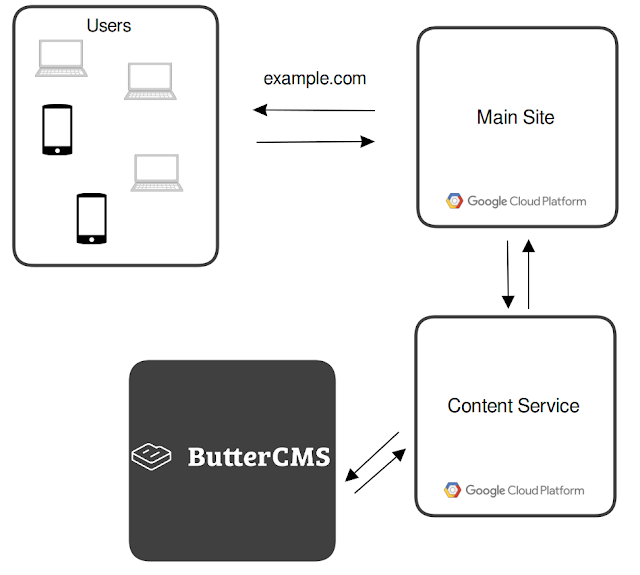
The tutorial shows you how to manage the content for the online store in Butter, and later retrieve it using the Butter API. It illustrates a good practice of encapsulating the implementation details of communicating with Butter in a separate content service. The website communicates with this content service to retrieve and render the content.

This design makes the system extensible and maintainable. For example, you could combine additional content from other sources or swap out Butter entirely for some other system, simply by changing the content service. Both the example website and the content service are deployed with App Engine.

It’s an elegant solution that shows how to use your existing web development skills, and impress your web developer colleagues by quickly building a complex, content-rich website designed in a service-oriented fashion. Your marketing colleagues, meanwhile, get a fully featured portal to manage their content, and see it scale automatically as the website goes viral.
Happy developing!

Quelle: Google Cloud Platform

Vagrant erreicht Level 2

Ohne großen Paukenschlag hat HashiCorp das Entwicklertool Vagrant auf Versionsstand 2.0 gehoben. Die Summe der Änderungen aus den letzten fünf Jahren rechtfertigt laut Entwicklern diesen Schritt.

Quelle: Heise Tech News