Read Apple CEO Tim Cook's Email To Employees About Charlottesville

Justin Sullivan / Getty Images

On Wednesday evening Apple CEO Tim Cook sent an email to all global employees condemning racism and bigotry as well as President Trump's response to the tragedy in Charlottesville, according to an email obtained by BuzzFeed News.

“Hate is a cancer,” Cook wrote to employees, noting that Apple must be “unequivocal” about fighting and denouncing bigotry in all forms.

Cook called for unity among Apple employees regardless of political views and affirmed the company's commitment to inclusion. Most notably, Cook came out strongly against Trump's press conference remarks on Tuesday afternoon.

“I disagree with the president and others who believe that there is a moral equivalence between white supremacists and Nazis, and those who oppose them by standing up for human rights. Equating the two runs counter to our ideals as Americans,” he wrote.

According to Cook's memo, Apple will be making two separate $1 million donations to both the Souther Poverty Law Center and the Anti-Defamation League. The company will also match employee donations to these and other groups two-for-one until September 30th. Cook also said that Apple would soon offer its users a way to contribute to the Southern Poverty Law Center through iTunes.

Here is the email in its entirety:

Team,

Like so many of you, equality is at the core of my beliefs and values. The events of the past several days have been deeply troubling for me, and I’ve heard from many people at Apple who are saddened, outraged or confused.

What occurred in Charlottesville has no place in our country. Hate is a cancer, and left unchecked it destroys everything in its path. Its scars last generations. History has taught us this time and time again, both in the United States and countries around the world.

We must not witness or permit such hate and bigotry in our country, and we must be unequivocal about it. This is not about the left or the right, conservative or liberal. It is about human decency and morality. I disagree with the president and others who believe that there is a moral equivalence between white supremacists and Nazis, and those who oppose them by standing up for human rights. Equating the two runs counter to our ideals as Americans.

Regardless of your political views, we must all stand together on this one point — that we are all equal. As a company, through our actions, our products and our voice, we will always work to ensure that everyone is treated equally and with respect.

I believe Apple has led by example, and we’re going to keep doing that. We have always welcomed people from every walk of life to our stores around the world and showed them that Apple is inclusive of everyone. We empower people to share their views and express themselves through our products.

In the wake of the tragic and repulsive events in Charlottesville, we are stepping up to help organizations who work to rid our country of hate. Apple will be making contributions of $1 million each to the Southern Poverty Law Center and the Anti-Defamation League. We will also match two-for-one our employees’ donations to these and several other human rights groups, between now and September 30.

In the coming days, iTunes will offer users an easy way to join us in directly supporting the work of the SPLC.

Dr. Martin Luther King said, “Our lives begin to end the day we become silent about the things that matter.” So, we will continue to speak up. These have been dark days, but I remain as optimistic as ever that the future is bright. Apple can and will play an important role in bringing about positive change.

Best,

Tim

Quelle: <a href="Read Apple CEO Tim Cook's Email To Employees About Charlottesville“>BuzzFeed

Apple Pay Is Cutting Off White Supremacists

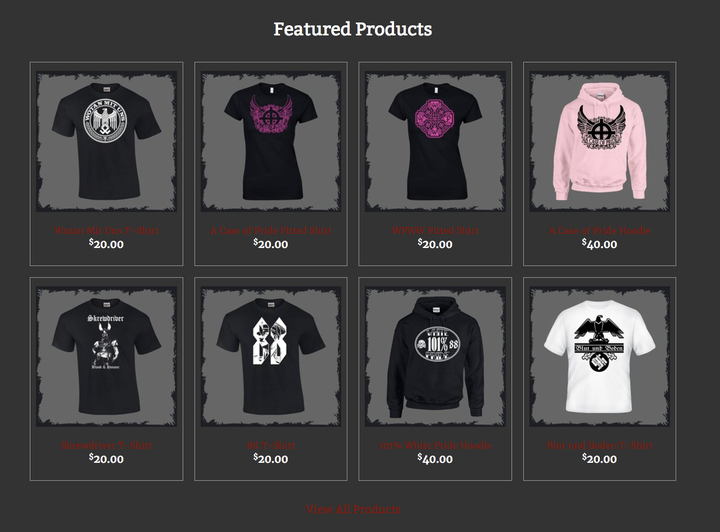
A screenshot of some the product offerings from VinlandClothing.com, which was banned from using Apple Pay and PayPal for selling Nazi apparel.

Blake Montgomery/BuzzFeed News / Via vinlandclothing.com

The most valuable company in the world is taking a stand against websites selling apparel and paraphernalia from white nationalists and hate groups.

On Wednesday, Apple confirmed to BuzzFeed News that it had disabled Apple Pay support for a handful of websites that sold sweaters with Nazi logos, t-shirts emblazoned with the phrase “White Pride” and a bumper sticker showing a car plowing into stick figure demonstrators. Following Saturday’s Charlottesville demonstrations, where one woman was killed by a car driven by a white nationalist, the iPhone maker blocked three white nationalist sites from using Apple Pay.

Apple was unable to provide comment for this story at the time of publication; A spokesperson referred BuzzFeed News to the company’s guidelines for Apple Pay which forbid the service’s incorporation into sites promoting hate, intolerance and violence.

Apple’s move to distance itself from these sites comes as a number of technology companies have faced intense scrutiny for enabling the websites or social media accounts of white nationalist and white supremacist organizations. On Monday, both GoDaddy and Google removed the registration capabilities of The Daily Stormer, a white supremacist blog, in response to its posts about the events in Charlottesville.

“We’ve seen the terror of white supremacy & racist violence before,” Apple CEO Tim Cook wrote on Twitter on Monday. “It's a moral issue – an affront to America. We must all stand against it.”

Uber, Facebook, Twitter, MailChimp, and WordPress have all taken varying levels of action against white supremacists on their platforms in the wake of Charlottesville. Airbnb banned people tied to white supremacist groups who attempted to use its site to book lodging for the rally last week. Intel's CEO and other leaders resigned from President Donald Trump's manufacturing council over what they saw as Trump’s inadequate condemnation of the violence and rhetoric from racist groups over the weekend. On Wednesday, Trump disbanded two major business councils following a cascade of member resignations.

Apple removed Apple Pay capabilities from little-known sites including AmericanVikings.com and VinlandClothing.com, the latter of which sells apparel with Nazi logos. Apple Pay’s “acceptable use guidelines” state that users may not incorporate its payment service into a site that “promotes hate, violence, or intolerance based on race, age, gender, gender identity, ethnicity, religion, or sexual orientation.”

Heidi Beirich, leader of the Southern Poverty Law Center’s Intelligence Project, praised Apple’s actions, and likened the move to one in 2014 when the company removed songs from iTunes that the SPLC had characterized as “hate music.”

“Tim Cook has been the leader in the fight against hate on tech platforms,” she said. “It would be a much better country if people had followed Tim Cook’s lead on this front.

A screenshot of a bumper sticker being sold on AmericanVikings.com, which was banned from using Apple Pay on Wednesday.

Ryan Mac/BuzzFeed News / Via AmericanVikings.com

Both VinlandClothing.com and AmericanVikings.com were hosted by GoDaddy, which provides users several options, including PayPal and Stripe, to process online payments. A spokesperson for Stripe said they were looking into the issue, but typically do not comment on individual users. GoDaddy said it was looking into the issue as well but has not commented.

A third site on which Apple disabled payments had gone offline before publication time. Shopify, which hosted the site, Behold Barbarity, did not return a request for comment.

Brien James, the owner of AmericanVikings.com said he identifies as “a civic nationalist” and “pro-white” and told BuzzFeed News he was unaware his business had even accepted Apple Pay. His six-year-old site currently sells white pride t-shirts as well as a bumper sticker that shows a car plowing into protestors that reads “No one cares about your protest.” James called the site a hobby, and did not seem too worried about losing payments capabilities or the possibility of being taken offline.

“I don’t know the legalities of free speech on a website or if you own a hosting company… but if you run a business you have a right to decide who or not you do business with,” James said. “If they don’t like me, they don’t have to do business with me.”

James said Facebook had removed his “American Viking Political” page earlier on Wednesday. His site still currently accepts PayPal. A PayPal spokesperson said the has banned Vinland Clothing and Behold Barbarity and confirmed that American Vikings can still accept payment via PayPal.

PayPal wrote in a blog post yesterday, “Intolerance can take on a range of on-line and off-line forms, across a wide array of content and language. It is with this backdrop that PayPal strives to navigate the balance between freedom of expression and open dialogue — and the limiting and closing of sites that accept payments or raise funds to promote hate, violence and intolerance.”

“If they don’t like me, they don’t have to do business with me.”

The SPLC’s Beirich had less flattering things to say about PayPal, though she did laud their actions: “PayPal has been the banking system for white nationalism, but this action is a great change in direction for them. We’ve been in correspondence with them about this for two years, and at times didn’t feel like they were taking it seriously. We’re very pleased that PayPal is going to enforce its terms of service aggressively.”

Apple and PayPal’s actions will likely exert pressure on credit card companies to act against white supremacists. Color of Change, a nonprofit advocating for racial justice, has started a campaign called Blood Money listing known hate groups that use major credit cards, employ payment processing services or sell items on Amazon.com. Blood Money was among the first to point out the three sites that Apple later banned from using Apple Pay.

PayPal told BuzzFeed News it had been working with Color of Change “for some time” on reviewing the sites listed for violations of the company’s Acceptable Use Policy. It has removed 34 of the sites on the list but said that “the process can take some time. It’s very thorough.”

After cutting service from larger, more well-known hate group sites — PayPal banned the Daily Stormer back in 2014, for example — payment processors are now scrambling to deal with many smaller ones that litter the web as they face increasing scrutiny over allowing hate groups to use their technology.

PayPal has banned some associated with the alt-right in the past six months, but the Southern Poverty Law Center (SPLC) alleged that PayPal had allowed eight white nationalists, including Unite the Right Organizer Jason Kessler and noted alt-right white nationalist Richard Spencer, to use its technology to raise funds for the Unite The Right rally. PayPal told BuzzFeed News that the company had already banned or hobbled some of the eight accounts in the SPLC’s blog post prior to Unite the Right and that it canceled almost all of the rest after the SPLC’s blog post.

Discover said in a statement to BuzzFeed News, “In light of recent events, we are terminating merchant agreements with hate groups, given the violence incited by their extremist views.”

The credit card company declined to specify which groups.

Quelle: <a href="Apple Pay Is Cutting Off White Supremacists“>BuzzFeed

Security Management Operations

This article positions key features employed by Red Hat CloudForms to secure the wealth of management operations it provides as a Cloud Management Platform (CMP).
 

CloudForms Providers
Red Hat CloudForms connects to providers, these are management end-points that provide to CloudForms inventory, metrics, event and automation capabilities. Red Hat CloudForms transforms these provider capabilities into business aligned Service Management, Compliance and Optimization.


When connecting to a provider Red Hat CloudForms does so using a set of credentials or token/key access.
 

Accessing CloudForms Providers
The level of access to a provider is determined by the use cases you wish to fulfill. This infers that the level of access could be restricted to the minimum requirements which is a good security practice.
However the features that CloudForms provides as a Cloud Management Platform to the providers it supports are such that the level of access required is typically way past the threshold of minimum requirements, in fact in practice for Red Hat CloudForms the administrator account is required but not mandated for most providers.
Each provider differs in the capabilities it can provide for automation, metric stored, inventory discovered or events collected. Therefore there is no single solution on the provider side than to configure a custom set of privileges per provider platform, maintain this as new use cases are covered by Red Hat CloudForms. This is a huge undertaking as follows;
Day 1 : The service account is configured with least privilege for the only provider connected to CloudForms. All working OK.
Day 2 : A new use case is to be covered by CloudForms, this would require updating the service account to include any new privileges required to meet the new use-case.
This process has to be repeated every time Red Hat CloudForms is given new use cases to cover in the environment.
Accessing a provider with an account of most privilege is of concern for the following reasons;

Extends the attack surface of the platform to encompass the management platform too.

This is a valid concern. Without the management platform you could state that number of entry points to the provider platform is less. The issue with this argument is that the provider platform itself should be questioned on its ability to granularly apply role based access rules to every operation performed from its tooling. This is where CloudForms adds security value to the provider platform, ensuring compliance and governance is adhered to, a capability not covered by any of the provider endpoints that Red Hat CloudForms integrates with.

The management platform has destructive capabilities that it can perform on a provider platform.

The capability to remove objects from a provider platform or add new ones to it forms a major role in most Cloud Management use cases.
Example – Quarantine virtual machines that are exposed to Heartbleed.
This use case, requires change rights in a provider platform. The use case also addresses a primary security concern.
In both cases one has to balance the need for automation and compliance against that the need of security requirements. This is why when addressing security requirements it’s important to do so knowing that the answer is not always a simple yes or no to compliance.  Often there is need to defer a requirement to a dependent secondary service such as authentication, or mitigate the compliance to the requirement through the use of a solution rather than just a single feature.
 

Secure Operations Management
The balance addressed in this article is to simply give the management platform full rights to the provider platform but in turn secure the management platform to meet the security requirements for connecting to the environment. After all, every environment should have  a pattern for onboarding management services as its a base capability for a management platform to connect to an end point.
We discuss the features that CloudForms employs under two headings Deferring or Mitigating.
 

Deferring
The following features in CloudForms would be considered deferrable. By that we mean secondary services should meet the security requirement.
Red Hat CloudForms supports the following authentication solutions;

IPA/AD Trust Authentication – Active Directory (AD) Trust Authentication in Red Hat CloudForms is supported with External Authentication to IPA.

This provides IPA Users access to the Appliance Administrative UI and the REST API using their AD credentials using the kerberos authentication protocol.

LDAP/LDAPS – This is most common and is native to CloudForms. LDAP/LDAPS allows for access to Microsoft Active and other directories. The groups are fetched and matched in CloudForms, giving pass through access to CloudForms Role Based Access mode and tenant spaces.
Single Sign On – Implemented with Keycloak and using SAML v2.0. The SAML implementation has been tested with KeyCloak but is implemented generically using Apache’s mod_auth_mellon module and should work with other SAML Identity Providers.

The current implementation only secures the Appliance’s Web administrative UI with SAML.

Two Factor Authentication – CloudForms external authentication provides 2-Factor Authentication via IPA. This provides IPA Users access to the Appliance Administrative UI and the REST API using their IPA Password followed by a One-Time-Password.

 
Apache Web Server
CloudForms uses the Apache web server to present the API and UIs through. SSL encryption is fully supported for all access.
 
Red Hat Enterprise Linux
Red Hat CloudForms is available as virtual appliance, this has a based operating system of Red Hat Enterprise Linux. Direct access to the operating system is governed as any secure implementation of Red Hat Enterprise Linux.
 
Firewall
The firewall configuration for CloudForms by default is the minimum viable for full product function.
 
Security Technical Implementation Guide – (STIG)
CloudForms can be configured to be locked down to be complaint against STIG requirements.
 
Security Content Automation Protocol – (SCAP)
CloudForms can be configured to be locked down to be complaint against SCAP vulnerabilities.
 

Mitigating
We mitigate the use of administrator access to a provider platform because CloudForms can secure its user and api entry points against misuse or attack using the following features;
 
Auto Logout
Users are automatically logged out of Red Hat CloudForms after 5 mins of inactivity. This is configurable.
 
Role Based Access
CloudForms employs Role Based Access Control. Within CloudForms and an administrator can define new custom roles or use out of the box ones to finely control what areas of the User Interface a role may access and to what level of access such as view, modify, execute or delete.
The following is the role tree that defines the object areas within the CloudForms UI and the level of access.


The example shows the out of the box “Limited Self Service User” role having access to view Templates, VMs and VMs & Template accordions.
Another example could be the out of the box “Container Operator” role, that grants only access to view dashboards and topologies under container providers.


With Role Based Access you can define roles to meet the security requirements of a persona executing the use case. If you wish to allow access to Container Operators then do so using a role template similar to the above. This allows for CloudForms to connect to the container provider platform using administrator rights, but the users accessing the same provider platform though CloudForms are restricted to their use case/persona. No user will perform a duty in the CloudForms UI unless the Role for that User allows them to, this is configured by a CloudForms Administrator as part of implementation of the cloud management platform.
 
Tenancy
Red Hat CloudForms implements a tenancy model for defining your organisation structure in. This allows for group level access to the resources that are available in the tenant space. No one tenant can access each other’s resources without the rights to do so.  Tenancy is configured by a CloudForms Administrator as part of implementation of the cloud management platform.
The default tenant model out of the box is as follows;


The tenant “My Company” is allowed access to all resources that the group list shows in the graphic.


Shown is the tenant “Line of Business”, that has only the “Standard User” group assigned. This group has only access to resources as defined by the CloudForms administrator. The group belongs to a Role as described in the previous section.
Tenants also support child tenants and projects. Either of which inherit from the parent and can have their own group assignments. Tenants, Child Tenants and Projects should meet most organizational structures.
 
Quota
You will want to protect your provider platforms from over provisioning, CloudForms introduces quota to the provider platforms it supports. Tenants, Projects, Groups or individual Users can be assigned quota limits. Example;


The example shows that the “Line of Business” tenant has 100 Virtual CPUs Allocated.  Currently nothing has been provisioned, but as new VMs are provisioned into a provider for users in this tenant the “In Use” will increase;


The graphic now shows that 50 Virtual CPUs have been consumed and 100 Allocated so 50 remain.
Having quota protects the provider platforms from being over provisioned. The provider platform administrators can adjust the quotas in CloudForms to meet the environmental limits or business needs, such as project budget control.
 
Reporting
CloudForms has extensive reporting capabilities. The reporting engine can access any of the event, inventory, metric or request history stored in the Virtual Machine Database. Reports generated can be automatically emailed to alert users of issues or status of the provider, their virtual machines or CloudForms itself. For example provider platform administrators could ask for a report to be generated that details the users defined in CloudForms and actions performed on a daily basis.


The graphic shows the request history as a sample report that can be saved or emailed. This can alert provider platform administrators to issues with the platform or to user activity.
 
Dashboards
CloudForms users are presented dashboards of information pertaining to their resources in their tenant space.
The default out of the box dashboards mixes user and operator information in a single view.


You may wish to restrict what users see, such as there is little requirement for a user to view the capacity and utilization of the underlying hypervisor hosts.


The graphic shows a new dashboard with only the “Guest OS Information” and “Vendor and Guest OS Chart”. The result is


Having the ability to mashup dashboard for your business needs is also a security requirement to ensure that the management platform is presenting the right level of information to varying user groups.
 
Smart State
CloudForms is unique as a Cloud Management Platform in that it can scan the internal file system of virtual machines and instances. The technology is called Smart State and can return Users, Groups, Processes, Packages, Applications, Registry Keys, Files and File Contents. The capability has varying support for both Windows and Linux file systems.


Users and Groups identified can be used to see if virtual machines including CloudForms itself has had its operating system account database adjusted.


This example shows the packages found along with files identified. You can configure CloudForms to scan for certain files and collect their contents back for further conditional processing. Knowing the packages and package versions allows you to identify vulnerabilities or misconfiguration of server roles.


This example shows how the contents of a file can be retrieved by CloudForms. Having the contents available inside CloudForms allows for further reporting of misconfigurations or non-compliance. This feature can be used to identify if CloudForms itself is drifting in configuration from the requirements mandated by the provider platform.
 
Compliance
CloudForms can check the compliance of any virtual machine or instance.


The example shown is for a virtual machine where a compliance policy has been defined and ran for SELinux enforcement. For the compliance to check this, the previously discussed Smart State technology was used to collect the contents of the selinux.cfg file on the filesystem and conditionally process its contents for the desired setting. CloudForms can have the provider platforms requirements defined as policies within its “Control” capability and applied to itself, alerting non-compliance via email or any other means available to automate or Ansible.
 
Container Smart State
CloudForms also offers the same compliance as virtual machines against the Smart State detail collected for container images.


The example shows the packages collected and also an additional compliance feature of SCAP results.


The SCAP results show what vulnerabilities exist in container images. This is a value item to the provider platform. Without CloudForms performing this duty, the container provider platform is exposed to running non-compliant container images.
 
Automate
The Automate area of the product allows for automation to be defined and executed. This area of the product is governed by the Role Based Access system and can be enabled or disabled per role and group. Only CloudForms administrators and Automation Engineers would/should have access to this area.
 
RESTapi
CloudForms can be accessed over a RESTapi, this is secured using the same authentication subsystem to that of the CloudForms user interfaces.  This means that when you authenticate with the RESTapi the visibility and actions you can perform is limited by the role based access model defined for your tenant, project or group space.

Virtual Management Database (VMDB)
CloudForms stores all the requests, metrics, events and inventory information within its VMDB. This means that you can track or trace any action performed by CloudForms, or on the provider by other tooling. You can use CloudForms to audit the provider platform and provide reports to unusual activity or meet regulatory requirements for audit data retention.
 
CloudForms Log Files
CloudForms stores all user actions for who, from, when and what they did within CloudForms . This means that you can track or trace any action performed by users. The log files can be picked up by any log analysis tool to identify any non compliance or you could define CloudForms policies to do this using Smart State and CloudForms Control.
 

Summary
“Users logging into CloudForms is NOT the same as CloudForms connecting to a Provider platform with Administrative rights”
This means, just because CloudForms is connected to a provider platform using an admin account does not give the users logging into CloudForms the same rights. It can, but we advise that CloudForms is implemented as a Cloud Management Platform, utilizing its RBAC model and many authentication integration points.
Quelle: CloudForms

The Pro-Trump Media's Post-Charlottesville Identity Crisis

The events in Charlottesville have created the first real crisis for the pro-Trump media, which is caught between its mainstream aspirations and its addiction to the traffic and energy of the white nationalist movement.

For the better part of 2017, the collective of Twitter personalities, trolls turned citizen journalists, and social justice-hating memelords that make up the pro-Trump media has tried to distance itself from Trumpism’s more virulently white nationalist elements. Much of that work, though, has likely been undone in the aftermath of Saturday’s deadly Unite The Right demonstrations, during which a white nationalist plowed into a group of anti-racist protesters, killing one and injuring more than a dozen.

Across the internet after the violence, the pro-Trump media’s narrative — usually clear and concise — appeared scrambled. Prominent pro-Trump personalities took to Twitter to condemn the political violence and declare the alt-right to be vile Nazis. They excoriated the anti-fascist movement and the violent and intolerant left, and they bashed the media for its anti-Trump bias and inciting rhetoric that helped create a culture of political violence.

Taken together, the hundreds of tweets, posts, and Periscopes from the “new right” over the last few days have ranged from anxious to defensive to exhausted. But most of all, they reveal a movement that, much like Trump himself, finds itself isolated — trying desperately to dissociate from the convenient alliances it made in the campaign, and in danger of irreparably tarnishing its credibility.

Throughout the campaign, the alt-right was a large, amorphous group of disparate and overlapping factions — neo-Nazis and white nationalists; young, excited, digitally savvy Trump supporters; alienated and anxious white men; media-hating opportunists; and any number of trolls, from the nihilists to the anti-SJWs. It was a convenient alliance under the banner of a candidate who continually gave voice to previously taboo cultural views.

But once their man was in office, the fissures began to show almost immediately. When reports surfaced that attendees of a Richard Spencer-hosted conference had done Nazi salutes, the moderate factions of the alt-right condemned the behavior. Then, a falling out among organizers of the pro-Trump “DeploraBall” inauguration party led to self-proclaimed white nationalist Tim Gionet (Baked Alaska) getting kicked out as an event host. Personalities such as Mike Cernovich and Jack Posobiec began distancing themselves from the alt-right by dubbing themselves the new right, an inclusive, nonbigoted nationalist movement. By June, the split was complete, with the two groups holding competing rallies and slinging insults across Twitter.

But this new right is, at present, ill-defined. It exists instead as a sort of media and communications arm for Trumpism and its core tenets: destroying the mainstream media, winning for the sake of winning, and pissing off liberals. Rather than advocating explicit policies, the new right appears more concerned with constructing a playbook for a formidable digital insurgency: Identify the outrage, swarm it, make it go viral, create chaos, control the narrative. But in order to do this, the new right must appeal to a broad audience. The movement is caught between the mutually exclusive goals of denouncing alienating ideologies like white nationalism, and continuing to appeal to the very people who made it a movement in the first place.

In this way, the new right is much like Trump. Both value attention and prominence in the news cycle above all else. Both must — at all times — speak their minds. Both flirted during the campaign with covert racists, if only by their silence. And both won and now find themselves dogged by their past association, as the alt-right trades in its fashionable haircuts for honest-to-god torches and swastikas.

Politically, the tragedy in Charlottesville offered a rare opportunity for the new right to rise above partisanship. Had the movement simply condemned the attack and said little else, or called for momentary unity with its enemies in the media and on the left, the group could have set itself fully apart from the violence. But it, like the president, opted instead to have the last word and relitigate past arguments. Borrowing from Trump’s playbook, the new right chose to play the victim. It bemoaned the attack as a massive setback for its movement. It castigated the media for dividing the country and not reporting on the violence of the left. It used the method of attack as an attempt to rehash arguments about migrants and Islamic terror.

And, like Trump, it seemed unable to avoid dredging up conspiracy theories. Alex Jones of Infowars suggested the rally was “staged” to vilify the right and stop future conservative gatherings. Mike Cernovich tweeted at KKK leader David Duke, calling him “Deep State David” as a nod to clandestine government involvement in the protests. A handful tried to blame the entire event on their favorite enemy: George Soros.

Pro-Trump media sites like Gateway Pundit and Chuck Johnson’s GotNews pushed unconfirmed stories from 4chan identifying the Charlottesville driver as an “anti-Trump druggie.” Posobiec also broadcast the unconfirmed and quickly disproved theories. Ian Miles Cheong — a Daily Caller reporter — referred his 53,000-plus followers to 4chan’s /pol/ message board floating a similar conspiracy. “I've been reviewing the evidence, the Ohio license plate, etc. The owner of the car is anti-Trump and made posts supporting communism,” he tweeted.

Like Trump, the new right appears unable to quit the fever swamp. The pro-Trump media’s leaders, publications, and followers claim the moral high ground with their denouncements of political violence and the alt-right on one hand, while pandering to the most unseemly corners of the internet on the other. Much like the president, who appears unable to sever ties with his small but dedicated base, the new right appears unable to abandon the internet’s underbelly — a place where many pro-Trump media personalities cut their teeth, and which is still frequented by part of the new right's audience. Like Trump, they denounce racism but gesture toward communities like 4chan, where ironic racism is not just an in-joke but a rite of passage.

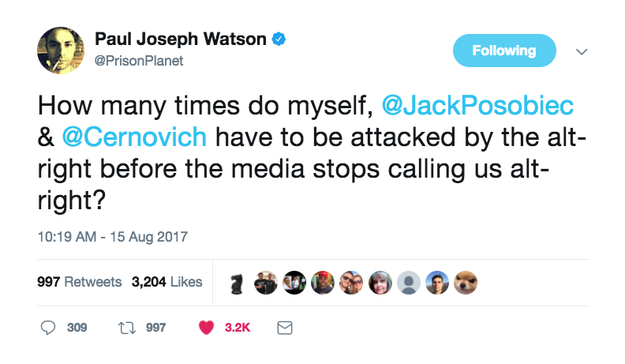
And so for now the isolation continues. On Tuesday morning, Infowars editor Paul Joseph Watson attempted to correct reports from outlets like CNN that labeled Posobiec as a member of the alt-right. For Watson — who nine months ago announced he was severing ties with the alt-right to be part of the group that “likes to wear maga hats, make memes, and have fun” — the constant distancing appears exhausting. “How many times do myself, @JackPosobiec & @Cernovich have to be attacked by the alt-right before the media stops calling us alt-right?” he tweeted.

And they aren't the only ones in this fix. Indeed, the main American figure caught halfway between the fringe and the mainstream, pleasing nobody, is the president of the United States.

Quelle: <a href="The Pro-Trump Media's Post-Charlottesville Identity Crisis“>BuzzFeed

Reference Architecture for a high availability SharePoint Server 2016 farm in Azure

The Azure CAT Patterns & Practices team has published a new reference architecture for deploying and running a high availability SharePoint Server 2016 farm in Azure.

It provides prescriptive guidance including the following topics:

Architecture resources necessary for the deployment, including resources.
Scalability considerations.
Availability considerations.
Manageability considerations.
Security considerations.

Like all reference architectures that can be found at the Azure Reference Architectures, it includes prescriptive guidance and a set of PowerShell scripts and Azure Resource Manager templates to deploy a working SharePoint Server 2016 farm with SQL Server Always On and a simulated on-premises network. The deployment time for this reference architecture may only take hours, simplifying a task that previously would take several days to build out and test.

We invite you to review the reference architecture, try out the deployment, and even contribute to this and other reference architectures on GitHub.

Note: The compute requirements for a SharePoint HA farm are significantly higher than many workloads running on-premises or in the cloud. If you do deploy this, be aware that the full deployment will consume 38 cores. So, if you’re just kicking the tires, be sure to shut down your virtual machines when you’re finished to avoid any surprises on your bill.

Below is the resulting configuration:


Quelle: Azure

Why base capabilities are no longer enough for operations management

The business objectives of an IT or network operations team have not changed substantially for years or even decades. Measures like mean time to repair (MTTR) or budget use frequently can be reduced to time, money and quality of service. Fundamentally, IT and network teams must maximize the availability of high-quality services while minimizing the cost of doing so.
The demand for services supported by larger, more sophisticated infrastructure has increased steadily, even if the objectives have not changed. Disciplines such as fault or event management have emerged and matured, and led to a set of key capabilities that are table-stakes for a credible solution. More complex infrastructure requires a solution that can:

Consume events from highly heterogeneous environments
Minimize the amount of noise that is presented to the people or processes tasked with responding to events
Integrate with other operations support systems, folding applicable context into the process of event management and resolution
Help pinpoint the probable causes of events
Scale and grow as the business and attendant infrastructure grows
Help automate responses to events
Drive efficiency improvements in operations

The new operations management playing field
I talked about what has stayed the same for IT and networks teams. So what’s changed? Pretty much everything else.
Businesses are increasingly driven by the demand for continuous delivery of cloud-scale applications and service capabilities. companies are employing key enabling technologies and architectural patterns including virtualization, containerization and microservices. And they’re relying on newer methodologies and practices, such as agile software development and DevOps. Many new services and applications sit atop and leverage backend systems that have been developed and updated over years. Some IBM clients are enabling their users with new, rapidly evolving systems of engagement—like mobile—by taking advantage of hybrid cloud.
Two things have driven the emergence of highly instrumented monitored environments: a renewed focus on the user’s experience of a business service or application, and extremely high expectations for availability. Faults and events are reported from the bottom of the technology stack to the top in traditional, cloud and hybrid environments.
While large portions of the industries we serve have begun to standardize on mechanisms for communicating management data—such as RESTful HTTP interfaces—the payload formats remain heterogenous and relate to additional layers of infrastructure with complex patterns of dependency.
In summary, apps and services are becoming more complex, dynamic, business critical and talkative. And the companies that build them have much higher expectations on availability and time-to-market.
So, how are DevOps managers and developers tasked with managing these environments going to be successful? IT and network applications might move to a point where successful operations cannot be achieved with human cognition alone.
In the next blog in this series, I’ll talk about how event analytics in Netcool Operations Insight helps with the challenges that operations management face.
To learn more, register for our webinar on the value predictive insight brings to IT operations. Check out the earlier posts in our IBM Operations Analytics series. And stay tuned for additional key learnings from our colleagues in coming weeks.
The post Why base capabilities are no longer enough for operations management appeared first on Cloud computing news.
Quelle: Thoughts on Cloud

White Supremacist Platforms Are Being Targeted By Hackers And Rejected By Hosts

White Supremacist Platforms Are Being Targeted By Hackers And Rejected By Hosts

Justin Ide / Reuters

Several right wing extremist websites and accounts that amplify bigotry were apparently hacked or denied service on various platforms in the wake of the race-fueled fatal white supremacist march this weekend in Charlottesvile, Virginia.

The Daily Stormer, 4chan's Twitter accounts, and Richard Spencer's website were among those hacked or denied service.

GoDaddy, the world’s largest seller of domain names on the internet, said on Sunday that it would no longer provide service to the Daily Stormer, a popular neo-Nazi and white supremacist website. The company has been criticized for providing services to white supremacist websites despite its terms of service that ban “morally offensive activity.”

The action was taken after The Daily Stormer posted an offensive article about Heather Heyer, a 32-year-old legal assistant, who was killed after a car drove into a group of protestors following the Unite the Right white supremacist rally in Charlottesville, Virginia on Saturday.

“Given that [The Daily Stormers’] latest article comes on the immediate heels of a violent act, we believe this type of article could incite additional violence, which violates our terms of service,” a GoDaddy spokesperson said. The company clarified that it does not host any Daily Stormer content on its servers but merely provided the domain name.

GoDaddy also appeared to drop the domain privacy protection for the Daily Stormer website, according to one Twitter user.

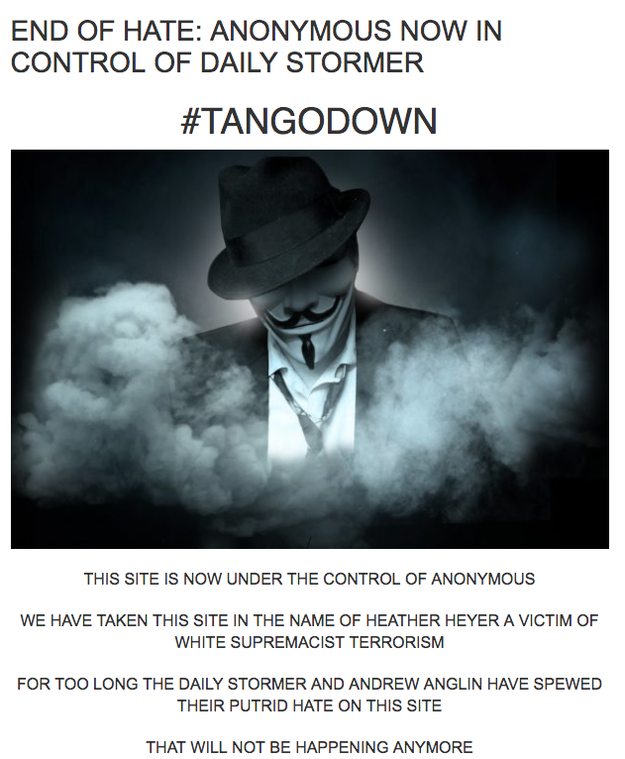
Shortly after GoDaddy announced its decision, the Daily Stormer website appeared to be under the control of the hacker group Anonymous. On Saturday, the group urged its followers to hack alt-right and white supremacist sites as part of what it called #OpDomesticTerrorism.

The Daily Stormer / Via dailystormer.com

After being rejected by GoDaddy, the Daily Stormer was briefly hosted by Google — until the company also shut the site down.

“The Stormer registered this morning with google domains and were immediately reviewed and suspended for Inciting violence,” a source told BuzzFeed News about Google's decision.

The Daily Stormer's YouTube account has also been terminated “due to multiple or severe violations of YouTube's policy prohibiting hate speech,” according to a message now displayed on the page.

BuzzFeed News has reached out to the Daily Stormer for comment.

On Monday, a major Anonymous twitter account, @youranonnews, said that they had no confirmation that Anonymous was behind the Daily Stormer hack and suggested that it was a stunt by the website itself to “woo their clueless base.”

Earlier, the Twitter account had claimed that the campaign had taken down other white nationalist and alt-right websites, including Richard Spencer's Altright.com. (The site appears to now be online forwarding to new servers.)

On Saturday, Henrik Palmgren of Red Ice, a white supremacist multimedia platform based in Sweden with more than 130,000 subscribers on YouTube, said its website was down and that hackers were threatening to release the names of some 23,000 people with paid subscriptions to the site.

And on Monday, Twitter also appeared to shut down accounts affiliated with /pol — a 4Chan message board that has been linked to extremist beliefs — its creator said. Twitter declined to comment on individual accounts, as is its policy.

Other tech platforms made individual or blanket policy decisions after the events in Charlottesville.

Over the weekend, Facebook removed Unite the Right's event page. Facebook removes event pages when the threat of real world harm and an event’s connections with hate organizations become clear, a Facebook spokesperson told BuzzFeed News.

The company also removed a number of other pages since the weekend, and said tools it uses to identify and remove hate speech are the same it's using to combat terrorism.

“Our hearts go out to the people affected by the tragic events in Charlottesville,” a Facebook spokesperson said. “Facebook does not allow hate speech or praise of terrorist acts or hate crimes, and we are actively removing any posts that glorify the horrendous act committed in Charlottesville.”

The newsletter service mailChimp announced Monday that it has updated its terms of service to ban hateful content.

And by Monday night, WordPress had suspended the site belonging to American Vanguard, one of the white supremacist groups that organized the weekend rallies in Charlottesville.

WordPress

WordPress' User Guidelines prohibit illegal content and conduct as well as threatening material, including “direct and realistic threats of violence.”

Over the last few months, PayPal has banned accounts of several alt-righters, and crowdfunding platforms like GoFundMe, Patreon, and YouCaring, have also cut fundraisers for white supremacy-related causes. Last week, Airbnb started deactivating accounts of people it believed were booking units to host gatherings related to the rally.

LINK: Google Joins GoDaddy In Booting Neo-Nazi Site Daily Stormer

LINK: Protests Erupt Nationwide After Deadly White Supremacist Rally In Charlottesville

LINK: This Twitter Account Is Trying To Identify People Who Marched In The Charlottesville White Supremacist Rally

Outside Your Bubble is a BuzzFeed News effort to bring you a diversity of thought and opinion from around the internet. If you don't see your viewpoint represented, contact the curator at bubble@buzzfeed.com. Click here for more on Outside Your Bubble.

Quelle: <a href="White Supremacist Platforms Are Being Targeted By Hackers And Rejected By Hosts“>BuzzFeed

Reference Architecture for SAP NetWeaver and SAP HANA on Azure

The Azure CAT Patterns & Practices team has published their first reference architecture on SAP NetWeaver and SAP HANA on Azure, which covers SAP workloads running in Azure. It provides prescriptive guidance on how to run SAP HANA on Azure including the following topics:

Architecture resources necessary for the deployment, including recommendations.
Scalability considerations.
Availability considerations.
Manageability considerations.
Security considerations.

Like all reference architectures that can be found at the Azure Architecture Center, it provides a set of PowerShell scripts and Azure Resource Manager templates to deploy the reference architecture. The deployment time for this one is about 2 hours, making simple a task that previously would take days.

This reference architecture expands on the Hybrid VPN reference architecture that will typically be used in a production environment. However, this reference architecture does not deploy the Hybrid VPN resources. Instead, it deploys everything but the VPN gateway in the cloud. So, if you plan to implement the SAP HANA reference architecture in a production environment consider deploying the Hybrid VPN reference architecture first. Then, you’ll be able to deploy the SAP HANA reference architecture into your virtual network configured with VPN.

We invite you to review the reference architecture, try out the deployment, and even contribute to this and other reference architectures on GitHub.

Note: The compute requirements for SAP are significantly higher than many workloads running on-premises or in the cloud. If you do deploy this, be aware that the full deployment will consume 49 cores. So, if you’re just kicking the tires, be sure to shut down your virtual machines when you are finished to avoid any surprises on your bill.

Here is the resulting configuration:


The deployed resources have been tuned for SAP HANA, as follows:

VM SKUs have been validated for small to medium SAP deployments.
VM computer names are set up per SAP requirements.
.NET 3.5 is loaded for the SCS machines, as required by SIOS DataKeeper.
Health probe has been set up for TCP 59999 with a 10 second interval and 30 second idle.
A jumpbox for administrative purposes was deployed.

Quelle: Azure