I.D. Buzz: VW baut den Elektro-Bulli

Volkswagen hat sich dazu durchgerungen, den Mikrobus I.D. Buzz doch zu bauen. Bisher gab es das Elektroauto, das an den legendären ersten Bus von VW erinnern soll, nur als Konzeptstudie. Der I.D. Buzz wird rein elektrisch angetrieben und soll auch als Nutzfahrzeug angeboten werden. (VW, Technologie)
Quelle: Golem

Twitter Grapples With "Verified" White Supremacists As Other Tech Companies Crack Down On Hate Speech

Kacper Pempel / Reuters

The reaction from major tech companies to the deadly white supremacist rally in Charlottesville, Virginia, was swift.

Apple cut off white supremacists from Apple Pay. Google and GoDaddy booted a Nazi website. And Facebook, WordPress, OkCupid, and others moved to ban white supremacists or crack down on hate speech.

Meanwhile on Twitter, people who use their accounts to spread white supremacist messages haven't just been left alone, they're operating with coveted blue “verification” checkmarks, putting the social media giant in the increasingly difficult position of trying to defend the “all speech” tenant it was founded on against a user base that is demanding more accountability.
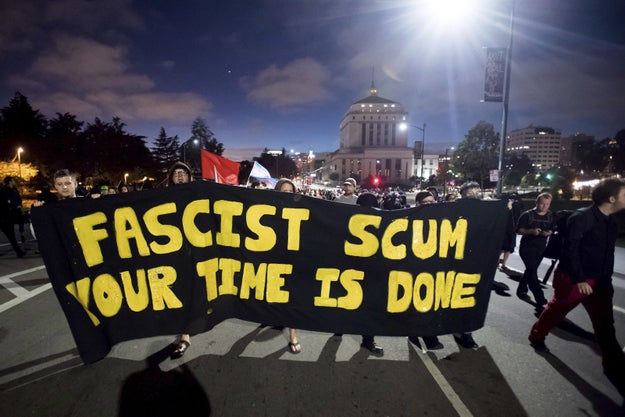
Protesters against racism march through Oakland on Aug. 12, 2017.

Noah Berger / AP

While Twitter says the checkmarks are meant to confirm that users are who they say they are on the social network, many see them as symbols of legitimacy or an indication of a user's prominence.

In the wake of the Charlottesville attack, Twitter did suspend a few accounts, but observers are questioning the company's decision to stand by the “verified” checkmarks for accounts associated with white supremacism, which in some cases rally massive troll armies and distribute everything from racist Pepe the Frog memes to Nazi imagery.
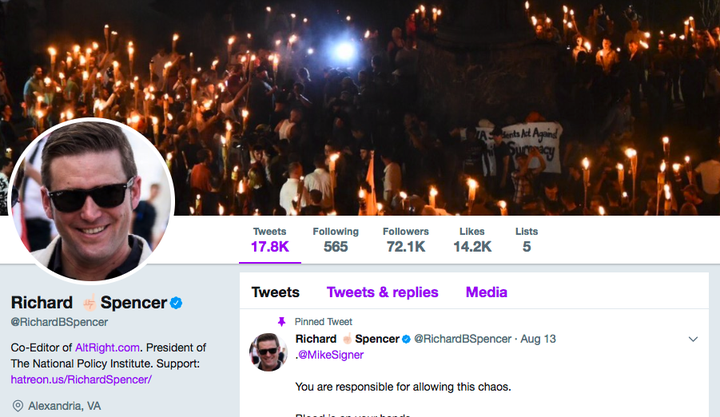
Twitter / Via Twitter: @RichardBSpencer

Twitter insists that the blue checkmark isn't an endorsement of the content an account shares and doesn't constitute special or elevated status. Instead, verification is supposed to let “people know that an account of public interest is authentic,” according to Twitter's official description.

“Typically this includes accounts maintained by users in music, acting, fashion, government, politics, religion, journalism, media, sports, business, and other key interest areas,” the company adds.

Twitter's pages about hateful conduct and online abuse don't mention anything about verification. If someone does break Twitter's rules — such as harassing another user — they face penalties that include having their account suspended.

But there's one very high profile case that significantly muddies Twitter's explanation of verification as a simple tool to tell who's who: Milo Yiannopoulos, the right-wing provocateur who lost his verified status last year.

Citing a policy of not commenting on specific accounts, Twitter has refused to say what Yiannopoulos did to lose his verification (he was later permanently banned). Yiannopoulos has also never been specific about why he thought he was unverified, but one Twitter executive suggested it was for a tweet containing the phrase: “You deserve to be harassed.”

A person familiar with the situation who spoke on the condition of anonymity told BuzzFeed News the decision to take action against Yiannopoulos was hotly debated inside Twitter at the time. Some argued the best vehicle to handle Yiannopoulos was through suspension.

“The ultimate decision was to do the verification, I think in part because, at the time, the policies, as written, made it quite difficult to suspend him,” the person said. “Because it was sort of the case of, 'We don’t want him on the platform, but he knows the rules really well.'”

In losing his verification, Yiannopoulos told BuzzFeed News that Twitter was using “a tool for establishing the identity of prominent people as an ideological weapon.”

“Obviously it also confers a sense of legitimacy,” he said.

The person familiar with the situation agreed that after its introduction, verification became more than just a way to identify if a person is who they say they are.

“That badge became literally sort of a badge of honor,” the person said. “People craved having the checkmark as a status symbol.”

As a result, in the days following Charlottesville, numerous users took to the platform — with some tweeting directly at Twitter CEO Jack Dorsey — to ask why people associated with extremism still have that “badge of honor.”

Some of the verified users spotlighted by observers used Twitter to promote the white supremacist rally in Charlottesville, and the social network remains their refuge as other major tech companies crack down on their presence.

Alt-right figures such as Tim Gionet, a former BuzzFeed employee better known by his Twitter handle @bakedalaska, tweeted promotional material for the rally. Richard Spencer, who was once temporarily banned from Twitter, shared numerous images and messages glorifying the scene. And a woman who uses the pseudonym Ayla and the Twitter handle @apurposefulwife invited people to watch her speak at the rally.

Questions have been raised about a number of other verified accounts as well, some of which weren't directly involved in Charlottesville, but routinely share racist content.

At the same time, some of these users are facing crackdowns on other platforms. After the recent violence, Paypal and web hosting company Squarespace cut off Spencer's National Policy Institute, a white nationalist think tank.

The pushback has been so widespread that on Friday Ayla wrote a blog post criticizing tech companies for “deplatforming us,” while Spencer wrote that “corporate America” was campaigning “to shut our web outlets down.”

When they needed to get their message out about the crackdown, they turned to Twitter.

Yiannopoulos said the platform is “structured to give more features and visibility to verified users.”

The person familiar with Twitter's policies said that in the past, verified accounts were prioritized by the social network's algorithms and would land higher in search results and “top tweets” sections. That prioritization actually came up during the conversation about what to do with Yiannopoulos, with some in the company arguing that “we should be under no obligation to promote someone that we feel is bad for the platform.”

Twitter did not respond to questions about whether tweets from verified accounts still get priority.

John Wihbey, a media professor at Northeastern University who has studied Twitter, told BuzzFeed News that it is widely believed verification “generates an additional layer of trust.”

Wihbey said the boost in perceived legitimacy may be waning today, (Yiannopoulos also said verification isn't what it used to be) but the perception still lingers.

“The blue checkmark is an important status symbol and it’s also a signaling that you’ve gone through some kind of vetting process,” he said.

In the wake of Charlottesville and President Trump's much-criticized remarks blaming “both sides” for the violence, many Twitter users are frustrated that the platform appears to be treating every side equally, a position at odds with other tech companies.

Twitter's approach to verification “isn't coherent in terms of the platform's overall approach to identity,” said Nicco Mele, director of Harvard's Shorenstein Center on Media, Politics and Public Policy.

“They don’t want to be gatekeepers, and yet sometimes they are gatekeepers,” he said. “Are they going to privilege truth? Or are they going to treat InfoWars the same way they’re going to treat the New York Times and BuzzFeed?”

The person familiar with Twitter's policies said that there are also differing opinions within the company, adding that “many view it as a good idea that got out of control and would be just as happy if verification didn’t exist.”

Wihbey, who said he spoke with Dorsey in the social network's early days, added that Twitter simply may not have been prepared for its evolution into a home for extremists with massive followings.

“To be honest, this whole 'herds of white nationalists and Russian bots,' it was just not foreseeable when they were founding the company and setting the rules of the game,” Wihbey said. “And once that ship is out to sea, it’s pretty hard to rebuild out in the middle of the ocean.”

But while he favors allowing people — even those with “totally repugnant” views — to have Twitter accounts, Wihbey said he doesn't think it's necessary to “help them with additional designations of credibility.”

“I think it's a problem for any hate group to be given extra designations, such as a verified account,” he said. “I'm not sure they meet the 'public interest' standard as articulated by Twitter.”

LINK: Here’s What Really Happened In Charlottesville

LINK: Apple Pay Is Cutting Off White Supremacists

LINK: Twitter’s Favorite Excuse Is Failing The Public

Quelle: <a href="Twitter Grapples With "Verified" White Supremacists As Other Tech Companies Crack Down On Hate Speech“>BuzzFeed

Ignore The Bullshit: iPhones Are Not Destroying Teenagers

Nicholas Kamm / AFP / Getty Images

Millennials may soon yearn for the days when our breakfast habits could launch a thousand thinkpieces. The oldest of us are now exiting the coveted 18-34-year demographic, meaning our days as the darlings of marketers and chin-scratchers everywhere are numbered. The youth culture industry is already moving on, shifting its attention to the post-millennial cohort, currently nicknamed “Gen Z.”

The worst example of this in recent memory was Have Smartphones Destroyed a Generation?, a particularly panicky Atlantic cover story by psychology professor, corporate consultant, and onetime millennial-whisperer Jean M. Twenge. The Atlantic has a particular affinity for this kind of trendy worrying dressed up as somber big-think remember Is Google Making Us Stupid? — and Twenge delivered it in droves here, arguing that the time today's teens spend alone with smartphones is poisoning them forever.

Twenge has been on the youth-scare beat for a while, and it’s notable that she has now turned to post-millennial fearmongering. I first encountered her work back in the mid-2000s, around the time when Twitter was launching and Time magazine was declaring us all “Person of the Year.”

Her first major foray into millennial thinkery was her 2006 book Generation Me: Why Today's Young Americans Are More Confident, Assertive, Entitled—And More Miserable Than Ever Before. Twenge expanded on the theme in 2009 with The Narcissism Epidemic: Living in the Age of Entitlement.

These books pandered to the same complaints old people have been making about young people since time immemorial, with just enough techno-scare to make them seem fresh and relevant. And they established Twenge as a go-to quote factory for cranky think-pieces on millennials, ushering in a new wave of hand wringing over our supposed shortcomings.

Why are young adults so miserable?” asked a 2006 Today Show segment on Twenge's work. “Are social norms steadily unraveling?” wondered USA Today the same year. “Too much self-esteem can be bad for your child,” warned Alternet. Many teens are “overconfident” and “have wildly unrealistic expectations,” said Fox News. A 2009 ABC story on Twenge's work was headlined “Today's Teens More Anxious, Depressed, and Paranoid Than Ever.”

Twenge's “narcissism epidemic” narrative fit perfectly with popular confusion and fears regarding social media, technology, reality TV stars, changes in parenting styles, the disintegration of 20th century social institutions, and the changing workforce. It also echoed popular criticism of the self-esteem movement, and the “participation trophy” fears that our cranky elders had already established about the generation then commonly called “Gen Y.”

But while consumer media ate up Twenge's sky-is-falling take on millennials, her peers in academia and the scientific community began to call bullshit.

Most of Twenge's assertions about millennial narcissism come from comparing answers given by them, Gen X'ers, and baby boomers on an index called the Narcissistic Personality Inventory (NPI). They're also peppered with anecdotes and dubious insights drawn from everything from the antics of Britney Spears and Paris Hilton to rising rates of plastic-surgery and school-shootings and the popularity of subprime mortgages.

There are some generational differences in the NPI. For instance, millennials are more likely than boomers at their age to agree to statements like “I am assertive,” “I like to take responsibility for making decisions,” and “I can live my life any way I want to.”

Yet Twenge takes these differences and teases out all sorts of unjustified conclusions.

Sure, millennials — primed our whole lives to value self esteem and believe in the validity of individuality while our grandparents were taught to keep their heads down and follow the mainstream — may be more likely than our predecessors to identify with statements projecting confidence. We’re more inclined to say “I am going to be a great person” than “I hope I am going to be successful.” But there’s little evidence this has negative social effects in aggregate, or that it means millennials are more prone to destructive pathological narcissism.

In fact, “trends in youth behavior support the opposite conclusion,” as Neil Howe and William Strauss noted in a 2007 Los Angeles Times op-ed. As evidence, they pointed to falling rates of crime, teen pregnancy, abortion, premarital sex, reckless driving, and drug use; rising rates of volunteerism; and research showing that millennials get along better with their parents than previous generations did.

According to Jeffrey Jensen Arnett, a psychology professor at Clark University, “evidence overwhelmingly shows that the self-esteem and self-belief of today’s emerging adults is not 'too high' by any reasonable reckoning.”

Writing in the journal Emerging Adulthood in 2013, Arnett cautioned Twenge's conclusions are also marred by her reliance on samples of college students. College students “are not representative of emerging adults more generally,” Arnett points out. “They are wealthier, whiter, and (by definition) more highly educated than their noncollege peers.”

It’s even more biased than it sounds. Twenge drew her conclusions from an even more rarified set within U.S. college students: those who attend four-year residential institutions.

But even if we take Twenge's data at face value, it's not necessarily cause for alarm — and may in fact represent good news, not a generational crisis. Most of the rise in alleged narcissism comes from girls and women, and women were, until a few decades ago, often taught that that pride and confidence were unladylike. Is it really a bad thing that fewer millennial women feel the need to downplay their own strengths?

Ultimately, “the evidence just isn't there for an epidemic of narcissism or anything else” in Twenge's thesis, declared the Chronicle of Higher Education in 2010. “Social scientists would do well to exercise a degree of caution when interpreting data. Just like with the little boy who cries wolf, people are bound to notice too many phantom epidemics.”

If only. Memories are short, and technology changes fast. If anything, today's accelerated news cycles and well-oiled outrage machine only increases the public appetite for phantom epidemics, which brings us back to this month’s smartphone freakout in The Atlantic.

Nicholas Kamm / AFP / Getty Images

Almost all of the problems with Twenge's millennial bullshit are on display in her somber analysis of Gen Z, which she defines to include those born from 1995 through 2012.

Perhaps aware that she needed a new shtick to stay at the top of the generational-guru game, Twenge is now claiming that, around 2012, data started showing that “many of the distinctive characteristics of the Millennial generation began to disappear” (she does not say what data shows this). And Gen Z isn't just psychologically far-removed from millennials, she says — they spend their time in far different ways, too.

All of this she blames on smartphones — and it's a superficially appealing idea. Elementary school kids now have their own iPhones. My best friend's three-year-old can take a selfie. It's quite possible that growing up with smartphones and social-media may produce distinct psychological and social effects.

But it's way too early to call them yet. And Twenge's data doesn't back up her attempt to do so.

Instead, she makes grave proclamations based purely on anecdotes, correlations — such as smartphone ownership rising alongside higher rates of teen depression — and selectively wielded data. For instance, she brings up a study suggesting more unhappiness among 8th graders who are heavy use social-media users, but doesn't mention that the same study found no effect for 12th graders.

Twenge “reviews only those studies that support her idea and ignores studies that suggest that screen use is NOT associated with outcomes like depression and loneliness,” objected psychologist Sarah Rose Cavanagh in Psychology Today. And “nowhere is Twenge's bias more obvious…than in some research that she actually does review but then casts aside as seemingly irrelevant to her thesis—namely, the vast counter-evidence to the 'destroyed generation' thesis contained in her headline.”

This counter-evidence includes ample data showing that Gen Z, like millennials before them, have far lower rates of smoking, unprotected sex, car accidents, alcohol use, and teen pregnancies. (“This is what a destroyed generation looks like?” asks Cavanagh.)

Today's teens also have a lower suicide rate than teens in the 1990s, and self-reported happiness levels among teens have held relatively steady since 1997. Neither fact fits the narrative of a generation more miserable than ever before. Instead, Twenge ignores all of this and starts throwing in buzzwords like “cyberbullying” and “Snapchat” to explain the non-existent spike in Gen Z suicides.

Consider one of those examples: teens today are going out unsupervised less. There are explanations for this other than teens being ruined shells of human beings — such as increased participation in extracurriculars and organized activities — that could account for this.

But more importantly, previous generations didn't have much choice but to go out if they wanted to do things like socialize with multiple friends or watch movies. Now that teens can communicate digitally or hang out together at home watching Netflix, does it really suggest a destroyed generation if they choose to do that instead of hanging out at the local movie theater?

Twenge even sees doom in teens today holding fewer part-time jobs during the school year. But at the same time, volunteering is up, as are educational demands. The minimum wage is higher, and there are tighter regulations on teen working hours. Why should we lament, as Twenge does, a 50% drop since the 1970s in 8th graders working for pay?

Twenge tells parents the best thing they can do for their kids' health and happiness is to make them put down the smartphones. I suggest it’s the parents who should close their browsers for a minute — at least long enough to stop reading panic pieces by snake-oil generational theorists. The kids, by almost all measures, are more than alright.

Quelle: <a href="Ignore The Bullshit: iPhones Are Not Destroying Teenagers“>BuzzFeed

Amazon Kinesis Firehose can now read data directly from Amazon Kinesis Streams

Amazon Kinesis Firehose is the easiest way to load streaming data into AWS. Today we have added a built-in integration that allows you to send streaming data from Kinesis Streams to Kinesis Firehose by configuring your stream as a data source to Kinesis Firehose using the console or API. You can now create and configure a Firehose delivery stream to automatically read data from your Kinesis streams and then deliver the data to destinations. This makes it easy for you to persist data in your streams to data stores such as Amazon S3, Amazon Redshift, and Amazon Elasticsearch Service. 
Quelle: aws.amazon.com

Skeptiker: Computer helfen nicht beim Lernen

Im US-Bundesstaat Maine erhält seit 15 Jahren jeder Oberschüler zum Unterricht einen persönlichen Laptop. Doch nun meinen Kritiker, die gesetzliche Intitiative habe bislang nicht zu besseren Schulabschlüssen geführt, nur zu mehr Copy-and-Paste-Mogeleien.

Quelle: Heise Tech News