Social Media Saved Harvey Victims In Texas — But That's Not Really A Plan

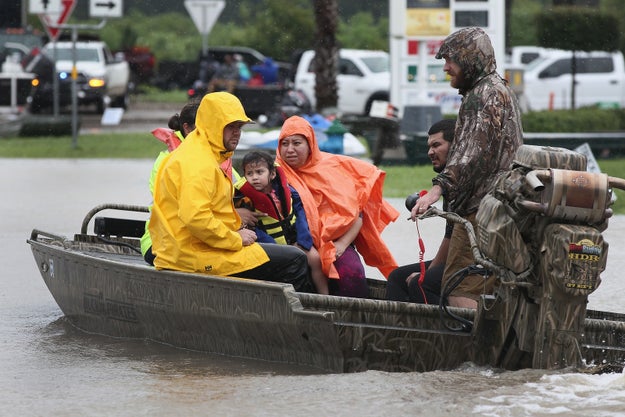
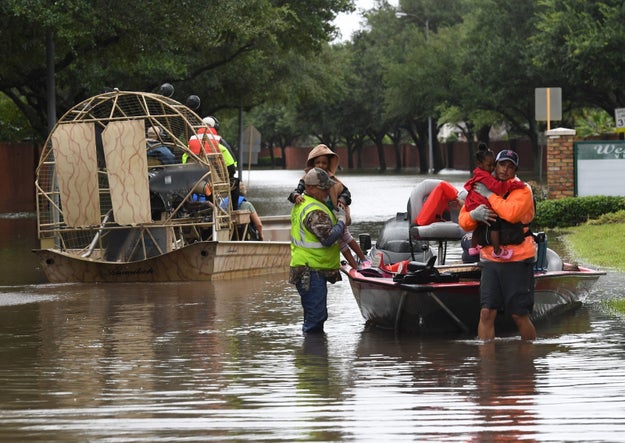
Houston residents being evacuated Tuesday by volunteers from San Antonio.

Mark Ralston / AFP / Getty Images

Tuesday afternoon, with floodwaters rising in Houston and residents still stranded in their homes, hundreds of people turned to the walkie-talkie app Zello, which posts short voice messages in an ever growing feed, to coordinate help.

One Zello group, Houston Harvey, posted hundreds of messages an hour. Among boat owners offering their services and drivers curious for a safe route out of town, much of the chatter focused on Heidi, a mother with an unspecified illness and two autistic sons, one of whom used a wheelchair.

“She’s on the emergency evacuation list several times over,” said a woman with the username mswrt. “We’re trying to get somebody out to her as fast we can.”

“What is the location for that mom with the autistic kids?” asked a man who used the handle yert68. “We have a low-water boat able to get to her, and we’re in the Baytown area right now.”

A third user, sarah1118, gave the address. “She is in an apartment complex that is slowly rising. And she is alone with her two sons and she needs a boat that can accommodate her son’s wheelchair.”

But Zello’s limitations were quickly apparent. It didn't offer a way to respond directly to other users if they hadn't been added as a contact. New messages, posted in real time, overwhelmed older ones. Some gave advice that only might be helpful. Others were just dead air. A quiet man who offered no other information simply asked “How can I help?” No one responded to him. Clearly, no one was in charge.

“The Coast Guard is in that area,” said a user identified as CW2009. “I’m not sure if they’re rescuing them.”

Eventually, according to a woman who said she was Heidi’s sister, the Coast Guard came for Heidi, but they didn’t rescue her. Misty, who said she was in touch with the Coast Guard, said it was because they couldn’t take the wheelchair, and Heidi wouldn’t, or maybe couldn’t, take her son out of it.

“It’s ridiculous. You have two kids and an adult that needs medication. No food, needs supplies, and they left her there behind,” the sister said.

Another user weighed in: did the Coast Guard help?

The response: “They’ve already left the area.”

——

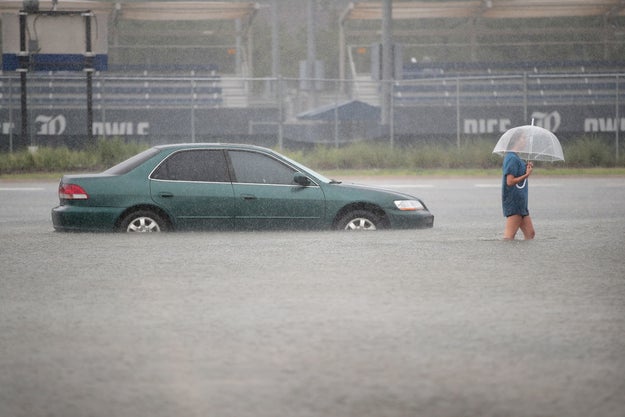
That Texans have turned to social media in the wake of a historic flood shouldn't be surprising. As of Monday, according to the Federal Communications Commission, 16 of the area's 911 call centers were having problems dealing with the deluge of calls they were receiving. That sent people needing help to Twitter, Facebook and Zello to summon help.

But while that's potentially valuable, it is an imperfect way for governments to help disaster victims, Michael Lindell, a professor emeritus at Texas A&M University and the former director of its Hazard Reduction & Recovery Center, told BuzzFeed News.

For one, he said, “You’re not going to wind up with 100% of the local population reading the local emergency management’s Facebook pages.”

For another, social media, with its thousands of users, offers little consistency in standards and practices, making dependence on it risky. Apps such as Zello, better known as a protest organizing tool in countries such as Turkey, Russia and Venezuela, aren't well known in Texas, and the app itself is a major drain on a smartphone battery.

In disaster areas, the internet can be as unreliable as any utility. Nearly 200,000 people have lost internet in their homes due to Harvey, according to the FCC, and internet service on cell phones has been hampered, with 364 cell phone towers in 27 counties in Texas and Louisiana suffering at least partial service outages.

Global Blocks, an activist group that grew out of censorship in Turkey and monitors internet outages around the world, noted that some areas, like Corpus Christi, suffered severe internet outages when the storm hit.

Others, like the city of Victoria, southwest of Houston, have suffered sustained trouble getting online. Dyn Research, an Oracle property that studies connectivity, found correlations between power outages — widespread in Harvey’s wake — and loss of internet connection.

That hasn’t stopped Texas authorities from trying to use social media to coordinate a hodgepodge attempt to connect aid workers and those in need of help. But even as they used it, they recognized its limitations.

At one point, Ed Gonzalez, the sheriff in Harris County, which includes Houston, requested that citizens in need of rescue stop tweeting him and call 911 instead, even though he admitted that it was at times impossible to get through.

Still, he used social media himself. On Sunday, he tweeted that a pregnant woman on Angelo Street was going into labor and needed help, and tagged the Houston Fire Department. Later, he tweeted that she’d gotten an ambulance.

But Twitter wasn’t a great system: another woman tweeted to him, adding a screengrab of a Facebook comment that another pregnant woman needed help. Gonzalez tweeted her address, tagging the Houston Fire Department and City of Houston Office of Emergency Management. But it wasn’t clear if they saw the tweet and were able to help, and he didn’t mention her again.

Conflicting and inadequate communications echo 2005’s Hurricane Katrina and its aftermath, which killed 1,833 people, displaced 600,000, and cost an estimated $130 billion. A congressional report on Hurricane Katrina found that inoperable or damaged communications systems drastically exacerbated problems caused by Katrina.

New Orleans police didn’t have functional communications for three days, and for a period, first responders were restricted to using only two radio channels on a backup system.

Louisiana state police found that damaged towers for its radio system, used by 70 agencies and 10,000 users and last updated in 1996, “severely hampered the ability of emergency responders operating on the state system to communicate with other emergency services personnel.”

That, of course, was before the creation of Twitter in 2006 or the introduction of the iPhone in 2007. The Houston flooding from Harvey makes clear both developments have changed the way disaster communications can work.

At the Digital Operations Center of the Red Cross in Dallas, Texas, volunteers monitored social media distress calls using an in-house software that pulled data from Facebook, Twitter and other web sites using search terms like “hurricane” or “storm.”

The in-house tool clustered the social media data it pulled in various ways — word clouds, heat maps, most tweeted posts and most popular images and videos — and allowed Red Cross workers to monitor the needs of people affected by disasters like Harvey closely.

“Social media is extremely important to the Red Cross because it allows us to connect to more people,” said Krysta Smith, a digital communications specialist. “It's a live feed that lets us know immediately what we’re facing, what residents are facing, and what actions need to be taken.”

But it has its limitations. The geolocation function can be inaccurate, for one.

Still, it shows the ways first responders could make better use of the last decade's advance in personal communications – if public officials and taxpayers are willing to commit to making it happen.

“Society has priorities,” Lindell said. “Could you develop evacuation plans for everybody in Houston? Of course. But the question is how likely is that to happen? How much are you willing to pay now for the capacity for something that might not happen for another 150, 250 years?”

Alex Kantrowitz contributed.

Quelle: <a href="Social Media Saved Harvey Victims In Texas — But That's Not Really A Plan“>BuzzFeed

Facebook Ditched The Red Cross For Hurricane Harvey Relief

Facebook

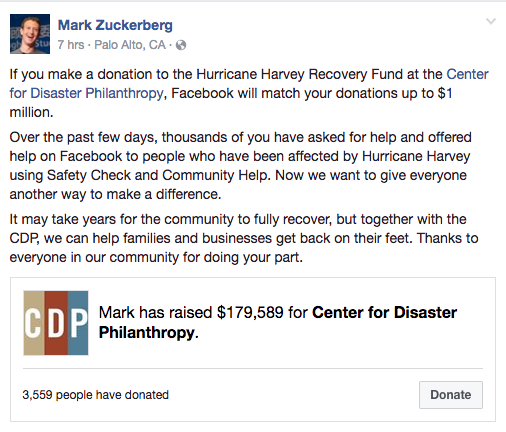
Facebook is steering donations for Hurricane Harvey relief to a tiny, little-known charity called the Center for Disaster Philanthropy — and bypassing the Red Cross, its longtime partner in the midst of disasters.

During Typhoon Haiyan in 2013 and the Ebola outbreak of 2015, a button on Facebook News Feeds prompted users to send money to the Red Cross. And as floodwaters have inundated Houston, Donald Trump and Barack Obama have both publicly donated to the Red Cross, as have dozens of major corporations.

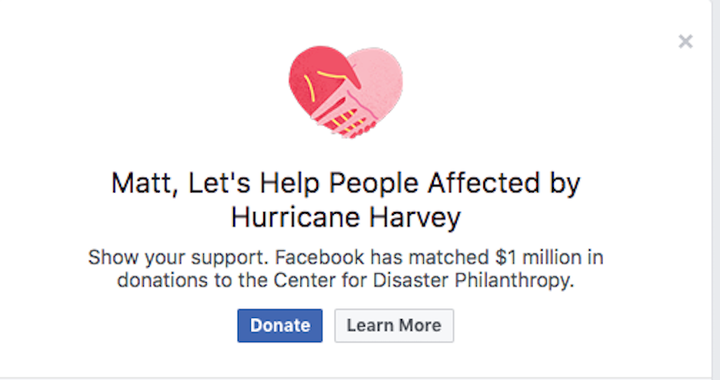
Now, Facebook is routing its millions of users, and $1 million of its own money, to the Center for Disaster Philanthropy, which in 2015 had just $3 million in revenue. A message on Facebook feeds with a donate button said, “Show your support. Facebook has matched $1 million in donations to the Center for Disaster Philanthropy.”

Bob Ottenhoff, the CDP’s president and former CEO of GuideStar, a clearinghouse for information on nonprofits, said the group works to change how donors think about giving during disasters, focusing on long-term recovery. “People are motivated right now, because they’re watching television and reading newspapers,” said Ottenhoff. “But we find there’s a dramatic reduction in contributions almost immediately once the media attention is over. In a case like this, with what we see happening in Houston, it’s going to be a very long recovery.”

Facebook’s shift is a potential sign of the growing discontent with the Red Cross and other rapid-response groups’ activities in the wake of natural disasters — as well as attempts by Silicon Valley to rethink how people give money to charity, steering donations to causes tech magnates think will be the most effective.

The Red Cross has faced intense scrutiny and criticism for its work in previous disasters. During Hurricane Harvey, people have encouraged others on social media to donate to groups other than the Red Cross.

Facebook’s unusual Harvey partnership sent so many users to the CDP that the organization’s website quickly crashed. The CDP’s Facebook page was inundated with comments from people who had never heard of it, demanding to know where their money was going and even worrying that the call for donations was a “scam.”

“I donated $50 and instantly freaked out,” commented one user, Jenna Workman Travers. “I called my bank and they think it’s okay, because it hasn’t come up yet as a scam. But, I cancelled the donation because it suddenly seemed shady.”

The CDP had reached Facebook’s $1 million matching goal in less than four hours, said Ottenhoff — by far its biggest fundraising push.

“We believe the Center for Disaster Philanthropy is well positioned to help meet the recovery needs of communities in Texas,” a Facebook spokeswoman said. “CDP knows from past disasters, especially through their experiences with hurricanes and floods, that full recovery will take many years.”

Facebook still partners with the Red Cross, the spokeswoman said, by allowing the group to raise money through its own page.

Scott Olson / Getty Images

Silicon Valley has been at the forefront of rethinking how philanthropy works — with an eye, tech barons say, toward maximizing well-being with each dollar spent.

Tech figures have been major funders of GiveDirectly, a nonprofit that makes direct, unconditional cash grants to individuals living in poverty. Facebook cofounder Dustin Moskovitz’s wife, Cari Tuna, is the president of the Open Philanthropy Project, which does extensive research to identify “high-impact” charity projects. GiveWell, a charity evaluation service connected with the Open Philanthropy Project, cautions potential donors to “support an organization that will help or get out of the way.”

The investigative journalism outlet ProPublica exposed a series of catastrophic failures at the Red Cross, including a “secret disaster” of mismanagement in the wake of superstorm Sandy and Hurricane Isaac and a massive influx of donations squandered in the wake of the 2010 earthquake in Haiti. One particularly blistering headline from a 2015 story: “The Red Cross Raised Half a Billion Dollars for Haiti and Built Six Homes.”

Last year was the Red Cross’s worst fundraising year since 2000, ProPublica reported. In a statement, the Red Cross said it still had an “established and ongoing” relationship with Facebook, which allowed it to raise money through a disaster fundraisers platform.

Unlike the Red Cross, which provides on-site aid, the Center for Disaster Philanthropy does not itself provide any services. Instead, it collects money and uses an advisory committee to disburse funds to smaller groups, many of them local — filling in gaps left by government organizations and large national charities.

“To have Facebook say ‘this is where we think our money should go and we welcome others to join us’ is a major tipping point in learning about recovery,” Debra Jacobs, the chief executive officer of the Patterson Foundation, told BuzzFeed News. The Sarasota-based charity announced Tuesday that it was donating $250,000 to the CDP’s Hurricane Harvey fund; it had also given money to the group in the wake of other disasters.

Facebook

Quelle: <a href="Facebook Ditched The Red Cross For Hurricane Harvey Relief“>BuzzFeed

An Inside Look at the Docker Captains Program

Since launching the Docker Captains over a year ago, we’ve received a lot of questions: What is a Docker Captain? What do Captains do? How do I become a Captain? So who better to answer that than the Docker Captains themselves? At DockerCon Austin, we asked the Docker Captains to share their favorite thing about wearing the Captain’s hat.

What is a Captain?
Captains are Docker experts that are leaders in their communities, organizations or ecosystems. As Docker advocates, they are committed to sharing their knowledge and do so every chance they get!
What do Captains do?
Captains are advisors, ambassadors, coders, contributors, creators, tool builders, speakers, mentors, maintainers and super users and are required to be active stewards of Docker in order to remain in the program.
In addition to sharing their knowledge with the community, Captains provide insight and feedback to Docker. They have direct access to our technical teams, and are first to hear about and try upcoming features, product releases and big announcements.

What do Captains get? 
In return for their efforts, Captains get access to the existing captains community and Docker staff. They get ongoing training, private briefings and Slack chat channels where Captains have real-time access to each other and the Docker team. Docker amplifies the efforts of Captains by sharing their activities on social media, in the Docker Weekly, and through speaking opportunities. They also get additional training and resources at Docker events like DockerCon. Oh and SWAG… lots of SWAG!
How do I follow what the Captains are up to?
Follow all of the Captains on twitter. Also check out the Captains GitHub repo to see what projects they have been working on.

How can I learn more about each Captain?
Docker Captains are eager to bring their technical expertise to new audiences both offline and online around the world – don’t hesitate to reach out to them via the social links on their Captain profile pages. You can filter the captains by location, expertise, and more.
What does Docker look for when selecting Captains?
Captains were nominated as candidates for the program because their passion for inspiring and educating others about Docker translates into creating incredible value for Docker’s users. Specifically, Captains meet some or all of the following criteria:

Technical: Captains are Docker practitioners – they use Docker and stay up to date with the latest Docker features and releases.
Innovators: Captains have created some amazing projects and are constantly inspired by the way they push the envelope:

Play with Docker – A sandbox training playground that allows users to immediately test Docker and related projects with no setup.
Open FaaS Project – OpenFaaS is a framework for building serverless functions with Docker which has first class support for metrics.

Creators: Captains create content to educate and support the Docker community, they respond to questions in forums and chat, and speak in public at meetups and conferences about Docker.
Influencers: Captains are leaders in their community, organization or ecosystem and focus on advancing the adoption and proper use of Docker technology.
Credible: Captains know their way around the container lifecycle and its applied uses, they’ve tried and worked with other technologies, and they share their findings. They are passionate about Docker as a solution, but the first to tell us we haven’t gotten something quite right.

How do I become a Captain?
We are actively looking to add additional leaders that inspire and educate the Docker community. Sign up for community.docker.com, let Captains know of your interest, share your activities on social media and hashtag #Docker, get involved in a local meetup as a speaker or organizer and continue to share your knowledge of Docker in your community and organization.

What does it mean to be a #DockerCaptain? @TheBurce shares an inside look at the programClick To Tweet

The post An Inside Look at the Docker Captains Program appeared first on Docker Blog.
Quelle: https://blog.docker.com/feed/

These Are The People Scraping Twitter And Crowdsourcing Rescue Requests From Harvey Victims

Scott Olson / Getty Images

Jessica Decker woke up Friday morning at her San Francisco home, having the day off from work, and began reading the news about the hurricane set to make landfall in Texas that night.

Decker, who has a background in science visualization, saw several tweets regarding relief efforts including where shelters will be located and information about food drives.

She put a call out on Twitter, tagging people she has worked with previously, asking if they’d want to map resource information. She was involved in involved in open-mapping projects in the past and wanted to see how it could help with what promised to be — and became — a historic, devastating, and deadly storm.

Danny McGlashing, a coder, responded and the two paired up to create a map of resources. They called their project Harvey Relief.

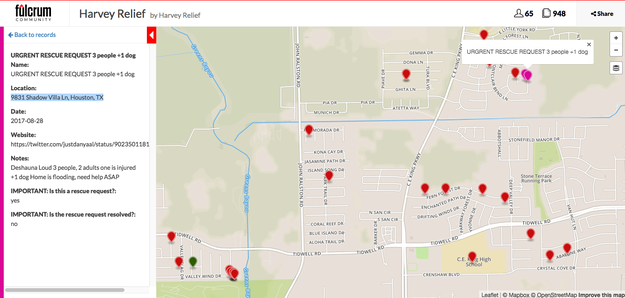
Since Friday, Harvey Relief teamed up with another group — Harvey Rescue — that was searching and mapping rescue requests on Twitter from people who were stranded. Harvey Rescue organized online by a group of people who had previously formed a private Twitter DM.

The groups have received the technical support of a mobile data collection app and have hundreds of volunteers working around the clock, scraping Twitter to log and map the information Houstonians are disseminating online.

“This community of complete strangers has come together and we are literally saving lives,” @RogueEPAstaff, who helped create Harvey Rescue, told BuzzFeed News.

The group doesn’t have a scientific methodology when it comes to collecting the data and mapping it out. The volunteers collect the SOS tweets and vet them “as much as we can” by calling and texting the phone numbers provided, Brooke Binkowski, who serves as the group's spokesperson, told BuzzFeed News.

“We’re allowing for a certain margin of error,” Binkowski said, adding that she knows there will be duplicate entries in the data and that some might be submitted from pranksters — a small price to pay if it means rescue teams will reach people in need, she said.

The group is working to fix the duplicate entries, but could not provide a timeline for when they expect that to be completed.

Harvey Rescue is comprised of about 25 people and was formed in November 2016 after the US presidential election. On Twitter, the users — who met by tweeting with the hashtag #AltGov — created a private DM group where they talk about everything from politics to their families and send each other funny memes.

They’re located all across the country and many have never met in person — or even know each other’s real names. They refer to each other by their Twitter handles and call each other friends.

“It’s obvious what we’re about,” Twitter user @altnoods told BuzzFeed News when asked about the group's politics. “But this action has nothing to do with that. We’re 100% country over party.”

“We have a lot of people who were in government when Katrina happened,” @altnoods added. “We didn’t want that to happen again.”

On Sunday morning, one user suggested they collect and map out the tweets o with people asking for immediate help.

“We were having a conversation as Harvey started coming in and initially wanted to make sure some of our people in Texas were safe,” @RogueEPAstaff told BuzzFeed News. “The conversation turned to how the 911 system was not able to keep up with the volume of calls.”

At the time, local law enforcement agencies were urging people to not use social media to report their whereabouts and instead call 911.

Several people reported on Twitter and in several news outlets that their 911 calls were not going through and that they waited on the phone for a long time.

“People need to be rescued, they're desperate, of course they're going to connect on social media,” @RogueEPAstaff told BuzzFeed News.

Twitter: @HarveyRescue

As the need for help grew, Harvey Rescue started to bring in more people including their family and friends who had data and mapping experience, Binkowski, who is also the the managing editor for Snopes.com, said.

Binkowski said she estimates there are about 200 volunteers involved.

“Everybody is working around the clock,” @RogueEPAstaff said, adding that the work was overwhelming. “I’ve done emergency responses at the federal level, and they say, if it feels like you’re drinking from a firehose, you’re doing it right.”

By Sunday evening, Harvey Rescue and Harvey Relief joined forces. While they’re providing similar services, they’re still operating as two distinct groups.

“We paired up with [Harvey Rescue] on Sunday and we have just volunteers mapping and updating both of these lists day and night,” Decker said.

web.fulcrumapp.com

Decker also reached out to Fulcrum, a data collection app, and requested to use the company’s Community initiative — free and open data-collecting crowdsourcing project specifically created for natural disasters such as earthquakes, tornadoes, and hurricanes.

Fulcrum CEO Anthony Quartararo told BuzzFeed News that through this tool, people on the ground in disaster areas are able to collect data that’s relevant to their humanitarian work.

Quartararo said that Fulcrum Community — which launched earlier this year — approved Decker’s request and anybody with access to Fulcrum’s website or mobile app is able to view the map created by Decker and her team.

About 1,000 entries have been put into Fulcrum related to Harvey rescue and relief efforts, Quartararo told BuzzFeed News.

Volunteers from Harvey Rescue and Harvey Relief told BuzzFeed News their work has identified a service that’s needed and was missing.

@RogueEPAstaff told BuzzFeed News that she hopes relief organizations such as FEMA and Red Cross “can take up this work and make it to something that’s usable long term.”

“I genuinely thought I’d log on and help out for a few hours on Friday,” Decker said. “I had the day off, so I was going to donate some time. All of a sudden you realize, ‘nobody is on this,” so we just had to do it.”

If you've been impacted by the storm in Texas or have a tip about rescue, relief, government, or aid efforts, call the BuzzFeed News tipline at (646) 589-8598. You can also find us on Signal, email, and SecureDrop here.

Quelle: <a href="These Are The People Scraping Twitter And Crowdsourcing Rescue Requests From Harvey Victims“>BuzzFeed