
Apple CEO Successfully Avoids Discussing Trump When Asked About Trump

Nicholas Kamm / AFP / Getty Images

When asked by an analyst about President Donald Trump's claim that Apple had promised to build “three, big beautiful plants” in the US, Apple CEO Tim Cook managed to talk about almost everything other than Trump.

“We have created 2 million jobs in the U.S., and we're incredibly proud of that. We do view that we have a responsibility in the U.S. to increase economic activity, including increasing jobs,” Cook said during the company's Q3 2017 earnings call.

He went on to detail what Apple does economically in the US, including how the iOS platform supports the jobs of hundreds of thousands app developers. As for the manufacturing plants specifically, Cook was pointedly non-committal, neither addressing Trump's claim or specifically refuting it.

Instead, he noted that in 2016 Apple bought “$50 billion worth of goods and services from U.S.-based suppliers” including goods like high-tech glass that is then shipped to China where iPhones are manufactured by Apple partners.

He also mentioned that Apple's “Advanced Manufacturing Fund,” which will put at least $1 billion into US companies, had invested $200 million into Corning, the Kentucky-based Apple glass supplier. As for new manufacturing plants specifically, the closest Cook would get to discussing it was saying that it was “probable” that “several plants… can benefit from having some investment to grow or expand or even maybe set up shop in the U.S. for the first time.”

Trump said last week in an interview with the Wall Street Journal “he’s promised me three big plants – big, big, big.”

When pushed for followup, Trump said, according to a full transcript published today by Politico: “We’ll have to see. You can call him. But I said, Tim, unless you start building your plants in this country, I won’t consider my administration an economic success, OK? And he’s called me and he says, you know, they’re going forward, three big, beautiful plants. You’ll have to call him. I mean, maybe he won’t tell you what he tells me, but I believe he will do that. I really believe it.”

Apple declined to comment when the Wall Street Journal first published Trump's comments on Apple last week.

Apple has 80,000 US employees and claims that it supports about 2 million US jobs, including people employed at its suppliers and in the “App Store ecosystem.” While the company does some manufacturing in the US — the Mac Pro is made in Austin, Texas for example — most takes place via a vast network of international manufacturing partners.

Trump is not the first US president to push Apple executives to bring more of its manufacturing to its home country. Then-president Barack Obama asked Steve Jobs in 2011 what would have to change for Apple to make iPhones in the US.

Jobs' response, according to the New York Times: “Those jobs aren’t coming back.”

Quelle: <a href="Apple CEO Successfully Avoids Discussing Trump When Asked About Trump“>BuzzFeed

AWS CodeDeploy Now Provides Flexible EC2 Tagging with Multiple Tag Groups

AWS CodeDeploy now supports using multiple tag groups to identify groups of EC2 instances to be included in a deployment group. This new feature allows greater flexibility and more granular control over which instances are included in your deployment groups. If you use a single tag group, any instance identified by at least one tag in the group is included in the deployment group. If you use multiple tag groups, only instances that are identified by at least one tag in each of the tag groups are included. For example, you can define a deployment group that contains only instances tagged with both ‘Application: Frontend’ and ‘Environment: Prod’. For more information, see Tagging Instances for Deployment Groups in AWS CodeDeploy
Quelle: aws.amazon.com

This Conservative Mom And Liberal Daughter Were Surprised By How Different Their Facebook Feeds Are

This Conservative Mom And Liberal Daughter Were Surprised By How Different Their Facebook Feeds Are

Lixia Guo & Lam Thuy Vo / BuzzFeed News

Katherine Cooper, 60, and Lindsey Linder, 28, are very similar. They’re mother and daughter and both grew up in West Monroe, La., a town of a little less than 13,000 people located four hours north of New Orleans. They both spend their working hours helping others — Lindsey as a policy attorney for the Texas Justice Coalition, a group advocating for criminal justice reform, and Katherine as a caregiver and teacher.

But like many American families in recent months, they have gotten caught up in vehement disagreements about the US election, its results, and other ideological issues. And not just that. On Facebook, Linder and Cooper’s political differences can lead to heated and ugly spats that both said they would have been able to avoid if they were talking offline.

Last fall, this divide came to a head. At the height of the contentious presidential elections, Linder posted an article titled “White America, It’s Time to Take a Knee” about Colin Kaepernick, an NFL quarterback who garnered national attention last year for refusing to stand during the National anthem at the beginning of his games.

An hour later her mother, Cooper, chimed in. “I love and adore you but Im unfollowing you starting right now,” she wrote as part of a longer comment.

“Go burn flags if thats what you want to do,” her brother added in another comment on the same posted article.

View Video ›

BuzzFeed News

The sparring between Linder and her family and friends from back home became so intense that she temporarily deactivated her Facebook account after the election. Her colleagues in Austin, Texas who had watched Linder’s online disputes were actually worried for her safety when she told them she was going home to visit her family, she said.

“In this political climate it seems that every issue is polarized. There's not a lot of issues that I can say ‘I really care about this’ and it hasn't been made into some kind of dividing factor,” Linder said.

“She's so outspoken cause she would just post anything on Facebook, and we'd be like: ‘What?! Are you kidding?’,” said Cooper about her daughter’s online presence.

“On Facebook for a while [my family and I] were in a very polarized position. […] It just became this place where we could be combative,” said Linder.

One reason why Linder and Cooper disagree so vehemently online may be the fact that the content they see on Facebook hardens beliefs they already have.
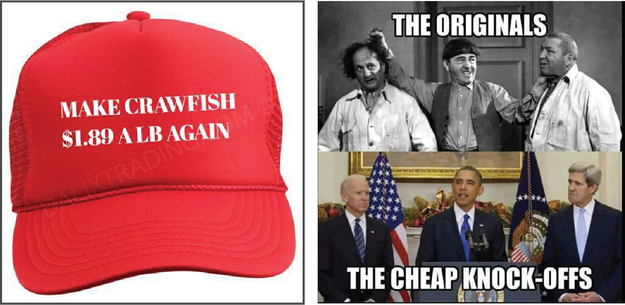
Left: A meme from Linder’s timeline. Right: A meme from Cooper’s timeline.

Facebook

People naturally surround themselves with people who share their beliefs. Online, this self-selected social circle results in people mostly encountering content that confirms rather than questions their beliefs, an effect often referred to as experiencing the world through a “filter bubble.”

To get a better idea about how much Linder and Cooper’s social media worlds differ, BuzzFeed News compared their Facebook news feeds and timelines. They gave us permission to look at a combined total of 2,367 posts shown on their news feeds for one day in January of this year.

The findings of our analysis are very specific to Linder and Cooper but may help illustrate how people’s experience of politics online can aggravate existing political differences and create conflicts that could have been resolved offline in a less contentious manner.

The content they choose to look at

Here are the top 15 pages and groups whose posts showed up most often on Linder and Cooper’s news feeds:

Lam Thuy Vo

Their interests vary. In terms of politics, for instance, Cooper follows five groups and pages that contain the name “Trump,” including pages with the names “Donald Trump for President,” “Trump & The Great America,” and “Trump Wall.” Cooper also liked one page named “Hillary for Prison.” Linder, on the other hand, receives content from two pages that are related to Bernie Sanders, “U.S. Senator Bernie Sanders” and “Bernie Sanders.” None of the groups mentioned above that Cooper likes are verified by Facebook (meaning the platform has confirmed that the pages are affiliated with the public person they named after), while both pages that Linder follows feature the blue tick mark that signifies them as official Bernie Sanders pages.

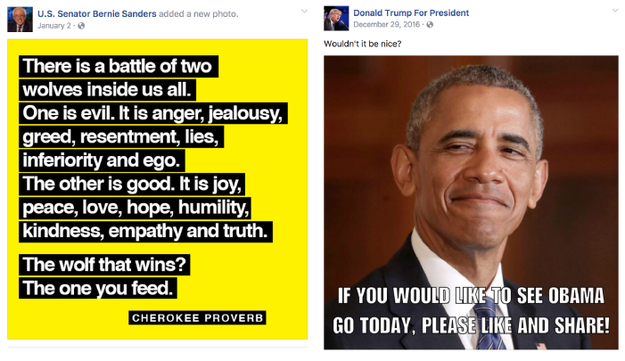
Below are two exemplary memes that appeared on Linder and Cooper’s news feeds in January from Pages named “U.S. Senator Bernie Sanders” and “Donald Trump for President” respectively :
Facebook

In terms of news, Linder follows at least two local media organizations — “WZTV FOX 17 News, Nashville,” where she does not live, and a local hip hop radio station from New Orleans, “Q93.” Cooper has liked at least 23 pages that identify themselves as news or media organizations, and the majority of them are openly right-leaning, with “Clashdaily.com with Doug Giles” and “Nation in Distress” showing up the most in Cooper’s feed.

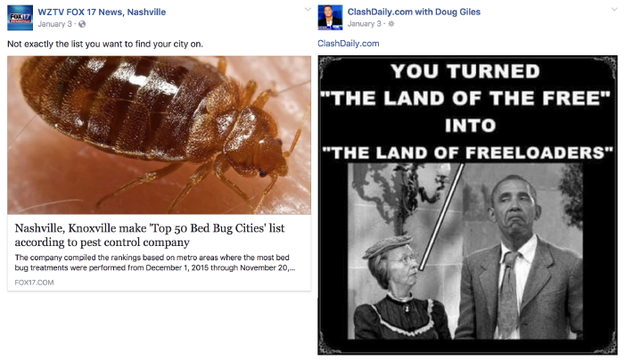
Here’s a typical post from the Nashville news station Linder follows and a post from ClashDaily.com found on Cooper’s feed from January:
Facebook

Fake and hyperpartisan news posts also contributed to tensions between Cooper and Linder.

Back in August, Cooper posted a news article titled “BREAKING: 49ers DROPS Kaepernick After He Refuses to Stand for National Anthem” from American Updater, a right-leaning Facebook page, on her own timeline. Linder commented on her mother’s post, pointing out that it wasn’t real news: “First, this is one of those scammy articles we discussed last week (please, for the love of God, stop sharing this crap without verifying its validity). Second, this is false.” The story is no longer available online, and its headline was incorrect.

Screenshot of an article Cooper shared that no longer exists

Facebook

Cooper’s experience online echoes that of many political news consumers on Facebook, who are increasingly targeted by partisan media makers on both sides of the political spectrum that rely on Facebook to attract readers.

“I'm real bad about reading stuff and not really knowing what fake news [is],” said Cooper about her online behavior during the election. “I'd see something and be like ‘What?’ and get really excited. [And then] Lindsey would be like, ‘This is fake news.’”

“Right now I'm really confused about what's true and what's not true,” said Cooper.

Despite all those ideological differences, however, Linder and Cooper have commonalities: both care about animals — Linder likes the “Companion Animal Alliance,” an animal adoption page, and Cooper likes at least five dog-related pages and both care about issues around the welfare of others. Linder, due to the nature of her work, follows several criminal-justice related pages while Cooper follows a page called “Support Our Military Heroes.”

Below are two exemplary posts from these groups:

Facebook

The friends who show up on their news feeds

Perhaps more important than what Linder and Cooper choose to follow may be the people they’re friends with on Facebook. Content from pages only constituted about 15% of Cooper’s feed and even less for Linder (almost 10%).

This is largely because Facebook explicitly prioritizes content from friends rather than pages on people’s news feeds.

The people who populate our unique social media worlds set the bar for what we may perceive as ‘common’ or ‘normal.’ They make up our networked information universe. The majority of Americans who are online — 62% of them — receive news from social media platforms. Of all American adults who are on Facebook 76% use the platform on a daily basis.

The graphic below represents the top 20 people who showed up on Linder and Cooper’s news feeds respectively. Their names have been retracted and replaced with descriptions of each person’s relationship to Linder and Cooper.

While Linder’s feed was dominated by lawyers, friends from home, and friends she made after leaving her hometown, Cooper’s news feed mostly showed content from people who live near her in a district that voted 61.4% for Donald Trump.

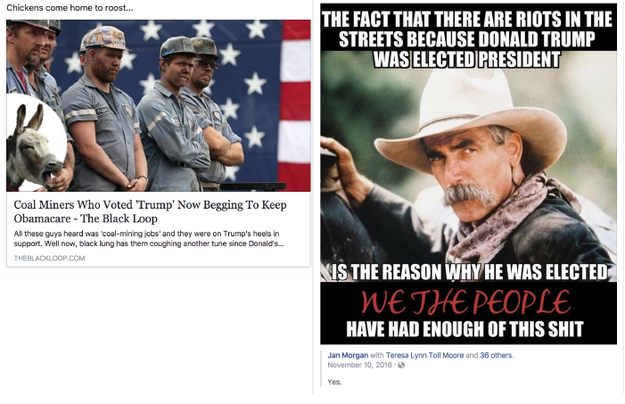
On the left is an article posted by one of Linder’s friends that appeared on her feed. Articles from this person appeared 75 times on Linder’s news feed. On the right is a meme from Cooper’s feed from a friend whose posts showed up 66 times in the data BuzzFeed news analyzed:
Facebook

Top 15 Facebook Friends Whose Posts Appeared on Linder and Cooper's Facebook News feeds

Lam Thuy Vo

“I think it’s interesting how different our Facebooks are. No matter how different we are, we do have similarities. And on Facebook there’s essentially no overlap in terms of people who we are seeing, pages that are posting,” said Linder.

Both recognized that their daily social media consumption was skewed.

“I hate the bubble and Lindsey pops my bubble every time I come see her. […] I wished I could be friends with everybody on facebook. That way I could see more,” Cooper said.

Not everyone sees it that way. For many, election-inspired unfriending sprees are only widening the rift between people of different political persuasions. With fewer people of opposite political persuasions in people’s social networks, they are less likely to see content posted by others that challenges their own views.

“I'm as guilty as anyone in creating a Facebook bubble. […] Most of the people from back home, some from my family, and a lot of the people from my school are unfollowed on my feed because I don't want to see things that I've come to disagree so strongly with,” Linder said.

When reached for comment, Facebook referred BuzzFeed News to several studies, including an October 2016 Pew survey about the political environment on social media that shows people report seeing a mix of political views in their networks. Another study, which Facebook conducted itself, found that, on average, 23% of people's friends on Facebook claim to have opposing political identities (based on self-reported political affiliation). The company also referred BuzzFeed News to a report from the Reuters Institute for the Study of Journalism that shows social media can actually help diversify a person's news consumption.

According to that same Pew survey Facebook pointed to, more than half (59%) of the study’s participants felt that online encounters with people from opposite political persuasions left them stressed and frustrated, rather than enlightened. Even worse, 64% said they felt like they had less in common with their political counterparts after discussing issues online than they did before.
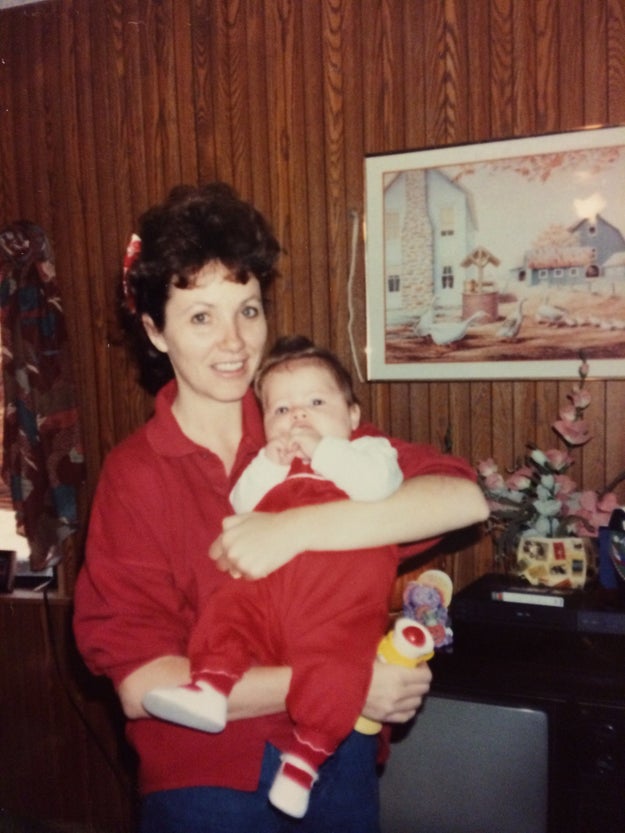
Cooper holding Linder when she was a baby

Courtesy of Lindsey Linder

Both mother and daughter admit that it’s much easier to discuss their conflicting views when they’re in the same room rather than trying to work it out online.

“We decided that [we share a lot of beliefs] the last time we were together; I felt so good because I don't think any different from Lindsey,” said Cooper.

Linder said, “When I was engaging on something on her Facebook, it was to say, ‘Are you kidding me? I can't believe you shared this.” … And then I went home for a visit and we had a chance to sit down and talk about some political issues. And it was really interesting because it started out as, ‘these are things we would never possibly agree on,’ and by the end of the conversation I felt like we got to a place where we both thought, ‘oh we don't actually disagree.’”

For example: Cooper has a strong anti-abortion stance and thought that she and her daughter would not be able to find common ground, but to her surprise, they were able to agree on some aspects of the subject.

“The thing that actually reduces the number of abortions — access to healthcare, access to contraceptives, comprehensive sex ed — these are the things that actually reduce abortions,” said Linder.

“We […] agreed on that issue,” said Cooper. “When I'm with Lindsey, I'm a Democrat,” Cooper added, laughing.

Quelle: <a href="This Conservative Mom And Liberal Daughter Were Surprised By How Different Their Facebook Feeds Are“>BuzzFeed

Uber Tells Employees It’s “Looking Forward” In Its Search For A CEO

Vcg / Getty Images

At an all-hands meeting Tuesday morning, Uber addressed rumors that the company’s former CEO Travis Kalanick is plotting a return to power.

The ride-hail giant’s general counsel Salle Yoo told employees that while the company is appreciative of Kalanick’s role in building Uber, the search for a new CEO isn’t focused on the past.

“The future is bright and we are looking forward,” she said, according to an employee who attended the meeting.

Kalanick resigned his role as CEO of Uber in June, at the insistence of the board, following two internal investigations into allegations of widespread harassment and discrimination at the company.

But earlier this week, Recode reported that Kalanick was talking privately about orchestrating a return to Uber. The chatter caused confusion in the board’s ongoing CEO search; Hewlett Packard CEO Meg Whitman withdrew her name from consideration for the role without warning during a meeting in which the board planned to vote on her appointment, according to The New York Times.

Uber is currently being managed by a multi-member executive team, which took advantage of Tuesday’s all-hands meeting to quell any discussion of a Kalanick comeback. At the same meeting, Uber HR head Liane Hornsey gave employees an update on the company’s efforts to meet recommendations for improving company culture. Hornsey said Uber will be establishing an outside advisory council on diversity made up of academics and other experts. She also told employees that Uber has exceeded its goals for pay equity; the company announced raises for thousands of employees at a meeting two weeks ago.

Uber declined to comment on this story.

While critics have blamed Kalanick’s style of leadership for contributing to Uber’s contentious and combative workplace, there are also many employees inside the company who remain loyal to him and would be happy to see him return. Two days after he resigned, a group of employees circulated an internal petition asking for Kalanick to be reinstated.

Meanwhile, Kalanick’s name has been popping up in the ongoing lawsuit between Uber and Alphabet’s self-driving car company Waymo over allegedly stolen intellectual property. Kalanick was deposed last week, and emails linking him to the decision to offer indemnity to Anthony Levandowski, the former Waymo employee at the heart of the suit, became public yesterday. Waymo has accused Levandowski of stealing self-driving trade secrets and giving them to Uber after it acquired his autonomous trucking startup Otto. According to Waymo’s legal team, a digital forensics expert recovered hundreds of deleted text messages between Levandowski and Kalanick that will be handed over to Waymo’s lawyers today. After that, Waymo will have the chance to depose Kalanick for a second time, for a total deposition time of more than seven hours.

So while it sounds like Kalanick won’t be returning to his role as Uber CEO, he’ll have plenty to keep him busy.

Quelle: <a href="Uber Tells Employees It’s “Looking Forward” In Its Search For A CEO“>BuzzFeed

Now available–Lumberyard Beta 1.10

We’re excited to announce the availability of Lumberyard Beta 1.10, the biggest release to date for Amazon’s free AAA game engine. This release contains over 545 features, fixes, and enhancements. Some highlights include:
• Order-independent Transparency – correctly display overlapping transparent surfaces (i.e. wine glasses or ice sculptures) in your games with greater ease • Temporal Anti-Aliasing – smooth out jagged edges and other imperfections caused by real-time rendering, getting you closer to achieving film-like quality in your games • Component entity workflows – 35 improvements to help speed up your iteration time • Cloud Gems – Over 50 improvements to help you better manage your player community • Plus much more, including a brand new docking system for customizing the editor, performance enhancements to the material editor, and new cinematic features
Quelle: aws.amazon.com

Migrating a Web App from ClearDB to Azure Database for MySQL

With the introduction of Azure Database for MySQL, I’ve seen a lot of interest and questions from customers on how they can move their existing Web App from using ClearDB as their MySQL database provider over to Azure Database for MySQL. If you’re not using ClearDB, but rather MySQL In-App as your provider, and want to move over to Azure Database for MySQL, a great blog has already been written on this that you should check out. For this blog, I’ll be migrating my WordPress website’s database from ClearDB to Azure Database for MySQL, as well as updating my Web App to point to the new database server.

Preparing for the migration

I’ll be using MySQL Workbench as the tool to do the data migration. Of course you can use other common tools or CLI as well. First, download MySQL Workbench. Once you’ve downloaded and installed MySQL Workbench, you will need to create a connection to your ClearDB database in order to kick-off the migration. To create the connection, you’ll need some information about your ClearDB database.

In the Azure Portal, open up your ClearDB database and click on the Properties task on the left navigation pane. Keep this open as you’ll need this for the next step in creating your MySQL Workbench connection.

Now open MySQL Workbench and create a new connection by clicking on the + icon at the top of the home screen. In the Setup New Connection screen, give your connection a name (this can be anything – I choose “My ClearDB Database”), and then switch back over to your browser where you have your ClearDB database properties open and copy the HOSTNAME, USERNAME, and PASSWORD into the respective fields of MySQL Workbench. Note that to enter the password in MySQL Workbench, you’ll need to click on the Store in Vault… button first.

Once this is done, save your connection and create another new connection for your Azure Database for MySQL. If you haven’t created an Azure Database for MySQL yet, refer to our documentation Quickstart on how to do so. Similar to ClearDB, you’ll need to get the hostname, username, and password of your Azure Database for MySQL through the portal.  But before we do that, we’ll need to configure control access to your Azure Database for MySQL server.

Open your Azure Database for MySQL Server in the Azure Portal and click on the Connection Security setting on the left navigation pane.  For simplicity in the migration process, I have disabled SSL connectivity by clicking on the Enforce SSL connection toggle switch to Disabled. With regards to firewall rules, you can either click on the + Add My IP icon at the top of the screen which will add your local IP address to the firewall, or in my case I’ve created a firewall rule that allows all IP addresses access to my server for the time being. Later, when I configure my Web App to connect to my database server, I’ll add the appropriate IP addresses and remove this rule. For more information on configuring SSL connectivity for your server, check out our documentation.

Now that you have configured access to your Azure Database for MySQL server, you can continue to create a new MySQL Workbench connection just as you did for your ClearDB database server.  Open your Azure Database for MySQL server and in the main Essentials dashboard, you’ll see that the Server Name and Server admin login name are in the main page. Your password is not exposed here. If you don’t remember what your password is for your server, you can always reset it using the Reset Password option in the upper left corner of the Essentials pane. With this information, create another connection in MySQL Workbench for your Azure Database for MySQL server the same way you did for your ClearDB database.

Migrate your database

Open MySQL Workbench and click on Database and then Migration Wizard from the drop-down to start your database migration.

In the migration wizard you’ll be asked to select your source and target database servers. For your source, choose the ClearDB database server connection you created first, and for the destination choose the Azure Database for MySQL Server you just finished creating.

Continue through the wizard until you get to the screen that asks you which schemas you want to migrate. Make sure to only migrate the schema that is applicable to your application. In this case of a WordPress application, there is only one schema which is applicable. The name of your schema should be similar as ClearDB randomly generates the schema name.

Once you select your source schema to migrate, the remainder of your migration should be the defaults selected in the migration wizard. The time it takes to migrate your database should not be long, even for larger databases assuming your Azure Database for MySQL server is in the same region as your source ClearDB database.

Configuring your Azure Web App

Now that your database has been migrated, you’ll need to connect your Web App to your Azure Database for MySQL. You’ll need to both update your Web App as well as the firewall rules of your Azure Database for MySQL if you choose to restrict access to your database to your Web App exclusively. We’ll start with this, so open up your Web App in the Azure portal. On the left navigation pane, select Properties and note the Outbound IP Addresses. These will be the specific IP addresses that you will create firewall rules for in your Azure Database for MySQL.

Open up your Azure Database for MySQL server and create firewall rules for each IP address to allow access for your Web App to the server. This is the same process as described above for adding firewall rules.

Now go back to your Azure Web App and open up the Application settings on the left navigation pane, and then scroll down to the Connection strings section of the main pain. You will now need to modify your connection string to point to the new database server. You can simply click on the string value and edit it directly. You will need to replace all of the values except the Database value, as you migrated the database (schema) intact from ClearDB which preserves the database name. In my case, my original connection string was as follows:

Database=acsm_8cb9eb8d372ebbd;Data Source=us-cdbr-azure-west-b.cleardb.com;User Id=b8c2e429e67ac2;Password=47bd9069

After I updated it to point to my new Azure Database for MySQL Server, it looks like this:

Database=acsm_8cb9eb8d372ebbd;Data Source=jasonsnewserver.mysql.database.azure.com;User Id=jason@jasonsnewserver;Password=MyPassword12

Make sure to click the Save button at the top of the screen, and that’s all you need to do. You’re now using Azure Database for MySQL on your existing Web App. Congratulations!

Jason – JasonMA_MSFT
Quelle: Azure

Announcing the first DockerCon Europe 2017 Speakers

Summer is flying by and DockerCon Europe 2017 (October 16-19) will be here before we know it! The DockerCon team is heads down reviewing all of the proposals submitted and we are almost ready to release a full agenda. With that, we are thrilled to share with you the DockerCon Europe 2017 Website including the first confirmed speakers and sessions.

Abby Fuller, AWS
 

Adrian Mouat, Container Solutions
 

Arun Gupta, AWS


Bret Fisher, Independent Consultant


Elton Stoneman, Docker


Nandhini Santhanam, Docker


Mike Coleman, Docker
  

Tycho Andersen, Docker
 

Learn more about DockerCon: 

Register to DockerCon Europe
Sign up to receive DockerCon News

Announcing the first @DockerCon Europe 2017 speakers cc @arungupta @adrianmouat @abbyfullerClick To Tweet

The post Announcing the first DockerCon Europe 2017 Speakers appeared first on Docker Blog.
Quelle: https://blog.docker.com/feed/