BuzzFeed News; Getty Images (3)
Donald Trump’s most prominent Silicon Valley supporter has distanced himself from the president in multiple private conversations, describing at different points this year an “incompetent” administration, and one that may well end in “disaster.”
Peter Thiel’s unguarded remarks have surprised associates, some of whom are still reeling from his full-throated endorsement of Trump at the Republican National Convention. And while the investor stands by the president in public — “I support President Trump in his ongoing fight,” he said in a statement to BuzzFeed News — his private doubts underscore the fragility of the president's backing from even his most public allies. Thiel’s comments may sting in particular in the White House as they they come amid a series of hasty and embarrassed departures from the Trump train, as conservative voices from the Wall Street Journal’s editorial page to the floor of the US Senate have begun to distance themselves from the administration.
Thiel’s views remain private — but various disparaging comments were recounted to BuzzFeed News by three separate sources, and others who subsequently confirmed those accounts. These people requested anonymity for fear of damaging personal relationships and possible retribution.
While Thiel told Trump that he is off to a “terrific start” at a White House event in June, his previous statements to friends and associates did not reflect that sentiment. In half a dozen private conversations with friends that were described to BuzzFeed News dating from spring 2016 to as recently as May, Thiel, who served on the Presidential Transition Team Executive Committee, has criticized Trump and his administration and developed increasingly pessimistic feelings about the president.
The sources who talked with BuzzFeed News spent time with Thiel in private group settings before and after the election at his homes in Los Angeles, San Francisco, and Hawaii, engaging in candid discussions on the PayPal cofounder’s politics and his backing of Trump. At one event with friends in January 2017, Thiel said of Trump’s presidency that “there is a 50% chance this whole thing ends in disaster,” according to two people who were in attendance. In other conversations, he questioned the president’s ability to be reelected.
Thiel, through a spokesperson, did not deny any of the quotes attributed to him by his friends and associates when approached by BuzzFeed News.
“The night he won the election, I said President Trump would face an awesomely difficult task,” Thiel said in a statement. “Today it's clear that resistance to change in Washington, D.C. has been even fiercer than I anticipated. We still need change. I support President Trump in his ongoing fight to achieve it.”
Within the White House, Thiel has been one of the few outsiders to crack Trump’s inner circle, which values one characteristic above all else: loyalty. The investor, whose book Zero to One reportedly became essential reading for Trump campaign staffers, gained that trust after a well-received Republican National Convention speech. Following Trump's election to the presidency, Thiel helped select political appointees for the new administration and as of August, was still advising the president on technology policy matters. During a December 2016 meeting of technology executives in New York City, Trump wrung Thiel’s hand and called him “a very special guy.”
“He got just about the biggest applause at the Republican National Convention,” Trump said as cameras snapped away in a room that included Apple CEO Tim Cook and Facebook Chief Operating Officer Sheryl Sandberg. “He’s ahead of the curve, and I want to thank him.”
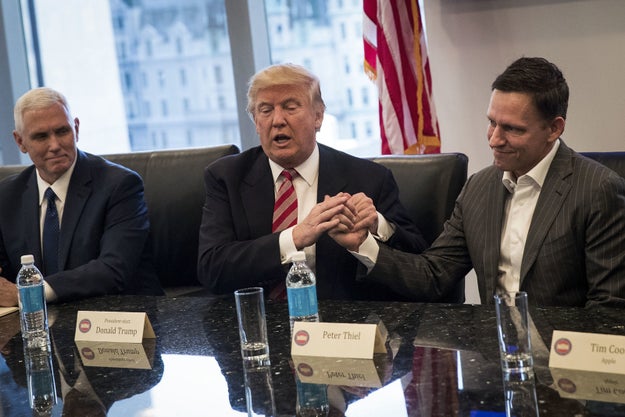
President Donald Trump shakes the hand of billionaire venture capitalist and transition team member Peter Thiel during a meeting with technology executives at Trump Tower in December.
Drew Angerer / Getty Images
Thiel’s views on Trump began to evolve during spring 2016, according to people close to him. In one private event at his home in San Francisco, he was cautious not to fully endorse Trump, but positioned him as a better option than Bernie Sanders, who he considered far too extreme, and Hillary Clinton, who he thought would be disastrous for trade and tax policy. When someone asked about Trump, however, Thiel, who had previously given $2 million to a Super PAC for then–GOP candidate Carly Fiorina, said that the bombastic Republican populist had a much better shot at winning the presidency than most pundits suggested, according to one person in attendance.
By May of that year, the billionaire investor was ready to tie himself to Trump. He was named a California delegate for the RNC that month, and by July, he was announced as a speaker at the event on the same day as the Republican candidate and his daughter Ivanka Trump. The crowd cheered Thiel’s six-minute speech, in which he declared himself proud to be gay and proud to be a Republican, garnering plenty of applause from Trump’s sons Eric and Donald Jr.
“He saw an opportunity to help somebody, who was not a sure thing, and get in on the ground floor,” said a friend of Thiel’s on his decision to speak at the RNC.
The RNC would be the first time Thiel met with Trump and his family in person. In a private dinner that summer following the event, a person who attended described Thiel as “giddy” and excited about the crowd’s reaction to his speech. This person also told BuzzFeed News that Thiel freely offered his first impressions of the Republican candidate, characterizing him as having “narcissistic tendencies.” He also suggested, in a claim that would be reiterated later, that if Trump were to be elected, there was a half probability that his presidency would end in failure.
The billionaire venture capitalist remained relatively quiet through the summer of 2016, avoiding interviews about Trump and Gawker Media, after Forbes revealed in May that Thiel had been secretly footing former professional wrestler Hulk Hogan's legal bills against the New York news organization. Gawker, which lost a landmark invasion-of-privacy lawsuit in a Florida court and was forced to pay $140 million in damages to Hogan, filed for bankruptcy and sold its assets to Univision Communications in August. Thiel said little publicly about the case.
He spent part of the summer traveling, taking advantage of his American, German, and New Zealand passports, the last of which has garnered its own controversy. Thiel’s Kiwi citizenship, which he’s held since 2011, was not revealed until the New Zealand Herald discovered in January that the government had granted him a passport under an “extraordinary circumstances” exception after he had spent 12 days in the country. “I am happy to say categorically that I have found no other country that aligns more with my view of the future than New Zealand,” Thiel wrote in his 2011 citizenship application, which was later released by the Kiwi government earlier this year after media pressure. Thiel's US$3.5 million property in Queenstown — referred to by locals as “the Plasma Screen” because of its expansive glass facade — was severely damaged in a suspected gas leak fire in August 2016, according to construction documents obtained by BuzzFeed News.
“What Trump represents isn’t crazy and it’s not going away.”
That September, Thiel penned an opinion piece for the Washington Post that highlighted Trump’s antiestablishment nature and “heretical denial of Republican dogma,” while largely ignoring the candidate’s policy initiatives. That was followed up by a $1.25 million donation — less than .05% of his $2.7 billion net worth, as estimated by Forbes — to Trump’s campaign in October. In dinners that fall in San Francisco and Los Angeles, Thiel was described by someone who attended both as “excited” and “positive” about Trump, emphasizing how good he would be for tax issues. Thiel’s boyfriend, Matt Danzeisen, also spoke about his support of Trump during at least one of these dinners, though was described as much more moderate, said that person.
Thiel’s only meaningful speaking appearance outside of the RNC came on Halloween day at Washington’s National Press Club, where he delivered a speech on Trump’s promise as a political outsider. “Trump’s agenda is about making America a normal country,” he said. Thiel also spent time addressing the candidate’s flaws, following the release of an Access Hollywood tape where Trump discussed sexually assaulting a woman. He called the comments “clearly offensive and inappropriate” and later noted in the same speech that “nobody would suggest that Donald Trump is a humble man.”
“No matter what happens in this election, what Trump represents isn’t crazy and it’s not going away,” he said.
At a gathering at his home in Los Angeles the weekend before the election, a source in attendance said Thiel reiterated that point. But in at least one private conversation, Thiel admitted he didn’t have much confidence in either candidate. Whoever wins, he said, will likely be a one-term president, according to a person familiar with the discussion, with Thiel predicting that there would be a major financial catastrophe in the next four years.
Trump’s victory was a marketing coup for Thiel. With a reputation as a renegade investor whose contrarian but prescient bets on companies like Facebook and SpaceX had paid off handsomely, Thiel — one of the few Silicon Valley elite to openly support Trump — now had a victory in the political sphere. The news media lauded his winning bet, with some speculating he might be named to the Supreme Court, a past dream of the Stanford University law degree holder.
While Thiel quickly shot down rumors of a Supreme Court appointment, he was named to Trump’s transition team. There he worked with two acolytes — Blake Masters, his Zero to One coauthor, and Trae Stephens, a former engineer at the Thiel-founded government contractor Palantir Technologies — to source and vet science and technology appointments.
One Trump campaign insider told BuzzFeed News that Thiel had his pick of cabinet positions, but never showed true interest in taking a permanent government job. Instead, he focused on adding his associates to positions of power. Thiel’s former chief of staff Michael Kratsios was named as deputy chief technology officer, while another former colleague, Kevin Harrington, joined the National Security Council as deputy assistant to the president. Justin Mikolay, an evangelist for Palantir — the Thiel-founded data-analysis company — was given a role in the Defense Department.
Thiel and his associates managed to steer clear of much of the infighting that troubled the Trump transition team in its early days. But they didn't escape unscathed. One source in a position to know told BuzzFeed News that when other transition members discovered that Stephens had not voted for Trump, he was summarily isolated from the group, souring some people’s perspectives on progress with the weeks-old administration.
“There is a 50% chance this whole thing ends in disaster.”
A spokesperson at Founders Fund, the Thiel-led venture capital outfit where Stephens is now a partner, declined to comment.
After organizing a meeting with technology leaders at Manhattan’s Trump Tower in December, where he was thanked profusely by the president-elect, Thiel spent the New Year’s holiday in Maui with about a dozen friends. While he worked for some of the time, he engaged with his close friends at meals and events, debating Trump’s merits with some of his more liberal attendees. According to two people in attendance, Thiel described the administration as a work in progress and discounted the suggestion that progress on social issues like gay marriage might be rolled back in the next four years. But these same people said Thiel tempered his enthusiasm with a caveat during one meal, remarking that “there is a 50% chance this whole thing ends in disaster.”
After about a week of relaxing in Maui, his guests, who included Y-Combinator President Sam Altman for part of the time, headed back to their jobs. Thiel readied himself to go back to New York, and later, the inauguration.
Thiel was one of the few chosen for a seat at the inauguration morning service at St. John’s Episcopal Church, and sat near the president during Trump's inauguration speech on January 20, BuzzFeed News has confirmed. In addition, on the night before the inauguration, he made an appearance at a Trump supporter event called the DeploraBall, but quickly left after being approached by reporters (including one from BuzzFeed News) inquiring about his role on Trump's transition team.
Later that month, he was back at his home in the Hollywood Hills, hosting a dinner in celebration for Hulk Hogan. While the two had never come into personal contact during the Gawker lawsuit, they met after the trial and became somewhat close. Thiel had even dressed up like the former WWE superstar during a December celebration at Trump donor Robert Mercer’s home.
The January dinner in Los Angeles was billed as a celebration of the former professional wrestler, and was also attended by Hogan’s attorney Charles Harder and other guests, who went home with goody bags of Hogan memorabilia. One guest in attendance recalled light political discussion, but nothing notable about Trump. Hogan, whose real name is Terry Bollea, would also speak about his life at Founders Fund’s San Francisco office.
“There’s some resonances between Hogan beating Gawker and Trump beating the establishment in this country,” Thiel told the New York Times’ Maureen Dowd in a preinauguration conversation, perhaps the most revealing interview the billionaire has given in the last year.
“I always have very low expectations, so I’m rarely disappointed,” he said of his role in the administration.
Even with his low expectations and his views on possible failure, Thiel hasn’t completely hidden his disappointment. At an event in May in San Francisco, he was described by one guest who was in attendance as “annoyed” with the first months of Trump’s presidency. With little policy being established by the White House, Thiel worried that the the next four years would be defined by stagnation and stressed the notion that he didn’t think Trump would be reelected.
In describing the administration, Thiel used one defining word in front of his guests: “incompetent.”●
With reporting from Nicola Harvey in Sydney.
Quelle: <a href="Peter Thiel Has Been Hedging His Bet On Donald Trump“>BuzzFeed