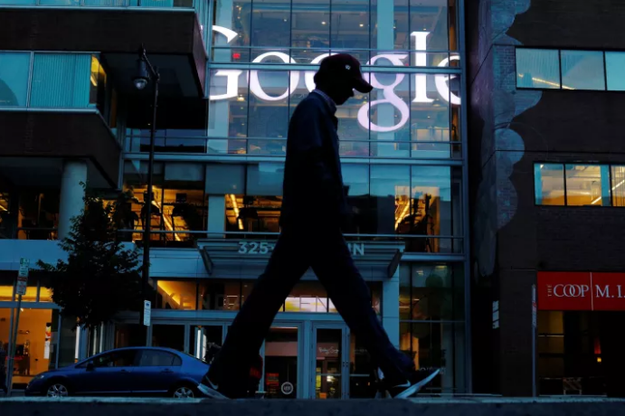
Brian Snyder / Reuters
The culture wars come for us all, and this week it was Google's turn.
Sometime on Saturday, an internal “anti-diversity” memo written by an engineer named James Damore spread throughout Google's internal messaging systems before being leaked in full to the press. The memo — which argued that genetic inferiority was the reason for the gender pay gap at Google and other tech companies — also took issue with the politics of Silicon Valley and other elite institutions. Google's progressive biases, Damore argued, alienated conservatives and effectively silenced voices that weren't aligned with a specific brand of social justice.
Google swiftly and strongly condemned the contents of the memo. The company’s Vice President of Diversity, Integrity & Governance, Danielle Brown, issued a statement arguing that though Google remained an open environment for “difficult political views,” those views need “to work alongside the principles of equal employment found in our Code of Conduct, policies, and anti-discrimination laws.”. Similarly, Google CEO Sundar Pichai issued a statement that the memo was a violation of Google's code of conduct. On Monday evening, Google fired Damore.
It's easy to see that the company had little choice but to fire Damore for violating its Code of Conduct. At its core, Damore’s manifesto and the backlash it inspired were an HR issue. But the incident also played right into these highly charged political times.
Indeed, within minutes, Damore’s firing spawned a predictable fallout across social media. In conservative pockets of the internet, Damore was hailed as a hero for speaking up. RIght-wing blogs like Breitbart have doubled down on the story, attempting to back Damore's assertions in articles featuring interviews with scientists who agree with him. On Twitter, pro-Trump media figures like Jack Posobiec combed through Danielle Brown's social media accounts and found that she worked for the Hillary Clinton campaign. Across 4chan, trolls floated Google boycotts and campaigns to “push back against” the company for its decision. Both Julian Assange and the right-leaning social network Gab offered him a job. Damore has threatened legal action for wrongful termination. A mess.
In almost every respect, the Damore debacle is perfect grist for our current culture war mill. It touches on all the hot-button issues of the day: gender, ideological monoculture, anti-conservative bias, and the political and cultural makeup of one of the biggest and most powerful companies in the world and others like it.
But while the debate across the internet is broadly concerned with the external politics of the firing, the internal politics are much more clear-cut. The memo was almost certainly as controversial within Google as it was on the broader internet: Emails were exchanged, complaints made, and employees drawn into conversations and away from their work. Executives have a material and procedural interest in pacifying their employees, and at least some of Google’s were upset.
What’s more, Damore's manifesto argument that women are biologically inferior is an untenable position inside almost any company — not just politically, but logistically. The first issue being: what does one do with Damore inside the company? You can't call people inferior and then, say, manage them. Or perhaps even be managed by them. And so who does Damore work with going forward? Will people still work with him? Does his career trajectory change post-memo? Is it fair to, say, exclude him from a management track? Does he need to switch teams? Do others need to switch teams? The manifesto invites endless human resources questions, many of them without any good answer.
Though we imbue Silicon Valley’s companies with all manner of culture war implications, at the end of the day they’re just that — companies, with bottom lines to meet and employees to keep happy. In suggesting that a large portion of his colleagues were genetically inferior, Damore got in the way of all that. Of course he was fired. The red line for the company wasn’t that Damore called said that Google has “an intolerance for ideas and evidence that don’t fit a certain ideology” — it was that he explicitly belittled an entire gender.
But in 2017, everything is political. Thus, the online shitstorm. And in Silicon Valley, it’s especially fraught. Though they tend to position themselves as politically neutral, many of the world’s biggest tech companies employ largely democrats and espouse socially liberal values such as gay marriage and women’s rights — a fact that has long been cause for anxiety from conservatives who feel the biggest platforms are too powerful to have any overwhelming political ideologies.
Specifically, Google has a well-documented progressive culture. In 2008, the company came out forcefully in favor of gay marriage, well before it was embraced by most politicians. The company's executive leadership has long championed liberal candidates and individually donated generously to their campaigns. Alphabet Chief Executive Eric Schmidt wasn't just an Obama donor, but advised his 2012 election campaign on digital strategies. In 2016, Schmidt was closely involved with Hillary Clinton's campaign, investing heavily in technology startups that eventually became the Clinton campaign’s “top technology vendor.”
Political bias makes the tech companies squeamish, too. Most days it seems, the companies and their leaders are grappling with the dueling desires to live up to their progressive values while also finding a way to appear as neutral platforms. They want #resistance without the responsibility (and backlash). And it's left the companies appearing tone deaf and seemingly unable to reconcile their values with the messy nature of being political in 2017.
But even if everything's political in 2017, it's not always necessarily politically motivated. When an employee alienates a significant percentage of the company’s workforce, the company has no choice but to sever ties, lest it be seen as forcing thousands of women in the company to simply put up with the idea that they’re genetically inferior.
And, as recent history shows, severing ties under intense internal pressure happens on both sides of the aisle. Breitbart News, which has fiercely criticized Google in numerous articles for Damore’s firing, recently terminated writer Katie McHugh for a series of anti-Muslim tweets. And early this year, reports detailed that the site forced its most popular editor, Milo Yiannopolous, to resign after pressure from higher-ups after comments that were viewed as an endorsement of pedophilia. Similarly, the conservative conference CPAC also canceled on Yiannopolous after the controversy.
Google’s decision is no different. And if the company is guilty of any disingenuousness, it’s in the messaging of Damore’s termination, which is exacerbated by Google's — and Silicon Valley's — precarious attempt to appear unbiased. Google could and should have been clearer about why Damore was fired. It could have noted that the company indeed does have political echo chamber issues. It could have taken pains to publicly reach out to conservatives in the company and begin a dialogue about political alienation in the workplace. It could have stressed that Damore’s memo wasn’t written in a vacuum, just as Google and Silicon Valley do not live in a vacuum and that the company understands that, for better or worse, everything is political now and the sooner Silicon Valley can come to terms with that, the better.
But above all else, Google should have stressed that the decision to fire Damore was difficult, but ultimately the only course of action — not a salacious political issue, but a mundane business decision.
Quelle: <a href="Why Google Had To Fire James Damore“>BuzzFeed