Amazon EMR now supports launching clusters with custom Amazon Linux AMIs

You can now create Amazon EMR clusters with custom Amazon Machine Images (AMI) running Amazon Linux. This enables you to preload additional software on your AMI and use AMIs that you customize and control. You can also encrypt the Amazon EBS root volume of your AMIs with AWS Key Management Service (KMS) keys. Additionally, you can now adjust the Amazon EBS root volume size for instances in your Amazon EMR cluster. Previously, this was fixed at 10 GiB.  
Quelle: aws.amazon.com

YouTube Is Rolling Out Counter-Extremism Features Today

YouTube Is Rolling Out Counter-Extremism Features Today

youtube.com

Today YouTube is rolling out a new feature to combat people who use its platform to promote extremist views.

In the past, YouTube has taken a reactive approach to content that violates its terms of service: After human users or the site's algorithm flag offending videos, YouTube deletes the videos and blocks the accounts responsible.

Now rather than simply removing content and banning bad actors, YouTube will take preemptive measures. When someone searches for extremist content on YouTube, the site will show them a playlist of videos that argue against extremism. NGOs that specialize in creating anti-extremist content will curate the video playlist.

The technique, dubbed the Redirect Method, “uses curated video content to redirect people away from violent extremist propaganda and steer them toward video content that confronts extremist messages and debunks its mythology,” according to a YouTube blog announcing the feature. The Redirect Method's dedicated website says that the technique uses Google AdWords in conjunction with the curated content.

For now, the feature focuses on English-language videos about Islamic extremism, specifically the videos that ISIS uses to recruit new members. YouTube said it's partnered with NGOs like Moonshot CVE to further research how best to counter extremism and to create new video content.

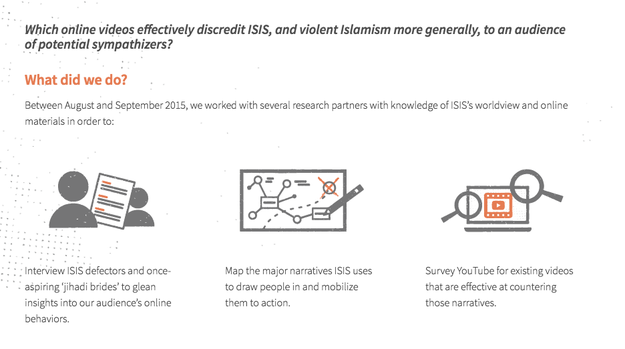
YouTube said it will measure the success of the program “by how much the content is engaged.” A pilot of the program conducted in August and September 2015 saw 320,000 people watch 500,000 minutes of 116 curated anti-extremism videos. According to YouTube, any institution is welcome to copy its methodology.

Google’s findings from its pilot program:

Google's findings from its pilot program:

YouTube

YouTube said the types of video that are most effective are not always overtly anti-ISIS: “We focused our survey on videos that were objective in appearance rather than materials that appeared specifically designed to counter ISIS. We used keyword searches to identify 'hidden' counter-argument content — that is, videos that are not necessarily well-known, and often not designed explicitly to refute ISIS.”

Three categories of video fit the bill in the pilot program: citizen journalism and documentary footage, religious debate between clerics and other religious figures, and videos featuring ISIS defectors.

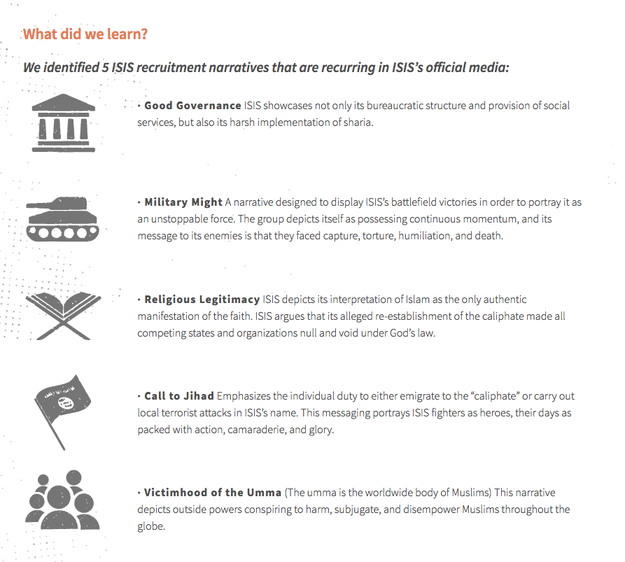
YouTube and its NGO partners identified five features that appear in many ISIS recruiting videos:

“Good governance, military might, religious legitimacy, call to jihad, and victimhood of the umma (the umma is the worldwide body of Muslims).”

YouTube

The program's next steps, according to YouTube's blog post, will focus on curbing Islamic extremism in Europe's many languages:

  • “Expanding the new YouTube product functionality to a wider set of search queries in other languages beyond English.”
  • “Using machine learning to dynamically update the search query terms.”
  • “Working with expert NGOs on developing new video content designed to counter violent extremist messaging at different parts of the radicalization funnel.”
  • “Collaborating with Jigsaw to expand the “Redirect Method” in Europe.”

British Prime Minister Theresa May has increasingly called for tech companies like Facebook and Google to do more to combat Islamic extremism in Europe.

France has backed her statements. May and France's President Emmanuel Macron agreed in May to develop a forum on fighting terrorism that will help tech companies develop better methods for rooting out recruitment efforts on their platforms.

Quelle: <a href="YouTube Is Rolling Out Counter-Extremism Features Today“>BuzzFeed

Amazon SNS Console Improvements Now Available in the AWS GovCloud (US) Region

Several enhancements have been made to the functionality and user experience of the Amazon SNS console in the AWS GovCloud (US) region. Amazon Simple Notification Service (SNS) is a flexible, fully managed pub/sub messaging and mobile notifications service for coordinating the delivery of messages to subscribing endpoints and clients. These improvements to the SNS console have made navigation and categorization of information easier, and allow you to now view up to 100,000 SNS topics, subscriptions and endpoints. You also can now run data validation for items such as resource names, ARNs and policies.
Quelle: aws.amazon.com

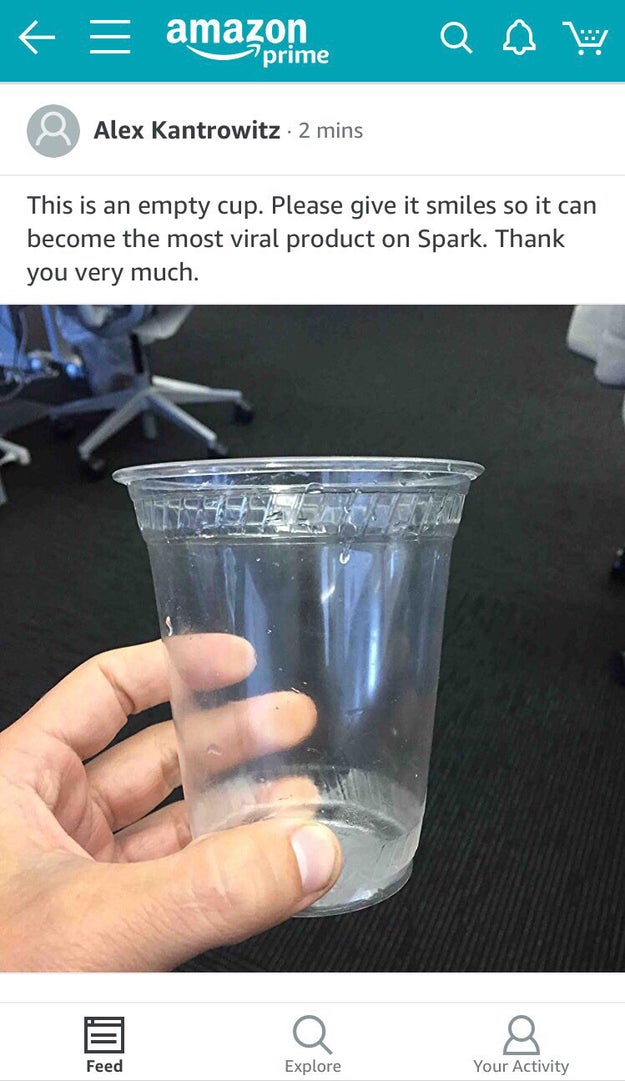
Scenes From A Thrilling Afternoon On Amazon's New Social Network, Spark

On Tuesday, Amazon introduced a new social network called Spark.

Spark is an Instagram competitor, with a commerce-y twist!

Amazon says Spark “makes it easy to discover—and shop—stories and ideas from a community that likes what you like.” The idea is to make it easier to move from talking about products in a social feed, to buying them.

We here at BuzzFeed News are always interested in what's hot and new in the social space, so we took Spark for a spin yesterday.

Inside Spark, we found lots of great stuff. There were some wonderful fashion tips:

Along with stunning home appliance photography:

Look at this pan. Wow.

Spark also has polls to help you make tricky purchase decisions. Check out this jaw-dropping functionality:

The social network is filled with thought-provoking questions.

The social network is filled with thought-provoking questions.

Like Instagram, Spark even has its own influencers. Meet Diego L.

Looking good, Diego L.

As Diego L. demonstrates, Spark has a good amount of sponsored content, like any top tier social network.

People discover amazing things when brands pay them to do it. And now you can be part of that discovery.

Here's a picture of a chair on Spark:

And here's a picture of a fan:

Here's a picture of a coffee mug on a boat on Spark.

And some shoeboxes.

And some shoeboxes.

There are some genuinely good pictures on Spark. Like this dog in a kitchen.

And this travel photo that is nice but doesn't really fit in.

Hey Jeff Bezos, I really like your new social network. Did I mention you look ripped lately? Please don't hurt me.

Quelle: <a href="Scenes From A Thrilling Afternoon On Amazon's New Social Network, Spark“>BuzzFeed

IBM leadership in cloud: Building on a legacy of excellence

The market for cognitive insights delivered via cloud to specific industries is estimated to grow to roughly $2 trillion by 2025. Given this huge opportunity, I’m not surprised that some IBM competitors are realigning their sales forces to target industry verticals.
While there are several reasons why companies choose IBM over our competitors, we believe the most important reason is that IBM is built to support the enterprise. IBM has built its cloud with Watson to be a highly differentiated platform focused on the needs of businesses and industry verticals. Most of all, it is optimized from the chipset to serve the user experience. This allows clients to integrate their data from their existing systems with other kids of data in the cloud and uses Watson to make sense of it.
Moreover, the nearly 60 IBM cloud data centers in 19 countries – including four new centers announced this week – are incredibly important. The breadth and location of our data centers is critical, as global enterprises navigating the transition to the public cloud are increasingly subjected to many different regulatory requirements related to security, privacy, governance and other key issues.
Enterprise clients require – and the IBM platform uniquely provides – controlled access to their data sets. This includes data locality – transparency of where their data is, who is using it, what it’s being used for, and data isolation to ensure their data is not intermingled with others’ data.
IBM also has the industry expertise to meet strict regulations across various industries while creating custom solutions for its customers. For example:

The IBM Cloud is designed for industries with stringent regulatory requirements including HIPAA, GxP, and QMS.
For industries such as automotive, aircraft, and consumer electronics, the IBM cloud platform offers a half-a-petabyte a day to/from connected devices.
Today, IBM Cloud supports some of world’s most notable brands, including American Airlines, AT&T, Bitly, BMW, Bombardier, Maersk, Chubb, Clarient Global, Etihad, Kaiser Permanente, Lloyds Banking Group, Halliburton, Pratt & Whitney, Shop Direct, US Army and Wanda Group.

While other providers are just now reorganizing around industries, IBM is already well positioned in key sectors, delivering industry-specific cloud solutions to clients:
Education: IBM and Sesame Workshop are working with Georgia’s Gwinnett County Public Schools, one of the top urban school districts in the US, on an initial pilot of the industry’s first cognitive vocabulary learning app, built on the IBM and Sesame intelligent play and learning platform. The new platform, powered by IBM Cloud, enables an ecosystem of software developers, researchers, educational toy companies and educators to tap IBM Watson cognitive capabilities and Sesame Workshop’s early childhood expertise to build engaging experiences to help advance children’s education and learning.
Retail: IBM announced that it is a pilot partner of BMW CarData. BMW CarData will allow up to 8.5 million BMW customers globally to make use of third party services in a secure and transparent way. BMW is the first OEM to release an open data platform with the introduction of BMW CarData. As a pilot partner, IBM has integrated the IBM Cloud with the BMW CarData platform. Vehicle data will be enhanced by IBM Watson Internet of Things (IoT) using cognitive and data analytics services to enable third parties, such as automotive repair shops or insurance companies, to develop entirely new customer experiences.
Health: Memorial Sloan Kettering clinicians and analysts are partnering with IBM to train Watson Oncology to interpret cancer patients’ clinical information and identify individualized, evidence-based treatment options. Through this partnership, IBM and Sloan Kettering are working to decrease the amount of time it takes for the latest research and evidence to influence clinical practice across the broader oncology community care.
Manufacturing: Bombardier announced it is extending its long-term partnership with IBM through a new six-year deal valued at approximately $700 million, which includes IBM Services and IBM Cloud management of Bombardier’s worldwide IT infrastructure and operations.
Financial services: IBM signed a 10-year cloud services agreement with Lloyds Banking Group in the UK with a contract value of $1.69 billion. IBM will provide dedicated cloud offerings hosted securely in both Lloyds and IBM data centers in the UK and will manage the application migration services to their new cloud.
Transportation: American Airlines announced this quarter it will move to the IBM Cloud and use it as the foundation for its digital transformation. American will migrate critical applications including aa.com, its customer facing mobility app and global network of kiosks.
These are just a few of our client wins over the past quarter. As we continue to strengthen our position as the enterprise cloud leader, we remain committed to continuing to innovate and provide cutting-edge solutions based on emerging technologies across multiple professions.
Because every day IBM remains committed to creating new, customer-centric solutions that are enterprise strong, data first, and most importantly, cognitive at the core.

The post IBM leadership in cloud: Building on a legacy of excellence appeared first on Cloud computing news.
Quelle: Thoughts on Cloud

AWS Mobile Hub enhances Cloud Logic import capabilities and releases React starter project to GitHub

AWS Mobile Hub released enhancements to the project import feature today, allowing a developer to import Cloud Logic functions through the one-click import from GitHub feature.  With the Cloud Logic import feature, developers can also specify environment variables and CORS settings, allowing for the same code to be used for multiple functions with different settings (for example, test vs. production workloads or CRUD API for different tables within a DynamoDB database). The Cloud Logic import feature will also provide appropriate authorization for a linked Amazon DynamoDB database and Amazon API gateway, taking care of all resource deployments, service connections and IAM configuration with a single command. 
Quelle: aws.amazon.com