Amazon AppStream 2.0 Now Supports Graphics Applications

Today, Amazon AppStream 2.0 is introducing Graphics Desktop and Graphics Pro instance families to deliver high performance graphics applications from AWS. These new graphics instance families allow you to stream powerful graphics applications to a web browser on any desktop, eliminating the need for expensive and bulky workstations. Applications are delivered remotely using NICE DCV, a secure hi-fidelity streaming protocol that is specially tuned for graphics workloads. Since graphics applications can now be run next to data that is stored on AWS, designers, engineers, and analysts using AppStream 2.0 can benefit from a high quality, low latency visualization experience for their 2D and 3D workloads. AppStream 2.0 provides secure, anywhere, anytime access, so your users can use the software and data they need to be productive, wherever there is a web connection. In addition, software developers can move their desktop applications to the cloud without rewriting code, creating new distribution channels and subscription services. 
Quelle: aws.amazon.com

Uber Is Still Fighting A Class-Action Lawsuit From Drivers

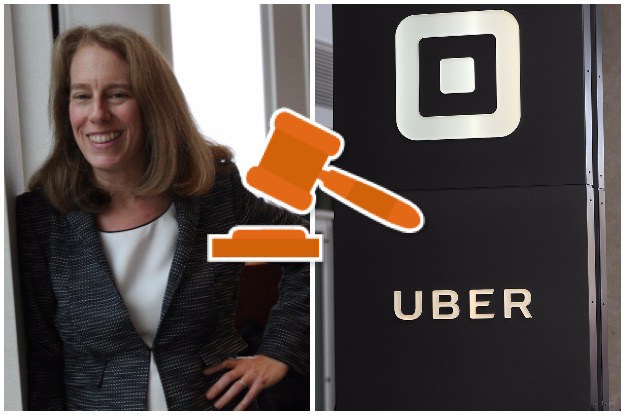
Four years after attorney Shannon Liss-Riordan first took legal action against Uber for allegedly misclassifying its driver workforce as independent contractors, the company is still fighting her class action lawsuit. And now, Uber is taking action against Liss-Riordan directly.

Uber is currently attempting a tectonic culture shift after a series of scandals. In February, a former employee’s viral blog post about discrimination and harassment launched two separate internal investigations into workplace culture; ultimately, Uber’s CEO Travis Kalanick stepped down and at least twenty employees were terminated. Executives have publicly apologized, and promised change, both for the Uber’s employees and the drivers who keep the app running.

But on Friday, Uber took a more typically pugilistic approach when it filed a motion to sanction Liss-Riordan, accusing her of willful misconduct, and saying she contacted drivers using confidential information found in court documents to solicit their business.

But Liss-Riordan says these drivers were already her clients, and told BuzzFeed News there’s “nothing improper” about communication between them and her firm. “We would not be representing them responsibly if we did not keep them informed about the defendant's attempt to strip them of their right to participate as class members,” she told BuzzFeed News.

Liss-Riordan, otherwise known as Sledgehammer Shannon, became famous in Silicon Valley four years ago when she started filing class action lawsuits accusing gig economy companies including Uber, Lyft, Handy, Postmates, and DoorDash of misclassifying their employees as independent contractors in order to cut down on labor costs.

In March, Lyft agreed to settle its class action for $27.5 million. But the lawsuit against Uber has stalled. In April 2016, Liss-Riordan negotiated what would have been a significant $100 million settlement with Uber — but it was thrown out that August by a judge who felt she could have pushed for a larger payout. Since then, the class has splintered, with some named plaintiffs seeking new representation, and Liss-Riordan being forced to defend herself against allegations from class members and other law firms who say she’s more interested in personal profit than helping drivers.

Liss-Riordan is still fighting to keep the class action suit together and to prevent Uber from sending drivers into individual arbitration. But she’s also preparing for the possibility that she won’t succeed. So in March she sent an email survey to drivers asking them to provide their personal information if they wanted her to represent them in private arbitration.

“In the event that Uber succeeds in breaking up the class, we want to ensure that all class members have the opportunity to continue pressing their claims individually if necessary,” she told BuzzFeed News.

But Uber says the means by which Liss-Riordan contacted these drivers violated rules around confidentiality. In the motion, Uber says she “willfully misused the name and contact information contained within the Class List—Uber’s very own “Highly Confidential— Attorneys’ Eyes Only Information”—to solicit some, if not all, drivers on the Class List for the purpose of initiating new, individual-plaintiff actions against Uber.”

Uber says, by sending the survey, Liss-Riordan confused drivers, leading them to believe that they have to sign up with her firm in order to continue to participate in the class-action lawsuit, which is not the case. In the filing, Uber points to a number of posts on popular driver message board UberPeople.net as proof that the email from Liss-Riordan’s firm led to confusion among the drivers.

Uber is asking the court to disallow Liss-Riordan from representing individually any driver who received the email in question. The company declined a request for comment on this story.

“Uber is (as I predicted) trying to stop at all costs the drivers pursuing their claims,” Liss-Riordan wrote in an email. The company’s decision to to ask for sanctions against her is, she continued, “just their first step to block drivers from pursuing their rights.”

Uber has been taking steps to improve the driver experience in recent months. They can collect tips now, and in a few states they can opt in to injury insurance, which gives them some of the protections employees are typically guaranteed. But drivers are still independent operators, working for themselves, and earning very little money in the process.

Meanwhile, most of the lawsuits Liss-Riordan has brought against gig economy companies have fizzled out; she settled with DoorDash for $5 million, and a suit against Postmates looks to be headed the same way.

But in September, four years after she initially sued Uber over misclassification, she might finally get her day in court, albeit against a slightly less infamous startup. She’ll be representing a former contractor who worked for Grubhub, a website that facilitates delivery of restaurant takeout, at trial in Northern California. The outcome of that case could finally provide insight on the question of who on-demand workers are really working for.

Quelle: <a href="Uber Is Still Fighting A Class-Action Lawsuit From Drivers“>BuzzFeed
Your Roomba Is Making A Map Of Your House, And It Might Sell It

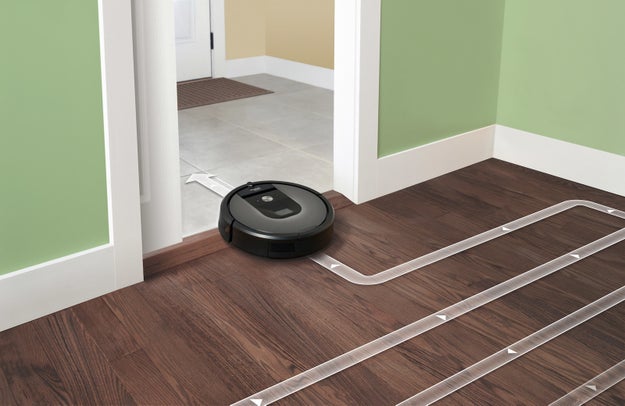
Your cute little Roomba that zooms around doing the vacuuming for you has been making maps while it works… and someday, its maker may sell your house's floor plan to other tech companies.

Instagram: @floeckchentherabbit

The CEO of iRobot, which makes the automatic vacuum, told Reuters that his company is considering selling the data Roombas have collected in customers' homes to companies like Google, Apple, and Amazon.

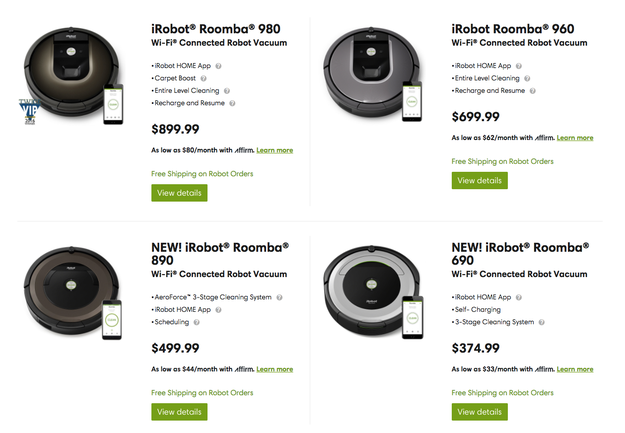
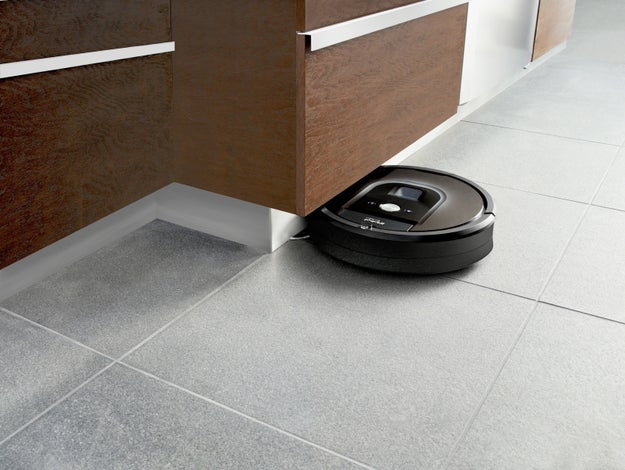
iRobot's actually been mapping your house since 2015, when it released the Roomba 980. That smart vacuum creates its own map of your house so it won't knock over your lamps. The technology, dubbed Simultaneous Localization and Mapping, allows the smart vacuum to smartly navigate your house, clean it, and return to its charging station autonomously.

And now iRobot has an idea for making money off that data. A lot has changed since iRobot started selling the first Roomba in 2002. The many internet-connected gadgets that make up a home smart have expanded to include lights, blinds, TVs, speakers, coffee pots, thermostats, toasters, security cameras, ovens, and more. Some of these devices could use a map of your house to be more effective, but none of them moves around your house collecting spatial data in the same way a Roomba does.

Reuters reports that iRobot is considering selling this data to companies making smart speakers and other smart home technology, including Amazon, Google, and Apple. Roomba is already compatible with Amazon's voice assistant Alexa and its accompanying smart speaker Echo. You can use the Echo to tell the vacuum to start cleaning, stop cleaning, go home to its charging station, and more. But the Roomba doesn't tell Amazon what the layout of your house looks like, at least not for now.

iRobot's potential plans have some privacy advocates concerned. Jamie Williams, an attorney at the Electronic Frontier Foundation, told BuzzFeed News, “Maps of the inside of your home can tell a lot about a person. For instance, how you lay out your living room could disclose whether watching TV is a central part of your life. It could disclose whether you have pets. How often you rearrange furniture. This information wouldn't be worth a lot to advertisers if it didn't reveal highly sensitive information about the inside of the home.”

If you think it's creepy that Roomba's been sharing maps of your house with its maker, there's a way to cut the data sharing with iRobot, though it might disable a key feature of your robo-vac.

iRobot

iRobot's privacy policy reads, “You can control or stop the collection of usage data from your registered iRobot device by disconnecting your Wi-Fi or Bluetooth from the app, for example, by changing your Wi-Fi password.” However, this will disable your ability to use the Roomba with your smartphone or with Alexa, which requires a Wi-Fi connection. iRobot advertises Wi-Fi connectivity and remote control as one of Roomba's primary features.

In a statement, iRobot told BuzzFeed News it “is committed to the absolute privacy of our customer-related data, including data collected by our connected products. No data is sold to third-parties. No data will be shared with third-parties without the informed consent of our customers.”

Williams told BuzzFeed News that while iRobot will need to get customers' permission, “this request for consent may appear as small print in some updated policy, which in our mind is not real consent, especially given the sensitivity of this information.”

But you don't have complete control. iRobot may still retain anonymized data connected to your device.

The company's privacy policy also says, “We reserve the right to de-identify your personal data, including information about Robot and Service usage, and to retain your anonymized information for our own records.”

iRobot does not specify in its privacy policy whether a map of a home would legally be considered personally identifiable information or anonymized user data. The company declined to comment on how it classifies the information.

“I hope we never get to a point where anyone things that constant tracking of behaviors inside the home is just a cost we pay for having a personal assistant or
making coffee via an Internet connected device,” Williams said. “How consumers react to iRobot's plans to gather and sell maps of the inside of their homes is going to reveal how likely we are to get there.”

Quelle: <a href="Your Roomba Is Making A Map Of Your House, And It Might Sell It“>BuzzFeed

Kubespray.io takes the pain out of Kubernetes deployment

The post Kubespray.io takes the pain out of Kubernetes deployment appeared first on Mirantis | Pure Play Open Cloud.
There are a lot of differences between OpenStack and Kubernetes, but one thing they both share is that setting them up is far from trivial. Fortunately, the Kubernetes community seems to have learned some lessons from its big brother, and today they launched an updated Kubespray.io website, a web-based toolset for deploying Kubernetes clusters on (almost) any environment with Kubespray, the Kubernetes community deployment project.

What is Kubespray?
Kubespray, formerly Kargo, is a project under the Kubernetes community umbrella. It’s a set of tools designed for easily deploying production-ready Kubernetes clusters.
For example, say you wanted to deploy a Kubernetes cluster on your OpenStack cloud, with 2 masters, 2 minions, and 3 etcd nodes.  The first thing you’d need to do is make sure you had seven nodes available.  If you were using kubespray-cli, you could simply type:
kubespray openstack –masters 2 –nodes 2 –etcds 3
This command would not only create the instances, it would let Kubespray know where they are, so you could automatically deploy a cluster to them with a command such as:
kubespray deploy –openstack -u ubuntu
Kubespray supports multiple Linux distributions to host the Kubernetes clusters, including Ubuntu, Debian, CentOS/RHEL and Container Linux by CoreOS. It also supports multiple cloud providers as an underlay for the cluster deployment, including AWS, DigitalOcean, GCE, Azure and OpenStack, as well as bare metal installations.
Kubespray can deploy Kubernetes clusters that may consume both Docker and rkt as container runtimes for containerized workloads, and can deploy the cluster over a variety of networking plugins, including Flannel, Weave, Calico, and Canal, or it can use the built-in cloud provider networking instead.
Once your cluster is up and running, you can simply start using it as you would any other k8s cluster.
It’s that easy.
Well, almost.
OK, so what’s Kubespray.io, then?
You know how they say if it sounds too good to be true, it usually is?  Well, there’s no question that Kubespray makes it a heck of a lot easier to deploy Kubernetes than doing it by hand, but it’s still not simple.  Before you can get to the point of running those simple commands, you need to take care of all of the necessary configuration.
That’s where Kubespray.io comes in.
While Kubespray itself is a CLI-based tool, Kubespray.io is an easier-to-consume web-based service. It enhances the existing experience of provisioning, deployment and management of Kubernetes installations with the web-based user interface and other notable improvements.
For example, suppose you want to use Kubespray to deploy Kubernetes on 5 AWS instances, sized t2.large.  After entering your AWS credentials, you can simply specify these parameters directly from Kubespray.io.  (Make sure that your Region is set to us-west-2.)

From there, Kubespray simply does the provisioning, providing you a stream of the log so you can see what’s happening.
When it’s done, you’ll see a link to your dashboard:

Kubespray.io is under active development, so while you can currently deploy Kubernetes installations on Amazon Web Services and DigitalOcean, extending its support to cover GCE, Azure, OpenStack and others is in the project roadmap.

Kubespray was originally intended for developers trying out Kubernetes, but it’s evolved to include the ability to deploy Highly Available clusters. So whether you’re a hobbyist or getting really serious with your container orchestration plans, please join us at kubespray.io to deploy your first Kubernetes highly-customizable cluster, and let us know how it works for you, and how we can make it even better.
(This article was originally published at Kubespray.io.)
The post Kubespray.io takes the pain out of Kubernetes deployment appeared first on Mirantis | Pure Play Open Cloud.
Quelle: Mirantis

Uber Is Trying To Improve How Five-Star Ratings Impact Drivers

Uber's trying to make its five-star rating system a little more fair.

The rating system, which uses customer feedback to determine driver performance, is a pain point for many drivers, who run the risk of getting kicked off the platform if their scores fall too low.

But starting today, Uber is rolling out a new interface aimed at preventing experiences that are outside the driver's control, such as software glitches or traffic, from impacting their overall rating.

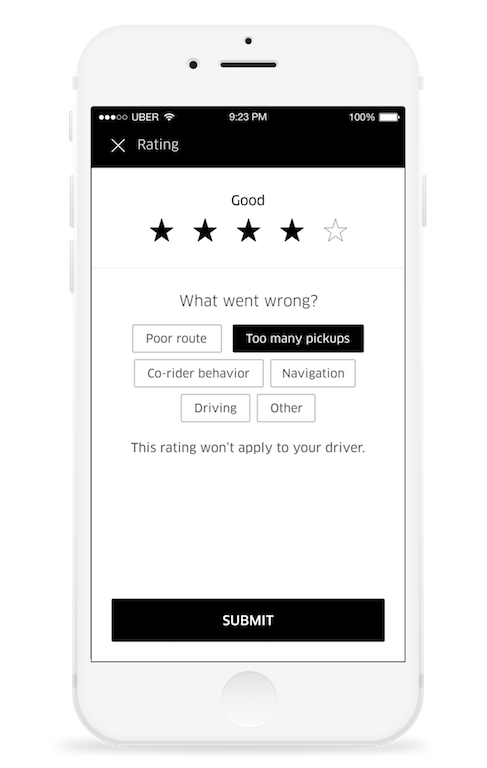
If a passenger gives a driver a rating of four or fewer stars, the app will prompt the passenger to say what they didn't like about their ride. If the reason they choose wasn't the driver's fault, the low rating won't be counted toward the driver's overall score.

The update is part of Uber's 180 Days of Change, a project dedicated to improving the Uber experience for drivers. The campaign kicked off in June with the news that Uber passengers would be able to tip their drivers through the app for the first time. Today's announcement comes with a host of other updates, including a phone hotline for drivers that's now available 24/7 and the ability for drivers to correct their own fares in case of an error.

There's one update that Uber passengers might not be thrilled about: Uber is going to start charging for returning lost items. Drivers will get paid $15 from riders in exchange for delivering wallets, iPhones, and other lost belongings to their rightful owners.

These changes follow a tumultuous six months for Uber during which CEO Travis Kalanick resigned, the company underwent two internal investigations regarding harassment, discrimination, and workplace culture, and at least 20 employees were terminated. Uber is also currently fighting a major lawsuit from Alphabet over allegedly stolen intellectual property.

The company has publicly vowed to make itself a better, safer place for its employees, and it's also committed to treating drivers better, too. After all, it was just this year that 200,000 Uber users deleted the app from their phones in protest of its perceived mistreatment of taxi drivers.

In a letter to drivers, US general manager Rachel Holt and head of driver experience Aaron Schildkrout said the company has “reviewed and revised” over 100 policies to make them more “driver friendly.” More updates, they wrote, are set to roll out next month.

Quelle: <a href="Uber Is Trying To Improve How Five-Star Ratings Impact Drivers“>BuzzFeed