Women In VR Really Hope Their Industry Can Avoid Becoming Just Another Sleazy Tech Story

LOS ANGELES — For an event billed as an “E3 Extravaganza,” Upload's mid-June celebration of the annual gaming conference was oddly subdued. Perhaps it was the headset-adorned partygoers, aloof in their immersive first-person shooters. Or maybe it was the chill of the bombshell sexual harassment lawsuit that had been brought against the virtual reality company just four weeks earlier.

While the tech world has been rocked with a spate of sexual harassment allegations recently, the lawsuit against Upload stands out. In the suit, filed in May, Elizabeth Scott, a former social media manager, alleges that prostitutes and strippers were invited to company parties,”male employees stated how they were sexually aroused by female employees and how it was hard to concentrate and be productive when all they could think about was having sex with them,” and women in the office were referred to as “mommies” who were there to “help the men with whatever they needed.” (Scott's attorney did not return multiple phone calls seeking comment; a spokesperson for Upload declined to comment.)

Ian Tingen of UploadVR uses Oculus goggles at The Village event space in San Francisco on March 15, 2016.

Gabrielle Lurie / AFP / Getty Images

Upload, which also offers a range of classes on various VR topics and publishes a news site about the industry, is not the only player in the VR space that's been hit with scandal in the last year. In February, VR company Magic Leap was sued for sex discrimination and retaliation by its former vice president of strategic marketing and brand identity, who alleged that she was fired after repeatedly trying to correct the company's gender imbalance and general hostility toward women. The suit quotes an IT support lead allegedly saying, “we have a saying; stay away from the Three Os: Orientals, Old People and Ovaries.” In March, Oculus founder Palmer Luckey left Facebook (which bought Oculus in 2014 for $2 billion), six months after he had donated $10,000 to a pro-Trump organization and meme group called Nimble America affiliated with Milo Yiannopoulos, and for secretly donating $100,000 to Trump's inauguration in the name of a company called Wings of Time. And in May, Oculus's head of computer vision, Dov Katz, was arrested for soliciting sex from an undercover police officer he thought was a 15-year-old girl.

“I love VR for its potential, but these fucking man-babies are ruining it.”

With its umbilical cord still firmly attached to the gaming world from which it emerged, VR seems in some ways tethered to that industry's long history of sexism. Can a world in which young men are given millions of dollars with little accountability ever really be a space where women can thrive? According to over a dozen women (and a couple of men) interviewed by BuzzFeed News who are involved in virtual reality, the answer is complicated.

“This is the third time that a big VR company or person has been the scum of the earth,” said a VR producer who asked to remain anonymous, referring to the most recent scandal at Upload. “I love VR for its potential, but these fucking man-babies are ruining it.”

Gaming fans in VR goggles play “Echo Arena” from Oculus on June 14, day two of E3 2017, the three-day Electronic Entertainment Expo at the Los Angeles Convention Center.

Frederic J. Brown / AFP / Getty Images

In 2016, the VR and AR (augmented reality) sectors attracted $2.2 billion in investment, a 300% increase over the $700 million invested in 2015. (Upload, for its part, closed a $4.5 million Series A round of funding in September.) The field has been heralded as the next big thing in tech for the past four years or so — and has also been lauded as a kind of utopia for female developers and producers in VR, something of a blank slate in a broader industry not known for being kind to women. A New York Magazine article last September proclaimed, “In Virtual Reality, Women Run the World,” arguing that because the field is so new, “female creators have gotten a rare opportunity to start from a level playing field.”

But if the past year is any indication, VR might not be quite the do-over optimists had hoped for. After all, this is an industry that emerged out of three notoriously misogynistic and male-dominated industries: video games, Silicon Valley, and Hollywood.

“These industries have not been very friendly to women,” said Angela Haddad, a virtual reality creative director in LA. “They haven't been very inviting or supportive in general. Silicon Valley and the entertainment industry are both bro cultures. There's been a lot of concern that VR will end up like these two industries.”

If the past year is any indication, VR might not be quite the do-over optimists had hoped for.

Or as Taryn Southern, a YouTube personality who is now working in VR, put it: “We don't want to end up with Silicon Valley tech bro culture shaking hands with Hollywood sleazy producer/director culture.”

In some ways, they already have. Much like in Hollywood, female directors are rare, according to Molly Swenson, cofounder of RYOT studios. And much like in video gaming, where the use of “booth babes” is still relatively common despite the backlash against it, it's almost exclusively women who are hired as “concierges” at conferences and conventions, encouraging people to come try on VR headsets.

Kent Bye, who hosts the Voices of VR podcast and writes about the industry for the Road to VR site, recalled attending an Upload party where guests were checked in by models. “What message is that telling me and other women in the industry, hiring models to play that role?” Bye said. “One of the claims Elizabeth [Scott] is making is that she could never check people in because she wasn't attractive enough. That seems incredibly plausible.” (The lawsuit states that “[Mason] also made it known that he did not find Plaintiff attractive and that she could not be used for marketing purposes because she was 'too big.'”)

Upload's former event producer, Olya Ishchukova, is also the founder of a company called Models in Tech that supplies models to tech companies for parties and conferences; for the year she was a contractor at Upload, from December 2015 to December 2016, she was simultaneously running Models in Tech. (An Upload spokesperson told BuzzFeed News that Ischchukova “worked on Upload events but also ran her business on the side. Models in Tech was never 'based' out of Upload SF.” Ishchukova did not return a phone call seeking comment.)

“Models were everywhere,” said someone who works in VR in the Bay Area who asked to remain anonymous. “At all of their events, models were greeting, models were hosting.” (Upload cofounder Taylor Freeman is on the Models in Tech website giving an endorsement: “Always knowledgeable, always professional. Models In Tech run vr demos at our events, engage with attendees and educated them about new virtual reality experiences.”)

Instagram: @modelsintech

Virtual reality is a notoriously small community — so small, in fact, that as Jodi Schiller, the founder of a VR company called New Reality Arts, noted, “it really feels a lot of times like I'm in high school again.” In Upload’s case, that means the organization is everywhere; they know everyone, and everyone knows them. But Upload, Schiller said, “were the popular kids. They were a driving force, they were the nucleus. Everyone has a connection from Upload.” And so for many in the VR world, it was especially disappointing when Upload, viewed as a pillar of the nascent community, was accused of sexual harassment.

Upload's role in the community made it particularly hard to speak out — especially since, at least externally, the company’s management seemed outspoken on gender equality. Cofounder Will Mason, who is 27, was briefly on the advisory board of SH//FT (“Shaping Holistic Inclusion in Future Technologies”), an organization founded by Jenn Duong and Julie Young, two LA-based young women in VR. He also contributed to discussions in the Women in VR Facebook group, which Duong and Young co-founded in the fall of 2015, and which boasts that its membership of 5,600 comprises of 80% women and 20% men. According to screenshots provided to BuzzFeed News, as recently as April, Mason had posted in the group that “the women in this group contribute a lot to making this industry the best in the world. I'm so glad that we are focusing on building VR and AR with a diversity focused approach :)”

“On paper [Upload was] doing so much good for VR as an ecosystem,” said the anonymous VR producer. “They were trying to create a virtuous cycle for VR …. Unfortunately, they're fucking scumbags, I guess.”

“They were trying to create a virtuous cycle for VR …. Unfortunately, they're fucking scumbags, I guess.”

Several women interviewed by BuzzFeed News expressed discomfort with how the group had handled the allegations. Some argued that the group's admins were too slow to act. Others said they questioned some messages Duong, in particular, posted to the group defending Upload. A comment in which Duong said she “viewed Upload as family to be very honest” and wanted “nothing more than for them to succeed” was particularly troubling to members who worried Upload was using them to polish its image. As one group member wrote, Upload had positioned itself as “a young, hip, progressive company that was about building community” and that they had “used people — Jenn Duong and others — to bolster the perception that they were a feminist-supporting, diversity-supporting organization that was positive for women.”

By mid-June, Mason and Freeman, along with two Upload employees named in the suit — Avi Horowitz and Greg Gopman (who is no longer working for Upload) — had been removed from the group.

“After receiving several member complaints that the presence of Upload executives within the group violated the sanctity of the space, we voted to remove said executives from the group,” Young and Duong told BuzzFeed News via email when asked in mid-June how they were addressing the fact that some members of Women in VR felt uncomfortable airing some of their issues with Upload in light of Duong's friendship with Will Mason and his previous position on the SH//FT board. “We've also taken the conversations that happened around the Upload situation as an opportunity to revamp our community standards and guidelines to make sure that they reflect the needs of the community.”
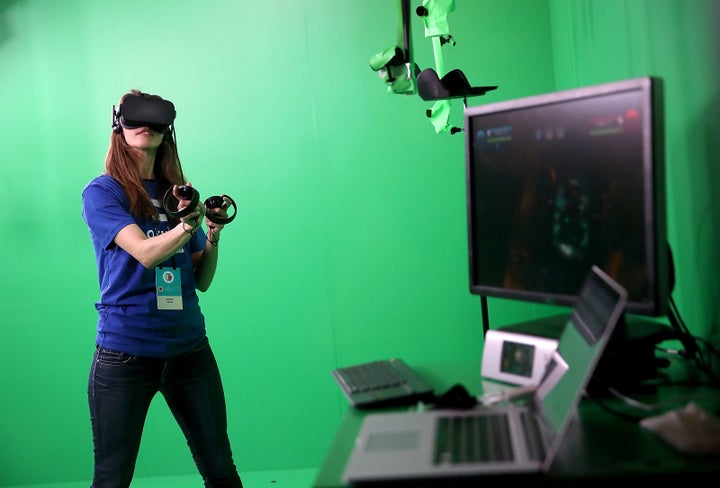
Adriana Ojeda uses an Oculus headset at Facebook's F8 Developer Conference on April 18 in San Jose, California.

Justin Sullivan / Getty Images

Upload is, to be sure, an extreme example. But even women who said they view the VR industry as a generally welcoming space said they'd had negative experiences. Ainsley Sutherland, a VR game designer who is a former BuzzFeed Open Lab fellow, recalled being unwittingly photographed during an Oculus demo. “There's something really odd about it — this idea that this woman can't see that we're all looking at her,” she said. “It's a little creepy. Especially because it's way more dudes than girls.”

Adaora Udoji, who started a VR and AR company called ZFs4 Productions after a long career in radio and broadcast news, remembered moderating an all-female panel about VR where two men interrupted the panelists before the Q&A started: “I've never been in a place where someone in a room of 150 people injected himself into the conversation,” she told BuzzFeed News about one of the men's comments. “And what he was saying was very hostile, that women don't have the skills. And you're talking to a panel of women who are technologists. It was so out of the bounds of accepted public behavior in a professional setting.”

Southern moderated a Women in VR panel about pornography at a conference that got derailed by a male audience member. “We were having a discussion around porn and VR and how the industry needs to be thinking and talking about porn and how it's shaping the industry,” she said. “We were being cognizant and thoughtful about it. This male individual berated us … saying as 'females' you have a responsibility to protect our children. It was very intense. It was an interesting display of this idea that somehow as a woman in VR, we can't talk about the same material or subject matter, that we have a responsibility that males don't have.”

Haddad was one of two women at a recent conference in the Bay Area. “Almost every man I spoke to assumed I wasn't in the VR industry, that I was accompanying someone at the conference. They kept asking, 'Who are you here with?' That's definitely stuff that sticks with you.”

“This is an industry that is forming as we speak. And we have a huge opportunity as this industry is in its nascent stages — we have an enormous opportunity to do better.”

Certainly, some people are trying to change the industry. Discussions on Women in VR often raise issues around gender parity at conferences. Shiller runs a Women in VR Meetup in the Bay Area with nearly 1,500 members, as well as another Facebook group, and women regularly attend VR meetups in New York and LA. Women in XR is an organization started by Malia Probst and Martina Welkhoff that aims to connect women in VR and AR with venture capital. The Reality Experiment is a series of monthly dinners with women in the VR and AR space hosted by Dani Van de Sande, who now works at Snap after running her own VR consultancy. And female industry stalwarts like Nonny de la Peña have certainly made their mark. Udoji said she still sees “a bunch of entry points for women in VR that just don't exist in the same way in the more mature industries.”

“This is an industry that is forming as we speak. And we have a huge opportunity as this industry is in its nascent stages — we have an enormous opportunity to do better,” Probst said. Or as Schiller put it, talking about what happened at Upload: “What I wish had happened is senior management/leadership had said to these young guys, ‘Hey, dudes, this isn't cool. Stop.’ Or given them better guidance.” Of course, guidance can be hard to come by: BuzzFeed News contacted all of Upload's investors to comment on the lawsuit, but only one — Presence Capital — responded: “We don’t comment on ongoing litigation with our portfolio companies and suggest you reach out to Upload for any details. But we’re following it closely.”

For women in the field, investors' nonresponses aren't enough. As RYOT cofounder Swenson said: “It’s always representative to me of this much larger issue of people in power not deploying resources against fixing the problem. Anyone who controls money and resources — it’s their responsibility to be part of the solution.” ●

Quelle: <a href="Women In VR Really Hope Their Industry Can Avoid Becoming Just Another Sleazy Tech Story“>BuzzFeed

Design patterns for microservices

The AzureCAT patterns & practices team has published nine new design patterns on the Azure Architecture Center. These nine patterns are particularly useful when designing and implementing microservices. The increased interest in microservices within the industry was the motivation for documenting these patterns.

The following diagram illustrates how these patterns could be used in a microservices architecture.


For each pattern, we describe the problem, the solution, when to use the pattern, and implementation considerations.

Here are the new patterns:

Ambassador can be used to offload common client connectivity tasks such as monitoring, logging, routing, and security (such as TLS) in a language agnostic way.
Anti-corruption layer implements a façade between new and legacy applications, to ensure that the design of a new application is not limited by dependencies on legacy systems.
Backends for Frontends creates separate backend services for different types of clients, such as desktop and mobile. That way, a single backend service doesn’t need to handle the conflicting requirements of various client types. This pattern can help keep each microservice simple, by separating client-specific concerns.
Bulkhead isolates critical resources, such as connection pool, memory, and CPU, for each workload or service. By using bulkheads, a single workload (or service) can’t consume all of the resources, starving others. This pattern increases the resiliency of the system by preventing cascading failures caused by one service.
Gateway Aggregation aggregates requests to multiple individual microservices into a single request, reducing chattiness between consumers and services.
Gateway Offloading enables each microservice to offload shared service functionality, such as the use of SSL certificates, to an API gateway.
Gateway Routing routes requests to multiple microservices using a single endpoint, so that consumers don't need to manage many separate endpoints.
Sidecar deploys helper components of an application as a separate container or process to provide isolation and encapsulation.
Strangler supports incremental migration by gradually replacing specific pieces of functionality with new services.

The goal of microservices is to increase the velocity of application releases, by decomposing the application into small autonomous services that can be deployed independently. A microservices architecture also brings some challenges, and these patterns can help mitigate these challenges. We hope you will find them useful in your own projects. As always, we greatly appreciate your feedback.
Quelle: Azure

Multi-Stage Builds

This is part of a series of articles describing how the AtSea Shop application was built using enterprise development tools and Docker. In the previous post, I introduced the AtSea application and how I developed a REST application with the Eclipse IDE and Docker. Multi-stage builds, a Docker feature introduced in Docker 17.06 CE, let you orchestrate a complex build in a single Dockerfile. Before multi-stage build, Docker users would use a script to compile the applications on the host machine, then use Dockerfiles to build the images. The AtSea application is the perfect use case for a multi-stage build because:

it uses node.js to compile the ReactJs app into storefront
it uses Spring Boot and Maven to make a standalone jar file
it is deployed to a standalone JDK container
the storefront is then included in the jar

Let’s look at the Dockerfile.
The react-app is an extension of create-react-app. From within the react-app directory we run AtSea’s frontend in local development mode.
The first stage of the build uses a Node base image to create a production-ready frontend build directory consisting of static javascript and css files. A Docker best practice is named stages, e.g. “FROM node:latest AS storefront”.
This step first makes our image’s working directory at /usr/src/atsea/app/react-app. We copy the contents of the react-app directory, which includes the ReactJs source and package.json file, to the root of our image’s working directory. Then we use npm to install all necessary react-app’s node dependencies. Finally, npm run build bundles the react-app using the node dependencies and ReactJs source into a build directory at the root.
FROM node:latest AS storefront
WORKDIR /usr/src/atsea/app/react-app
COPY react-app .
RUN npm install
RUN npm run build
Once this build stage is complete, the builder has an intermediate image named storefront. This temporary image will not show up in your list of images from a docker image ls. Yet the builder can access and choose artifacts from this stage in other stages of the build.
To compile the AtSea REST application, we use a maven image and copy the pom.xml file, which maven uses to install the dependencies. We copy the source files to the image and run maven again to build the AtSea jar file using the package command. This creates another intermediate image called appserver.
FROM maven:latest AS appserver
WORKDIR /usr/src/atsea
COPY pom.xml .
RUN mvn -B -f pom.xml -s /usr/share/maven/ref/settings-docker.xml dependency:resolve
COPY . .
RUN mvn -B -s /usr/share/maven/ref/settings-docker.xml package -DskipTests
Putting it all together, we use a java image to build the final Docker image. The build directory in storefront, created during the first build stage, is copied to the /static directory, defined as an external directory in the AtSea REST application. We are choosing to leave behind all those node modules :).
We copy the AtSea jar file to the java image and set ENTRYPOINT to start the application and set the profile to use a PostgreSQL database. The final image is compact since it only contains the compiled applications in the JDK base image.
FROM java:8-jdk-alpine
WORKDIR /static
COPY –from=storefront /usr/src/atsea/app/react-app/build/ .
WORKDIR /app
COPY –from=appserver /usr/src/atsea/target/AtSea-0.0.1-SNAPSHOT.jar .
ENTRYPOINT [“java”, “-jar”, “/app/AtSea-0.0.1-SNAPSHOT.jar”]
CMD [“–spring.profiles.active=postgres”]
This step uses COPY –from command to copy files from the intermediate images. Multi-stage builds can also use offsets instead of named stages, e.g.  “COPY –from=0 /usr/src/atsea/app/react-app/build/ .”
Multi-stage builds facilitate the creation of small and significantly more efficient containers since the final image can be free of any build tools. External scripts are no longer needed to orchestrate a build. Instead, an application image is built and started by using docker-compose up –build. A stack is deployed using docker stack deploy -c docker-stack.yml.
Multi-Stage Builds in Docker Cloud
Docker Cloud now supports multi-stage builds for automated builds. Linking the github repository to Docker Cloud ensures that your images will be always be current. To enable automated builds, tag and push your image to your Docker Cloud repository.
docker tag atsea_app <your username>/atsea_app
docker push <your username>/atsea_app
Log into your Docker Cloud account.

Next connect your Github account to give Cloud access to the source code. Click on Cloud Settings, then click on sources, and the plug icon. Follow the directions to connect your Github account.

After your Github account is connected, click on Repositories on the side menu and then click your atsea_app repository.

Click on Builds, then click on Configure Automated Builds on the following screen.

In the Build Configurations form, complete

the Source Repository with the Github account and repository
the Build Location, we’ll use Docker Cloud with a medium node
the Docker Version using Edge 17.05 CE which supports multi-stage builds
leave Autotest to off
create a Build Rule that specifies the dockerfile in the app directory of the repository

Click on Save and Build to build the image.

Docker Cloud will notify you if the build was successful.

For more information on multi-stage builds read the documentation and Docker Captain Alexis Ellis’ Builder pattern vs. Multi-stage builds in Docker. To build compact and efficient images watch Abby Fuller’s Dockercon 2017 presentation, Creating Effective Images and check out her slides.
Interested in more? Check out these developer resources and videos from Dockercon 2017.

AtSea Shop demo
Docker Reference Architecture: Development Pipeline Best Practices Using Docker EE
Automated Builds in Docker Cloud
Docker Labs

Developer Tools
Java development using docker

DockerCon videos

Docker for Java Developers
The Rise of Cloud Development with Docker & Eclipse Che
All the New Goodness of Docker Compose
Docker for Devs

Multi-stage builds in the #DockerCon AtSea demo app by @spara @jessvalarezo1Click To Tweet

The post Multi-Stage Builds appeared first on Docker Blog.
Quelle: https://blog.docker.com/feed/

OpenShift Commons Briefing #80: Workspaces for Dev Teams with Eclipse Che

Eclipse Che is a next generation cloud IDE and developer workspace server that allows anyone to contribute to a project without having to install software. Che uses a server to start and snapshot containerized developer workspaces attached to a cloud IDE. In this briefing we’ll demonstrate how Che can be used by a development team with a multi-container application to speed project bootstrapping.
Quelle: OpenShift

Uber And Lyft Are Back In Austin, And Drivers Say It’s Hurting Their Wallets

Caroline O’Donovan / BuzzFees News

Uber and Lyft, the two leading ride-hail companies in the US, are back in Austin, Texas, but some ride-hail drivers say their return is cutting into drivers' earnings.

When the companies pulled out of the Austin market last year after losing a battle over fingerprinting requirements, drivers who relied on Uber and Lyft for income felt abandoned.

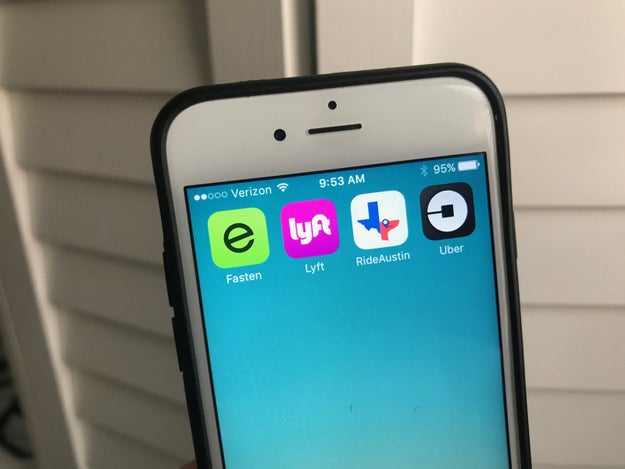
But within just a few weeks of their departure, half a dozen companies — GetMe, Dryvrs, Fare, Fasten, Ride Austin, Arcade City — stepped in. While these replacements didn’t always work perfectly, drivers were pleased with the fact that the ride-hail newcomers charged much lower commissions than Uber and Lyft.

Fast forward a little over one year, however, and drivers are greeting Uber and Lyft’s return to Austin at the end of May with almost as much consternation as the companies’ departure. While the rest of the tech world was focused on Uber’s very public unraveling for the first half of 2017, the $69 billion ride-hail giant was aggressively lobbying Texas state legislators. That effort, along with the support of Governor Greg Abbott, led to a legislative victory that allowed Uber and Lyft to resume operating in Austin without fingerprinting drivers. On May 29, both companies turned their apps back on in Austin, and the ride-hail economy there was once again turned on its head.

In order to regain the edge they’d lost during their yearlong absence, both Uber and Lyft re-entered the market at lower rates than their competitors. This has forced prices down across Austin, and ultimately — despite short-term incentives and promotions — made it more difficult for drivers to earn as much as they used to.

Drivers who spoke with BuzzFeed News estimated that their pay has been cut between 5 and 35% since Uber and Lyft came back to Austin. In the first week after they came back, the nonprofit Ride Austin estimated that driver earnings per trip fell from about an average of $14.43 to $12.70.

“Where before I was making $30 to $35 an hour, now I’m making $15 to $20 an hour, and that’s not necessarily net,” Austin driver Terry Garrett told BuzzFeed News. Garrett said that before Uber and Lyft came back, the money he was earning on Fasten was helping him support his family while took certification classes in hopes of a more lucrative career. Ride-hail was “like a blessing,” he said, until the return of Uber and Lyft lowered fares, raised commission, and reduced surge pricing. He estimates his overall income has decreased by at least 35%.

Ride Austin driver Annabel Knight said the price cuts are less of an issue than a sudden decrease in volume of rides. While some of that is the result of the natural summer slump that happens in Austin when tens of thousands university students and state lawmakers clear out for the summer, the simultaneous reintroduction of Uber and Lyft has exacerbated the problem.

“I’m not getting nonstop pings anymore,” said Knight, who typically drives the bar crowds during weekend evenings. “There’s more of a lag.”

Since Uber and Lyft came back, “things have been very different,” Martin Galway, who exclusively drives for Ride Austin, told BuzzFeed News. “Ride Austin doesn't surge like it used to. So even when I'm giving a ride, there is less earned.” He said that because of Uber and Lyft’s attractive pricing and promotions, as well as the fact that tourists are more familiar with those companies, there just aren’t as many people trying to get a ride on Ride Austin, even though it lowered its per-minute rate by five cents to match Uber and Lyft’s.

Another driver, Evaristo Ramos, once commuted 150 miles from Houston to Austin every weekend to drive for Fasten, Ride Austin, GetMe, and Fare, earning up to $200 a day. But after Uber and Lyft came back, he told BuzzFeed News he quit driving in Austin altogether because he “knew it wasn't going to be very long before the locals would have to lower their rates.”

Vlad Christoff, co-founder of Fasten, the company that’s currently doing the most rides per day in Austin, estimates that the drop in his company’s driver earnings has been close to 4%. Fasten cut its per mile rate by ten cents just three days after Uber and Lyft came back online. “If they drop the rates, we drop rates to match them,” Christoff said.

In the three weeks since Lyft and Uber came back, competitors have taken major hits. Ride Austin, a nonprofit ride-hail app that charges no commission, lost 55% of its ride volume in just one week. In the same time span, Fare, another competitor, had to abandon the city altogether because it was “unable to endure the recent loss of business.”

Some drivers, like Galway, who are trying to drive exclusively on Ride Austin, are frustrated by how quickly other drivers capitulated to Uber and Lyft. “If the Austin-based drivers didn't do this, there would be hardly any drivers [on Uber and Lyft], and riders would see long wait times, and they would seek out alternatives, just like they did before,” he said.

Anabel Knight, another Ride Austin loyalist, saw it the same way. “Drivers are the supply. If the drivers don’t drive for these terrible rates, there won’t be any supply, and people will go where the supply is,” she said.

Even with lower fares, Ride Austin and Fasten are technically still better deals for drivers. Uber and Lyft both charge a 25% commission per ride, while Fasten only charges a flat $.99 fee and Ride Austin charges nothing.

But both Uber and Lyft have been running aggressive promotions — a $350 sign on bonus from Lyft, an extra $75 for every 30 rides on Uber — that are hard for drivers to resist, especially when every company has started cutting prices. In the long term, the cost of those incentives will be hard to sustain for Uber and Lyft, but that won’t matter if they’re able to crush the competition in the meantime.

“It plays to their strengths to do this type of pricing war,” said Ride Austin CEO Andy Tryba. “We have no desire to engage in a pricing war because it's not one we can credibly win. They've got 12 billion dollars between the two of them. We don't.”

Both Uber and Lyft said that they’re making the driver experience a priority in their return to Austin.

“Uber offers a stable, reliable opportunity for partner drivers to earn money,” the company said in a statement. “And that’s what we are focused on: helping ensure Uber is the best end-to-end experience for drivers.” Three weeks after reentering the Austin market, Uber raised rates by six cents per mile in order to allow drivers there the opportunity to buy accident insurance, a program it’s now offering in eight states.

Lyft, meanwhile, said it’s offering drivers a number of incentives, including a Power Driver Bonus program that includes commission free fares. “Since our relaunch in Austin,” a company spokesperson said in a statement, “we've been focused on two things — making sure passengers can get an affordable, reliable ride, and drivers can earn extra income by driving when and where they want.”

Todd, who asked to be referred to by his first name only, said he fundamentally disagrees with the way Uber does business and that he prefers to drive for Fasten. But that hasn’t stopped him from picking up an Uber passenger when he’s got a good promotion.

“Invariably, once I start moving, going to pick up that Uber ride, I get a Fasten ride. It’s a weird choice — I’m engaged in an Uber ride, and I don’t want to cancel it, because they'll ban you if you do that too much. But here's a Fasten ride I could have gotten, and, all things being equal, you're going to get paid more on that Fasten ride,” he said. Competition is a good thing, Todd said, but at the moment it feels like drivers are getting caught in the middle.

Quelle: <a href="Uber And Lyft Are Back In Austin, And Drivers Say It’s Hurting Their Wallets“>BuzzFeed

Handling data encoding issues while loading data to SQL Data Warehouse

This blog is intended to provide insight on some of the data encoding issues that you may encounter while using Polybase to load data to SQL Data Warehouse. This article also provides some options that you can use to overcome such issues and load the data successfully.

Problem

In most cases, you will be migrating data from an external system to SQL Data Warehouse or working with data that has been exported in flat file format. If the data is formatted using either the UTF-8 or UTF-16 encoding standard, you can use Polybase to load the data. However, the format of your data is dependent on the encoding options supported by the source system. Some systems do not provide support for UTF-8 or UTF-16 encoding. If the data you are working with is formatted in an alternate format, such as ISO-8859-1, then being able to convert the data to UTF-8/UTF-16 format can save valuable time and effort.

The flow of data from a source system to Azure Blob Storage and then on to Azure SQL Data Warehouse (DW) is shown in the following graphic:

Azure Blob Storage is a convenient place to store data for use by Azure services like SQL DW. PolyBase makes it easy to access the data by using T-SQL, for example creating external tables for the data on Azure Blob Storage and loading the data into internal tables of SQL Data Warehouse using a simple SELECT query.

If the volume of the data being loaded is small, then it may be easier to export the data from the source system again, this time using UTF-8/UTF-16 encoding. For larger volumes of data, however, re-export, data compression, and data load to Azure Blob Storage can take weeks. To avoid this delay, you need to be able to convert the encoding on the data files within the Azure environment without accessing the source system again.

Solution

The sections below provides details on options you have for converting source file encoding to UTF-8/UTF-16.

Important: PolyBase supports UTF16-LE. It shouldn’t matter for customers in the Windows ecosystem, but a customer may specify UTF16-BE and have their load fail.

Option 1: Notepad++

You can use the Notepad++ tool to change the encoding of a file on a local computer. Simply download the data file to a local computer, open the file in Notepad++, and then convert the file encoding to UTF-8/UTF-16.

1. To view the encoding of a source file, click the Encoding menu, as shown in the following graphic:

The source file in the example above is encoded in ANSI.

2. To convert file encoding to UTF-8, on the Encoding menu, select Convert to UTF-8.

3. Save the file, use the Encoding menu to view the encoding, and confirm that the file is now encoded using UTF-8.

After the file is saved in UTF-8 encoding, you can use Polybase to upload it to Azure Blob Storage and load it into SQL Data Warehouse.

While this is a viable approach, there are some drawbacks, which are listed below:

Download time
Available space on local system
Upload time
Works only with small files because of memory and space constraints

Option 2: Azure VM

To overcome some of the drawbacks associated with using Notepad++, you can use an Azure VM to convert data file encoding. With this method, the entire process occurs within the Azure environment, thereby eliminating delays associated with transferring data between Azure and the local system. This process is shown in the following graphic:

This approach has the following high-level steps:

Setup an Azure VM (Windows or Linux)
Download data file from Azure Blob Storage to local storage on Azure VM
Extract data file (if applicable)
Convert data file encoding using a utility (custom/built-in)
Upload the converted data file from local storage on Azure VM to Azure Blob Storage

Note that this approach has its own drawbacks:

Download time
Available space on local system
Upload time

Option 3: Azure File Storage

To overcome the limitations associated with download and upload time when using Azure VMs, you can use Azure File Storage, which offers cloud-based SMB file shares that you can use to quickly migrate legacy applications that rely on file shares to Azure without costly rewrites. With Azure File Storage, applications running in Azure virtual machines or cloud services can mount a file share in the cloud, just as a desktop application mounts a typical SMB share. Any number of application components can then mount and access the File Storage share simultaneously, as shown in the following graphic:

Note: Learn more about Azure Storage.

When using Azure File Storage, be aware of the capacity limits identified in the following table:

Note: A full listing of Azure Storage Scalability and Performance Targets is now available.

With this approach, you can have all the data files on Azure File Storage and have an Azure VM that can mount Azure File Storage. After having the mount, the Azure VM can directly read and write files from/to Azure File Storage without having to download to or upload from local storage on Azure VM.

This approach includes the following high-level steps:

Setup an Azure VM (Windows or Linux)
Mount Azure File Storage on Azure VM (see procedure below)
Extract data file (if applicable)
Convert data file encoding using a utility (custom/built-in)

The diagram below shows the complete flow of data compression, transfer, extraction, transformation, and load via PolyBase into SQL DW:

Mounting Azure File Storage to VM

The process of mounting Azure File Storage to VM, Ubuntu Linux VM in this case, involves three high-level steps:

Installing the required libraries/packages.

sudo apt-get install cifs-utils

Creating the mount point location on Azure VM to which the Azure File Storage will be mapped.

sudo mkdir /mnt/mountpoint

Mounting Azure File Storage location to Azure VM mount point.

sudo mount -t cifs //myaccountname.file.core.windows.net/mysharename /mnt/mountpoint -o vers=3.0,user=myaccountname,password=StorageAccountKeyEndingIn==,dir_mode=0777,file_mode=0777,serverino

Note: Get full details on mounting Azure File Storage from a Linux VM.

Automating data encoding conversion

This section provides some details on a project that leveraged this approach to convert the encoding of a data file:

131 tables data exported from Netezza system
4 data files per source table organized under the folder name representing the source table
All data files encoded in ANSI format (ISO-8859-1)
All data files compressed using GZ compression
Total compressed data files size was 750GB
Total uncompressed converted data files size was 7.6TB

The data files were organized on Azure File Storage in the following structure:

A snapshot of the bash script on Ubuntu VM that was used to convert the encoding on the data files automatically is shown in the following graphic:

This script performed the following:

Accepted the table name as an argument
Looped through each of the 4 data files for the given table
For each data file

Extracted the compressed GZ file using gunzip command
Converted the encoding of each file using iconv command where the source file encoding is specified as ISO-8859-1 and the target file encoding is specified as UTF-8
Wrote the converted file to a folder with the table name under ConvertedData

The script was further enhanced to loop through a list of table names and repeat the above process, rather than accepting the table name as an argument.

Convert from any encoding to any other encoding

The script can be modified to accept the from and to encoding as arguments instead of hardcoding them in the script. A full list of encodings supported by iconv command can be retrieved by running the command iconv -l on the computer you will be using to convert the data encoding. Be sure to check for any typos in the encoding format specified before running the command. A snapshot of the generic script and an example on how to invoke it is shown in the following graphic:

The above command converts the data files from UTF-8 encoding to ISO_8859-1 encoding format.

Recognition

The Data Migration Team would like to thank primary contributors Rakesh Davanum, Andy Isley, Joe Yong, Casey Karst, and Mukesh Kumar, for their efforts in preparing this blog posting. The details provided has been harvested as part of a customer engagement sponsored by the CSE DM Jumpstart Program.
Quelle: Azure

This Is Probably The Twitter Account Of Melania Trump's Lawyer

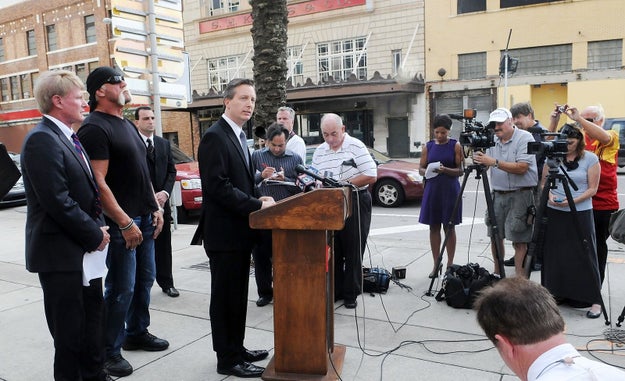
Charles Harder (center) of Harder Mirell & Abrams serves as a lawyer for an eclectic group of people including First Lady Melania Trump, former professional wrestler Hulk Hogan and actress Sandra Bullock.

Gerardo Mora / Getty Images

In the last five years, Charles Harder has built a career challenging and beating media companies. Once a Hollywood-based celebrity lawyer who represented the likes of Lena Dunham and Sandra Bullock, the Harder Mirell & Abrams LLP partner is now more commonly known as the attorney who secretly took money from billionaire Peter Thiel to represent former professional wrestler Hulk Hogan in an invasion of privacy lawsuit against Gawker Media.

After winning that case and sending Gawker into bankruptcy, Harder built up a powerful group of clients, among them the late Fox News founder Roger Ailes and Melania Trump. Working on behalf of the First Lady for the past year, Harder has been quite busy. He demanded that People Magazine retract details from a story in which a reporter detailed being sexually harassed by President Trump; he sued and settled with The Daily Mail over a story that suggested that Melania Trump once worked as an escort; and he threatened a YouTube user who posted a video suggesting that the Trumps' son, Barron, may be autistic. The video was later removed.

A little-known Twitter account suggests Harder may be working on something more with the First Lady. Since July of last year, a Twitter user with the name @CharlesJHarder has been musing about First Amendment law, his work with the White House and other topics to about 50 followers.

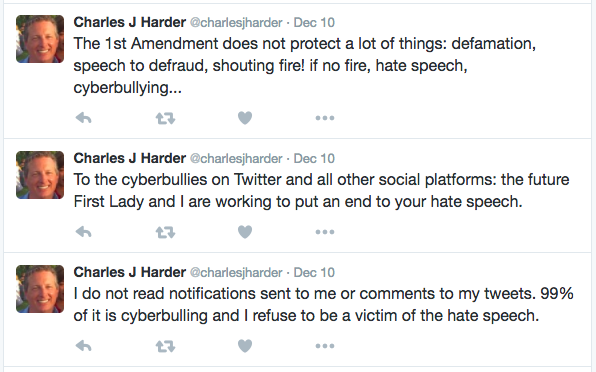
“To the cyberbullies on Twitter and all other social platforms: the future First Lady and I are working on a way to end your hate speech,” the user wrote in a now deleted Tweet from Dec. 10 2016. BuzzFeed News has periodically taken screenshots of @CharlesJHarder’s account as tweets were frequently deleted from it.

Screenshots of now deleted tweets posted on Dec. 10, 2016 from the Twitter account of @CharlesJHarder.

Ryan Mac/BuzzFeed News

Harder's tweets suggesting a plan to deal with cyberbullying are of particular interest following a series of Twitter messages from President Trump last week in which he attacked media outlets and Morning Joe host Mika Brzezinski. In one tirade on the social network, the president lambasted Brzezinski as “crazy” and “low I.Q.” and taunted her about some alleged plastic surgery.

The spitefulness of the president's tweet — which recalled past attacks against other prominent women, including journalist Megyn Kelly — led reporters to ask the White House about Melania Trump's pre-election promise to address online abuse. The First Lady pledged that she would commit to fighting cyberbullying in a pre-election speech on Nov. 3, but has provided little information on how she will go about that campaign

Stephanie Grisham, a spokesperson for Melania Trump, told BuzzFeed News that the First Lady “continues to be thoughtful about her platform” and promised an announcement of some sort “in the coming weeks.” Asked about the deleted tweets from @CharlesJHarder on cyberbullying, Grisham noted they were written before Donald Trump took office.

“He is not a [White House] employee, so I would have no idea what that was about, nor would it be appropriate for me to try and speculate,” Grisham wrote in an email.

Reached by phone and asked to confirm his ownership of the @CharlesJHarder Twitter account, Harder told BuzzFeed News “I can't say anything right now; I'm busy and I'm neck deep in a bunch of stuff” before abruptly ending the call.

Despite Harder's reply, there is plenty of evidence suggesting the unverified Twitter account is his. The account tweets from a location in Los Angeles, where the lawyer resides. It also features a profile photo of Harder that cannot be found anywhere else on the web using a Google image search. In other now-deleted tweets, the user discussed details about Harder's family, including a mention of his Japanese-American in-laws.

Other tweets from the @CharlesJHarder account address the user's view on free speech. In one deleted message from Dec. 10, the user noted that he did not read notifications because “99% of it is cyberbullying and I refuse to be a victim of the hate speech.”

“The 1st Amendment does not protect a lot of things: defamation, speech to defraud, shouting fire! [sic] if no fire, hate speech, cyberbullying…” read another message from Dec. 10, which is still live today.

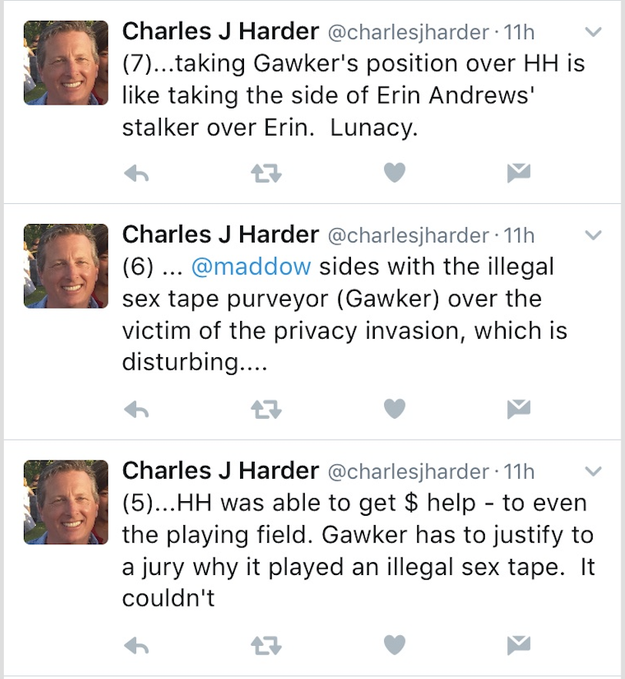
In February, following an episode of The Rachel Maddow Show during which the host discussed the Hulk Hogan-Gawker trial, @CharlesJHarder unleashed a long tweetstorm noting that Hogan accepted outside money from Thiel to “even the playing field.”

Screenshots of now deleted tweets posted on Feb. 16, 2017 from the Twitter account of @CharlesJHarder.

Ryan Mac/BuzzFeed News

The @CharlesJHarder account , which follows three people — Melania Trump, Michelle Obama and Taylor Swift — has deleted all tweets since Dec. 10. While other messages have been more personal or lighthearted, including praise of former Los Angeles Dodgers announcer Vin Scully, the tweets that are still viewable evince a person looking to pursue action.

“If a media company is going to pathologically defame people, invade their privacy rights, break the law, and ruin people’s lives in the name of the 'First Amendment,' and for the purpose of making millions of dollars, and the sadistic thrill of hurting people then eventually someone is going to come along and put a stop to it,” the account wrote across a three-tweet message.

Quelle: <a href="This Is Probably The Twitter Account Of Melania Trump's Lawyer“>BuzzFeed