Facebook
When Facebook held its first Communities Summit in Chicago last month, Meetup CEO Scott Heiferman watched attentively from his New York City office. His browser trained on Facebook's live video stream, Heiferman watched as Facebook CEO Mark Zuckerberg told an enthusiastic crowd of his plan to get 1 billion people involved in “meaningful communities” on Facebook. He watched as Zuckerberg explained how the company would go about doing this, rolling out new features designed to bolster Facebook-hosted communities online and off. And he watched as Zuckerberg touted a Facebook group event called “Mommy Meetup” as evidence of the company's ability to bring people closer together in the real world. Then, he shut it off and suited up for battle.

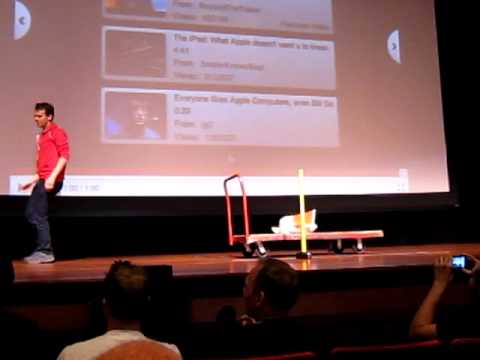
Heiferman sledgehammering an iPad to encourage people to spent time offline.
youtube.com
Meetup, a scrappy tech company that helps people meet online and then get together offline, is in for what may be the fight of its life. Building “supportive community” — long Meetup’s core mission — is now the first bullet point in Zuckerberg's latest manifesto outlining the future of the company. And Facebook is running hard at it — both with its June Communities Summit and the “Give people the power to build community and bring the world closer together” mission introduced there. After not coming up against a true competitor in its 15-year history, Meetup is now facing off against a determined and formidable challenger armed with a massive network of active users, a vast repository of knowledge about those users' interests, the technological acumen to recommend appropriate groups, and the financial wherewithal to offer event-organizing capabilities free of charge.
Heiferman is aware of companies like Vine, Timehop, and Snapchat who’ve competed with Facebook and suffered severe damage. (Remember Meerkat? The livestreaming app’s creators pulled it from the App Store months after the debut of Facebook Live.) But the tenacious Meetup CEO is not the type to lie down without a fight. And indeed, he and his team have a plan.
Two weeks before Facebook’s Communities Summit, on the 10th floor of Meetup's downtown Manhattan headquarters, Heiferman sat across from an investor considering putting millions of dollars into his company and outlined where Meetup is going. He started by rattling off a series of impressive stats. More than 20,000 meetings a day take place via Meetup, organized via any number of its 300,000 paid groups, whose members total nearly 40 million people, Heiferman said. The company, he emphasized, had real growth potential, 10x potential. And after discussing the product’s past and present, he turned to its future to explain why.
As the investor looked on, Heiferman played an internal video that showed the product Meetup was working toward, one conceived before Zuckerberg’s manifesto, that could be its bulwark against Facebook’s incursion. The video showed a concept for “self-driving Meetups,” as they’re known inside the company. These meetups are formed initially by computers, not humans, allowing for smaller, smarter groups that better fit people’s interests, as opposed to the broader, less tailored groups that exist on Meetup today. Illustrating what Meetup is after, the video showed a person looking for a running group, but instead of a joining an umbrella New York runners group, this person answered a few questions from Meetup, telling it she was specifically interested in an women-only group, made up of intermediate runners, that meets up at a specific entrance of Brooklyn’s Prospect Park every Wednesday. Then, instead of waiting for a human to form this group (and it’s hard to imagine an organizer creating something this specific), Meetup’s software did it on its own. After a critical mass of people told Meetup they were interested in the same type of group, the platform put them in touch and, in the next frame, they were off running.
Heiferman watched this video with the look of someone who know he was onto something. More tailored Meetups, he told BuzzFeed News, would give the company a way to serve far more people. “The accuracy, the precision, the specificity — we know plain as day that traditional methods of [organizing] groups and events through apps isn’t going to give people what they want,” he said. “If there’s a meetup that has the right people, the right time, the right place, the right purpose, naturally people are going to go.”
Facebook, of course, has the technical wherewithal to mimic those features too. And it’s unknown whether the investor in the room, who declined to be named, was put off by concerns about Facebook. But Jeremy Liew, an early Snapchat investor and partner at Lightspeed Venture Partners, told BuzzFeed News he wouldn’t shy away from companies competing with Facebook. “If they are showing strong engagement, retention, and growth with a competitive product, then I would definitely want to dig in and learn more,” he said. “If I could see a unique insight that was driving new habits and a scalable, repeatable path to growth, then I would definitely consider an investment.”
Right after the investor meeting, Heiferman took an elevator a few floors down to a design sprint in which his team was in the midst of bringing the product in the video to life, separating into teams to work on specific bits of it codenamed “Ask,” “Spark,” and “Deliver.” Fiona Spruill, Meetup’s VP of product, said the product would be “absolutely key” to fending off Facebook’s challenge, and that Meetup was in good position because it’s focused only on getting people to interact offline, as opposed to starting at the screen. “We want to have the shortest jumping-off point from online to great in-real-life experience.”

The design sprint
Heiferman bristles at the notion that smaller companies can’t fend off bigger competitors. In an email following his discussion with BuzzFeed News, he shared a handful of links to articles written by skeptical reporters who seemed unable to conceive a tech giant could lose a battle. “Of course, Google's biggest problem may well be (cue soundtrack from ‘Jaws’) Microsoft,” one Newsweek article about search argued. “Bill Gates is constitutionally unable to countenance the idea that a cheeky Silicon Valley start-up can claim even the mildest role as an Internet gateway.”
“It wasn't that long ago that people thought it would only be Microsoft. And then they thought it would only be Google,” Heiferman said.
Still, for Heiferman and Meetup, squaring off against Facebook won't be easy. Zuckerberg at the summit made clear that getting people to meet offline is important to Facebook. “Online communities strengthen physical communities by helping people come together online as well as offline, even across great distances,” he told the audience. And as Facebook’s history suggests, when Zuck comes for your bread and butter, it can be difficult, and sometimes impossible, to hold on to it. The convenience of doing everything inside one app with all your friends can be hard to resist, even for the most ardent of brand loyalists.
“Facebook is an all-in-one platform. People already use it, are familiar with it, and it's free,” Lauren Kent, an admin of Moms of Beverly, the Facebook group that hosted the moms meetup highlighted by Zuckerberg, told BuzzFeed News. Kent, a former Meetup member, said she chose to use Facebook “simply because it's a free platform whereas Meetup is not. Also, almost 2 billion people already use Facebook.”
Still, Meetup is growing even in the face of Facebook’s challenge, adding millions of new members each year. And perhaps, the combination of its characteristic tenacity, a new product that imagines organizing in a brand-new way, and possibly a little cash will put Meetup in position to hold its own. Despite the odds, and admitting that Meetup has a real competitor for the first time in its history, Heiferman thinks the company is in position to thrive.
“There’s a giant body pile of all the apps that have said they’re going to be the new Meetup,” Heiferman said. “The fact that Facebook will also be doing stuff that operates in some similar veins, fine. They’ll create good in the world with it. And I’m honestly happy to see that. But our purpose is not to keep people glued to the screen — our purpose is to get people away from the screen and sparking communities that change people’s lives.”
Quelle: <a href="Facebook Is Coming For Meetup, And Meetup Is Ready To Fight“>BuzzFeed