Start-up Desktop Metal baut Metalldrucker
Eine Firma, die fast 100 Millionen US-Dollar an Investitionen eingeworben hat, will den 3D-Druck revolutionieren.
Quelle: Heise Tech News

Eine Firma, die fast 100 Millionen US-Dollar an Investitionen eingeworben hat, will den 3D-Druck revolutionieren.
Quelle: Heise Tech News

Um seine Karrierechancen zu verbessern, ließ ein neuseeländischer Minister seine Mitbewerber vom Geheimdienst GCSB ausspionieren. Die Aufsichtsbehörde kritisiert – die Aktenführung.
Quelle: Heise Tech News

By Dave Stiver, Product Manager, Google Cloud Platform
Starting today, developers can choose to run applications and store data in Australia using the new Google Cloud Platform (GCP) region in Sydney. This is our first GCP region in Australia and the fourth in Asia Pacific, joining Taiwan, Tokyo and the recently launched Singapore.
GCP customers down under will see significant reductions in latency when they run their applications in Sydney. Our performance testing shows 80% to 95% reductions in round-trip time (RTT) latency when serving customers from New Zealand and Australian cities such as Sydney, Auckland, Wellington, Melbourne, Brisbane, Perth and Adelaide, compared to using regions in Singapore or Taiwan.
The Sydney GCP region is launching with three zones and several GCP services, and App Engine and Datastore will be available shortly:
Google Cloud customers benefit from our commitment to large-scale infrastructure investments. With the addition of each new region, developers have more choice on how to run applications closest to their customers. Google’s networking backbone, meanwhile, transforms compute and storage infrastructure into a global-scale computer, giving developers around the world access to the same cloud infrastructure that Google engineers use every day.
In Asia-Pacific, we’re already building another region in Mumbai, as well as new network infrastructure to tie them all together, including the SJC cable and Indigo cable fiber optic systems.
What customers are saying
Here’s what the new regions means to a few of our customers and partners.
“The regional expansion of Google Cloud Platform to Australia will help enable PwC’s rapidly growing need to experiment and innovate and will further extend our work with Google Cloud.
It not only provides a reliable and resilient platform that can support our firm’s core technology needs, it also makes available to us, GCP’s market leading technologies and capabilities to support the unprecedented demand of our diverse and evolving business.”
—Hilda Clune, Chief Information Officer, PwC Australia
“Monash University has one of the most ambitious digital transformation agendas in tertiary education. We’re executing our strategy at pace and needed a platform which would give us the scale, flexibility and functionality to respond rapidly to our development and processing needs. Google Cloud Platform (GCP) and in particular App Engine have been a great combination for us, and we’re very excited at the results we’re getting. Having Google Cloud Platform hosted now in Australia is a big bonus.”
—Trevor Woods, Chief Information Officer, Monash University
Modern geophysical technologies place a huge demand on supercomputing resources. Woodside utilises Google Cloud as an on-demand solution for our large computing requirements. This has allowed us to push technological boundaries and dramatically reduce turnaround time.
— Sean Salter, VP Technology,Woodside Energy Ltd.
Next steps
We want to help you build what’s next for you. If you’re looking for help to understand how to deploy GCP, please contact local partners: Shine Solutions, Servian, 3WKS, Axalon, Onigroup, PwC, Deloitte, Glintech, Fronde or Megaport.
For more details on Australia’s first region, please visit our Sydney region page where you’ll get access to free resources, whitepapers, an on-demand training video series called “Cloud On-Air” and more. These will help you get started on GCP. Give us a shout to request early access to new regions and help us prioritize what we build next.
Quelle: Google Cloud Platform

The new Dating.ai app uses facial recognition to reference a photo you upload – a celebrity, your ex, your high school crush – and scan through thousands of profile photos sourced from dating sites and apps to find people whose faces look similar. Then, you can click on photos of the face matches to see their profiles on Tinder, Match, Plenty of Fish, and other dating apps (Dating.ai wouldn’t specify every site its app references).
The result is slightly terrifying, kind of fun, and most of all a very cynical approach to helping people find romantic partners. However, the dating apps that Dating.ai depends on for its search results are not so amused, and say the app is violating their terms.
The app’s facial recognition technology works pretty well – well enough that when you try one of the suggested celebrities like Kanye West or Jennifer Lawrence, the first few matches are inevitably the same celeb (some people use celeb pics on their dating profiles, apparently). And while the rest may not look EXACTLY like the celebrity, they’re also… not totally wrong.
The same for when we tested out photos of ourselves in the BuzzFeed office: The matches weren’t dead ringers, but there was some vague approximation of uncanny similarity. I tested two different photos of myself making different expressions in different light, and both times it picked the same 35-year-old woman from Long Island who does kinda look like me as one of my top matches.
While there’s plenty of science to what kinds of ratios of faces we find “beautiful”, this app shows the shortcomings of actually applying these metrics to human desire. If you want to date someone who looks like Jennifer Lopez, it’s because she’s insanely gorgeous in a way that’s more than just the ratio of distance between her nose and ears or the spacing of her eyes.
Of course there’s a bigger issue here: the privacy of the dating app users whose profiles are being used. People who sign up for Tinder might not agree to have their faces scanned on some other random app. Heath Ahrens, the founder of Dating.ai, told me he didn’t really see this as a problem. “If you’re on a dating app, you want to be found,” he said.
The idea for the app, which has about 15,000 users, came when Ahrens and his team were looking for ways to use the facial recognition software they had developed. After they read about another app that used Tinder’s API, they got the idea to use their technology on dating apps. “When you have a bunch of single guys in the office, it goes in that direction,” he said. “You wanna try your own dog food.”
Currently, you can limit your search on Dating.ai for men or women, but you can’t search by sexual preference (“men looking for men”), for example.
“Users like innovation. When they did name your own price, our users are doing name your own face.”
A Tinder spokesperson said that Tinder doesn’t allow automated scraping of their API, and that they “contacted the developer to inform them that the app is violating our terms, and we have been told that they will address the issue.” Ahrens would not confirm that Tinder asked to stop using their API, but said, “we’ve been having very a productive conversation with them.”
A rep from Plenty of Fish (Tinder, Match, and Plenty of Fish are all owned by the same parent company, but operate separately) said that they were trying to get Dating.ai removed from the iTunes app store. “That’s news to me,” said Ahrens.
Ahrens and his business partner say that Dating.ai is acting in an affiliate capacity and compared it to the innovation of airfare booking sites. “Priceline and Expedia freaked out airlines at first,” Ahrens said. “Users like innovation. When they did name your own price, our users are doing name your own face.”
Right now, the future of Dating.ai seems unclear. Ahrens and his business partner would only say that they are looking forward to working with the dating apps; Tinder, Match, and Plenty of Fish tell a different story. For now, the app is still up in the app store and still pulling Tinder profiles. We’ll update if anything changes.
Quelle: <a href="This App Lets You Find People On Tinder Who Look Like Celebrities“>BuzzFeed
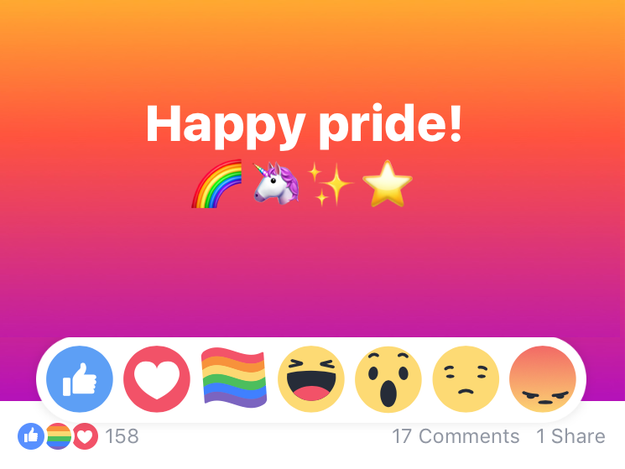
Facebook is limiting the availability of its rainbow reaction, which is meant to celebrate Pride Month, and is offering very little detail as to why. The reaction is currently unavailable in a number of locations, including countries with repressive LGBT policies such as Russia.
The rainbow reactions went live this month as part of Facebook’s pride celebration, and appear next to Facebook’s traditional “like,” “haha,” and “wow” reactions. But Facebook says it isn’t rolling them out everywhere because it is “testing” them.
Facebook’s approach to its pride-reaction rollout is drawing criticism from some who think it’s playing into the hands of repressive governments. “This is shameful,” Jillian C. York, director for international freedom of expression at the Electronic Frontier Foundation, wrote on Twitter. “Facebook isn't even ‘kowtowing’ to anti-gay states, they're doing their job for them.”
In a post on June 5 announcing the new LGBT-themed reaction, Facebook said “We believe in building a platform that supports all communities. So we’re celebrating love and diversity this Pride by giving you a special reaction to use during Pride Month.” To access the reaction, Facebook asked users to like its LGBTQ@Facebook page.
“Because this is a new experience we’ve been testing, the rainbow reaction will not be available everywhere,” the company said in a blog post.
Although Facebook runs tests all the time, this situation appears different from the typical tech tests the company might use to determine, for example, whether people like its latest Snapchat-inspired feature. Rainbow reactions aren't a feature in and of themselves, and how they're used doesn't influence whether a product is viable or not.
A Facebook spokesperson declined to say whether the test in question was technological, or whether the reaction's limited rollout was designed to take into account repressive governments with anti-LGBT policies.
In this case, Facebook said in its post that the rainbow reactions would be made available to “people in major markets with Pride celebrations.” Other specially themed Facebook reactions, like a set of Halloween reactions that appeared last year, also had a limited rollout. But while Halloween simply isn’t a holiday observed everywhere, LGBT people exist all over the world.
In Russia, which has a law prohibiting “gay propaganda” and where pride parades often get shut down by attacks, people reported being able to see the rainbow reactions but not being able to use them. On its own Facebook page, the company responded to people in other countries inquiring about the rainbow reaction with varieties of this explanation: “This isn't yet available in some areas, but we hope to roll it out in more soon.”
Presented with the criticism of its test's limitations, Facebook declined to comment beyond its initial post.
Quelle: <a href="Here's Why Facebook Says It's Not Rolling Out The Rainbow LGBT Reaction Everywhere“>BuzzFeed

AMD hat offiziell die Epyc-Prozessoren der 7000er-Serie vorgestellt und verspricht viel. Manche Ein-Sockel-Konfiguration soll bei ähnlichem Preis Zwei-Sockel-Systeme von Intel schlagen und AMDs Epyc ist mit zwei CPUs fast doppelt so schnell wie einzeln. AMD kämpft vor allem mit vielen Kernen gegen Intels Xeon. (Epyc, Prozessor)
Quelle: Golem

Drei Modelle im dritten Quartal: Die für Deep Learning gedachten Beschleuniger, die Radeon Instinct, liefern eine hohe FPS32/FP16-Leistung für Training und Inference. Die Vega-basierte Variante darf sich bis zu 300 Watt genehmigen. (Grafikhardware, AMD)
Quelle: Golem

Mit dem neuen Server-Prozessor Epyc mit Zen-Architektur will AMD dem nahezu alleinigen Marktbeherrscher Intel etliche Marktanteile abknapsen: Erste Benchmark-Werte, etwa CPU2006, lassen aufhorchen.
Quelle: Heise Tech News

Nicht so schnell wie manche Xeon SP, aber flotter als ein Xeon D: Applied Micros X-Gene 3 ist mit acht DDR4-Speicherkanälen ausgestattet und für ARM-Server gedacht. Die Leistungsaufnahme ist ebenfalls konkurrenzfähig, gleiches gilt für den Preis. (Prozessor, Embedded Systems)
Quelle: Golem
Learn how to enable distributed tracing in your service mesh, in the third installment in this series about using Envoy Proxy and Istio.io to enable a more elegant way to connect and manage microservices.
Quelle: OpenShift






