Hello, I'm Katie, and I find those new color block Facebook text post thingees very annoying. My boss, Mat, loves them.
I’m talking about these things, btw:
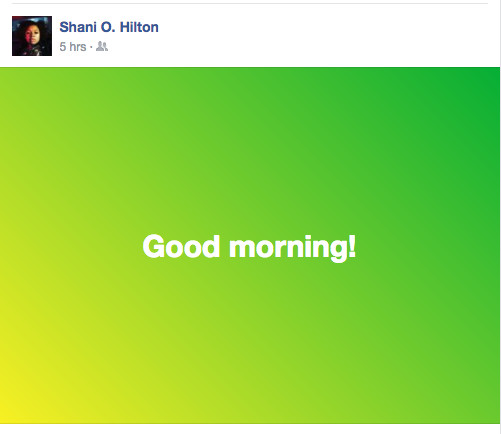

We decided to discuss the issue over email. Please vote at the end to help us settle this debate.
Dear Katie,
Recently, in our tech news Slack room, you lobbed an accusation at me. You said that you thought that I “have been abusing the color block fb post.” This was a reference to those colored backgrounds Facebook now lets people put in their status updates. They started off as, I think, simple colors. Then came gradients. Now, there are bold patterns and prints that you can write text over.
While I'll admit to using these a lot recently, it's because I find them delightful! They visually segment and break up the news feed nicely, and I suspect they are having the effect of getting people to post more status updates, more frequently. (Which was probably the entire intent.) And besides, I've noticed that when I do a colorful status update, more people ~engage~ with my posts. Which in turn makes me want to do more of them! What's the harm?
Concernedly,
Mat
Hi Mat,
Well, here's the thing. It's partly the Facebook color blocks, but it's also partly you. You have been abusing them. I agree with you that they are probably designed to make people use them more, and it's a great way to make your post standout if someone is scrolling through their news feed which might be full of photos and videos that are much more eye-catching than a standard text status. But that's precisely your problem. You are abusing the potent power of the eye-popping, scroll-stopping color blocks. These should be reserved for important updates.
Allow me to remind you what your most recent color block updates are:
May 10: “Oh, wow, fucking hell.”
May 12: “Eventually i'm going to buy one of these Quip toothbrushes just to make the damn ads go away.”
May 16: “Can you believe the latest news about Trump?”
May 17: “Omg, can you believe the latest news about Trump?”
May 19: “Ugh. I think Twitter is down.”
May 19: “Wow… can you believe the most recent news about Trump?”
May 24: “Ugh.”
I think anyone would agree with me here that you are NOT using these for important statuses only. You're using it like the worst possible Twitter feed of all time.
Please do not fire me,
Katie
Dear Katie,
You missed this one from May 30: “So, Katie Notopoulos says I'm over-using these colorful new Facebook posts. I disagree. How do you feel?”
Anyway. If I take your meaning, you think these colorful backgrounds should be reserved for only important life updates, rather than the banalities of our day-to-day existence.
(Speaking of banalities, you also missed this one from a few hours ago.)

First of all, who are you to tell me what is and is not important about my life!?! But more broadly, these updates make Facebook a safe space for the mundane and banal again. That's kind of great, right? Why should Twitter get all of that juice?
They're like Instagram filters from 2010. They take your boring life and class it up! I feel like that's the whole idea, and if it is, how could I be abusing them?
Your colleague,
Mat
Mat,
So I decided to try it out for myself and post a color block post.
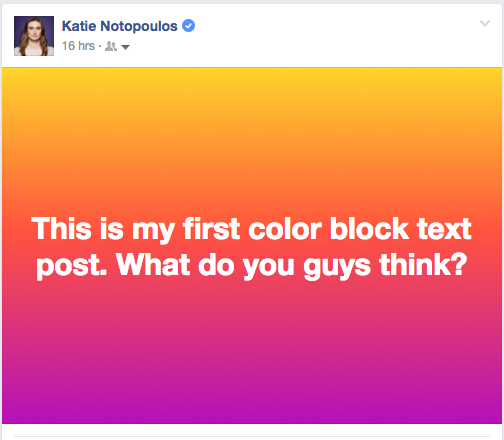
And guess what? You were right – it got lots of engagement. Way more than any of your posts, btw. I guess like… I dunno, people like me a lot more? My friends actually care about me and think it's fun to chat about stuff with me? I'm wondering what it must feel like for you to be constantly sending out these hideous neon pleas for human interaction and coming up short. How lonely you must be. Now I feel sort of sorry for you. I realize what I thought was your “trolling” by overusing the color blocks is actually just your grasp at a social life.
Btw I still say the color blocks are “bad.”
Your friend,
Katie
Quelle: <a href="Are Those Color Block Facebook Posts Terrible Or Great?“>BuzzFeed








