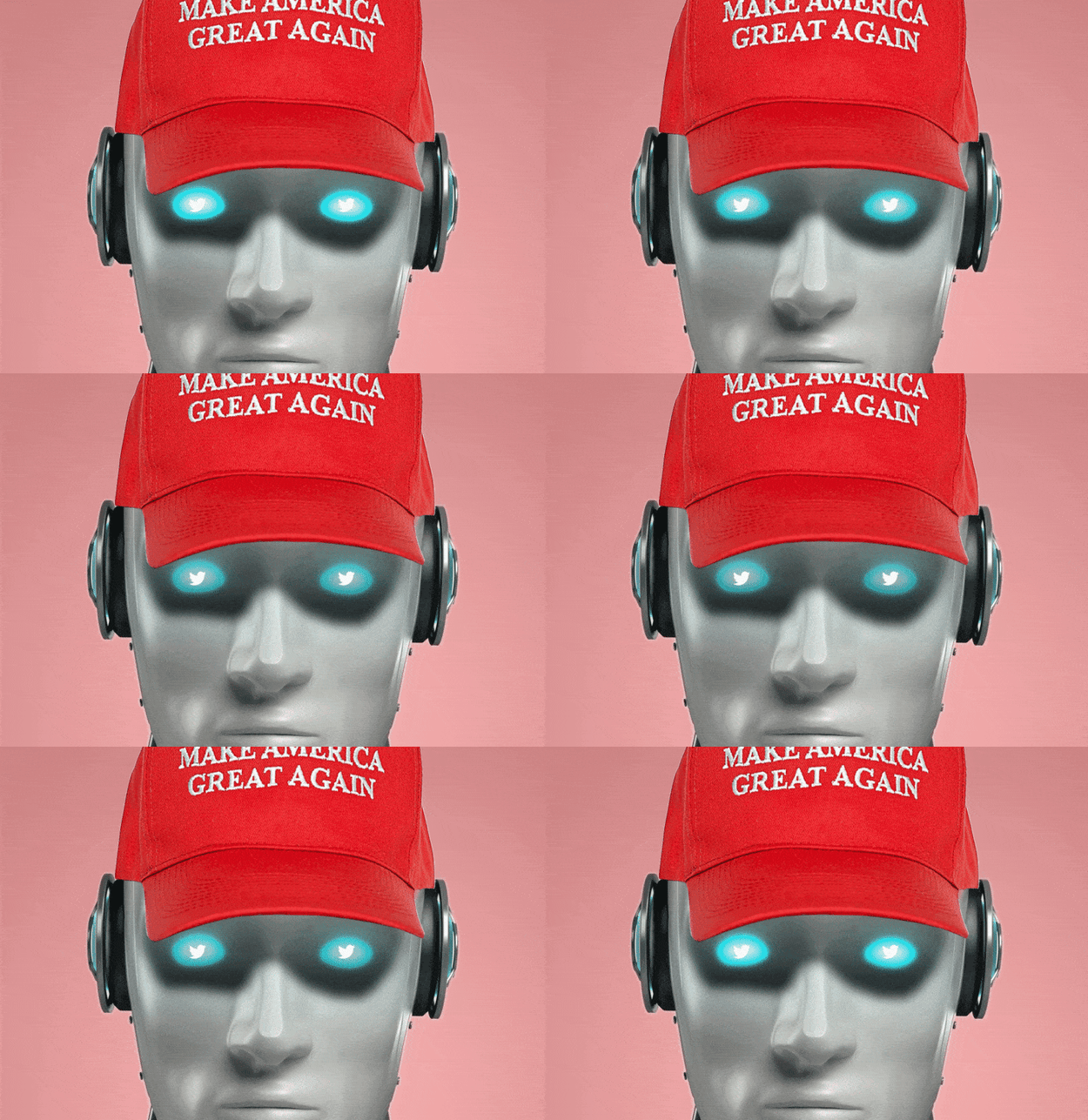
BuzzFeed News / Getty Images
On May 30th, Empty Lighthouse Magazine published an article with an alarming headline: “Why Did Trump Get Millions Of Twitter Bots To Follow Him This Week?” The story — which was picked up by dozens of publications including Newsweek, Mashable, Perez Hilton, and Fortune, claimed that the President’s personal account gained 5 million followers in just a few days — many of them fake, automated accounts, or bots. The article argued that Donald Trump’s followers were rife with fakes — roughly half, according to Twitteraudit.com, a site that uses dubious methodology to identify fake followers. And while some light follower fraud might undermine Trump’s popularity, the article suggested something more nefarious at play. “We know that Russia has used fake Twitter followers in the past as a way to spread disinformation,” the article said. “Trump's war room team may be using the additional bot followers to trick the Twitter algorithm into trending/promoting Trump's messages.”
It’s a compelling conspiracy theory, but one that was quickly debunked. Trump’s account did indeed see an uptick — 2.4 million over the course of the month, with a huge spike of 166K followers on May 25th, according to the analytics firm Socialbakers. Big, but commensurate with being both President and one of the biggest accounts on Twitter. Similarly, Trump’s account is inundated with fake followers and automated bots, but that’s also standard for huge Twitter accounts. President Obama’s account as well as celebrities from Katy Perry to Justin Bieber have similarly high percentages of egg followers.
Still, there’s a desire to believe the more insidious narrative: that Twitter is overrun by wildly powerful and influential propaganda bots, perhaps purchased or orchestrated by governments foreign and domestic. The Great Bot Crisis is a theory bandied about by Russia conspiracy theorists like former British MP Louise Mensch and scholars who suggest that Trump voters are disproportionately swayed by ill-intentioned accounts disseminating pro-Trump or anti-liberal fake news. On Saturday the New York Daily News suggested that “Trump Twitter bots, numbering in millions, could be used for evil” and last week even Hillary Clinton cited the debunked fake Trump followers story, suggesting the bot scourge was a product of bad actors “sitting in Moscow, or Macedonia, or the White House.”
In a recent New York Times column, Farhad Manjoo laid out a reasoned argument detailing “How Twitter Is Being Gamed to Feed Misinformation.” Quoting numerous researchers in the botosphere, Manjoo said that “the more I spoke to experts, the more convinced I became that propaganda bots on Twitter might be a growing and terrifying scourge on democracy.”
Twitter is certainly clogged with bots — a number of which are designed to elegantly spread information that’s far from credible and push narratives. Scholars at Oxford suggest bots accounted for 18 percent of Twitter’s traffic related to the 2016 election and that roughly one-third of pro-Trump tweets came from bots.
Yet while the numbers sound substantial, the true effect these bots have on political discourse is still incredibly hard to quantify. And focusing on Twitter’s bot scourge is an enticing but partial explanation for a far more difficult problem. It’s also ignorant of the very real, very human media machine bent on pushing a pro-Trump narrative and trolling its opponents at all costs, for whom bots are just one of many tools.
Take the recent Seth Rich conspiracy theory that a murdered DNC staffer was the true source of the hacked DNC emails, rather than Russia. The story was re-ignited by a now-debunked Washington D.C. Fox affiliate report using a bogus quote from a private investigator. The man who facilitated the investigation was also a Fox News contributor with links to both White House senior advisor Steve Bannon and the billionaire conservative donor family, the Mercers.
Once the story was out, it spread across social media with the full power of pro-Trump Twitter personalities like Mike Cernovich, Paul Joseph Watson, Jack Posobiec, and Jim Hoft — all of whom have hundreds of thousands of Twitter followers. It was picked up by Fox News and then Fox News pundits like Sean Hannity, who has more than 3 million followers. From there, it hit Breitbart News and in a few short hours made its way to the front page of the Drudge Report, where it would be funneled to hundreds of conservative blogs and outlets.
The Rich conspiracy bled across Twitter using the hashtag #SethRich. There’s little doubt that bots were used to amplify the hashtag and push it into trending status quickly. But the Rich conspiracy theory didn’t spread because of a number of zombified ‘egg’ accounts or even cleverly constructed and sophisticated bots that look, sound, and behave just like real human beings. These accounts tend to have a few hundred or thousand followers at most and are almost never verified. And while they’re great at tricking a trending algorithm into thinking something is more important than it really is, they’re less effective at whole-cloth convincing otherwise skeptical people of an explosive conspiracy theory.
What’s far more impactful, however, is the pro-Trump media’s relentless spin and willingness to obfuscate any and all inconvenient facts to construct a compelling narrative. And when it comes to building a case, the pro-Trump media is wildly effective. Personalities like Cernovich, Watson, Posobiec, and Hannity aren’t just well-followed, they’re adored and trusted by those looking for pro-Trump news. Across the right fringes of Twitter, they’re seen less as omniscient Cronkite-esque voices of truth and more as vaunted teammates — officers among the lower ranks in a greater information war. And they are savvy builders of spurious narratives.
Within minutes of the Fox affiliate report, pro-Trump messageboards on 4chan, 8chan, and Reddit launched vigilante investigations into finding more information about Rich — probing to try and access his social media and email accounts. They offered their own — unconfirmed and anonymously sourced — theories that the DNC was melting down.
Some pro-Trump media outlets like The Gateway Pundit ran with these theories, printing them with breathless headlines, suggesting there was conclusive “bombshell” evidence to support the theory (there wasn’t). In each of these echo chambers, real #MAGA men and women swarmed the topic and encouraged all users to take to Twitter and spread the story. In 24 hours, the conspiracy theory was a full-fledged news story across the mainstream media — no matter that most of the coverage consisted of the theory being debunked, starting with Twitter, the pro-Trump media conjured a news cycle out of thin air.
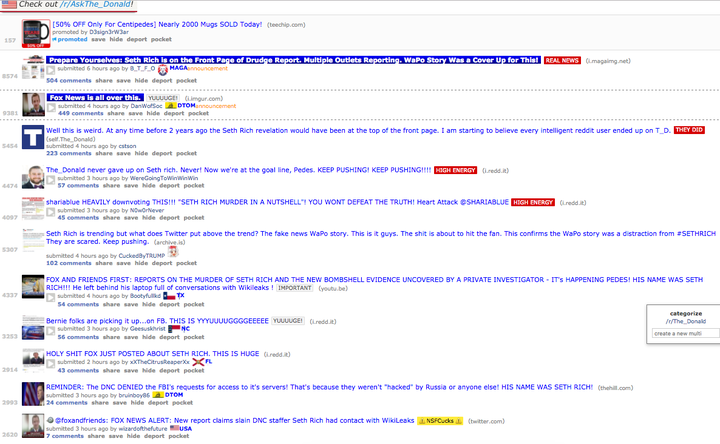
The front page of the pro-Trump subreddit, The_Donald the morning after the Seth Rich story broke mid May.
Granted, the pro-Trump cohort isn’t afraid to use sophisticated bot networks. As BuzzFeed News has reported, some people like Microchip, “a notorious pro-Trump Twitter ringleader” orchestrate automated networks of Twitter accounts to help push trending topics and advance narratives. In one instance, after a story Mike Cernovich published about Obama National Security Advisor Susan Rice requesting the “unmasking” of Americans connected to the Trump campaign, MicroChip “tweeted or retweeted more than 300 times about Rice.”
Microchip has assembled dozens of channels to orchestrate retweets on major trending initiatives. Microchip told BuzzFeed News in April that that all the accounts that orchestrate his retweets are real but even if a reasonable percentage are bots, it’s beside the point. The sophisticated networks — like the narratives and even the verified reporting from someone like Cernovich — are all the result of painstaking work from very real people. Like other major social movements born on the social web, the most influential and consequential campaigns are authentic and powered by humans.
As Manjoo notes in his piece, bots do play a very important role in distorting reality. “In a more pernicious way, bots give us an easy way to doubt everything we see online,” he argues. That’s true, given that fake follower audits are unreliable at best. We know only that the bots are out there, and that they’re malicious and, as Manjoo put it, “if that’s the case, why believe anything?”
But the pro-Trump media universe is, unquestionably, made up of real people, not bots, who understand the power they wield to gin up outrage, frame conversations across the internet and mainstream media, and attempt to win the battle of the narrative. And the network supporting these voices is boundlessly enthusiastic and relentless in its output.
Last week, as Twitter lit up with outrage — much of it bipartisan — over the Kathy Griffin beheading photoshoot, a pro-Trump message board regular direct messaged me, giddy that a liberal comedian had provided the #MAGA meme army with powerful ammunition — no bots necessary.
“This is awesome,” the person wrote. “We will put this on every 2018 mid[term] meme. This is Persuasion self-kill shit. We will meme Kathy's face out and replace with every D[emocrat] we can find. This is hilarious.”
Perhaps the only certainty of the 2018 elections is that those memes will show up. Some, maybe even many, will be spread by bots. And that's surely a problem — one that Twitter would be good to continue to combat. But the Great Bot Crisis is only a partial explanation — one that takes a complicated ideological problem and offers a technical solution: destroy the bots. It belies a deeper truth: that the political internet is hopelessly polarized and populated by fringes on both sides who'll stop at nothing to win. All that misinformation we're so worried about? It's man-made.
Quelle: <a href="Twitter's Pro-Trump Bot Crisis Is Really A Human Crisis“>BuzzFeed