Adam Best is always ready for a new tweet from President Trump. The Austin-based entrepreneur — and founder of the site Fansided —has set his phone is set to notify him the second the President hits “send”; since it’s his only Twitter notification, he rarely misses it.
“There’ve been times I’ve been in bed and I’ll hear the alert and roll out of bed and start firing back,” Best told BuzzFeed News. Sometimes he’ll mock up a series of tweets on a subject in advance — say, the congressional investigation into the Trump administration’s ties to Russia — so he can copy them into an instant tweetstorm. For Best, a self-identified member of the anti-Trump #resistance, it’s a form of catharsis and a chance to “fight back” during what he calls a “particularly depressing time” in politics.
“Trump’s very predictable so sometimes it’s just like ‘BOOM!’ Two minutes after the Trump’s tweet I have a seven-part response that’s topical and engaging.”
Best is far from the only person racing to reply to a Trump tweet. Thanks to Twitter’s weighted reply algorithm, you don’t even have to be the first to hit “send” — though it certainly helps. So seconds after the president sounds off to his 31-plus million followers, he’s is bombarded with replies — almost all of them extreme. There are: breathless condemnations of Trump policy; cries for his speedy impeachment; furious demands for his administration to admit its role in any number of global and political conspiracies; #Resist-ers; #TrumpTrain conductors and passengers; impassioned defenses of his character; praise for Trump as chessmaster-in-chief, 10 steps ahead and constantly outwitting enemies. There are comedians, actors, doctors, scientists, admirers, goons, politicos, activists, journalists, and trolls. And within seconds they’re all just a few pixels below the President’s missive — yelling, arguing, and looking to be the one Donald Trump sees when he checks his Twitter feed.
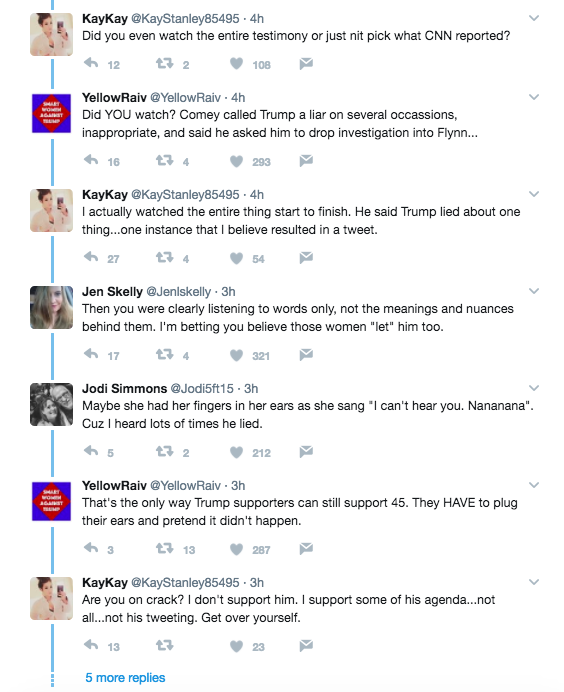
A standard argument — one of tens of thousands — in a Trump tweet reply chain.
Even if Trump himself never sees it, there’s a chance it will show up in the news, embedded in countless articles or projected across cable news as a producer scrolls down through a @realdonaldtrump tweetstorm.
Engaging with the President of the United States is Twitter’s weirdest growth hack.
Most importantly, the top reply to a Trump tweet is guaranteed to get in front of hundreds of thousands of eyes. That’s likes and retweets, not to mention profile views, replies, and new followers. In January, Mike Elgan, a technology writer, replied to a Trump tweet within ten seconds and watched the tweet rack up 800,000 impressions and 24,000 engagements in just a few hours. Within 24 hours, Elgan’s account grew by 300 followers — proof that mere proximity to a 6:00 A.M. presidential diatribe is among the most reliable ways to boost one’s Twitter account. Engaging with the President of the United States is Twitter’s weirdest growth hack.
On four separate occasions last May, New Right blogger and pro-Trump Twitter personality Mike Cernovich beat out the thousands of other replies to be the top response to a Trump tweet. As a screenshot sent to BuzzFeed News shows, each tweet brought in at least 300,000 impressions to the tweet.
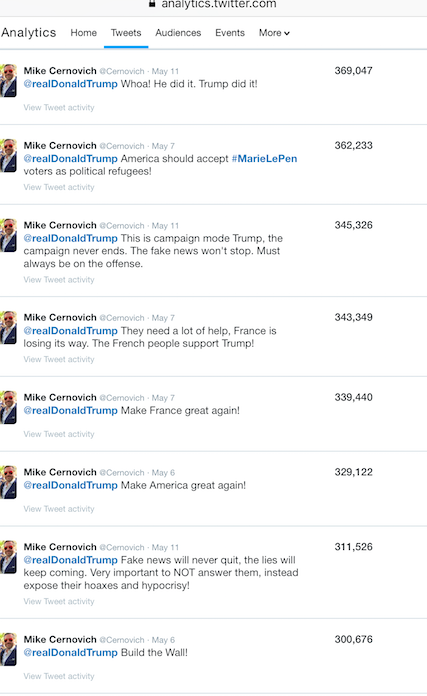
Cernovich says he’s done trying to game Trump’s replies, but argues that it’s a key tactic for budding political Twitter personalities. “If you get that top spot for five or six tweets each day, then that’s about 2 million impressions,” he said. “And it’s an effective way for people who might be considered trolls by some people to get their message out and to build their brand. That’s why there’s fierce competition for top spot.”
On the opposite side of the political spectrum, the strategy is much the same. William Legate, a 22-year-old entrepreneur and Thiel Fellow who’s become an active member of the anti-Trump online resistance since January, took his Twitter account from a few hundred followers to more than 100,000 in mere months, due in no small part to nabbing the top reply. For the last few months, Legate has jumped on Trump tweets within minutes, threading antagonistic tweets at the President that question policy, or point out inaccuracies.
“Honestly, it’s just using Trump’s strategy against him,” Legate said. “I studied the strategies Trump uses. He uses all kinds of psychological techniques — it appears he's read The Art Of War. I understand and use these techniques back. It's controlled chaos.”
Legate won’t detail his strategy for rising up in the reply algorithm, but assured BuzzFeed News he’s not a bot nor does he use any automated bots to cheat the system. He’s frequently accused by those in pro-Trump circles of having a clandestine deal with Twitter to rig the top reply in his favor. He insists that’s not true. “I don’t have deal with Twitter. Believe me, I wish I had some kind of deal,” he said.
And while Legate appears to be just one man, there’s precedent for fears that the game in Trump’s replies is rigged. In the months leading up to the 2016 election, Trump’s replies were dominated by a number of sophisticated bots with names like @keksec__org, @NeilTurner_ and @WhiteGenocideTM. As New York reported in the summer of 2016, these bots were almost always the first responses to Trump’s tweets, coughing up image- and link-heavy replies at inhuman speeds — often within two or three seconds. That speed was rewarded at different points during the campaign when, on at least three occasions, Trump retweeted each of the accounts.
But just being first doesn’t assure you a top spot in Trump’s replies, thanks to Twitter’s algorithmic “conversation ranking.” Until November 2016, when Twitter revamped its replies on mobile, Twitter replies were largely ranked by who was first to respond. Now, according to Twitter, “Replies are grouped by sub-conversations” that are ranked differently for each user by “factors such as if the original Tweet author has replied, or if a reply is from someone you follow.” Ostensibly this means that different people will see different top replies, but on Trump tweets, a select few still dominate.
Even though Twitter’s reply ranking algorithm is largely a mystery — when asked, Twitter did not provide any concrete explanation of how it weights tweets in large reply chains — those who’ve managed to beat the algorithm suggest there are a few tried and true strategies. Speed is important, but so is being a verified Twitter user — almost all the top replies to Trump tweets come from verified users, which Twitter argues improves the quality of the top replies .
If you can’t get there first, top repliers suggested it’s better to reply to the top reply, instead of to Trump: A “conversation” between two verified users often results in high placement. Threading tweets into a longer tweetstorm helps, too, others said — especially when they’re laden with images or videos. Two different top repliers offered that Twitter aggregates the likes and retweets of an entire thread when ranking replies, meaning that a tweetstorm is seen as more engaging than a lone tweet, increasing the odds it’ll be shown higher up in the stream.
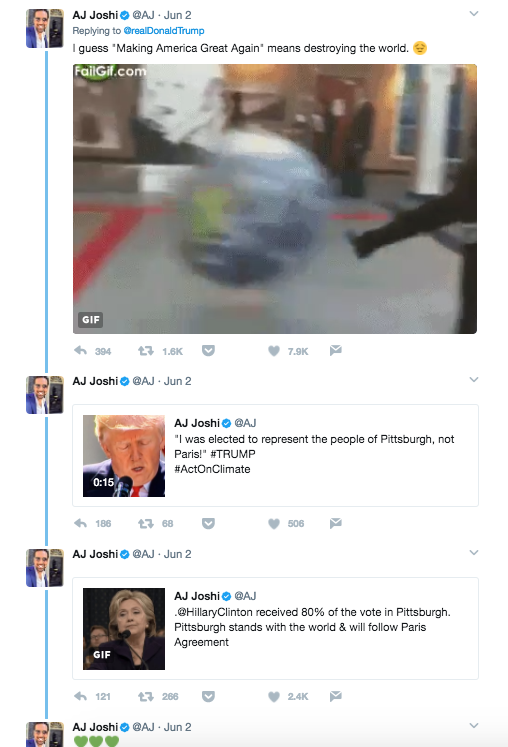
As a result of all this, even the most innocuous @realdonaldtrump tweets instantly descend into madness with one small scroll downward into the replies. Like on June 1 when Trump dashed off a throwaway tweet — a simple, all caps “MAKE AMERICA GREAT AGAIN!” that brought in 60,000 replies. The first replies came from AJ Joshi, an entrepreneur with nearly 400,000 followers, who offered up an eight tweet thread accusing Trump of destroying the planet (394 replies, 1,599 retweets, 7,883 likes on just the first tweet)
This was countered by a nine-tweet image thread from a pro-Trump account with the display name “Mr. Trumpism™” (350 replies, 236 retweets, 963 likes on just the first tweet).
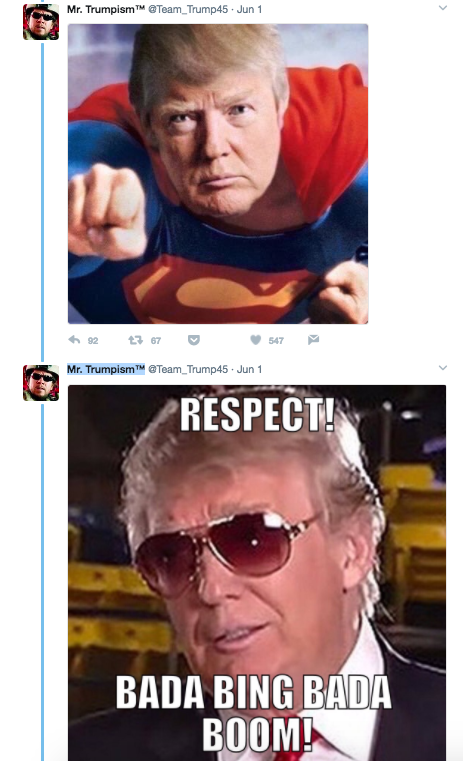
From there, the thread devolves into a toxic mix of partisan bickering and trolling from verified and non-verified users alike with accusations of transphobia, treason, and “daddy issues”. There also plenty of heavy-handed pleas — for Trump to resign as well as for him to implement safer football pads for America’s athletes. It goes on and on and on…for 60,000 tweets.
These novel-sized threads highlight just how contentious and important an outlet Twitter has become for venting at and defending the President. And — given that the President has chosen it as his go-to outlet for communicating White House policy — the space beneath a Trump tweet has raised unique legal questions. This week, lawyers representing Twitter users blocked by Trump urged the President to unblock them on the grounds that being blocked was a violation of the First Amendment. Under this argument, Trump’s replies are a “designated public forum,” meaning that the President is barred from banning people because they disagree with his views.
Nik Lentz, a featherweight MMA fighter who is an active defender of the President in Trump’s replies, told BuzzFeed News he sees Trump’s replies as an opportunity to have a “direct feed to the SJW matrix” that allows him to “troll these moron Soros bots.”
Lentz was first drawn to Trump’s replies after seeing that they were dominated by liberal-leaning, verified accounts castigating Trump. For Lentz, replying to the haters offered a bit of agency — and the fun of adding in some chaos. “Posting a few gifs of Trump dancing does many things,” Lentz said. “It shows the ridiculousness of trying to become famous off talking about make-believe Russian stories to virtue signal to the world that you matter on the Prez’ twitter post. And you get to see those same people lose their minds over a simple gif.”
“It really is almost like an SEO strategy now.”
In recent months, Trump’s replies have only grown more intense. And some publications are even getting involved. The Tylt, a startup media company inside Advance Publications (which is owned by Conde Nast), recently began mixing it up in the replies to Trump’s tweets as a content strategy. “We noticed that individuals were threading replies to Trump and saw a natural opportunity to jump in and pose questions using Twitter’s native polls,” Adrian Arizmendi, The Tylt’s Creative Manager told BuzzFeed News.
Arizmendi began peppering in in-house videos and embedded media into the threaded tweets and watched as engagement exploded — with a single thread generating 2 million impressions and half a million engagements. In the middle of May, Arizmendi claims that, thanks to Trump’s tweets, The Tylt’s account was generating more raw social engagements than Vice, Mic and Fusion combined.
“It really is almost like an SEO strategy now,” Philip Lewis, an editor at the Huffington Post and prolific tweeter said. “If you can get that prime real estate it's worth millions of views.” Lewis generally stays away from replying to Trump tweets, but occasionally uses a similar strategy to win the top reply on other big accounts. “You gotta have a good eye for the tweets that go viral, Lewis said. “I only do it when I can add a little value, otherwise it’s just leeching off another account. But that doesn’t stop plenty of people from doing it.”
And as Trump continues to tweet, there’s indications the gaming is only going to continue.
“I absolutely plan to expand this sort of threaded reply beyond just Trump,” Arizmendi said. “So don’t be surprised if you see more of us out there in the future posing questions of other public figures/companies/entities.” ●
Quelle: <a href="Inside The Chaotic Battle To Be The Top Reply To A Trump Tweet“>BuzzFeed