Server-CPUs: Aus AMDs Opteron wird AMDs Epyc

Tschüs Opteron: AMD vermarktet seine nächste Generation von Server-CPUs als Epyc. Die Chips mit bis zu 32 Zen-Kernen und sechs DDR4-Kanälen sollen Intels Xeon-Modellen Paroli bieten. Die neue Roadmap sieht Chips mit 7 und 7+ nm Technik vor. (AMD Zen, Prozessor)
Quelle: Golem

New Azure Quickstart template – Cloudera CDH and Tableau Server by Slalom

Developers and IT-Pros usually start their Cloud journey by installing software on virtual machines.  While this makes it easy to create running Infrastructure as a Service (IaaS), it requires additional work to load data and develop a coherent business solution.  Today we’re excited to announce a quick and easy way for the moderately technical user to get started with a pre-bundled visual analytics & big data solution running on Microsoft Azure: The Tableau/Cloudera Quickstart, built by Slalom.

We are also inviting everyone to join us on May 24, 2017, for a Webinar and demonstration of this solution delivered by Slalom and Microsoft. RSVP here – Webinar: Multi-Server Cloudera deployment on Azure.

To process and rationalize the large amounts of data produced in today’s modern businesses, users need flexible, sophisticated visualization tools combined with Internet-scale data processing clusters.  As you may already know, Tableau’s Server is acclaimed for self-service data visualization and collaboration, whereas Cloudera’s Enterprise Data Hub (CDH) framework provides robust data management and processing. Numerous customers are deploying these solutions every day on Azure, and both solutions can be found in the Azure Marketplace.

As a way for our customers to quickly experience the power of Azure and the strengths of our market-leading partners Tableau and Cloudera, Microsoft teamed up with Slalom to develop a sample, integrated business solution.  Whether you deploy for trial purposes, for a proof of concept, or a production environment, you can get started with this solution with very little configuration and setup effort.  Simply follow the Quickstart Cloudera + Tableau Deployment Guide, and you will end up with a pre-configured, Azure-optimized cluster of VM’s running Cloudera CDH that is pre-loaded with data. This cluster will also contain a Tableau server VM that is pre-configured with a Tableau retail dashboard that allows you to work with and analyze the Cloudera CDH data. 

The solution is designed to configure all the necessary components and the network topology, so you can focus on your data ingestion, management, analytics, and insights. If you have specific environment requirements or you prefer to customize the setup, you also have the flexibility to fork the repository, update the ARM Template and deploy the Cloudera with Tableau solution to fit your needs.

We hope this helps with your Azure journey with Cloudera and Tableau – and we are looking forward to your comments. Please feel free to reach out.


Suggested learning path:

Check the GitHub Repo with the Cloudera and Tableau Quickstart
Visualize the Quickstart and see the underlying JSON
Review the Deployment and Usage Guide
Deploy the Quickstart directly to your Azure subscription
Reach out to Slalom if you need help
Explore other Azure Partner Quickstarts to push your Azure skills to the next level

Practical aspects:

(1)   Licenses – Both Cloudera and Tableau solutions are provided as Bring-Your-Own-License (BYOL) model, as an initial free trial basis. These trials cover 60 days for Cloudera CDH and 14 days for Tableau server. After the initial trial period, you will need to reach out to the respective ISVs for licenses.

(2)   Versions:

Cloudera CDH 5.4.x Apache Hadoop deployment on CentOS
Tableau Server 10.1 running on Windows

Acknowledgments

This article is a collaboration between several people. Special thanks to Nicolas Caudron and Gil Isaacs.
Quelle: Azure

How The Pro-Trump Media Responds To A Crisis In Just 4 Steps

This week has posed a new test for the pro-Trump media — a loose affiliation of news organizations, trolls, and independent journalists — who fight the moment-to-moment battle to defend the president and rally his supporters as he reels among self-imposed crises.

The latest came in the form of a bombshell report from the Washington Post that President Trump disclosed highly classified information to the Russian foreign minister and ambassador last week and, in doing so, may have jeopardized a source in the fight against ISIS.

The pro-Trump media operates as a mirror image of its mainstream counterpart with its own “alternative facts,” audience, and interpretation of truth. And perhaps never has this been clearer than in its response to Monday's news.

Below is a timeline and breakdown of how — in just 17 hours and 4 steps — the Upside Down media flipped the script on a particularly thorny news cycle.

Phase 1 – Quiet Period:

As the Washington Post scoop hit Twitter, the pro-Trump media's most active spaces — 4chan, Reddit, and Twitter — were unusually quiet while waiting to figure out how to respond to the story.

Phase 2: Blaming The Usual Suspects/Dismissal

It took about an hour or so for the first quick takes to appear. As is expected, they touched on familiar pro-Trump media talking points — reflexive plays to the base audience including:

Basically, an attempt to discredit the Washington Post and its reporting by suggesting that the decision to publish the sensitive information would tip the terrorist organizations and individuals involved.

Basically, an attempt to discredit the Washington Post and its reporting by suggesting that the decision to publish the sensitive information would tip the terrorist organizations and individuals involved.

The Washington Post story notes, however, that it did not publish sensitive details. “The Post is withholding most plot details, including the name of the city, at the urging of officials who warned that revealing them would jeopardize important intelligence capabilities,” the story read.

The Gateway Pundit, a far-right/pro-Trump outlet, also attempted to attack the Post's credibility, suggesting yesterday's report was the 4th false story from the paper in a week.

Another staple of the pro-Trump media is to call into question the anonymous sources, such as the ones cited in the Washington Post article. The suggestion: if the sources won't attach their name to the claim, then they have nothing to lose — and thus their credibility is suspect.

It's important to note that anonymous sources are a staple of investigative journalism on highly sensitive stories. While the use of anonymous sources are a contentious issue — Margaret Sullivan, the former public editor of the New York Times, used her column to attempt to get the Washington Post to crack down on its use of anonymous sources — they are used by reporters to unearth deeply sensitive or classified information that would otherwise not come to light.

Also, Jack Posobiec has often cited sources without naming them during his reporting on Twitter.

But the pro-Trump tactic of questioning the anonymous sources plays well with those outside of the media. A March poll by Morning Consult revealed that “half of Americans think it is inappropriate for journalists to cite anonymous sources in their reporting, and many think reporters are simply making up those sources.”

Early in the evening, White House national security adviser H.R. McMaster, spoke to the press and declared the Post story “as reported, is false.”

In the statement — which did not expressly deny that Trump disclosed classified information to Russia — McMaster noted that, “the President did not disclose any military operations that were not already publicly known.” And said that, “two other senior officials who were present, including the secretary of state, remember it being the same way and have said so. Their on-the-record accounts should outweigh those of anonymous sources. And I was in the room. It didn’t happen.”

On 4chan, anonymous users floated the theory that Trump — ever the mastermind — was planting false information to identify leakers. The suggestion that Trump is continually far ahead of his critics and constantly out-foxing the mainstream media is a common defense of some in the pro-Trump media.

The Deep State Leaks Defense
The Deep State Leaks Defense

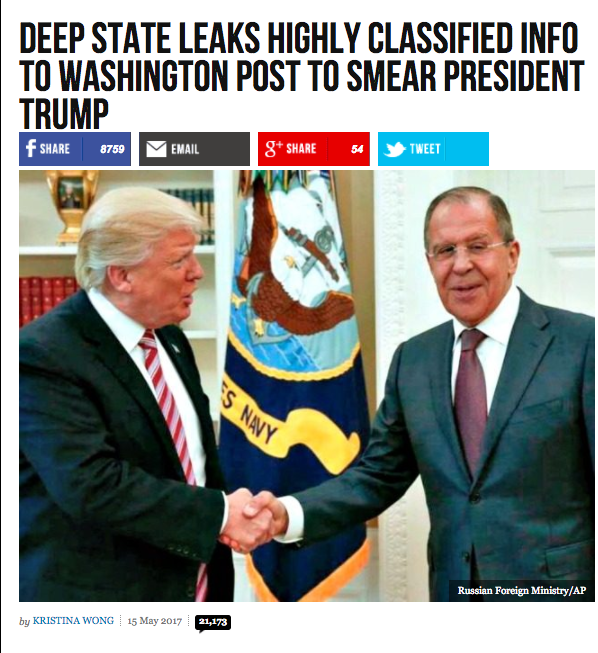
In the early evening, Breitbart News published a pretty straightforward write-up of the days news with a sensational headline, blaming the leaks on the deep state to smear Trump. The body of the story hardly touches the deep state angle addressed in the headline. The story notes just below the headline that it “is 'unlikely' Trump broke any laws.”

By late evening, the Drudge Report — which largely helps set the right-wing media agenda — settled on a narrative, focusing on the White House's inability to crack down on leaks (the story Breitbart wrote).

Drudge has been very critical of White House leaks recently and reportedly expressed his distaste to President Trump during a recent trip to the White House.

After Drudge, the leak angle gained traction. The pro-Trump conspiracy and news site, Infowars, spun the story slightly, suggesting that McMaster leaked the story to save his own job.

Infowars' Alex Jones and Roger Stone argued that the leak “came out of the NSA and not the White House” and that since “McMaster's head is on the chopping block” he “leaked the information to make himself indispensable” to the news cycle — and thus un-fireable.

Across bigger conservative media outlets, the Washington Post story got very little real estate across homepages.

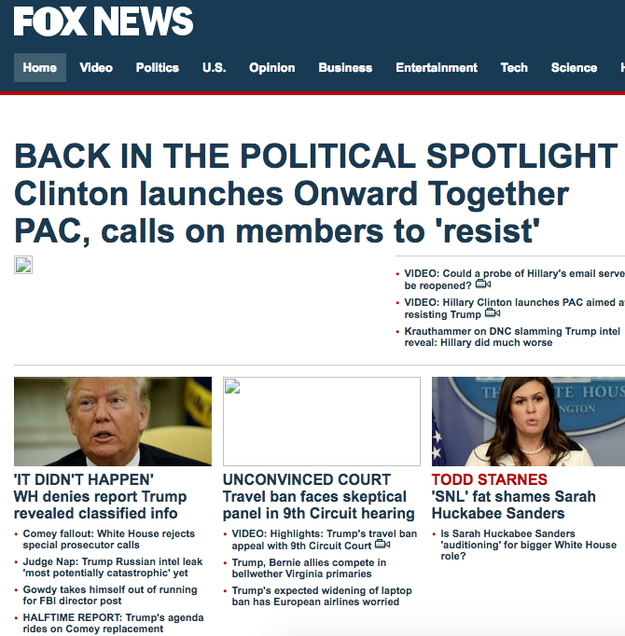
An archive.org rendering of FoxNews.com later in the evening shows that Fox News then changed the headline to reflect the White House's denial of the Post story. “'IT DIDN'T HAPPEN,'” the headline read.
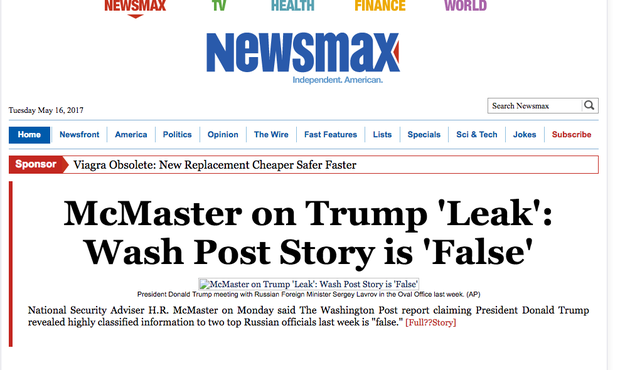
And Newsmax — a site whose CEO, Chris Ruddy, is a close friend of Trump — opted for a similar White House denial headline.
Phase 3: Changing The News Cycle

Just before 10:00 P.M., Fox 5 — a Washington D.C. affiliate — posted a report alleging that the murdered DNC staffer Seth Rich “was communicating with WikiLeaks prior to his death.”

The story said that “Rod Wheeler, a private investigator hired by the Rich family, suggests there is tangible evidence on Rich's laptop.” It's since been confirmed by BuzzFeed News that Rich's family did not hire Wheeler as an investigator (a third party did) and that Rich's family rejects the report.

The report was quickly seized upon by some of the biggest pro-Trump outlets, including Breitbart and Drudge.

By morning, Breitbart was crediting Fox News, not the Fox 5 report.

By morning, Breitbart was crediting Fox News, not the Fox 5 report.

Phase 4: Close The Loop/ Merge The Dueling News Cycles.

This is perhaps the thing that the pro-Trump media is best at. Here, Infowars' Paul Joseph Watson closes the conspiratorial loop and suggests that the initial Washington Post story was part of a nefarious plot to crowd out the news cycle and distract from the real news of the day — no matter that the Fox 5 report on Seth Rich came hours after the Washington Post scoop.

Here, the pro-Trump media continues to sow doubt and undermine the credibility of the Post and the mainstream media while flipping the script on those who believe that the Seth Rich story was timed to kill a news cycle that was hurting the Trump administration.

Quelle: <a href="How The Pro-Trump Media Responds To A Crisis In Just 4 Steps“>BuzzFeed

Meet The Private Detective Who Ignited A Clinton Conspiracy Theory

Fox News

A Washington, DC Fox affiliate report Tuesday night that a deceased DNC staffer had been in contact with Wikileaks prior to his murder set conservative media ablaze.

The story poured fresh fuel on a long-simmering wild conspiracy theory — for which there is no evidence — that the Clintons had the staffer, Seth Rich, murdered for leaking DNC emails to Julian Assange's organization. It was based on an interview with a single source, a private investigator named Rod Wheeler who, the article said, had been hired by the Rich family to investigate the crime.

This morning, though, the Rich family rejected the report and told BuzzFeed News through a spokesman that Wheeler had been “paid for by a third party” and was contractually “barred from speaking to press” without permission from the family.

So who is Rod Wheeler, what do we know about him, and what is his relationship to the Riches?

Wheeler is a former homicide detective for the DC Metropolitan Police Department, who, per his LinkedIn, has been a contributor to Fox News since 2002. And it was through his television appearances that he was ultimately put in contact with the Rich family, through a fellow Fox News contributor named Ed Butowsky.

Butowsky, a prominent wealth manager from Dallas and a contributor to Bretibart News who attended President Trump's inauguration, told BuzzFeed News that he reached out to the Rich family after hearing about the Clinton-Rich conspiracy theory from a friend.

“They said they didn’t feel they were getting any answers,” Butowsky said. “The investigation wasn’t going anywhere. I said 'why don’t you hire a private detective?' They said they didn’t have any money.”

Butowsky said he offered to pay for a private investigator, and called Wheeler. There, he said, his involvement ended.

“They negotiated something,” Butowsky said. “In their contract it said, any money Rod is going to bill, Butowsky is going to pay. But Rod Wheeler has never billed me a penny. Nobody has ever paid anybody anything.”

Beyond his involvement in the Rich case, Wheeler is mostly known for saying outrageous things on air. In 2007, in reference to a controversy over racial profiling and policing, Wheeler pulled his eyes back on air to demonstrate what “a Chinese male” looks like. And in the same year, on the Bill O'Reilly show, Wheeler said that a “national underground network” of armed lesbians were raping girls.

In addition to his private detective business, Capital Investigations, Wheeler is also, according to his LinkedIn, the CEO and founder of the Global Food Defense Institute. (“Food defense,” per the website of the FDA, focuses on “the risk of criminal or terrorist actions on the food supply.”)

But it's Wheeler's experience in the DC police department that seems to have qualified him to investigate the Rich case. In the Fox story, Wheeler said that a source within the department told him that they were ordered to “stand down” on the Rich investigation, and that it was “confirmed” that Rich was in contact with Wikileaks.

Calling Wheeler's allegations “unfounded,” a spokesperson for the MPD said that Wheeler had been employed by the department from 1990 to 1995 and that he was “dismissed from the agency.”

It's unclear what prompted Wheeler to speak to Fox, but earlier today, the Rich family denied having seeing the investigator's report in a statement:

“We see no facts, we have seen no evidence, we have been approached with no emails and only learned about this when contacted by the press.”

BuzzFeed News called a cell phone number appearing to belong to Wheeler and the number of the Global Food Defense Institute, which both had full mailboxes.

Quelle: <a href="Meet The Private Detective Who Ignited A Clinton Conspiracy Theory“>BuzzFeed

AWS X-Ray Makes AWS Lambda Request Tracing Generally Available

AWS X-Ray’s integration with AWS Lambda is now generally available for all customers. You can use AWS X-Ray to trace requests made to your serverless applications built using AWS Lambda. This enables you to gain insights into the performance of serverless applications, allowing you to pinpoint the root cause of issues so that you can address them. 
Quelle: aws.amazon.com

Optimize content delivery for your scenario with Azure CDN

When delivering content to a large global audience, it is critical to ensure optimized delivery of your content. This new capability is targeted to accelerate and optimize performance based on the scenarios you may use Azure CDN to deliver. These scenarios can include general website or web application delivery, media streaming, file download, etc. Optimization will be applied by default to the scenario you specified in the "optimized for" option when you create a CDN endpoint.

Optimization that we apply includes caching, object chunking, origin failure retry policy, among others, depending on the specific scenario. Media streaming is time sensitive in that packets arriving late on the client can cause degraded viewing experience, for example, frequent buffering of video content. The new enhancements, reduces the latency for delivery of media content. For large file download, object chunking is critical. Files are requested in smaller chunks from the origin to ensure a smooth download experience. We apply these enhancements based on the experience with many customers and we will continue adding additional settings to improve content delivery performance.

You can optimize the CDN endpoint to one of the following scenarios:

General web delivery
General media streaming
Video on demand media streaming
Large file download

When creating a new CDN endpoint, simply select from the drop down that best matches your scenario.

Depending on the optimization CDN providers support and how they apply enhancement in different scenarios, "optimized for" options can vary based on the provider you select. Currently Azure CDN from Akamai supports general web delivery, general media streaming, video on demand media streaming, and large file download. Azure CDN from Verizon supports general web delivery. You can use general web delivery for video on demand and large file download. We highly recommend you to test the performance between different providers to select the optimal provider for your delivery.

Read also:

Enable Azure CDN
Azure CDN overview

Is there a feature you'd like to see in Azure CDN? Give us feedback!
Quelle: Azure