Amazon Polly introduces a new German female voice, Vicki

You now have the choice of a second female German voice, Vicki, in addition to the German male voice Hans, and female voice Marlene. Vicki is a high-quality, TTS voice of a similar fluency and naturalness as the German voice of Alexa, able to fluently and intelligibly pronounce Anglicisms frequently used in German texts, including fully inflected version.
With the addition of this new female German voice, there are now a total of 48 voices in Amazon Polly’s Text-to-Speech portfolio. All 48 Amazon Polly voices are accessible worldwide from the following AWS regions: US East (N. Virginia), US East (Ohio), US West (Oregon), and EU (Ireland). 
Quelle: aws.amazon.com

Introducing Mirantis Cloud Platform — Webinar Q&A

The post Introducing Mirantis Cloud Platform — Webinar Q&A appeared first on Mirantis | Pure Play Open Cloud.
Just before the OpenStack Summit we gave a webinar introducing Mirantis Cloud Platform. Here are the answers to your questions.
Why does Mirantis Cloud Platform have two SDNs?
The Calico SDN is only used for K8s networking. It’s used for container-to-container connectivity. For the OpenStack SDN we support both Neutron ML2 OVS and OpenContrail in MCP 1.0. In general most applications only require L3 connectivity and do not require the same overlay network between containers and OpenStack. There are some exceptions, such as NFV workloads, that could demand that the container in K8s has L2 connectivity to a VM inside of OpenStack, however, and for that specific NFV workload case, we’ve shown a demo of using OpenContrail as the SDN for both OpenStack and K8s. You can view it here:
Can existing MOS environments be upgraded to MCP 1.0? If yes, which version(s) of MOS can be upgraded?
Transition from MOS to MCP for particular customers will require engagement with the Mirantis Services organization. The migration path will largely depend on the configuration of the original cloud and installed extensions/plugins, and in most cases will require additional engineering effort to develop. Clouds running on versions of MOS earlier than 9.0 are unlikely to transition to MCP in-place or in-service due to the extreme complexity of the transition path. Customers can still go from MOS to MCP by installing MCP separately and gradually moving data and workloads to the MCP cloud.
Why isn’t Mirantis Cloud Platform available for download like MOS 9?
As we transition from Mirantis OpenStack to MCP, which includes DriveTrain, a new operations-centric deployment and lifecycle management capability based on a CI/CD pipeline, a number of new considerations need to be in place for successful access, download and evaluation of the technology.  Please be patient as we work towards a new download capability that will enable the evaluation of MCP.
Are there any plans to support plugins, similar to MOS version 9.x ?
MCP is highly customizable, so it can be extended to enable deployment of a wide range of infrastructure (such as SDNs, storage back-ends, and so on) beyond the default choices. For the time being, however, Mirantis intends to avoid making such customizations except as required by customers, or where otherwise justified in terms of closing engineering gaps or satisfying business objectives. We do not anticipate creating frameworks (like Fuel Plugin SDK) enabling third parties to engineer infrastructure-level integrations of their products with MCP.
So are you going to continue to develop MOS? Will we see MOS 10?
We truly believe that the MCP model is the right way to deliver OpenStack and other private cloud components, so we feel like we’d be doing our customers a disservice by providing it any other way.
That said, MOS is part of MCP, so we’ll continue to develop it. As far as a standalone OpenStack that’s deployed via Fuel, we’ll continue to support MOS 9.2 through at least mid-2019 to give our customers a chance to migrate to MCP at their own convenience, rather than on an arbitrary schedule.
Are containers deployed on bare metal or on VMs? Or both?
MCP currently incorporates two independent cloud frameworks: OpenStack, which is an IaaS framework used to host virtual machines, and Kubernetes, an orchestration framework for (Docker) containers and containerized applications. At present, in MCP, the OpenStack and Kubernetes frameworks are deployed separately on aggregations of bare metal nodes provisioned with Linux. In the simplest case, an MCP cloud operator could deploy container workloads on bare-metal Linux-provisioned nodes in the Kubernetes cluster (which have nothing to do with OpenStack). The operator could also start VMs on OpenStack, provisioned with a Linux guest OS, and deploy a container host (such as Kubernetes, Docker Swarm, and so on) on these VM nodes, using these to host containers. Finally, the operator could use MaaS to provision bare-metal nodes separate from either the OpenStack or Kubernetes clusters, deploy Linux and a container host on these nodes (such as Docker Swarm), and deploy container workloads to them directly. Other layerings are also possible.
So is MCP a bundle of pieces with OpenStack and Kubernetes working together for OpenStack and container platforms or is OpenStack deployed on Kubernetes? Please clarify.
Mirantis Cloud Platform currently incorporates two independent cloud frameworks: OpenStack, which is an IaaS framework used to host virtual machines; and Kubernetes, an orchestration framework for (Docker) containers and containerized applications. At present, in MCP, the OpenStack and Kubernetes frameworks are deployed separately on aggregations of bare metal nodes provisioned with Linux. Mirantis has also demonstrated deployment of a containerized OpenStack control plane on Kubernetes: an architecture that enables agile scale-out of OpenStack capacity on demand and facilitates in-place-updating of OpenStack components with minimal downtime. No release date for availability of this architecture in production MCP has yet been provided.
Is a specific version of OpenContrail and Kubernetes used, or will it be continuously integrated by the CI/CD chain more or less live from upstream?
OpenContrail, Kubernetes, and all of the other components of Mirantis Cloud Platform will be updated as appropriate. For example, a needed driver might lag behind, delaying the release of a component, but as soon as it’s ready, the component will be released into the toolchain with the new version of the driver. All components are tested and hardened before being added to or upgraded in MCP.
Is DriveTrain free?
DriveTrain is included in the overall pricing of MCP and MMO.
Is DriveTrain only for MCP, or can it be used for MOS?
DriveTrain is a core component to MCP. It is used as the LCM for all open cloud software within MCP, and can also be utilized for other software deployment and LCM.  Part of that open cloud software includes the latest OpenStack from Mirantis, Mirantis OpenStack, but MOS 9.x and earlier versions included Fuel as the means of deployment.  DriveTrain is not for use with earlier versions of MOS.
What is the difference between Mirantis Cloud Platform and Red Hat’s Openshift?
MCP is a complete cloud platform that includes OpenStack, Kubernetes, and various other services. OpenShift is basically a Kubernetes distribution and PaaS.
Does MOS still exist, or it is completely obsoleted by MCP?
MOS is a component of Mirantis Cloud Platform, so is not obsoleted in any sense. With the release of MCP 1.0, the importance of MOS as a stand-alone product deployed by Fuel is reduced — though Mirantis will continue supporting and evolving MOS to serve the requirements of customers who cannot, or prefer not to adopt MCP.
How is Mirantis prepared to support their customers across all the components of the private cloud ecosystem, such as the host and guest OS, hypervisor, and virtual switch?
Mirantis — historically a top 3 contributor to OpenStack — also contributes to Kubernetes, OpenContrail and many other open source projects encompassed by Mirantis Cloud Platform, and is a member of key industry groups such as OPNFV. Mirantis works closely with providers of Linux distributions, platform and network hardware, and other MCP components.
Are acceleration technologies such as SR-IOV, DPDK supported? Are Smart-NICs supported?
Yes, SR-IOV and DPDK environments are supported depending on the NIC that is being used. Smart-NICs may be supported upon validation of them on a case by case basis per customer request.
What is Jenkins’ role?
Jenkins serves as the pipeline automation tooling within DriveTrain for delivering LCM features to MCP.
Can Cisco ACI be used instead of openContrail?
Not currently, but features and additional support are being integrated continually.
Will it ever be possible for smaller operators with order of 10-15 OpenStack compute nodes to “self-consume” MCP (or perhaps a subset thereof) the way they could with MOS? Otherwise, where do you suggest they turn to so they can adopt MCP once they reach critical mass?
The best way to prepare for MCP is to transform your company culture into a cloud-native organization, and to start using DevOps principles such as CI/CD. These changes will benefit your organization by giving you greater agility and development speed outside regardless of the cloud platform you’re using.  MOS 9.2 will be available for the next few years, so you can gradually ramp up to the point where you’re ready for MCP.
How does MCP differ from MOS ?
MCP is an ecosystem of around 100 cloud services, including OpenStack and Kubernetes environments deployed with DriveTrain (SaltStack/Reclass) lifecycle management capabilities. MOS is strictly OpenStack with Fuel as a deployment tool and plugin framework.
DriveTrain is the new Fuel?
In a manner of speaking, yes. DriveTrain is the new way we are deploying both Mirantis Cloud Platform OpenStack and Kubernetes environments, as well as managing their lifecycles. Fuel is the deployment and LCM tool strictly for MOS.
What is the timeline for release for MCP?
MCP 1.0 became generally available in mid-April, 2017.
How do I get the details from StackLight? What is the client using?
StackLight is a toolchain of many various logging, metering, and alerting applications; including but not limited to Kibana, Elasticsearch, Grafana, InfluxDB, Sensu, and Uchiwa, wrapped around a Heka framework. Please visit the StackLight page for additional details.
With MCP, do you first build a Kubernetes cluster as a base and then run OpenStack services in Kubernetes?
MCP deploys both OpenStack and Kubernetes as separate environments under the same lifecycle management architecture. Currently, both environments are parallel in nature, and not installed on top of each other.
In the managed solution, will Mirantis deploy MCP on the customer’s own infrastructure (servers/storage) or 3rd party clouds (AWS, Azure, etc)?
MMO on-premises delivery is onto customer managed hardware, this can be in their own physically owned datacenter or a colocation facility. However, we do not deliver MMO onto public cloud infrastructures such as AWS or Azure.
Can MCP span private and public clouds?
One of the great things about MCP is that it leaves things open for the latest technology.  Mirantis delivers hybrid cloud solutions through MCP technology and professional services. One of those technologies is Kubernetes Federation. Once this is in place, your applications will be able to easily span Kubernetes to both public and private clouds.
Did you miss the original webinar?  Check out the video and the slides.
The post Introducing Mirantis Cloud Platform — Webinar Q&A appeared first on Mirantis | Pure Play Open Cloud.
Quelle: Mirantis

Now You Can Livestream Major League Baseball Games On Facebook For Free

Hannah Foslien / Getty Images

Facebook and Major League Baseball (MLB) have announced a deal to broadcast 20 Friday night MLB games live during 2017 season from the MLB's Facebook page. Anyone on Facebook in the US can watch the games for free. The first one will stream tomorrow night at 7:10 pm ET when the Colorado Rockies play the Cincinnati Reds at the latter's home stadium, and MLB and Facebook said they would announce other teams at a later date.

Local networks will film the games on site, and those feeds will appear on Facebook. The social network began broadcasting sports in the US in April 2016 with soccer and hockey, both of which drew audiences in the hundreds of thousands. It now broadcasts soccer, table tennis, esports, basketball, and other sports in deals with networks as large as Univision. Notably, the National Football League has cut deals with Twitter and Amazon, but not Facebook.

The MLB also broadcasts games from its MLB.com At Bat app, which charges a subscription fee. The league already uses Facebook Live for several different kinds of broadcasts, like daily talk shows, players' interviews and workouts, award ceremonies, and even opening baseball card packs.

As subscriptions to traditional cable TV decline, broadcasters are teaming up with tech companies to find ways to retain subscribers and attract new viewers. Sports represent a keystone of TV programming because of the way people watch sports — live, as a game is happening — as opposed to scripted television, which streaming services like Netflix lean on for content. YouTube TV, for example, places a heavy emphasis on channels that broadcast live sports. Facebook, for its part, is looking to diversify beyond the News Feed, its most visited product, to attract more advertising dollars. Facebook CEO Mark Zuckerberg said last year that the company sees a future with “video at the heart of all of our apps and services.”

Dan Reed, Facebook's head of sports partnerships, said in a statement that he hopes broadcasts on Facebook Live would reimagine the community experience of being in stadium stands. MLB Commissioner Dan Reed called the deal “really important for us in terms of experimenting with a new partner” in a news conference.

Quelle: <a href="Now You Can Livestream Major League Baseball Games On Facebook For Free“>BuzzFeed

AWS Training and Certification Portal Now Live

AWS Training and Certification can help you get more out of the AWS Cloud. And now, the AWS Training and Certification Portal allows you to access and manage your training and certification activities, progress, and benefits – all in one place. Previously, you had to rely on multiple websites to find and manage training and certification offerings. Now you have a central place where you can find and enroll in AWS Training, register for AWS Certification exams, track your learning progress, and access benefits based on the AWS Certifications you have achieved. This makes it easier for you to build your AWS Cloud skills and advance toward earning AWS Certification. 
Quelle: aws.amazon.com

Racial Profiling Is Still A Problem On Nextdoor

Racial Profiling Is Still A Problem On Nextdoor

Thousands of people in more than 100,000 US communities use Nextdoor, the app that allows neighbors to chat about everything from yard sales to bike theft, but which has also struggled with a reputation that it’s become a hub for racial profiling.

Last August, Nextdoor proudly announced a solution to this problem: an algorithmic form that prevents people from racially profiling, or making posts about crime and safety that focus on an individual’s race and nothing else. But almost nine months later, Nextdoor still hasn’t patched holes in its anti-racial-profiling system. In fact, until earlier this month, the company hadn’t even started rolling out the feature on mobile. As a result, racial profiling — which has the potential to put real neighbors in danger — continues to be a problem on Nextdoor.

Laurie Bertram Roberts, who lives with her seven kids in a majority-white neighborhood in Jackson, Mississippi, noticed two months ago that one of her neighbors had posted on Nextdoor under the heading “Beware.” The message warned that two black men were going door to door in the neighborhood asking if they could cut grass for money. “May be harmless,” the message poster said. “Just be wary of letting them inside!” An hour after the post went up on Nextdoor, another neighbor who saw the men walking up someone’s driveway called the police.

Nextdoor's racial profiling prevention tools only rolled out in the app on Android phones earlier this month, and they still aren’t in use on iOS.

The incident incensed Roberts, who is black, and she replied to the post. “You just painted every pair of black males in [the neighborhood] as suspects, including my son and his friends who may be on their way to the store minding their business,” she wrote, according to screenshots reviewed by BuzzFeed News. “We have a right to walk around without being deemed suspects because 2 dudes scared you.”

A member of the Jackson Police Department wasn’t able to locate any additional information about this incident, but said going door to door looking for work isn’t a criminal activity.

Nextdoor has been lauded by local officials in Oakland for its efforts to stop racial profiling. It even won an award from the Bay Area chapter of 100 Black Men, a national civic organization for professional black men. “We created the company because we believe in bringing people together,” said CEO Nirav Tolia in a CBS This Morning interview last year. “In terms of racism, it’s one of the most divisive things in our community today. We want to be part of that solution.”

But a BuzzFeed News review of various local Nextdoor groups suggests there’s still a lot of racial profiling on Nextdoor.

For example, here’s a post that a user near St. Louis saw in January.
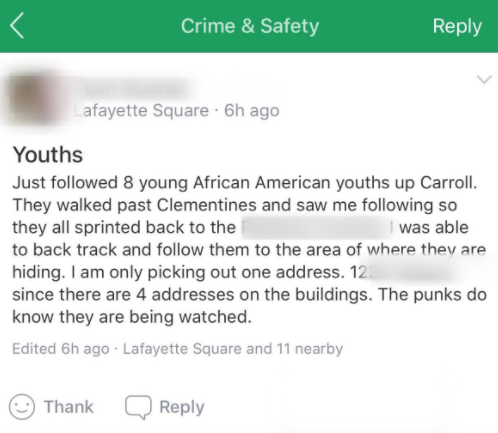
For example, here’s a post that a user near St. Louis saw in January.

Here’s another one, in the Bay Area in December:

Here’s another one, in the Bay Area in December:

And here’s a third example from Florida, shared on Twitter in February. Nextdoor’s CEO responded to this post, saying in a tweet that the “work in this area will never be done.”
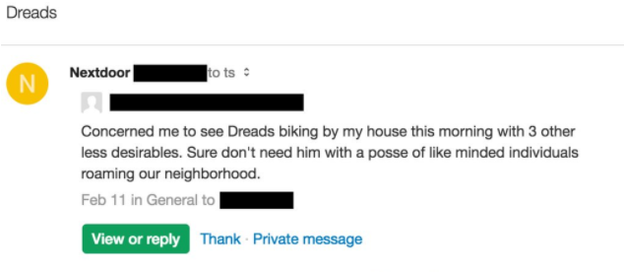
And here’s a third example from Florida, shared on Twitter in February. Nextdoor’s CEO responded to this post, saying in a tweet that the “work in this area will never be done.”

Part of the reason the problem persists is that racism is pervasive and pernicious, and no piece of software is going to stop it. But while Nextdoor’s algorithmic solution certainly forces users to stop and think about the role race plays in their analysis of a suspicious situation, it was deployed with significant weak points that have made it less effective than it originally seemed.

The features Nextdoor built to prevent racial profiling only rolled out in the app on Android phones earlier this month, and they still aren’t in use on iOS. (The company said it plans to roll out the algorithm on iOS on May 24.) And people can still post whatever they want in comments and Urgent Alerts, which are short, time-sensitive messages distributed immediately by text message or email to the whole neighborhood.

In an email statement to BuzzFeed News, a Nextdoor spokesperson said all the instances of racial profiling cited here either were “not alerted” to Nextdoor or were flagged by a neighbor and “handled appropriately by our support team,” which may or may not involve removing a post. The spokesperson said the company does not comment on individual members or posts.

One user said her Oakland neighborhood Nextdoor group still sees at least one instance of racial profiling a month.

Nextdoor said the “vast majority of the instances of racial profiling have been eliminated due to the actions we have taken.” A company spokesperson declined to explain the rationale for or methodology behind that conclusion. Nextdoor also declined to share what percentage of content posted to its site comes through mobile apps.

Nextdoor acknowledged back in November that racial profiling was still possible in Crime & Safety posts on mobile apps, and in urgent alerts and replies, but more than six months later, the company is still searching for a way to prevent it. “With the support of our partners, community groups, and experts in the field, we will continue to address this issue and specific instances as they come up,” Nextdoor’s statement pledges.

Individual users aren’t the only ones who have noticed that racial profiling persists on Nextdoor. Shikira Porter is a representative for Neighbors for Racial Justice, one of two community groups that’s been working with the company to address racism on its platform. (Nextdoor also brought on Debo Adegbile, formerly of the NAACP Legal Defense Fund, and Grande Lum of the Divided Community Project as national advisers.)

Porter said she presented Nextdoor with a 15-page document of ongoing problems and possible solutions during a conference call in November, but the company took until January to make any changes. “They tweaked one thing out of all the things we listed were problematic,” she said. The result is that Nextdoor’s system still has “all of these major holes.”

Porter said her Oakland neighborhood Nextdoor group still sees at least one instance of racial profiling a month.

But even when Nextdoor fully deploys its racism-fighting algorithm in its app, there will always be some racial profiling the system won’t catch. To make a judgment call in those instances, Nextdoor relies on local neighborhood leads — frequent users who are nominated by their neighbors to be group moderators. Porter said Neighbors for Racial Justice stressed to Nextdoor the importance of “mandatory and comprehensive Leads training” on the definition and risks of racial profiling.

In August, during a meeting at Nextdoor’s headquarters, a spokesperson said the company was thinking about ways to scale up the racial profiling and unconscious bias trainings it had done internally to all of its national neighborhood leads. Asked for details on the program, Nextdoor’s spokesperson said some neighborhood leads in Oakland had received bias training, a program the company is working to put online “to provide to our Leads across the country.”

One of the problems with putting volunteers in charge of policing racial profiling on Nextdoor, says Jackson resident Tom Head, is that not all neighbors agree with Nextdoor’s stance on racial profiling. For example, when one of Head’s neighbors recently posted an urgent alert saying a black man was sitting in a parked car in a driveway, the neighborhood lead responded to the post by clicking “Thank,” which is the Nextdoor equivalent of Facebook’s “like.”

“I stay on [Nextdoor] because I really do fear the day someone sends an alert and it's my kids they're describing as suspicious.”

“I haven't actually seen a lead post a message where they said, 'I will not enforce the racial profiling guidelines,' but I have certainly seen leads participate in threads where [the guidelines] were being ridiculed,” said Head. “In majority-white communities in Mississippi, the idea of opposing racial profiling as a matter of policy is not necessarily a popular one.”

Head added that even if a lead is personally against racial profiling, “enforcing these policies against their neighbors, coworkers, employers, and clients” can have unwanted social and financial consequences. “If you look at the people who signed up early and did the most invites and ended up as leads, it incentivizes, for example, realtors,” he said. “If you're a realtor, and you're selling houses in a neighborhood, you have to maintain relationships with some of the people who might be posting these objectionable posts. It can become financially risky to offend these people by taking socially unpopular positions.”

A solution to this problem, Head suggested, would be to have Nextdoor employees intervene when a lead declines to take action when another neighbor reports a post for racial profiling. The good thing about leads being local community members, Head said, is that “they’re usually willing to do it for free.” But, he continued, it also “creates a problem in that, if you have a national policy that a local neighborhood doesn’t like, it’s very hard for the lead to enforce it.”

In August, Nextdoor said all posts flagged for racial profiling would be directly reported to a team of two dozen trained customer support staffers. But Head said that when he reported the urgent alert about the man sitting in a car to Nextdoor’s support team, “nothing came of it.”

“It’s the people who are using the platform that I’m most frustrated about,” said Rebekah Goode-Peoples, a former Nextdoor user in Atlanta. “My greatest disappointment was realizing how bigoted many of my neighbors were.” Goode-Peoples deleted her Nextdoor account in September of last year, after reporting an incident in which a black female delivery worker was blamed for her own mugging because she willingly delivered food to a black neighborhood and didn’t bring a gun. Goode-Peoples never heard back from Nextdoor about her complaint.

“We remain completely committed to eliminating racial profiling on Nextdoor,” a company spokesperson told BuzzFeed News.

Laurie Bertram Roberts — the mom in Jackson — said the Nextdoor post about two black men going door to door looking for work was eventually taken down, after a few people shared a screenshot on Facebook. (However, sharing Nextdoor content on other social media is against Nextdoor’s rules, because the posts are linked to people’s real names and locations.)

“I only became active on Nextdoor again after the new rules because I thought it would be better,” she said over Twitter DM. “I stay on because I really do fear the day someone sends an alert and it's my kids they're describing as suspicious.”

Quelle: <a href="Racial Profiling Is Still A Problem On Nextdoor“>BuzzFeed

Securing Containers on OpenShift with Aqua

Red Hat OpenShift Container Platform is one of the popular and mature platforms for developing and managing container deployments. While it has many built-in security features, Aqua provides an additional layer of security both in development as well as for protecting containerized applications in runtime.
Quelle: OpenShift

AWS CodePipeline Adds Integration With Nouvola

You can now use Nouvola as a test action in your software release pipelines modeled in AWS CodePipeline. This lets you automate performance and release testing for your applications so issues are caught earlier and code is tested against real-world traffic scenarios before it’s released to production. Nouvola offers real-world performance and load testing for web, mobile, API and IoT applications so you can release better code faster.
Quelle: aws.amazon.com

Amazon CloudWatch Events Service is now available in AWS GovCloud (US) region

We are excited to announce the immediate availability of CloudWatch Events in our AWS GovCloud (US) region. With this new region, CloudWatch Events is now operating at sixteen AWS regions worldwide, bringing the total number of AWS Availability Zones to forty two. You can learn more about our growing global infrastructure footprint at our Global Infrastructure page.
Quelle: aws.amazon.com

New smaller Windows Server IaaS Image

We continue to find ways to make Azure a better value for our customers. Azure Managed Disks, a new disk service launched in Feb '17, simplifies the management and scaling of Virtual Machines (VM). You can choose to create an empty Managed Disk, or create a Managed Disk from a VHD in a storage account, or from an Image as part of VM creation.

The pricing of Managed Disks, both Premium and Standard, is based on the provisioned disk size, which is different from the pricing of Standard Unmanaged Disks. To keep the cost lower, we created lower disk pricing options with smaller 32GB and 64GB Standard Managed Disk sizes. Building on that foundation, we have also added a second set of Windows Server offerings with 30GB OS disks for Windows Server 2008R2, Windows Server 2012, Windows Server 2012R2 and Windows Server 2016 in Azure Marketplace. These smaller images are prepended with  “[smalldisk]” in the image title on Azure Portal. For Powershell, CLI and ARM Templates, the image SKU is appended with "-smalldisk". If your application do not require large amount of OS disk space, you would observe savings of $2.18 per VM if you choose to deploy with 32GB Standard Managed OS disk vs. 127GB. For large scale deployments, the benefit would accumulate and may represent significant cost savings. 

You can also have the flexiblity to expand the OS disk by following the existing guide for expanding OS Disk:

How to expand the OS drive of a Virtual Machine in an Azure Resource Group

If you have expanded the OS Disk, log into your Windows VM and use Disk Management Tool to extend the OS partition to match the OS disk size.
Quelle: Azure