Twitter Has Been Guessing Your Gender And People Are Pissed

On Wednesday, Twitter debuted new tools that make it easier to see the kinds of information the company is collecting about you and using to tailor your advertisements. As part of the update, you can now download a list of all the accounts that are serving you ads (and if you're inclined, someone made instructions for how to automatically block all those advertiser accounts, lol).

Want to find out what Twitter knows about you? Go to “Settings and privacy,” and then close to the bottom of the lefthand side, go to “Twitter data”:

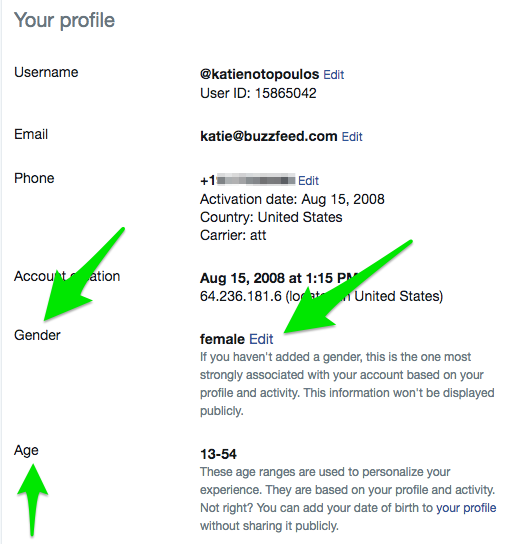
Here’s the basic profile info that Twitter has about you:

Here's the basic profile info that Twitter has about you:

It turns out that Twitter has been inferring your gender. Some people were pissed about this.

It feels pretty creepy to find out that Twitter has been using people's data to assign them gender identities. But this isn't unusual. It's entirely common for websites to infer their visitors' and users' genders for advertising purposes. Google does this for you too (and you can check what assumptions Google's made about you here).

The fact that Twitter allows you to edit your assumed gender or write in how you identify is actually a step up from what some other tech companies offer users. Google only allows you to indicate that you are male, female, or “rather not say.” Facebook has allowed you to write in your own gender field since 2015 (though gender has always been part of your Facebook profile, unlike Twitter, who has never asked you to specify). And overall, transparency about how these platforms use our data is good! Yay transparency!

We all know that companies like Twitter and Facebook are using our data to allow advertisers to find and target specific people – that's social media companies' business model. In additional to the gender and age that they infer, there's a whole list of things they think you're interested in that advertisers can use. Twitter thinks I'm interested in “investing” and “men's pants” even though I'm not, but that's low stakes and more funny than anything else.

But for trans and gender-nonconforming people, seeing that a platform for free expression like Twitter has been making gender assumptions for them – whether it's right or wrong – can be jarring and upsetting.

Quelle: <a href="Twitter Has Been Guessing Your Gender And People Are Pissed“>BuzzFeed

Redefining TV Infrastructure: Shifting Media Processing into the Cloud Q&A

The post Redefining TV Infrastructure: Shifting Media Processing into the Cloud Q&A appeared first on Mirantis | Pure Play Open Cloud.
While demand for TV services is being disrupted and subscribers are expecting more personalized experiences, operators need to satisfy customer video demands to stay competitive. However, many workflows still operate in functional silos within organizations, and offering non-linear/OTT services often remains costly and inefficient. To innovate and keep pace with new over-the-top (OTT) entrants, operators need to experiment with cloud-orchestrated functionality. 
On March 15, Przemek Bozek, Principal Analyst, Consumer Electronics, Broadband & Video Technology at IHS Markit, Ryan Day, Principal Solutions Architect at Mirantis, and Yaniv Ben-Soussan, VP Product Management Cloud and SaaS at Harmonic presented a webinar exploring the role of the cloud in the pay-TV ecosystem and its importance to agility of service, innovation and competitive differentiation while reducing cost of operations and increasing quality of services. Here are some of the questions that came up.
Will Mirantis and Harmonic prepare a reference architecture for this joint solution?
We have several collateral projects nearing completion right now, including deployment guidelines and a detailed case study.
When you used the term “EMS,” did you mean Element Management System?
Yes – “EMS” means Element Management System.
Is load balancing, i.e., video quality vs bandwidth, achieved through Mirantis cloud or Harmonic VOS?
These trade-offs are managed by VOS. In general, the amount of CPE and bandwidth your application requires will be dictated by the number of different profiles you need to support and the traffic under each profile.
Did it become necessary to transport raw video within your cloud for distributed processing? If so, did this require the need for specialized routers/NICs?
On the contrary — a design requirement for this cloud-based solution is that all traffic is managed under IP with standard network hardware. That said, there are IP-based protocols for encapsulating video which are used as needed to transport data among microservice-based components and ingress and egress systems, as required.
Are we doing the video transcoding in VOS in the software, or there is any requirement for any specialized HW or CPU instructions?
All the encoding and transcoding is managed purely in software running on x86 vCPUs, with no additional special requirements for virtual or physical hardware support.
What are the performance numbers of the video transcoding sessions?
What we find is that — even though, naturally, we have generalized benchmarks — every customer in this industry actually has its own, unique requirements for transcoding, influenced by many factors, including where they are in the world, such as the US, Europe, or Asia. It actually depends on the density you want to achieve, per node. What we usually do, and what we always recommend, is for the customer to benchmark this themselves — and we can help with this; we have a benchmark system. With these benchmarks and target transcoding requirements, we can come back to the customer with recommendations for achieving those numbers and maximizing node density.
How does cloud meet cabling? Ingress/egress over coax?
By definition, the cloud environment is based on IP infrastructure. And over the IP infrastructure you can move compressed or uncompressed video. We have different standards and technology to move video over IP networks, and we know how to do so efficiently. There are separate systems at ingress and egress that can convert raw video to IP, and back into QAM for your customers.
Is Harmonic VOS running on Docker Containers and/or as a VM? Or is it hybrid?
Core services of Harmonic VOS run as microservices in Docker containers. Other parts of VOS include middleware that does container scheduling and orchestration, provides a persistent data store and performs other functions. We install all of this on KVM virtual machines provided by OpenStack.Virtual machines are, of course, only one way to provide compute resources to an application; bare metal is another.
Sound interesting?  You can view the entire webinar on demand.
The post Redefining TV Infrastructure: Shifting Media Processing into the Cloud Q&A appeared first on Mirantis | Pure Play Open Cloud.
Quelle: Mirantis

Docker Federal Summit Recap and videos

On May 2nd, Docker returned to the Newseum to host the second annual Docker Federal Summit.  This one day event is designed to bring government agency developers, IT ops, program leaders and the ecosystem together to share and learn about the trends driving change in IT from containers, cloud and devops.  We expanded the agenda this year two tracks, with presentations from Docker, ecosystem partners, agency and community leaders to drive discussions, technology deep dives and hands on tutorials.
View the general session replay here:

General session table of content and slides

13:05 Iain Gray, SVP Customer Success discusses how Docker delivers a unique secure supply chain for all applications and infrastructure
33:35 Nathan McCauley, Director Security Engineering discusses the principles of least privilege design on which Docker is built
55:30 Modernize Traditional Apps to gain portability, security and efficiency without changing source code
59:13 Banjot Chanana, Senior Director Products delivers an overview and demo of Docker Enterprise Edition

In addition, the following breakout sessions dove deeper into pragmatic advice, security, development, cloud and compliance.

Lessons Learned from Deploying Containers in Production featuring a panel discussion with Booz Allen Hamilton, JIDO, GSA and USCIS
Scaling and Securing Applications on Your Terms featuring Doug Gebert, HPE Deputy CTO for DISA and DoD
Supercharge Modern App Development with Azure Government and Docker featuring Eddie Villalba and Steve Michelotti
Federal Compliance Panel Discussion featuring Andrew Weiss, Susie Adams, James Scott and Greg Elin
Docker Secure Substrate for Container Apps featuring Riyaz Faizullabhoy and Andy Clemenko

For hands on training, the Federal Summit offered tutorials on Modernizing .NET apps, Docker Orchestration and Deploying Apps with Docker Enterprise Edition. These hands on labs are now available publicly for anyone interested in learning more about Docker.
Last but not least – Thank you to our event sponsors.

Continue your Docker journey with these helpful links

Try Docker Enterprise Edition for free
Learn more about Docker in Government
Register for an upcoming Docker webinar


#DockerFedSummit videos and tutorials now available onlineClick To Tweet

The post Docker Federal Summit Recap and videos appeared first on Docker Blog.
Quelle: https://blog.docker.com/feed/
Amazon Athena adds API/CLI, AWS SDK support, and audit logging with AWS CloudTrail

You can now run queries on Amazon Athena via the REST API using the AWS SDK available in Java, .NET, Node.js, PHP, Python, Ruby, Go, and C++. Please visit the API reference and CLI guide to learn more. To help you get started, you can use new code samples that illustrate running & stopping a query, creating, listing and deleting saved queries, and listing your query execution history. With the current release, you can now run queries via the console, JDBC driver or using the API. We have also updated the JDBC driver to support the new APIs. 
Quelle: aws.amazon.com

Price reductions on General Purpose Virtual Machines

We believe in providing the most innovative cloud offerings at incredibly competitive prices to our customers. As part of this promise, we regularly lower our prices as Azure continues to grow at scale and remain committed to our price match promise.

Last week, at the Microsoft //Build conference, we showcased great new Azure services and improvements. Today, we are pleased to follow up these announcements with additional price reductions that make Azure even more attractive. Specifically, we are lowering prices on previously-launched Dv2 Promo Virtual Machines to provide our customers with the cost savings of our upcoming hyper-threaded Dv3 VMs prior to their launch. 

Effective today, prices of Dv2 Promo VMs will be lower by up to 7% for Linux VMs and by up to 5% of Windows VMs. Below are the price reductions in a few representative regions. The complete set of new prices can be found on our VM pricing page.

Region

Linux

Windows

West US

-7.0%

-5.0%

East US

-7.0%

-5.0%

Canada Central

-6.5%

-4.0%

West Europe

-6.5%

-5.0%

North Europe

-6.5%

-4.0%

UK South

-7.0%

-4.0%

Southeast Asia

-6.0%

-4.5%

Japan East

-7.0%

-4.5%

Australia East

-7.0%

-5.0%

Central India

-6.5%

-4.0%

Korea Central

-7.0%

-4.0%

Brazil South

-7.0%

-5.0%

When we launch our next generation, Dv3 VMs in the next few months, they will be available at these new lower prices as well. For more information on Dv2 promotion and additional details on pricing, please visit the Azure VM pricing page.
Quelle: Azure

Okja: Buhrufe bei Netflix-Premiere in Cannes

Bei der Premiere auf dem Filmfestival Cannes ist die Netflix-Produktion Okja ausgebuht worden – auch von Pressevertretern. Der Film startete außerdem zunächst in einem falschen Seitenverhältnis. Die Filmcrew lobt Netflix für seine Produktionsweise. (Netflix, Film)
Quelle: Golem






