Amazon baut Videoangebot mit Bezahlkanälen aus
Jeder Kanal soll sich einzeln abonnieren und auch monatlich wieder kündigen lassen. In den USA ist das Angebot mittlerweile aber schon weitaus größer.
Quelle: Heise Tech News

Jeder Kanal soll sich einzeln abonnieren und auch monatlich wieder kündigen lassen. In den USA ist das Angebot mittlerweile aber schon weitaus größer.
Quelle: Heise Tech News

Apple repariert Macbook Pro mit Grafikfehlern nur noch kostenfrei, wenn diese aus dem Modelljahrgang 2012 oder jünger stammen. Notebooks mit Baujahr 2011 fallen raus. (Macbook, Apple)
Quelle: Golem

SiFive und Arduino haben das Mikrocontrollerboard Arduino Cinque vorgestellt. Als Hauptprozessor kommt der RISC-V-SoC Freedom E310 zum Einsatz, der mit 4 Megabyte Hauptspeicher ausgerüstet ist.
Quelle: Heise Tech News

Amazon hat seine Channels für seinen Videostreamingdienst gestartet. Es ist eine Art Pay-TV-Plattform; Kunden können in der Video-App weitere Sender dazu buchen. So sind auch Sportübertragungen möglich. Der Start in Deutschland fällt allerdings weniger furios aus als in den USA. (Amazon-Video, Amazon)
Quelle: Golem
Today, the Resource Groups Tagging API introduced a pagination parameter to the GetResources action that makes it easier for you to manage lists of resources returned by your queries. Using this parameter, you can list resources that are associated with specific tags or resource types, and limit result sets to a specific number per page. Previously, you could list resources only by the number of tags. With this release, you also can return all resources that meet your query criteria in a single call using the updated AWS CLI.
Quelle: aws.amazon.com

A typical Gateway Pundit headline.
In July, a few days before the Wikileaks release of thousands of DNC emails, Rich, was killed in what police says was an attempted robbery. Far-right conspiracy theorists have claimed Rich was the leaker, and his killing was ordered by the Clintons in retaliation.
Since last Monday, the story has dominated far-right media — even as it's dismissed, debunked, and ignored by the mainstream, and despite a series of bombshells regarding the potential ties between Donald Trump and Russia. To better understand how the pro-Trump media keeps a conspiracy theory alive in the face of overwhelming evidence against it, it's instructive to look at one of its most popular blogs, The Gateway Pundit.
The Gateway Pundit is a pro-Trump site run out of St. Louis, Missouri by long-time blogger Jim Hoft. The site reaches a wide audience — Hoft claimed that during the 2016 campaign, it was pulling down over one million unique views a day. The site has a reporter who regularly attends White House press briefings. Outside of its readership, Gateway Pundit is maybe best known for reporting on and pushing sensationalized claims and rumors that get picked up on bigger sites like the Drudge Report. Some of its greatest hits: that Hillary Clinton was having seizures during the campaign, that Obama's birth certificate was a forgery, and that illegal voting cost Trump the popular vote.
Hoft and Gateway Pundit have been instrumental in championing the Seth Rich/Wikileaks conspiracy. On Hoft's Twitter feed alone, which has over 73,000 followers, Hoft has kept up a steady clip of Seth Rich tweets since a D.C. local Fox station broke the story.
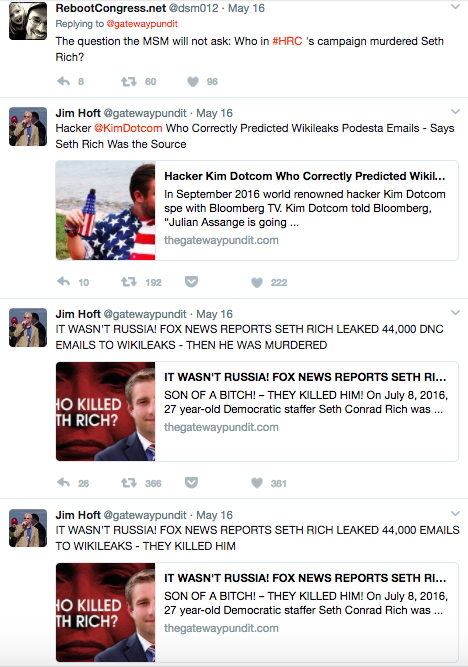
Hoft and Gateway Pundit are far from the only pro-Trump outlets to push the Rich story, but Gateway Pundit stands out as a prime example of how the pro-Trump media can not only champion a conspiracy but also continue to feed itself and whip up more outrage and intrigue. Here's how it works:
In the last week, Gateway Pundit published 15 stories about the Rich murder and Wikileaks conspiracy — some of which are almost exact copies of each other.
They have two different headlines:
“BREAKING: Seth Rich Family Detective Tells FOX 5 DC THERE IS EVIDENCE Seth was “Emailing” Wikileaks …UPDATED WITH REPORT”
And:
“IT WASN’T RUSSIA! FOX NEWS REPORTS SETH RICH LEAKED 44,000 DNC EMAILS TO WIKILEAKS – THEN HE WAS MURDERED”

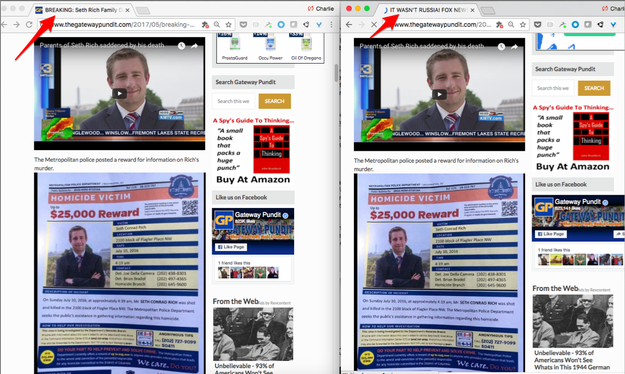
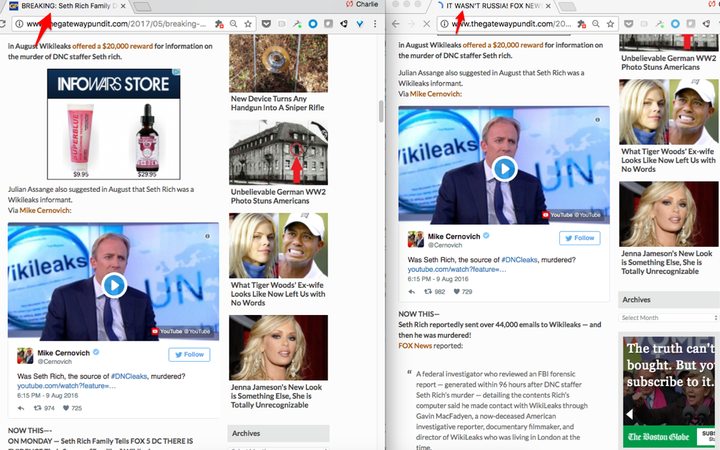
The repetition serves two purposes. First, it makes it so that Hoft and Gateway Pundit can quickly churn out new posts without having to spend the time to re-write new copy. And second, it cements the narrative with its audience. There is maybe only a tweet's worth of new information in the two posts, but each post is framed as a huge new revelation, ensuring that the audience feels the story is constantly moving and developing, despite the fact that little has changed since the now-discredited Fox 5 report. The reader, trying to get to the new information, has to read to the bottom. And in doing so, re-absorbs the Rich narrative again and again.





Gateway Pundit uses headlines to increase the stakes of each story. Often, they describe how the reader is supposed to feel about the story (example: “ABSOLUTELY SICKENING!”) or what they should take away from the piece (example: “IT WASN'T RUSSIA!”).
They draw the reader in, and undoubtedly play well on social media, but, much like the constant repetition, they also add to the sense that the Rich conspiracy is rapidly moving forward and that the minor updates are actually shocking revelations. Basically: they add false gravity to a story that's largely stagnant.
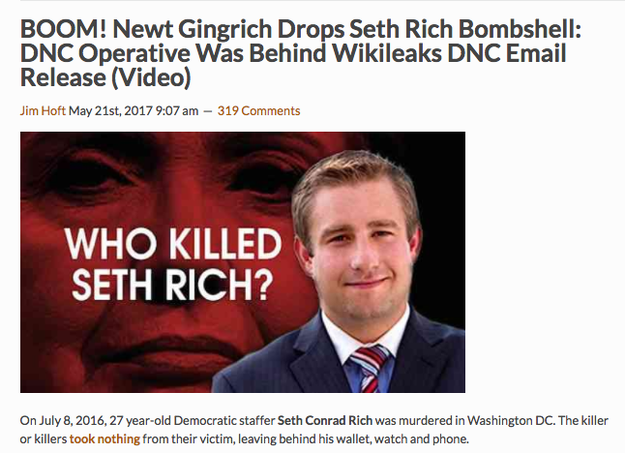
There was no “bombshell”: The post was a write-up of an appearance Gingrich made on Fox and Friends on Sunday morning. Though the headline suggests Gingrich put forth proof that the “DNC operative was behind Wikileaks DNC email release,” Gingrich did no such thing. He merely acknowledged that the Rich story was “very strange” and repeated rumors pushed by Gateway Pundit.
As with the above examples, the body copy of the Gingrich story was nearly identical to the other Gateway Pundit stories about Rich. In this case, the only difference is the inclusion of the Gingrich video at the end, alongside a short transcription of his interview.
Though the transcript clearly shows there's no bombshell from Gingrich, the information is included so far down in the post that Gingrich's quote is almost beside the point. The incendiary headline, which reinforces the rumor Gateway Pundit has been pushing for a week, cements the narrative and Gingrich's name attaches extra credibility to the conspiracy theory.
To recap: First, Gateway Pundit promotes rumors. Then, a politician repeats those rumors. Finally, Gateway Pundit uses politician's sound bite as proof rumors are true.
Perhaps the best example of Gateway Pundit's manufactured controversy came on Sunday night, when the site reported “'Complete Panic' at Highest Levels of DNC.”

The post hinges on an anonymous 4chan thread from an individual claiming to “work in D.C.” The post claims that “the Seth Rich case has scared the shit out of certain high ranking current and former Democratic Party officials,” and goes on to say the DNC “is near open panic.” The post's headline doesn't take into account that the 4chan user in question is completely unverifiable or that 4chan is a notorious breeding ground for trolls and misinformation.

While it's hard to know how Hannity came upon the 4chan post, it's possible he stumbled upon this tweet (which Gateway Pundit notes was the first public tweet of the 4chan post):
In other words: Hannity, drawing on information likely gleaned from an anonymous 4chan post, claimed that “complete panic” had set in at the DNC. And Gateway Pundit — with no verification — reported this as fact.
In isolation, each one of these examples may seem extreme. But taken together, they present a formidable misinformation campaign that's highly effective at pushing and cementing a narrative among devoted readers. Gateway Pundit may not have started the Rich conspiracy, but thanks to its constant promotion, it's helping to keep it in the news.
Quelle: <a href="How One Pro-Trump Site Feeds Its Own Conspiracy Theories“>BuzzFeed

Hybrid cloud can free your organization by providing complete flexibility in infrastructure. But does your IT strategy involve an enterprise-grade cloud platform that supports both your cloud-enabled and cloud-native application deployments?
Join us on June 7th at 1:00 p.m. EDT for a special webcast. We’ll discuss trends in hybrid cloud deployments and the total economic impact of IBM PureApplication, a platform designed to accelerate and simplify the deployment of your application and middleware environments.
Recently, Forrester Consulting interviewed PureApplication clients and developed a Total Economic Impact (TEI). The TEI can help organizations evaluate hybrid cloud application platforms. This webcast will give you an overview of the TEI results. We’ll also discuss the latest version of PureApplication, V2.2.3.
You can access the full commissioned study: The Total Economic Impact™ Of IBM PureApplication.
Our guest speakers – Forrester VP and Principal Analyst John Rymer, and Forrester Total Impact Principal Consultant Reggie Lau – will join Director IBM Hybrid Cloud Management Danny Mace to share insights that help you advance your cloud journey.
Hear about the most significant findings in the TEI of PureApplication, and learn how adopting this hybrid cloud solution can help:
Accelerate application time-to-market
Reduce time, effort and errors in provisioning application environments
Reduce IT management, maintenance and issue resolution costs
Improve business capabilities and resiliency
If you haven’t already, make sure you’re registered for the webcast, and share this event with your peers. Be sure to come with your questions. You don’t want to miss out on this event. Register today.
The post Webcast: Forrester and IBM reveal hybrid cloud trends appeared first on Cloud computing news.
Quelle: Thoughts on Cloud

Professional graphics users in every industry count on an immersive, photorealistic, responsive environment to imagine, design, and build everything from airplanes to animated films. Traditionally, these high-powered workstations were tethered to physical facilities and shared among professional users such as designers, architects, engineers, and researchers. But today’s enterprises find themselves operating in multiple geographies, with distributed teams needing to collaborate in real-time.
Hence, last year we released Azure’s first GPU offerings targeting high-end graphics applications. NV based instances are powered by the NVIDIA GRID virtualization platform and NVIDIA Tesla M60 GPUs that provide 2048 CUDA cores per GPU and 8GB of GDDR5 memory per GPU as well. These instances provide over 2x performance increase in graphics-accelerated applications as compared to the previous generations.
Targeting the high-end workstation user, you can run NVIDIA Quadro GPU optimized applications such as Dassault Systems CATIA or Siemens PLM per user directly on the NV instances without the need to deal with the complexity of licensing. Additionally, with up to 4 GPUs via NV24 you’re able to run up to 4 concurrent users utilizing these Quadro applications with features such as multiple displays, larger maximum resolutions and certified Quadro software features from hundreds of software vendors.
Furthermore, if your organization has a need to run Virtual Apps or Virtual Desktops using solutions like RDS, Citrix XenApp Essentials, VMware Horizon, or Workspot, you’re now able to run up to 25 concurrent RDSH users per GPU. Office workers and professionals who don’t require Quadro optimized applications, can finally enjoy virtual desktops with a high-quality user experience that's optimized for productivity applications. It's all the performance of a physical PC, where and when you need it. You can now dramatically lower IT operational expense and focus on managing the users instead of PCs.
NV6
NV12
NV24
Cores
6
12
24
GPU
1 x M60 GPU
2 x M60 GPUs
4 x M60 GPUs
Memory
56 GB
112 GB
224 GB
Disk
380 GB SSD
680 GB SSD
1.44 TB SSD
Network
Azure Network
Azure Network
Azure Network
Virtual Workstations
1
2
4
RDSH Virtual Apps and Virtual Desktops
25
50
100
“Because so many of today’s modern applications and operating systems require GPU acceleration, organizations are seeking greater flexibility in their deployment and cost options,” says John Fanelli, VP NVIDIA GRID. “With NVIDIA GRID software and NVIDIA Tesla M60s running on Azure, Microsoft is delivering the benefits of cloud-based RDSH virtual apps and desktops to enable broad-scale, graphics-accelerated virtualization in the cloud that meets the needs of any enterprise.”
These new updates will go a long way to making sure that you have the best infrastructure whether you’re running the most graphics demanding CAD application that require Quadro optimization or if you’re just running office productivity applications on the go.
Azure N-Series VMs are now generally available in multiple regions. To launch these VMs please visit the Azure Portal.
Quelle: Azure

Die neue Zahlungsdiensterichtlinie der EU zwingt die Banken, Drittanbietern wie der Sofortüberweisung Zugriff auf Kontodaten zu geben. Eine einheitliche Schnittstelle soll den Zugriff begrenzen.
Quelle: Heise Tech News

Ein Berufungsgericht hat das bei der US-Luftfahrtbehörde FAA geführte Drohnenregister in seinem bisherigen Ausmaß für rechtswidrig erklärt. Zu melden sind demnach nur noch unbemannte Flugobjekte im kommerziellen Einsatz.
Quelle: Heise Tech News






