What’s new for Serverless at Microsoft Build 2017

Serverless computing continues to gain momentum. The idea of building powerful solutions without worrying about infrastructure resonates with customers for many scenarios.

Today we are happy to announce preview support for several new capabilities for serverless application development in Azure using Azure Functions and Azure Logic Apps.

Visual Studio 2017 tooling for Azure Functions and Azure Logic Apps

Serverless is primarily about making developers more productive and allowing them to focus on their solutions. The integrated tooling provided by Visual Studio makes the serverless development experience with Azure Functions and Azure Logic Apps really stand out.

We are happy to announce that Azure Functions tools for Visual Studio 2017 are now available in preview. Available as an extension from the Visual Studio Marketplace, these tools allow developers to seamlessly integrate Azure Functions development into their normal development flow that includes leveraging 3rd party extensions, testing frameworks, continuous integration systems, etc. For more details, please see the blog post Azure Functions tools for Visual Studio 2017.

We are also happy to announce the availability of Azure Logic Apps tools for Visual Studio 2017. Also available as an extension from the Visual Studio Marketplace, these tools provide full support for developing and managing Logic Apps in Visual Studio 2017. For more details, please see the blog post Azure Logic Apps tools for Visual Studio 2017.

Application Insights integration with Azure Functions

Getting visibility into your app’s performance in production helps you to troubleshoot issues faster, and make your apps better. Azure Application Insights provides an excellent way to do this for your cloud applications. For serverless apps, you might want to understand metrics around number of executions, latency, etc. Or if you are feeling adventurous, you might want to look deep into how your Functions code really interacts with the underlying resources. This is now possible.

We are happy to announce that Azure Functions support for Application Insights has moved from beta to public preview. With this release, we have included support for adding Application Insights at the time of app creation, a direct link from Azure Functions’ portal to the Application Insights blade, and additional settings to configure the amount of data that needs to be collected for the apps. For more information, please see the blog post Azure Functions integration with Azure Application Insights.

Express export to PowerApps and Flow

Building custom logic that can be used inside business apps and automation workflows, is a common requirement among enterprises. Azure Functions is a handy way to build such logic in a serverless manner.

We are happy to announce that we are providing an express option that allows developers to export their Functions based API directly from Azure portal to be used inside PowerApps and Flow. Along with the recently announced OpenAPI (Swagger) support for Functions, this new feature now provides an easy way to create, document, and publish serverless APIs to PowerApps and Flow, all as a part of the regular Functions development workflow. To learn more about this and other API development enhancements in Azure Functions, please read this blog post Azure Functions API development updates.

Azure Functions templates for Common Data Service

Data is at the heart of business applications, whether it is coming from Excel, on-premises sources like SQL Server, or cloud sources like Salesforce, SharePoint Online etc. Microsoft’s Common Data Service brings together all business data in one place so app builders can focus on building apps rather than dealing with disparate systems. However, app developers are invariably required to write custom business logic with this data, to be used in their business apps.

Today, we are happy to announce the preview availability of Azure Functions templates for the Common Data Service (CDS). This functionality allows developers to build Azure Functions based APIs, which talk to data aggregated using CDS, and can then be invoked from PowerApps based apps across the organization. The ease of use of Functions serverless experience coupled with the versatility of CDS provides app builders a powerful tool. For more details, please see this blog post Azure Functions integration with CDS.

Azure Functions Runtime

Customers have embraced Azure Functions because it allows them to focus on application innovation rather than infrastructure management. The simplicity of the Functions programming model that underpins the service, has been key to enable this. We have realized that this model that allows developers to build event-driven solutions and easily bind their code to other services, while using their favorite developer tools, has good utility even outside the cloud.

Today we are excited to announce the preview of Azure Functions Runtime that brings the simplicity and power of Azure Functions to on-premises.  Built on the same open source roots that Azure Functions service is built on, Azure Functions Runtime can be deployed on-premises and provides a near similar development experience as the cloud service. For more details, please see this blog post Introducing Azure Functions Runtime.

We are excited to bring these new capabilities into your hands and look forward to hearing from you through our Forums, StackOverFlow, or Uservoice.
Quelle: Azure

Microsoft extends Azure managed database services with introduction of MySQL and PostgreSQL

As we look across what is happening at Microsoft Build, we are excited to announce the preview of managed database services with Azure Database for MySQL and Azure Database for PostgreSQL. Like the other news coming out of this massive moment for Microsoft, these new database offerings are about helping customers do what they truly want with technology. As a company, we’re helping developers thrive in the modern cloud-first, mobile-first environment where intelligent apps are being built across many platforms. They need to be able to work with data where they want, and we’re meeting them where that data lives.

Azure Database for MySQL and Azure Database for PostgreSQL services are built on the intelligent, trusted and flexible Azure relational database platform. This platform extends similar managed services benefits, global Azure region reach, and innovations that currently power Azure SQL Database and Azure SQL Data Warehouse services to the MySQL and PostgreSQL database engines. Starting at preview, customers can use the service to build and deploy their applications using MySQL version 5.6/5.7 and PostgreSQL version 9.5/9.6 in 11 regions across US, Europe, Asia and Japan.

The relational database platform is built with the scalable Azure Compute and Azure Storage foundational services that powers over 90% of fortune 500 companies in over 38 global Azure regions. This platform is:

Intelligent: Built-in monitoring, advisors and performance tuning insights to help you get the most performance out of your database

Flexible: Predictable performance and on-demand scaling without application downtime

Trusted: Built-in high availability, security, audit with full resource isolation

MySQL and PostgreSQL databases are popular choices amongst open source developers to build and deploy applications be it – web, mobile, content management system (CMS), customer relationship management (CRM), business, or analytical applications. These developers can now choose their favorite database engines delivered as a managed service on Azure that seamlessly integrate with most common open source programming languages such as PHP, Python, Node.js, and application development frameworks such as WordPress, Magento, Drupal, Django, Ruby on Rails. Therefore, whether you want to build a website using MySQL database or want to quickly build and deploy a geospatial web or mobile app with PostgreSQL, you can now quickly get setup using the managed service capabilities offered by Azure. In addition, app developers can continue to use the familiar community tools to manage their MySQL or PostgreSQL databases. The Azure Database for MySQL and PostgreSQL improves application developer productivity by bringing the following common differentiated benefits of the relational database platform services to all applications:

Provision database server in minutes with built-in high availability that does not require any configuration, VMs or setup.
Predictable performance with provisioned resources and governance.
Scale Compute Units up/down in response to actual or anticipated workload changes without application downtime.
Built-in security to protect sensitive data by encrypting user data and backups as well as data in-motion using SSL encryption.
Automatic backups with storage for recovery to any point up to 35 days.
Consistent management experience with Azure Portal, Command Line Interface (CLI) or REST APIs.

All these benefits are offered in a simple and inclusive pay-as-you-go pricing. These benefits not just provide you MySQL and PostgreSQL database engine choices, but a complete platform for app development, data management, business analytics and intelligent apps – one that can be used in a consistent way across both on-premises and the cloud.

The Azure Database for MySQL and PostgreSQL offers flexible service tiers – Basic, Standard, Premium, each with the ability to flexibly scale compute (Compute Units) and storage independently. Developers can get started using the Basic service tier for small-scale, infrequently used apps with variable IOPS. The standard service tier offers a broad range of scaling options with provisioned IOPS and is designed to be the go-to option for most workloads. Over the course of preview, we will introduce the Premium tier which will deliver IO and memory-optimized instances with the lowest IO latency. The service allows users to dynamically scale performance up or down anytime without application downtime. At the announcement of the service in preview, the service can scale up to 800 compute units and up to 1 TB of storage. These scaling limits will continuously increase through the preview timeframe.

We have worked with many customers in beta to ensure these new database services deliver exactly what our developers are looking for. As a result of this collaboration, we’re excited to share what our customers have to say about these services:

“The biggest benefit of Azure Database for MySQL will be to have Microsoft manage and backup that resource for us so that we can focus on other aspects of the site. Plus, we will have the ability to scale up and down temporarily as traffic surges and then bringing it back down when it is not needed. That’s a big deal for us.”–Kevin Lisota, Web Developer, GeekWire
“Hosting PostgreSQL on Azure will enable us to scale seamlessly worldwide, and all the services that we need from a development standpoint are just a few clicks away. ”–Irakliy Khaburzaniya, Chief Executive Officer, Credo360
“Rather than taking hours and hours to do something that isn’t primary to our business, we will use Azure Database for PostgreSQL so we can eliminate that busy work.”– Eric Spear, Chief Executive Officer of Higher Ed Profiles
“The ability to mix Azure and our open source technologies is definitely a big advantage for us…. Moving the geospatial database from our datacenter to the Azure Database for PostgreSQL service will save us money, allow for much more scalability, and lower our support overhead.”– Andy Grigg, Enterprise Architect, Somerset County Council.
“Using Azure for our websites has made the ability to communicate with parents a non-issue. For example, our staff used to panic about snow days, and now everybody has forgotten that they were ever a problem because the site stays up. Put simply, it’s a win for us.”–Matthew Williams, Systems Analyst, School District 42 Maple Ridge—Pitt Meadows

We’re excited to release these services – please go and try the MySQL and PostgreSQL service today! We are committed to building a portfolio of database technology that addresses your unique needs and fits your style. To learn more about each service independently, check out Sunil Kamath’s blog post on Azure Database for PostgreSQL and Jason Anderson’s blog post on Azure Database for MySQL. We look forward to your feedback on MySQL and PostgreSQL service.
Quelle: Azure

Compute Engine machine types with up to 64 vCPUs now ready for your production workloads

By Scott Van Woudenberg, Product Manager, Google Compute Engine

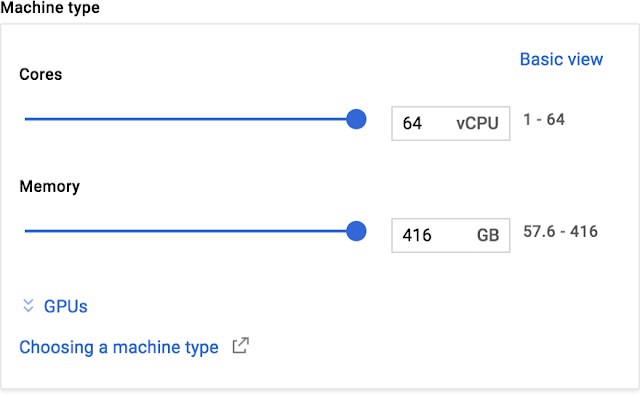
Today, we’re happy to announce general availability for our largest virtual machine shapes, including both predefined and custom machine types, with up to 64 virtual CPUs and 416 GB of memory.

64 vCPU machine types are available on our Haswell, Broadwell and Skylake (currently in Alpha) generation Intel processor host machines.

Tim Kelton, co-founder and Cloud Architect of Descartes Labs, an early adopter of our 64 vCPU machine types, had this to say:

“Recently we used the 64 vCPU instances during the building of both our global composite imagery layers and GeoVisual Search. In both cases, our parallel processing jobs needed tens of thousands of CPU hours to complete the task. The new 64 vCPU instances allow us to work across more satellite imagery scenes simultaneously on a single instance, dramatically speeding up our total processing times.”
The new 64 core machines are available for use today. If you’re new to GCP and want to give these larger virtual machines a try, it’s easy to get started with our $300 credit for 12 months.

Quelle: Google Cloud Platform

New innovations at Microsoft Build 2017: Helping developers achieve more

This post was authored by Scott Guthrie, Executive Vice President, Cloud and Enterprise Group, Microsoft.

More than ever, organizations are relying on developers to create breakthrough experiences. From start-ups to enterprises to government agencies, developers are creating new digital experiences that are redefining organizations to empower us all. The cloud is a key enabler for this era, bringing powerful, new technology to developers across the globe. But, the cloud also brings with it an unprecedented pace of technology releases and heightened expectations for developers to deliver breakthrough experiences all the time. It is this understanding that shapes how we build and deliver Microsoft Azure.

This morning, at Microsoft Build conference in Seattle, I talked about a core design principle for Azure – helping guide your success. Providing powerful tech and lots of new features is necessary, but not sufficient – it is how you achieve success with the cloud that matters most. The cloud is no longer about just who has more features; it’s about how successful you can be with the cloud. To deliver on this principle, we focus Azure innovation on your needs – making cutting edge technology approachable to all developers, and doing the heavy lifting to ensure Azure uniquely meets enterprise scenarios. Trust is one of our core values, and we will continue to lead the industry in our work on security, compliance, privacy, and responsibility. And, Azure is designed for your results, ensuring you have proven guidance, expert advice, and support. With these core tenets, every developer can be successful with Azure – it is this goal the Azure team focuses on delivering every day.

For you to be successful, the cloud and the development tools also must work seamlessly together, which is why we ensure great experiences across Azure and the Visual Studio family. Whether it is Visual Studio Enterprise, Visual Studio Team Services, Visual Studio Code – we are committed to providing the most productive developer experience end-to-end. To this end, today we announced the general availability of Visual Studio for Mac.

Visual Studio for Mac brings the integrated development environment (IDE) loved by millions to the Mac. Developers get a great IDE and a single environment to not only work on end-to-end solutions – from mobile and web apps to games – but also to integrate with and deploy to Azure. Whether you use C#, F#, .NET Core, ASP.NET Core, Xamarin or Unity, you'll get a best-in-class development environment, natively designed for the Mac.

Get started with Visual Studio for Mac: aka.ms/vs4mac

In complement to the IDE and the Azure Portal, we streamlined the experience of working with Azure from the command line. The new Azure Cloud Shell provides an authenticated, browser-based shell experience hosted in Azure, and is accessible from anywhere. Azure takes care of managing and updating Cloud Shell with commonly used command line tools and support for multiple popular programming languages, so that you can stay productive. Each Cloud Shell session provides a ready-to-use environment automatically synced to a $Home directory that is stored in Azure to enable persisting files such as your favorite automation scripts. Azure Cloud Shell maximizes versatility and productivity.

Data is a core part of every app and experience developers deliver today. I know that every developer has their database preferences – some love SQL Server, some love MySQL and PostgreSQL. Increasingly, developers want to move to database-as-a-service options, to maximize productivity. Azure is making it possible to develop using any database you prefer and use it as a service. Today, we announced a new service that seamlessly migrates third-party and SQL Server databases into Azure SQL Database with near-zero application downtime. Additionally, we announced the availability of both Azure Database for MySQL and Azure Database for PostgreSQL options in Azure, to ensure developers can use their favorite database with Azure. These new Azure database offerings run as a service and therefore provide high-availability, data protection and recovery, and scale without downtime – all built-in at no extra cost or configuration.

But, data isn’t just a core part of apps – increasingly it’s becoming the most mission critical aspect and fundamental to developing intelligent apps. As cloud-based applications increasingly scale, reach global users, and power AI experiences, we have come to a place where we need data at planet scale. Today, we announced Azure Cosmos DB, the first globally distributed, multi-model database service delivering turnkey global distribution with guaranteed uptime and millisecond latency at the 99th percentile. While most database services force you to choose between strong or eventual consistency, Azure Cosmos DB is the only globally distributed database service which offers five well-defined, intuitive consistency choices – so you can select just the right one for your app. These breakthrough capabilities are made possible with the foundational work of Leslie Lamport, Turing Award winner and Microsoft Researcher.

Azure Cosmos DB allows you to elastically scale across any number of geographical regions while delivering the industry’s only financially-backed database SLA across availability, latency, throughput, and consistency. As the first and only schema-agnostic database, Azure Cosmos DB automatically indexes data so you can perform blazing fast queries without having to deal with complexities of schema and index management or schema migration in a globally distributed setup. Customers including Jet.com are using Azure Cosmos DB to scale to 100 trillion transactions per day and growing, spanning multiple regions. Tapping into Azure Cosmos DB gives them planet scale, so they can keep focused on growing their business.

Beyond data, I continue to talk with developers about the challenges of modernizing existing applications. New container and microservice technologies have incredible benefit, but can require rewriting apps – a luxury most developers don’t have. We’ve been working hard to address this need with Azure. Today, we enable you to use your choice of container orchestration technology including Kubernetes, Docker Swarm, and Mesos DC/OS with Azure Container Service, which allows you flexibility to use containers exactly how you need.

Additionally, we’ve also been working hard to help you containerize existing .NET apps and deploy them to Azure. Today we’re extending this scenario to Azure Service Fabric. Service Fabric is a powerful microservices platform that supports the ability to run both Windows- and Linux-based containers. Today, we are updating Service Fabric to natively support Docker Compose for deploying multi-container applications to Service Fabric. This makes it easy to build microservice-based solutions that can leverage the best of the Windows ecosystem and the best of the Linux-based ecosystem – all while easily using the existing code you have. We’re announcing the general availability of container support for Windows Server containers in Azure Service Fabric with the 5.6 runtime and 2.6 SDK release. We’re also previewing Service Fabric support for Docker Compose for deploying containerized apps. And, with the Visual Studio Team Services integration, you can realize continuous integration and deployment of these containerized application integrations.

Beyond these advancements, we are also continuing to help you innovate with serverless computing – event-driven programming in a fully managed environment – using Azure Functions and Azure Logic Apps. Microsoft’s serverless offering uniquely includes rich tooling support with Visual Studio, seamless workflow and systems integrations, and built-in DevOps with Visual Studio Team Services, GitHub, and Bitbucket. Today, I’m excited to announce the next step that provides the most productive serverless development experience on the planet. Azure Functions Visual Studio tooling preview, available as a Visual Studio 2017 extension, creates an integrated developer experience. These tools allow you to integrate Azure Functions development seamlessly into development flows: leveraging third-party extensions, testing frameworks, and continuous integration systems. Azure Application Insights support for Azure Functions preview provides better intelligence about Azure Functions code, allowing teams to measure performance, detect issues, and diagnose the source of the problem with serverless apps. Also, we know you want the flexibility to deploy your code everywhere. Azure Functions Runtime preview extends the innovations in Azure Functions to on-premises or anywhere outside of the Azure cloud. Developers can leverage the serverless programming model and bindings on-premises while future-proofing their code assets. Together, these capabilities provide an unmatched developer experience, helping every developer successfully and efficiently build serverless solutions.

Developer success is, of course, founded on technology, but just as important is business growth around these developer solutions. This is particularly true of companies providing SaaS solutions. Azure provides a fantastic cloud platform for SaaS-based offerings, but beyond this, Microsoft can also help these SaaS providers grow their business. We recently announced that Office 365 has reached 100 million monthly active users. Azure provides the easiest way for SaaS solutions to integrate with Office 365 and reach those 100 million active users and grow their business. By integrating with Azure Active Directory, Microsoft Power BI, and Microsoft PowerApps, SaaS providers can create a seamless, integrated experience for their customers, making them even more valuable. One of the key capabilities Microsoft has is the largest global sales force. For SaaS providers built on Azure, we will now enable them to publish PowerApps and Flow connectors that Office 365 enterprise customers can use at no extra charge, to integrate the solutions into their productivity workflow. Also for those providers using Microsoft AppSource and who are qualified for our co-sell program, the Microsoft sales force will be compensated to help sell these SaaS solutions into the accounts they cover. The combination of these investments for SaaS companies provide incredible opportunity to grow their business, and give yet another example of how we’re working hard to guide every developer to success.

In addition to these exciting advancements I talked about onstage, we rolled out even more innovation across our developer tooling and cloud today – all with the aim of helping every developer create transformative experiences with Azure:

NET Core 2.0 Preview allows developers to use .NET Standard 2.0’s expanded set of uniform APIs – including XML, Serialization, Networking, IO, and thousands more –  to write once and run on multiple .NET runtimes (.NET Framework, .NET Core, Xamarin and Universal Windows Platform).
ASP.NET Core 2.0 Preview’s new capabilities include Razor Pages, a lightweight syntax for combining server code with HTML, streamlined startup, even more performance improvements – and ASP.NET Core 2.0 web apps can now leverage automatic Azure diagnostics and monitoring, without requiring developers to write any code or republish the application.
Visual Studio 2017 version 15.2 delivers bug fixes and new functionality that was not previously available in the past releases, including the return of Python workload and Data Science workload (includes R, Python, and F#) and added support for Typescript 2.2.
Visual Studio 2017 version 15.3 Preview includes bug fixes, improvements in accessibility, and new functionality; most notably .NET Core 2.0 preview support, Live Unit Testing for .NET Core projects, more C++ standard conformance, enhancement in continuous delivery for ASP.NET and ASP.NET Core projects targeting an Azure App Services, and improvements in container development tools.
Visual Studio Snapshot Debugger, our new cloud debugging experience, gives developers deep insight into cloud production code behavior at the time of an exception, without writing extensive logging statements or exception handling code.
Azure Batch Rendering offers an easy way to help scale rendering jobs using market leading applications like Autodesk 3ds Max and Maya.  Teaming up with Autodesk, Azure is the first public cloud to offer this seamless integration across, client application, licensing, orchestration and infrastructure.
Low-priority Batch for Linux and Windows VMs introduces access to surplus capacity using Azure Batch. At discounts up to 80%, Low-priority Batch increases the flexibility and cost-control for large-scale workloads, allowing you to mix and match low-priority and on-demand VMs.
New capabilities for VM maintenance and availability, including Scheduled events and instance metadata API General Availability. With this new feature, applications running in a VM can learn about upcoming updates. In the rare case that maintenance requires VM reboots or redeploy, we now offer the capability for customers to select a timeframe within a 30-day window to schedule the maintenance. We can now also detect and predict some imminent hardware failures, and perform VM live migration to another server to avoid disruption to you.
Storage Service Encryption for Azure Files on all available redundancy types (LRS and GRS) at no additional cost, that ensures that all data being stored in Azure Files is encrypted using AES-256.
New Azure Service Catalog to enable organizations to package and curate managed applications approved for an organization’s use.
Managed disks support for Azure DevTest Labs including VM OS disks, data disks, and custom images that makes storage and cost management easier.
Azure Functions with Common Data Service is available in preview, to create and use Azure Functions with Common Data Service (CDS) to extend the functionality of apps.
Azure SQL Database enhancements including Managed Instance private preview, which offers SQL Server instance-level compatibility like VNET, SQL Agent, 3-part names, and CDC, making it even easier for you to migrate SQL Server apps to Azure SQL Database. We also announced preview coming soon for Graph support and General Availability for Threat Detection.
General Availability of Azure HDInsight 3.6 backed by our enterprise grade SLA. HDInsight 3.6 brings the latest versions of various open source components in Apache Hadoop & Spark eco-system to the cloud, allowing you to deploy them easily and run them reliably on an enterprise grade platform.
New previews of Azure Accelerated Network to reduce network latency and VM overhead by off-loading the VM network interface to an FPGA.
CDN Enhanced Integrations with App Services and Storage so you can add CDN to your Azure web app service or Azure storage account without leaving the respective portal experience. 

Quelle: Azure

Azure Cosmos DB: The industry’s first globally-distributed, multi-model database service

Today, we’re excited to announce the general availability of Azure Cosmos DB. Azure Cosmos DB is the first globally-distributed data service that lets you to elastically scale throughput and storage across any number of geographical regions while guaranteeing low latency, high availability and consistency – backed by the most comprehensive SLAs in the industry. Azure Cosmos DB is built to power today’s IoT and mobile apps, and tomorrow’s AI-hungry future.

It is the first cloud database to natively support a multitude of data models and popular query APIs, is built on a novel database engine capable of ingesting sustained volumes of data and provides blazing-fast queries – all without having to deal with schema or index management. And it is the first cloud database to offer five well-defined consistency models so you can choose just the right one for your app.

To create these five consistency levels, and build many of the capabilities within Azure Cosmos DB, we married decades-worth of distributed systems and database research with world-class engineering rigor. You can learn more about the research we implemented in Azure Cosmos DB by watching this video from Turing Award-winning, Microsoft Researcher, distributed systems giant and our inspiration, Dr. Leslie Lamport.

Azure Cosmos DB – Transforming Cloud-based App Development

We believe that Azure Cosmos DB fundamentally transforms the way developers will build cloud-based apps:

1. Build globally distributed apps, more easily

Azure Cosmos DB makes global distribution, turnkey. With a single click, you can add/remove any number of Azure regions to your Azure Cosmos DB database, anytime. Azure Cosmos DB will seamlessly replicate your data wherever your users are.

2. Elastically scale throughput and storage, at any time, on demand, around the globe

Azure Cosmos DB allows your application to elastically scale throughput and storage on demand, worldwide. You can elastically scale up from 1000s to 100s of millions of requests/sec around the globe, with a single API call and pay only for the throughput (and storage) you need.  Azure Cosmos DB is the only cloud database which allows you to scale throughput at both second and minute granularities. This in turn helps you to predictably deal with any unexpected spikes in your workloads without having to over-provision for the peak.

“We are using Azure Cosmos DB for our transaction processing systems because it is capable of handling an extremely high volume of writes per second with predictable consistency, which gives our systems the high performance and reliability our customers demand. Our ability to scale throughput for each collection gives us the control we need to fine tune performance and cost to provide the highest value to our customers.”

– Andrew Hochstetler, Senior Director Application Architecture, Blackboard.

3. Build highly responsive apps

Azure Cosmos DB guarantees single-digit millisecond latencies at the 99th percentile to your app, anywhere in the world. The write-optimized, log structured and latch-free database engine, which is at the core of Azure Cosmos DB, enables sustained ingestions of data and blazing-fast queries. Users will love how responsive your app is!

4. Build always “on” apps

Azure Cosmos DB makes sure your app is always “on,” automatically. We guarantee high availability of your data in every region as well as, across all regions. Its multi-homing capabilities allow both your application and your data to remain highly available even in a case of regional disasters, without requiring complex redeployment of your app.

“The Xpander team within Microsoft develops one of the key services that powers a number of critical flows across Windows and Xbox, as such they have extremely high availability goals, strict latency requirements, distributed in key data centers across the world.  Since the migration from our previous storage solution to Azure Cosmos DB we have seen a drastic increase in overall reliability, significantly improved performance characteristics and a drastic reduction in something previously called “Micro-outage timeouts” that would affect 0.001% of transactions for <1 minute throughout any given day.”

– Cary Mitchell, Principal Software Engineering Lead, Xpander

5. Choose the consistency model that works best for your app

With Azure Cosmos DB, developers do not have to settle for extreme consistency choices (strong vs. eventual consistency). It offers 5 well-defined consistency choices – strong, bounded-staleness, session, consistent-prefix and eventual – so you can select the consistency model that is just right for your app.

“Johnson Controls is a global company, with a presence on all seven continents. Having a global database like Azure Cosmos DB available makes it dramatically easier to build applications to support our customers and equipment wherever they may be. Azure Cosmos DB gives us the low latency we need, and with fine-grained control over consistency we can make the right choices for our application for performance. Microsoft’s got some of the best folks in the world on their team, and we know that we can count on them to meet their very aggressive SLAs.”

– Erik Paulson, Data Engineer, JCI Connected Offerings

6. Iterate your app quickly without worrying of schemas or indexes

Keeping database schema and indexes in-sync with an application’s schema is especially painful for globally distributed apps. With Azure Cosmos DB, you no longer need to deal with schemas or indexes. The database engine is fully schema-agnostic.  Since no schema and index management is required you also don’t have to worry about application downtime while migrating schemas. We automatically index all the data – no schema, no indexes required – and serve blazing-fast queries.

“Citrix switched to Azure Cosmos DB to support the Citrix Identity Platform which enables single sign-on for more than 400,000 organizations and 100 million individuals globally. Azure Cosmos DB helped Citrix remove a primary issue faced by the development team, where a previous NoSQL database required indexing and constant code modifications. Azure Cosmos DB now automatically indexes all the properties of every record it ingests, by default.”

– Tom Kludy, Principal Architect, Citrix

7. Use the right data model for your app

The database engine of Azure Cosmos DB is designed to natively support nearly any data model. With today’s launch, we are enabling; key-value, document, and graph, but the engine is designed to be extensible and efficiently support newer types of data models. Stay tuned.

8. Use the APIs of your choice

Our goal is to help you to write globally distributed apps, more easily, using the tools and APIs you are already familiar with.  Azure Cosmos DB’s database engine natively supports DocumentDB’s SQL dialect, MongoDB API, Gremlin (graph) API, and Azure Table Storage APIs. In the future, we will support other popular data access APIs natively, giving you even more choice and flexibility.

9. Industry-leading, comprehensive SLAs

Azure Cosmos DB is the first and only globally distributed database service in the industry to offer financially-backed comprehensive SLAs. They cover: high-availability, low latency at the 99th percentile, consistency and throughput.

“When ASOS evaluated the market for our future NoSQL platform, we looked at multiple options, however we selected Azure Cosmos DB because we were impressed with it on many levels. Firstly, it’s a managed database-as-a-service which was extremely appealing – we don’t think as a retailer there’s value in running databases, the value is in the propositions you build using them! Obviously this only plays out if the availability and the SLA’s around that service are enterprise grade. Secondly, our customers were global so the ability to simply replicate the data globally for performance as well as for resiliency was key. Finally, ASOS is running a micro-service architecture and naturally each service has different workload and performance characteristics, so the ability to vary the consistency levels without having to move to a different technology gives us a lot of benefits. Azure Cosmos DB is already an important part of the ASOS architecture, and looks increasingly to be core to our proposition.”

– Dave Green, Enterprise Application Architect, ASOS

A Brief History of Cosmos

Azure Cosmos DB started as “Project Florence” in 2010 to address developer the pain-points faced by large scale applications inside Microsoft. Observing that the challenges of building globally distributed apps are not a problem unique to Microsoft, in 2015 we made the first generation of this technology available to Azure developers in the form of Azure DocumentDB. Since that time, we’ve added new features and introduced significant new capabilities.  Azure Cosmos DB is the result.  It is the next big leap in globally distributed, at scale, cloud databases. As a part of this release of Azure Cosmos DB, DocumentDB customers, with their data, are automatically Azure Cosmos DB customers. The transition is seamless and they now have access to the new breakthrough system and capabilities offered by Azure Cosmos DB.

For a technical overview, please check out the first of a series of blog posts you can expect from me and my team here. This post also includes a longer version of the interview with Dr. Leslie Lamport titled Foundations of Azure Cosmos DB.

With Azure Cosmos DB, our mission was to enable the world’s developers to build amazingly powerful, cosmos-scale apps, more easily. Today marks the Big Bang moment for us in the Azure Cosmos DB team and we’re excited to share it with all of you—our developers and customers around the world.
Please try out #AzureCosmosDB and let us know what you think!  We are excited to see what you build.

— Your friends at Azure Cosmos DB (@AzureCosmosDB)
Quelle: Azure