A Federal Judge Ordered Uber To Return Documents Allegedly Stolen From Google's Waymo
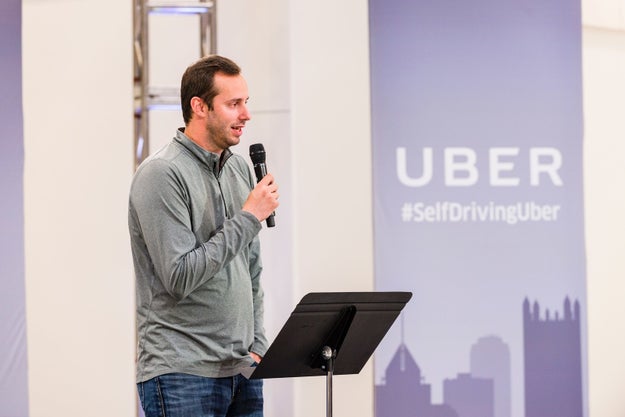
Anthony Levandowski
Afp / AFP / Getty Images
A federal judge has ordered Uber to return any driverless car documents its employees allegedly stolen from Google's Waymo by May 31 as part of a bitter trade secrets lawsuit between the two tech giants, according to an order unsealed by the court Monday morning. California judge William Alsup also barred a key engineer from working on a portion of Uber's self-driving car program.
Waymo had requested an injunction to halt or limit Uber's self-driving program pending a trial as part of its lawsuit alleging the ride-hail giant is using stolen trade secrets from Alphabet's autonomous vehicle unit for its own benefit. The court order on Monday requires Uber to produce a comprehensive log of all communications that Anthony Levandowski – the ex-Google engineer who now works at Uber and is at the center of the lawsuit – had about LiDAR, the technology at issue in the case. LiDAR refers to “light detection and ranging” systems; It uses rapid pulses of laser light to help self-driving cars measure distance and navigate the world around them.
“Competition should be fueled by innovation in the labs and on the roads, not through unlawful actions. We welcome the order to prohibit Uber’s use of stolen documents containing trade secrets developed by Waymo through years of research, and to formally bar Mr Levandowski from working on the technology,” a Waymo spokesperson said in a statement. “The court has also granted Waymo expedited discovery and we will use this to further protect our work and hold Uber fully responsible for its misconduct.”
Uber had already moved Levandowski down from leadership and into a lesser role, and said it would not allow him to work on LiDAR-related work during the case. The order stopped short of halting Uber's self-driving research or pilot programs. Uber's self-driving cars on the road now use LiDAR technology developed by the company Velodyne, rather than a system developed by the ride-hail giant in-house.
“We are pleased with the court's ruling that Uber can continue building and utilizing all of its self-driving technology, including our innovation around LiDAR,” an Uber spokesperson said in a statement. “We look forward to moving toward trial and continuing to demonstrate that our technology has been built independently from the ground up.”
On Thursday, Alsup asked federal prosecutors to investigate Uber's self-driving program and one of its top engineers for potential theft of trade secrets.
Waymo had requested that the judge bar Uber from using its trade secrets and prevent Levandowski from working on the self-driving project entirely. On April 27, Uber preempted an injunction decision by moving Levandowski out of a leadership position in its self-driving program and into a lesser role. The lawsuit centers around laser technology called LiDAR (Light Detection And Ranging), which helps self-driving cars see. Uber has said its own technology is “fundamentally different” from Waymo’s designs. But Waymo insists that Uber’s work has been informed by its own trade secrets. Levandowski's new role absolved him from any official involvement with LiDAR.
Uber's self-driving program got off the ground in February 2015, after the company poached dozens of researchers from Carnegie Mellon University's robotics unit. It has since lost many of those engineers to newer upstarts, including Aurora Innovation (started by the former leaders of Google and Tesla's respective self-driving programs) and Argo AI, which is backed by Ford.
The ride-hail giant has since launched pilot programs in Pittsburgh, Pennsylvania, Arizona and San Francisco. While its program is still in its early stages – in March, some of its cars in Arizona still needed human intervention about once per mile, according to internal metrics obtained by BuzzFeed – its program has made a very public splash.
Google's spinoff Waymo, on the other hand, began working on self-driving technology in 2009 and just launched a public pilot program in Phoenix, Arizona in April to chauffeur people around on a daily basis in its own cars. (The company has also invited many people over the years to ride in its vehicles, but this is its first pilot of this kind.)
At a court hearing last week about Waymo's request for an injunction against Uber, Alsup told Waymo it had one of the strongest bodies of evidence he had seen in his career. But while it had shown much evidence indicating Levandowski downloaded files before leaving the Google program, it but hadn't yet convinced him that Uber had benefitted from that information.
“All that has been proven is he downloaded 14,000 files. I’ve given you lots of discovery and so far you don’t have a smoking gun,” Alsup said.
In the order unsealed Monday, Alsup appeared to be more convinced.
“The bottom line is the evidence indicates that Uber hired Levandowski even though it knew or should have known that he possessed over 14,000 confidential Waymo files likely containing Waymo’s intellectual property; that at least some information from those files, if not the files themselves, has seeped into Uber’s own LiDAR development efforts,” he wrote.
Quelle: <a href="A Federal Judge Ordered Uber To Return Documents Allegedly Stolen From Google's Waymo“>BuzzFeed








