Introducing Mirantis Cloud Platform
The post Introducing Mirantis Cloud Platform appeared first on Mirantis | Pure Play Open Cloud.
The post Introducing Mirantis Cloud Platform appeared first on Mirantis | Pure Play Open Cloud.
Quelle: Mirantis
The post Introducing Mirantis Cloud Platform appeared first on Mirantis | Pure Play Open Cloud.
The post Introducing Mirantis Cloud Platform appeared first on Mirantis | Pure Play Open Cloud.
Quelle: Mirantis



Sadly, we&039;re still very far off from commuting to work in our hovering cars. Kitty Hawk says that this version is designed only to fly about 15 feet above the surface of water. But it still looks pretty damn cool. Here&039;s a video of a person in a nice boat getting totally one-upped by her friend on a flying jet ski.
The New York Times writes that the Flyer&039;s eight propellers make it as loud as a speedboat and that the vehicle weighs about 220 pounds.
Named after the site where Orville and Wilbur Wright tested their first airplanes, Kitty Hawk says on its website its mission is “to make the dream of personal flight a reality.”
Kitty Hawk also says the flyer is completely electric and legal to fly in “uncongested areas under the Ultralight category of FAA regulations.” You won&039;t need a pilot&039;s license to fly one, according to the company, though the guy flying machine in the video is an aerospace engineer, according to the Times.
It&039;s unclear what protects people from a potential crash. What happens when you run out of battery and hit the surface of the water? What happens if you fly over land (you know someone will)? Kitty Hawk declined to comment.

The company hasn&039;t announced the exact date of its commercial release. If you&039;re ready to spend your life&039;s savings on a Flyer, keep in mind that the retail version may not look anything like what you saw in the video. Kitty Hawk writes in its FAQ, “The go-to-market Flyer will have a different design than the prototype Flyer that appears in our April 2017 photos and videos.”
In the meantime, you can become a three-year Kitty Hawk Member for $100, which will get you $2,000 off the retail price whenever you can buy a Flyer, and access to “our flight simulator, flight demonstrations, and events where a select few will get the chance to ride the Flyer,” Kitty Hawk writes on its website.
Quelle: <a href="This Water Copter Looks Very Cool And Very Dangerous“>BuzzFeed
Starting today, Amazon RDS enables you to use AWS Identity and Access Management (IAM) to manage database access for Amazon RDS for MySQL DB instances and Amazon Aurora DB clusters. Database administrators can now associate database users with IAM users and roles. By using IAM, you can manage user access to all AWS resources from a single location, avoiding issues caused by permissions that are out of sync on different AWS resources.
Quelle: aws.amazon.com
When you deploy an application to OpenShift, by default it will be run with an assigned user ID unique to the project the application is running in. This user ID will override whatever user ID a Docker-formatted image may declare as the user it should be run as.
Running applications under a project as a user ID different to applications running in any other project is part of the multi-layered approach to security used in OpenShift. In this post, we will delve more into the topic of user IDs, as well as what changes would need to be made to the Jupyter Notebook image being used to enable it to run as the user ID OpenShift assigns to it.
Quelle: OpenShift
This post is meant to be a braindump – to present a common understanding of the different software development/consumption models our customers have.
Quelle: OpenShift
When you are deploying an application from the OpenShift web console you have the choice of deploying an image hosted on an external image registry, or an existing image which was built within the OpenShift cluster using either the Docker or Source build strategies. This is done from Deploy Image after having selected Add to project in the web console.
Quelle: OpenShift

At the NAB Show 2017 Conference this week, we’ll be reprising our session “Securing the Making of the Next Hollywood Blockbuster” (Las Vegas | April 25, 2017 | 1:30 PM – 2:00 PM in the Cybersecurity & Content Protection Pavilion – Booth C3830CS – Central Hall). Azure’s very own Joel Sloss will regale the audience on the transition to secure movie production in the cloud, made possible by Microsoft Azure and a cadre of ISV partners who’ve ported their solutions to the platform.
Content comes in many forms and must be stored in many places, including on servers, workstations, mobile storage, archives, etc., which presents a massive security challenge. Securing this ever-moving data on top of the added challenge of properly handling personal information such as health records, contract details, and paystubs, strains an already complicated data governance situation.
In this session, we’ll look at an end-to-end workflow leveraging Azure and the combined wizardry of Avid, 5th Kind, Contractlogix, Docusign, MarkLogic, and SyncOnSet. Lulu Zezza, Physical Production Executive and the driving force behind the end-to-end workflow, will be co-presenting with Mr. Sloss. She noted that, “Moving to the cloud is the best way to implement security controls across so many different physical and logical environments, locations, and data types. We have people working all over the world, for different companies, using different systems, all contributing to the same production. In the past, it’s been like a free-for-all, with contractors getting access to things they shouldn’t, information being duplicated and stored in the wrong places, and sensitive content left out in the open.”
The new digital workflow enables a secure “script-to-screen” experience for the management of both production data and the crew’s personal HR information, to which new global privacy standards apply. Metadata captured from contracts, scripts, and camera files is associated with filming days, scenes and takes recorded, and later to the final edit of the film, reducing the need for document sharing and film screenings. Plus communications are kept protected and confidential. It’s a whole new way to make movies.
Join Joel at his session where you’ll hear about:
Architectural considerations for multi-domain cloud environments
Secure access and device management for BYOD users
Content protection and privacy in connected and disconnected networks
Learn more information about Microsoft’s activities at NAB Show 2017.
Quelle: Azure
By Sowmya Kannan, Technical Curriculum Developer, Google Cloud Platform
A multi-cloud strategy can help organizations leverage strengths of different cloud providers and spread critical workloads. For example, maybe you have an existing application on AWS but want to use Google’s powerful APIs for Vision, Cloud Video Intelligence and Data Loss Prevention, or its big data and machine learning capabilities to analyze and derive insights from your data.
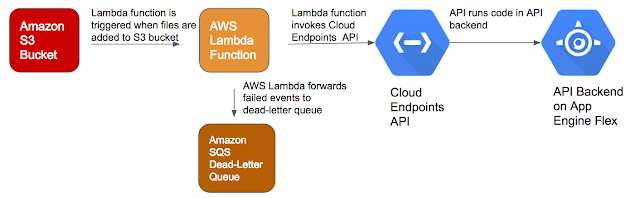
One pattern (among many) to integrate workloads on Google Cloud Platform (GCP) and Amazon Web Services (AWS) is to use Google Cloud Endpoints and AWS Lambda. The pattern has the following architecture.
Cloud Endpoints enables you to develop, deploy, protect and monitor APIs based on the OpenAPI specification. Further, the API for your application can run on backends such as App Engine, Google Container Engine or Compute Engine.
AWS Lambda can automatically run code in response to events in other AWS services. For example, you can configure an AWS Lambda function to fire when an object is added to an Amazon S3 bucket, when a notification comes into an Amazon SNS topic or to process records in a DynamoDB Stream.
In this blog, we’ll create a Cloud Endpoints API and invoke it from an AWS Lambda function. You can download the complete source code for this sample from GitHub. Read on to learn how to implement this solution.
Setting up Cloud Endpoints
The first step toward implementing the solution is to deploy Cloud Endpoints APIs on App Engine flexible environment. GCP documentation contains excellent Quick Start topics with information to deploy APIs on App Engine flexible environment, Container Engine and more.
Create a GCP Project, if you don’t already have one:
Use the GCP Console to create a new GCP project and an App Engine application.
When prompted, select the region where you want to run your App Engine application located and then enable billing.
Note the ID of your project, because you’ll need it later.
Activate Google Cloud Shell
Retrieving source code
In Google Cloud Shell:
Clone the GitHub repository with source code for the example.
Change directory to blogs/endpointslambda/aeflex-endpoints/
Launch the code editor to view source code.
This example uses Python to implement the API backend.
Implementing application code
Next, you’ll need to implement code for your API backend. The aeflex-endpoints example is a Flask application. The main.py file defines the application code that should be executed when the processmessage endpoint is invoked.
@app.route(‘/processmessage’, methods=[‘POST’])
def process():
“””Process messages with information about S3 objects”””
message = request.get_json().get(‘inputMessage’, ”)
# add other processing as needed
# for example, add event to PubSub or
# download object using presigned URL, save in Cloud Storage, invoke ML APIs
return jsonify({‘In app code for endpoint, received message': message})
Configuring and deploying the Cloud Endpoints API
Use the OpenAPI specification to define your API. In the aeflex-endpoints example, the openapi.yaml file contains the OpenAPI specification for the API. For more information about each field, see documentation about the Swagger object.
The openapi.yaml file declares that the host that will be serving the API.
host: “echo-api.endpoints.aeflex-endpoints.cloud.goog”
The /processmessage endpoint is defined in the paths section. The inputMessage parameter contains the details about the Amazon S3 object to be processed.
paths:
# This section configures the processmessage endpoint.
“/processmessage”:
post:
description: “Process the given message.”
operationId: “processmessage”
produces:
– “application/json”
responses:
200:
description: “Return a success response”
schema:
$ref: “#/definitions/successMessage”
parameters:
– description: “Message to process”
in: body
name: inputMessage
required: true
schema:
$ref: “#/definitions/inputMessage”
security:
– api_key: []
definitions:
successMessage:
properties:
message:
type: string
inputMessage:
# This section contains information about the S3 bucket and object to be processed.
properties:
Bucket:
type: string
ObjectKey:
type: string
ContentType:
type: string
ContentLength:
type: integer
ETag:
type: string
PresignedUrl:
type: string
Then, deploy the Open API specification:
gcloud service-management deploy openapi.yaml
This command returns the following information about the deployed Open API specification:
Service Configuration [2017-03-05r2] uploaded for service
“echo-api.endpoints.aeflex-endpoints.cloud.goog”
Update the service configuration in the app.yaml file:
endpoints_api_service:
# The following values are to be replaced by information from the output of
# ‘gcloud service-management deploy openapi.yaml’ command.
name: echo-api.endpoints.aeflex-endpoints.cloud.goog
config_id: 2017-03-05r2
Deploy the API:
gcloud app deploy
Create an API Key to Authenticate Clients:
In the GCP Console, on the Products & services menu, click API Manager > Credentials.
Click Create Credentials > API key. Note the API key.
Setting up the AWS Lambda function
This section describes how to set up and trigger a Lambda function when a file is uploaded to an Amazon S3 bucket. In this example, the Lambda function is written in Python. The complete source code for the Lambda function is available in
blogs/endpointslambda/lambdafunctioninline.py.
Creating the S3 Bucket for your files
In the S3 Management Console in AWS, create an S3 bucket called images-bucket-rawdata. Your Lambda function will be triggered when files are added to this bucket.
Creating an IAM Role
In the IAM Management Console, create an IAM role that has the permissions for the Lambda function to access the S3 bucket, SQS queue and CloudWatch logs as follows:
In the IAM Management Console, click Roles in the navigation pane.
Create a new role called LambdaExecRole.
Select AWS Lambda Role Type, and then select the following policies:
AWSLambdaExecute: This policy gives the Lambda function Put and Get access to S3 and full access to CloudWatch Logs.
AmazonSQSFullAccess: This policy gives the Lambda function permissions to send messages to the dead-letter queue (DLQ).
Review the settings and create the role.
Creating an SQS queue
In the SQS Management Console, create an SQS queue called IntegrationDLQ that will act as the dead-letter queue for your Lambda function. AWS Lambda automatically retries failed executions for asynchronous invocations. In addition, you can configure Lambda to forward payloads that were not processed to a dead-letter queue.
Creating a Lambda function in the AWS Console
In the Lambda Management Console, create a Lambda function as follows:
In the Select blueprint page, use the s3-get-object-python blueprint.
In the Configure triggers page, specify the following:
Bucket: images-bucket-rawdata
Event-type: Object-Created (All)
Enable the trigger.
In the Configure Function page, specify the following:
Name: CallEndpoint
Runtime: Python 2.7
Code entry type: Edit code inline
Environment variable key: ENDPOINT_API_KEY
Environment variable: . Note: For production environments, consider securing the API key using encryption helpers in AWS.
Handler: lambda_function.lambda_handler
Role: Choose an existing role
Existing role: LambdaExecRole (that you created earlier)
In Advanced settings, DLQ resource: IntegrationDLQ
In the inline code editor for the Lambda function, replace the original code with the following code. The Lambda function retrieves the bucket and object information from the event, retrieves object metadata, generates a pre-signed url for the object, and finally invokes the Cloud Endpoints API.
from __future__ import print_function
import boto3
import json
import os
import urllib
import urllib2
#print(‘Loading function’)
s3 = boto3.client(‘s3′)
endpoint_api_key = os.environ[‘ENDPOINT_API_KEY’]
endpoint_url = “https://aeflex-endpoints.appspot.com/processmessage”
def lambda_handler(event, context):
print(“Received event: ” + json.dumps(event, indent=2))
# Get the object information from the event
bucket = event[‘Records’][0][‘s3′][‘bucket’][‘name’]
object_key = urllib.unquote_plus(event[‘Records’][0][‘s3′][‘object’][‘key’].encode(‘utf8′))
try:
# Retrieve object metadata
response = s3.head_object(Bucket=bucket, Key=object_key)
# Generate pre-signed URL for object
presigned_url = s3.generate_presigned_url(‘get_object’, Params = {‘Bucket': bucket, ‘Key': object_key}, ExpiresIn = 3600)
data = {“inputMessage”: {
“Bucket”: bucket,
“ObjectKey”: object_key,
“ContentType”: response[‘ContentType’],
“ContentLength”: response[‘ContentLength’],
“ETag”: response[‘ETag’],
“PresignedUrl”: presigned_url
}
}
headers = {“Content-Type”: “application/json”,
“x-api-key”: endpoint_api_key
}
# Invoke Cloud Endpoints API
request = urllib2.Request(endpoint_url, data = json.dumps(data), headers = headers)
response = urllib2.urlopen(request)
print(‘Response text: {} nResponse status: {}’.format(response.read(), response.getcode()))
return response.getcode()
except Exception as e:
print(e)
print(‘Error integrating lambda function with endpoint for the object {} in bucket {}’.format(object_key, bucket))
raise e
Review the Lambda function configuration and create the function.
Testing the integration
Now for the moment of truth! To test the integration between your AWS Lambda function and Cloud Endpoints API, follow the steps below:
In the AWS S3 Management Console, upload a file to images-bucket-rawdata.
In the Lambda Management Console, navigate to the CallEndpoint function, and view the Monitoring tab. The CloudWatch graphs show that the function was invoked successfully.
Click View Logs in CloudWatch and view the details for the function’s log stream. The log shows that the Lambda function received a success response code (200) from the API as well as details about the S3 event that the API received from the Lambda function.
You’ve now successfully integrated AWS Lambda with Cloud Endpoints to perform real-time processing of files uploaded to your S3 bucket! This is just one of the many patterns you can use to create a multi-cloud environment with GCP. Stay tuned for other examples down the road.
Quelle: Google Cloud Platform

Pete Ryan for BuzzFeed News
Last month, after Republican leadership failed to bring its Obamacare replacement bill to a House vote, the television writer Justin Halpern spotted an easy opportunity to crack a joke. He doctored the same-day New York Times story, adding a paragraph that (completely inaccurately) described Speaker of the House Paul Ryan leaving “the White House in defeat … Within moments, the muffled sound of Papa Roach's &039;Last Resort&039; were heard blaring from inside the car as it drove away.” And then he tweeted it.
It was a tossed-off prank; Halpern told BuzzFeed News the whole thing might have taken him two minutes.
But, like the 2000 song it references, the joke was a massive hit.
In addition to being retweeted nearly 20,000 times, often by people (including journalists) who believed the screenshot to be authentic, the tweet prompted a spate of piggybacking jokes and, ultimately, a game response from the band itself:
(A spokesperson for Ryan declined to comment about Papa Roach.)
Seventeen years after its biggest song, a band that Spin described at the time as “the latest in midline nu-metal minstrelsy” had landed, mirthfully, at the center of the news cycle. What is it about this song that caused such an intense reaction? And what is so damn funny about Paul Ryan listening to “Last Resort”?
“It&039;s the perfect joke, that song,” Halpern told BuzzFeed News. “The punchline hits the moment you press play. It&039;s a comedy writer&039;s dream.”
The punchline, of course, is the notoriously melodramatic opening couplet — “CUT MY LIFE INTO PIECES / THIS IS MY LAST RESORT” — which singer Jacoby Shaddix screams a capella, in a verge-of-tears staccato.
And though it leads into a song about a very unfunny subject — suicide — the lines, in all of their uncomfortably emotional glory, have recently become a kind of joking social media mantra of exasperation, sadness, and defeat. Used alike by devastated sports fans, cackling Keksters, Obama nostalgists, and rankled cultural commentators, the song serves now as an ironized shorthand for letting something get under your skin, for caring too much, for losing and then getting into your feelings. If, as Amanda Hess wrote recently, none of us are safe from getting “owned,” “Last Resort” is the anthem of the owned-but-owning-it, the internet loser&039;s performative cry of pain, the cuck&039;s winking lament.
“Last Resort” is the anthem of the owned-but-owning it, the internet loser&039;s performative cry of pain, the cuck&039;s winking lament.
“Last Resort” is a gift that keeps giving social media new ways to laugh. But to understand why it&039;s been so durable, it&039;s useful to remember just how big a smash “Last Resort” was when it was just a rock song — back when rock songs could be cultural touchstones.
The song started as an idle classical scale plinked on a piano by the band&039;s bassist Tobin Esperance in early 1999, in the Sacramento house where Papa Roach practiced. “I was like, that&039;s fucking sick, let&039;s put that on guitar,” Shaddix recalled to BuzzFeed News. They did, and it turned into the song&039;s instantly memorable power metal riff. Inspired, Shaddix wrote the “stream of consciousness” lyrics, about a friend who attempted suicide.
“From the moment we wrote it, we were like, this could be the song that gets us a record deal,” Shaddix said.
It did more than that: On the strength of “Last Resort,” Infest, the band&039;s major-label debut, sold 7 million copies worldwide. And the “Last Resort” video became a staple on MTV, to the point that the network eventually invited the band on Total Request Live. Indeed, that ubiquitous video, which cuts between overhead fisheye shots of the band and Nan Goldin-esque portraits of sullen teens in their late-’90s suburban bedrooms, may be as responsible as the lyrics for the song being so closely associated with teenage over-emoting. For people listening to popular music at the turn of the millennium, “Last Resort” and its vision of teenage angst were inescapable.
Eventually, the song receded into rock radio afternoon rotation. And by the mid-2000s, rap-rock and nu-metal — two genres with which Papa Roach were closely associated — had become music-world punchlines. That, combined with the infamous opening line and the humorless video, made it a natural target for the Weird Al-style lyrical interpolations that were popular on message boards like 4chan and Something Awful in the late aughts. According to KnowYourMeme, the first “Last Resort” meme to break out of the message boards was the still-popular “Cut my life into pizza / This is my plastic fork.” (Others included “Cut my life into peaches / This is my last fruit tart” and “Cut my life into beaches / This is my last resort.”)
Shaddix took it in stride. “That shit’s genius,” he told BuzzFeed News. “I even came up with one. I almost went through a divorce, so, &039;Cut my wife into pieces, this is my last divorce.&039; Thankfully, we worked it out.”
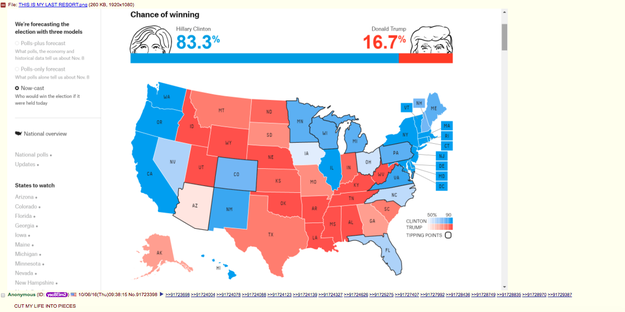
As much internet joke-making moved onto Twitter, users began to post the lyrics next to any old thing: An image of someone famous with their mouth open, a screenshot of Shaquille O&039;Neal looking distressed, a dog forced to wake up too early. Today, dozens and sometimes hundreds of people tweet “Last Resort” content every day. A quick Twitter search finds “Last Resort” as the punchline to an array of up-to-the-minute memes, from the Meryl Streep shouting meme to the mildly offensive different-ethnicities-pandering-to-each-other-with-music meme. But in 2017, it is used most predominantly to signify ironic despair or alarm over caring too much about something on the internet, as these users of 4chan/pol did when FiveThirtyEight predicted a Hillary Clinton victory:
So what is it about “Last Resort” specifically — why has it hung on as meme fodder for so long, once we account for its datedness and its popularity? Nu-metal produced far more embarrassing songs, and “Last Resort,” however dramatic, can&039;t touch the skin-crawling emotiveness of, say, Linkin Park at its treacliest. Well, for one, maybe it&039;s not surprising that a song about teenagers bursting with inexpressible emotions, featuring a video about sad and angry high-schoolers alone in their rooms, has had such a lasting second life on the solipsistic social internet, where obsessive self-presentation is the norm and nobody knows that you&039;re a dog. Or maybe, once you look past the trappings, you&039;re left with a song that is really, actually, gasp, kind of great.
“That guitar riff to open up is super catchy,” Halpern said. “We get to enjoy it and make fun of it at the same time — the holy grail for a cynical, snark-filled audience.”
But, wait, isn&039;t the song about suicide? Well, yes:
So should it really be a joke? Shaddix, for one, said he was happy people were using his band&039;s song at the expense of Paul Ryan, who was “trying to take this bill that’s helping people and ditch it.” And, he added, the song “continues to be an anthem for struggling kids.” (Papa Roach is currently touring in support of its forthcoming ninth studio album, Crooked Teeth.)
But also, Shaddix said, funny is funny. “I love having a good laugh and if it&039;s at my expense, whatever. Whether someone’s taking the piss out of it or not, who cares? It’s a straight fucking banger.”
“I’ve been cutting life into pieces for 17 years, dog, what&039;s up?” ●
Quelle: <a href="How "Last Resort" Became The Internet&039;s New Favorite Joke Song“>BuzzFeed

Acht Rotoren, zwei Schwimmer, ein Passagier: Das Fluggerät Kitty Hawk Flyer ist ein Ultraleichtflugzeug, das über US-Binnengewässern eingesetzt werden soll. Das Projekt hat einige prominente Unterstützer. (Flugauto, Technologie)
Quelle: Golem






