Freenome CEO and cofounder Gabriel Otte.
Courtesy / Freenome
You could be forgiven for thinking that Gabriel Otte, the CEO and cofounder of a well-funded biotech startup called Freenome, holds a PhD. Articles, conference programs, and other websites identify him as a PhD. Freenome’s website even identified him as “Gabriel Otte, PhD” — that is, until BuzzFeed News began asking questions about his degree, and the honorific disappeared last week. But he does not have a PhD.
Like many startup founders in Silicon Valley, Otte dropped out of school. In his case, he left a PhD at the University of Pennsylvania and started Freenome, which is creating a blood test for early-stage cancer.
Moreover, Otte’s departure from school was not amicable, BuzzFeed News has learned. In fact, he left under a cloud after a professor says she raised questions about some of his research.
“There were many issues about Gabe’s work in the lab and Gabe leaving,” said his former adviser, Shelley Berger, director of UPenn’s Epigenetics Institute and a professor at its medical school, when reached for comment.
Asked about the circumstances under which he left UPenn, Otte said in an interview this week, “It’s a very sensitive subject for me. I do not want to discuss that.”
From September 2011 to October 2014, Otte was a graduate student in the Genomics and Computational Biology group, according to university spokesperson Katherine Baillie. His research there does not seem related to what Freenome is now developing: a test to catch cancer before patients know they’re sick, based on telltale bits of DNA in a blood sample, instead of a more conventional, costly, and invasive tissue sample.
Based in South San Francisco, California, Freenome says it has started testing its screening method in clinical trials on patients’ samples, and has partnered with Massachusetts General Hospital, UC San Francisco, and other medical centers. It has not published any data in a peer-reviewed journal.
Otte and his cofounder Riley Ennis, both of whom made Forbes’ “30 Under 30” list this year, are in a fierce race against Grail, a rival that just raised almost $1 billion.
“There were many issues about Gabe’s work in the lab and Gabe leaving.”
Earlier this month, Freenome raised $65 million in a round led by Andreessen Horowitz. The powerhouse venture-capital firm (and BuzzFeed investor) also led a $5.5 million seed round in Freenome last year. Other high-profile backers include Eric Schmidt’s Innovation Endeavors, Peter Thiel’s Founders Fund, Polaris Partners, and GV, Alphabet’s venture arm. BuzzFeed News reported that the startup was worth about $210 million after the latest round (Freenome declined to comment).
The biotech company’s backers say they know that Otte’s degree is incomplete. Documents that Freenome provided to investors while raising money, and that investors in turn shared with BuzzFeed News, list Otte’s degree as unfinished.
“From the day we first met Gabe, he has been incredibly upfront about the fact that he doesn’t have a PhD and left Penn before finishing his PhD work,” said Vijay Pande, general partner at Andreessen Horowitz and Freenome board member. “Separately, we have done our own due diligence on Gabe and the technical details of the work he’s doing at Freenome and we’re thrilled to be one of his investors.”
Erin Gleason, a Founders Fund spokesperson, said, “Gabe did not misrepresent his background to our team, and his academic credentials had no bearing on our investment in Freenome.” “Gabe was always clear with GV that although he had done PhD work at Penn, he did not complete his PhD,” said Blake Byers, a general partner at GV. “This wasn’t an issue for us, as it’s not uncommon for grad students to drop out of school to start companies.” Luke Lee, principal at Asset Management Ventures, said, “We knew that he was enrolled in a PhD program at Penn and he eventually chose to leave and we understood that.”
Otte says he has always been clear about his academic history. “I am very open about speaking about the fact that I did work on a PhD,” the 28-year-old said. “I don’t claim I’ve ever completed one.”
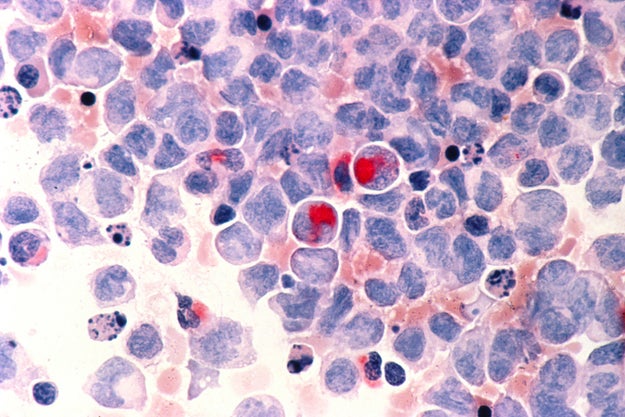
Human cells with acute myelocytic leukemia
Dr. Lance Liotta Laboratory / Via visualsonline.cancer.gov
But interviews and other publicly available online information could be reasonably interpreted to mean that Otte has a PhD. The CEO says that these instances are misunderstandings.
On why Freenome’s website identified him as a PhD, then removed the reference: “To the extent that I’m aware, it did not. I do think there was a refresh of the website that we were performing and there could have been a typo.”
In an interview with Fast Company last year, he said, “And my PhD is in genomics.” (“I believe what I actually said was ‘PhD work was in genomics,’” he told BuzzFeed News.) His biography reads: “While working on his Ph.D. in computational biology at the University of Pennsylvania, he published several papers on applications of machine learning on large genomics datasets and other big data.” (Asked if he thought this sentence implied he had a PhD, Otte said, “Not at all.”) A conference identified him, a speaker, as a PhD on its website. (“I don’t know what they listed me as.”) So did a few other conferences. And Fortune described him as “a Ph.D. in computational biology.” (Otte did not respond when asked for comment about these references.)
On March 3, BuzzFeed News emailed Freenome’s public relations agency to ask if Otte had finished a PhD. A Freenome spokesperson responded: “Yes he did, he received his PhD in computational biology from UPenn.” (Otte later said, “They put a bio together and it was not a bio that I had personally written, but it’s something I should have been more careful about.”)
After answering questions on the phone with BuzzFeed News, Otte later issued a statement in which he pledged to be more careful. “I was working towards a PhD, but did not receive a PhD,” he said. “It’s an important distinction and one where I haven’t been careful enough to ensure that it is correctly reflected in public information attached to me. This is inexcusable. I need to do a better job of this and will correct errors that exist in the public today and any moving forward.”
He added, “My advisors and investors understand I don’t have a PhD. But they also understand and support the work we’re doing at Freenome (and how we are doing it) and have made independent assessments of what they’re investing in and why.”
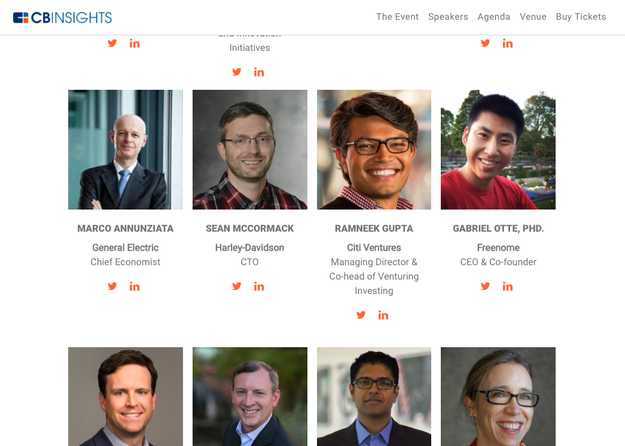
A tech conference identified speaker Gabriel Otte as a PhD.
BuzzFeed News / Via events.cbinsights.com
At UPenn, Otte joined Berger’s lab in 2012, she said. He co-authored five papers published from 2013 to 2016. Those papers, which were about biological mechanisms that control gene activity, are sound, and his work on them appears to be unrelated to Freenome’s publicly stated objective of finding cancer-relevant mutations in blood drawn from patients, Berger said.
But Berger did have concerns about research of his that was never published. “In one instance, Gabe reported experimental results to me for which the primary physical data could not be found and hence, in my opinion, the information was unpublishable and hence not submitted to any journal,” she said when contacted by BuzzFeed News.
An anonymous UPenn-affiliated source confirmed this account. According to a person familiar with Otte’s time in the lab, someone then conducted a search for his primary data, but came up empty.
Otte said, “I’m not going to speak about that incident around my leaving Penn.”
“From the day we first met Gabe, he has been incredibly upfront about the fact that he doesn’t have a PhD.”
“I do know there was some issue with his adviser in terms of the authenticity of data and there were claims going in both directions,” said a person familiar with how the company presented itself to investors.
Another investor said that Otte had been consistently honest about not having a PhD. “His and his team’s work at Freenome has been independently validated by academic and industry experts, and we believe that it can transform cancer care and save countless lives,” said Matt Ocko, managing partner at Data Collective.
Otte was a PhD student at UPenn, according to Baillie, the university spokesperson, but appears to have presented himself at times as working toward a medical degree as well as his PhD. According to five alumni, all of whom requested anonymity due to the sensitivity of the situation, Otte told classmates he was earning both degrees. “He was able to convince a few faculty members he was an MD student,” one alum said. (“I think they must have misheard then,” Otte said.)
A 2013 church newsletter identified him as an MD/PhD student. And the website of Acorn, a three-person startup that Otte used to run, described him as having “received his MD/PhD from the University of Pennsylvania.”
“I didn’t develop that site, so I don’t know,” Otte said. While he said he did consider joining the program, “I didn’t have an MD/PhD from Penn, that’s for sure.”
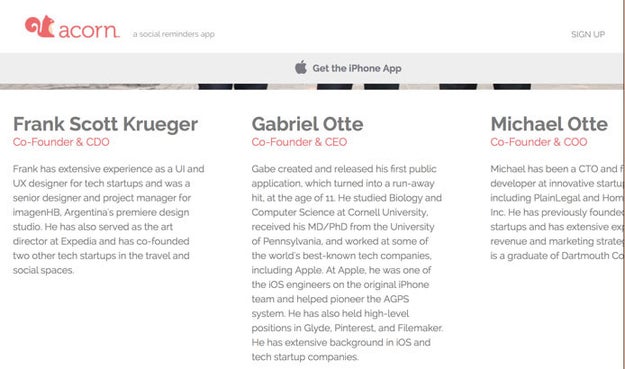
A screenshot of the former website for Acorn, Gabriel Otte's ex-social media app, says Otte “received his MD/PhD from the University of Pennsylvania.”
BuzzFeed News
Otte left UPenn in October 2014. He had spent the summer at a tech startup accelerator in New York City, working on Acorn, a location-based social media app, with his younger brother, according to several media accounts. (Otte declined to comment on this subject.)
Soon after, they moved to Northern California and abandoned Acorn, and Otte cofounded Freenome. In November 2014, he said he was taking a break from school. “I was actually almost kicked out of my program because starting a company violated my PhD contract,” he said in an interview with a blogger at Cornell University, his undergraduate alma mater, when asked about Acorn. “Thankfully, it was worked out in the end and I’m currently on a leave of absence.” (Otte declined to comment on this remark.)
Otte has said he started a biotech company out of a disillusionment with academia, fostered at UPenn. “I looked at my paper and realized that it was not going to amount to very much in terms of helping human health,” he told the Silicon Valley Business Journal. And it was a lack of resources that drove him out of Philadelphia. “When I asked Penn, where I had connections, for help, they just basically shut us down,” he said. “They said these are valuable samples and you are just a rinky dink startup.”
Otte is now leading one of Silicon Valley’s hottest biotech startups, working on a screening method that’s a self-described “combination of machine learning, biology and computer science.”
If proven accurate and reliable, Otte says it could be “a catch-all, first line of defense you might be able to take, as easy as doing a yearly physical.”
If you have information or tips, you can contact this reporter over the encrypted chat service Signal at (415) 322-8701. You can also find our SecureDrop information here.
LINK: This Startup Wants To Catch Cancer In Its Early Days
Quelle: <a href="Does This Biotech CEO Have A PhD? The Answer Is No. But He Did Leave School Under A Cloud“>BuzzFeed