Twitter Is Considering Offering An Enhanced Version Of Its Service — For A Price

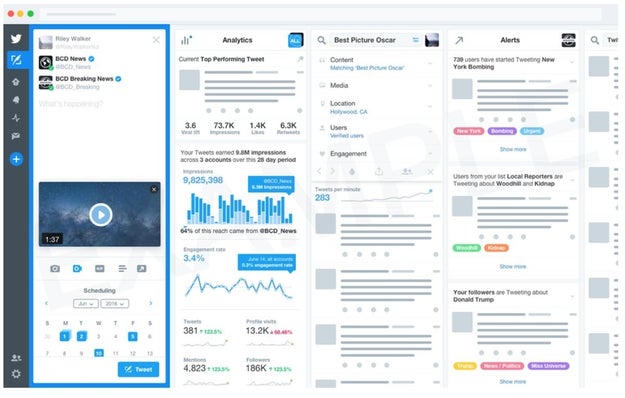
A mockup included in a Twitter survey shows an enhanced version of the company&;s Tweetdeck app.

Twitter

Twitter is considering offering a paid version of its service, the company confirmed Thursday.

The paid version, geared to power users, would feature a number of enhanced features made available in the Twitter-owned app Tweetdeck. It would not supplant the current version of Twitter. The company is still determining what features it would include in such a product, and is surveying some users to figure out what features they&039;d be most interested in.

“We’re conducting this survey to assess the interest in a new, more enhanced version of Tweetdeck,” a Twitter spokesperson told BuzzFeed News. “We regularly conduct user research to gather feedback about people’s Twitter experience and to better inform our product investment decisions, and we&039;re exploring several ways to make Tweetdeck even more valuable for professionals.”

Twitter is not currently developing the product, and it would continue to offer a free version of Tweetdeck if it decided to roll the paid product out. The survey used language describing what the product “will be,” making it seem like an inevitability.

“This premium tool set will provide valuable viewing, posting, and signaling tools like alerts, trends and activity analysis, advanced analytics, and composing and posting tools all in one customizable dashboard,” the survey said. “It will be designed to make it easier than ever to keep up with multiple interests, grow your audience, and see even more great content and information in real-time.”

Twitter is trading far below its IPO price and is struggling to grow its revenue, so a subscription product for power users could be one method to squeeze some cash out of those who get the most out of the platform.

Quelle: <a href="Twitter Is Considering Offering An Enhanced Version Of Its Service — For A Price“>BuzzFeed

Solutions Delivery Executive- UK

The post Solutions Delivery Executive- UK appeared first on Mirantis | Pure Play Open Cloud.
Mirantis, Inc. is looking for an experienced Solutions Delivery Executive to help lead our clients on their journey to the cloud. This highly-visible, senior leadership role within the Mirantis Services organization is a functional peer to the Enterprise Sales executives aligned to our most strategic global accounts.Your top-level responsibilities will include: overall ownership of the end-to-end service delivery experience, building & executing multi-year client account plans, establishing/maintaining corporate governance, driving cross-functional collaboration & communications with client executives and business stakeholders, and ensuring operational excellence & successful business outcomes for the clientCandidates considered for this role must have a good mix of strong operational & business skills combined with strategic thought-leadership and a mind for tactical execution. Acting as a liaison between the client and Mirantis worldwide, you should be a strong advocate for the client, but with the goals of sound business judgments and mutual assured success for both parties.Primary ResponsibilitiesLead the global service delivery experience; single point of ownership and accountability for all client service delivery related activitiesBuilding and maintaining trusted advisor relationships with influential client decision-makers for the successful adoption and deployment of cloud services and technologiesWork in collaboration with the client Sales team to create and execute multi-year business plans to accelerate the adoption of cloud across the client’s business units, exceed revenue goals, and driving client referrals and referencesManage client level P&L &; drive revenue recognition, achieve and/or exceed quarterly PS revenue, cost, utilization & profitability objectivesEnsure client-specific operational, change management and compliance practices are implemented and adhered-to; continually seek to improve processes, reduce complexity and drive predictability for clientsAct as escalation lead for all service delivery-related issues that could impact client relationshipParticipate in contract and financial negotiations (MSAs, SOWs, ELAs, T&Cs)Qualifications10+ years experience in infrastructure/cloud solutions Services company,ideally as an executive within a large Enterprise IT organization, consulting firm or global systems integration companyBachelor’s degree (Business, Science, Technology, Engineering, Math) or equivalent experienceAnalytical decision-making and detail-oriented thinking combined with strong management skillsDemonstrated experience managing large, cross-functional teams within matrix organizationsSuperior interpersonal, written, verbal, listening and presentation skills &8211; ability to communicate cross-functionally with most senior-level executivesHighly organized, able to track multiple concurrent tasks and activities simultaneously; first-hand Change Management and Business Process Mapping experienceHistory of leading successful business transformations using cloud & related technologiesIn-depth knowledge of OpenStack or similar cloud technologies (AWS, Azure, CloudStack)Ability to travel freely between client sites and Mirantis HQ as neededWhat We OfferPartner with exceptionally passionate, talented and engaging colleagues.Implement cloud solutions for some of the best known brands in the industry for use in mission critical applications.High-energy atmosphere of a young company, competitive compensation package with strong benefits plan and stock options.Environment that fosters creativity and personal growth.The post Solutions Delivery Executive- UK appeared first on Mirantis | Pure Play Open Cloud.
Quelle: Mirantis

Instacart Just Settled A $4.6 Million Worker Lawsuit

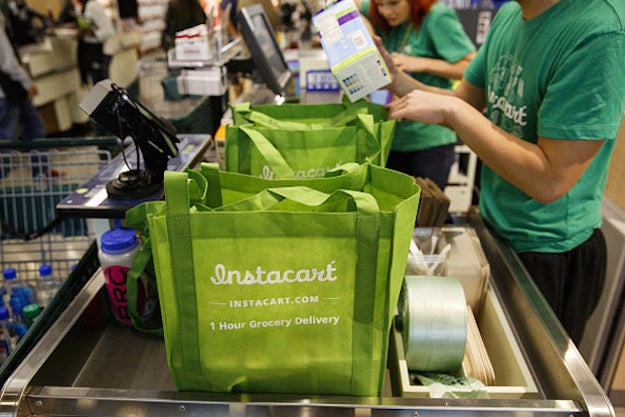
Instacart employees fulfill orders for delivery in downtown Los Angeles, California.

Patrick T. Fallon / Getty Images

The Instacart workers who buy and deliver groceries just won a small victory — the grocery-on-demand startup just settled a class action lawsuit to the tune of $4.6 million.

The lawsuit alleged that workers were owed back pay because Instacart should have classified them as employees, not independent contractors; the payout, per Recode, will be as much as $5,000 for three workers named in the suit, while others will receive “a couple hundred dollars” at most, depending on a points-based system that ranks how much they worked. The settlement won’t, however, grant workers employee status.

“We have settled a nationwide class action lawsuit, primarily over the classification of our shoppers as independent contractors. This is a positive, early resolution for the Company, and we look forward to finalizing the settlement,” Instacart said in a statement.

In 2015, workers filed an initial suit against Instacart, claiming they had been misclassified as contractors, and were owed for the benefits and protections they would have earned as employees of the company. At the end of 2016, after the first case was moved to private arbitration, the same firm, Arns Law, refiled a second lawsuit, hoping to get the workers their day in court.

Since the first lawsuit was filed, Instacart has reconfigured its workforce, changing its in-store shoppers status to employees, while delivery workers remained contractors. But it has also repeatedly cut wages, and made it more difficult for customers to tip, which workers say has severely impacted their overall earnings.

Though Instacart workers will remain contractors under this settlement, they have won changes that might alleviate some of their concerns about tipping.

In a copy of the settlement agreement obtained by Recode, Instacart promised to modify its app&;s user interface to make “the differences between the Service fee and tip” more clear for customers.

Last fall, BuzzFeed News reported that when Instacart added a pooled service fee in addition to tips, some workers wages fell by around 30%, because customers weren&039;t tipping as much. Some workers were so frustrated with the pooled service fee they threatened to strike, and passed out flyers detailing how to tip in the new app to customers. When the second lawsuit was filed in December, it pointed to Instacart’s control over how tips are distributed as evidence that delivery workers should have been classified as employees.

Other on-demand startups that have faced class action lawsuits over worker classification include Uber, Lyft, Postmates, Washio, DoorDash, Homejoy and Caviar. Of those, the most high profile settlements so far have been the Uber and Lyft cases. (Like Instacart, Uber and Lyft successfully avoided trial by jury because workers agreed to private arbitration when they signed their contracts. Instacart has since made arbitration opt-out, as has Postmates.) Uber’s settlement, which could have forced Uber to pay out $100 million, is still being negotiated. Lyft recently finalized its $27 million settlement with drivers.

In October, Instacart CEO Apoorva Mehta told BuzzFeed News that, in order for the company to continue to grow, some delivery workers were going to have take a paycut. Earlier this month, Instacart finalized a funding round of $400 million, bringing the company’s valuation to $3.4 billion.

In an email to workers announcing the funding, Mehta said he planned to hold a town hall to answer any questions they might have about the news. “This is a big milestone for our company. It will allow us to continue to make our product and tools better for you and the customers,” Mehta wrote. “It will also allow us to invest in marketing as well as rapidly expand, so that many more customers across the country can use our service.”

Some shoppers noted that the influx of cash did not bring with it news of a pay raise. In fact, in some markets, wages for Instacart workers have continued to fall since the beginning of the year. For example, screenshots of pay rates reviewed by BuzzFeed News show that in Hollywood, the per-order base rate has fallen from a little below $10 at the beginning of the year to as low as $7.50 by the end of February.

Deirdre Big, a worker in Boulder, said she “won’t be sticking around Instacart much longer” after rates fell from around $7.55 per order at the end of January to $6.25 at the end of February.

This is a developing story; further details to follow.

Quelle: <a href="Instacart Just Settled A .6 Million Worker Lawsuit“>BuzzFeed

Announcing Support for Multi-member Consortium Blockchain Networks on Azure

As your blockchain application development efforts and pilots mature, we realize that the requirements for the underlying consortium network will change, and that you will need to easily and securely create and deploy across multiple regions and support members comprised from organizations that exist within separate administrative and trust boundaries. We are excited to announce expansion of our blockchain support on Azure to be the first public cloud that enables multi-member consortium blockchain networks addressing enterprise scenarios that require a deployment of a private network across Azure regions, subscriptions, and Azure Active Directory (Azure AD) tenants.

As we work with customers, we see scenarios divide into three common topologies:

1.       Single organization, multiple subscriptions: This is a common topology when divisions in an organization do not trust each other, for example when one division is auditing another division. Each division has its own footprint, but they are physically separated in different subscriptions across the same Azure AD tenant.

2.       Multiple organizations, private: This is the true consortium scenario where each organization will have its own footprint and subscriptions, Azure AD tenants, and regions are all different. Given enterprise IT requirements, the services deployed must not be publicly accessible on the internet, even though communication will occur across organizations.

3.       Multiple organizations, public-facing: Similar to the above topology, but in industries, enterprises, or scenarios where IT requirements allow or require the services deployed to be accessible to the public, over the internet. This simplifies the network connectivity requirements for the distributed system.

Today, we are releasing a set of solution templates in the Azure Marketplace that address the first two topologies configuring multi-region and multi-member Ethereum Consortium Blockchain Networks with a simple multi-step process through the Azure Portal or cmdline. The first template deploys and configures the footprint for the initial consortium member (or region), while the second template deploys, connects, and configures additional members (or regions) to form the overarching private network.  If you are still experimenting, we suggest using the simpler single subscription deployment solution released in November.

These solution templates are designed to make it easier and quicker to deploy and configure a multi-member consortium Ethereum network with minimal Azure and Ethereum knowledge. With a handful of user inputs and a single-click deployment, each member can provision their network footprint, using Microsoft Azure compute, networking, and storage services across the globe. Each member&;s network footprint consists of a set of load-balanced transaction nodes with which an application or user can interact to submit transactions, a set of mining nodes to record transactions, and a VPN gateway. A subsequent connection step connects the gateways to create a fully configured multi-member blockchain network.

A multi-member network architecture is illustrated below.

It is important to note that to whom a member connects is not dictated by the template. The consortium should determine the network connectivity model, whether hub and spoke or mesh.

For more information about the solution, you can visit our guided walkthrough.

As with our first blockchain solution, rather than spending hours building out and configuring the infrastructure and networking across organizations, we have automated these time-consuming pieces to allow you to focus on building out the consortium and your production pilots.

Let us know if you have any questions, feedback, or additional requests once you try out these new blockchain solutions. We are excited to help you expand your blockchain deployments to true multi-party topologies.
Quelle: Azure