OpenStack Developer Mailing List Digest March 18-24

SuccessBot Says

Yolanda [1]: Wiki problems have been fixed, it&;s up and running
johnthetubaguy [2]: First few patches adding real docs for policy have now merged in Nova. A much improved sample file [3].
Tell us yours via OpenStack IRC channels with message “ <message>”
All: [4]

Release Naming for R

It&8217;s time to pick a name for our “R” release.
The assoicated summit will be in Vancouver, so the geographic location has been chosen as “British Colombia”.
Rules:

Each release name must start with the letter of the ISO basic Latin alphabet following the initial letter of the previous release, starting with the initial release of &;Austin&;. After &8220;Z&8221;, the next name should start with &8220;A&8221; again.
The name must be composed only of the 26 characters of the ISO basic Latin alphabet. Names which can be transliterated into this character set are also acceptable.
The name must refer to the physical or human geography of the region encompassing the location of the OpenStack design summit for the corresponding release. The exact boundaries of the geographic region under consideration must be declared before the opening of nominations, as part of the initiation of the selection process.
The name must be a single word with a maximum of 10 characters. Words that describe the feature should not be included, so &8220;Foo City&8221; or &8220;Foo Peak&8221; would both be eligible as &8220;Foo&8221;.

Full thread [5]

Moving Gnocchi out

The project Gnocchi which has been tagged independent since it&8217;s inception has potential outside of OpenStack.
Being part of the big tent helped the project be built, but there is a belief that it restrains its adoption outside of OpenStack.
The team has decided to move it out of OpenStack [6].

In addition out of the OpenStack infrastructure.

Gnocchi will continue thrive and be used by OpenStack such as Ceilometer.
Full thread [7]

POST /api-wg/news

Guides under review:

Define pagination guidelines (recently rebooted) [8]
Create a new set of api stability guidelines [9]
Microversions: add next_min_version field in version body [10]
Mention max length limit information for tags [11]
Add API capabilities discovery guideline [12]
WIP: microversion architecture archival doc (very early; not yet ready for review) [13]

Full thread [14]

 
Quelle: openstack.org

Scam Calls Are The Devil, So Phone Carriers Are Doing More To Block Them

T-Mobile said today that it will start labeling scam calls in caller ID.

In a statement, T-Mobile told BuzzFeed News the filtering technology works by comparing an incoming call to a “database of tens of thousands of known scammer numbers” and analyzing how people typically respond to the number. If identified as a possible scam, the number will identify the caller as “Scam Likely” on the phone&;s screen.

T-Mobile

T-Mobile users will also be able to opt into complete scam call blocking by dialing # (), which won&039;t allow any calls labeled as possible scams to go through. The technology is launching on April 5. Scam calls affect 75% of Americans and collectively cost consumers half a billion dollars, according to T-Mobile estimates.

T-Mobile said these calls come in myriad forms, “from IRS scam to Medicare cons to &039;free&039; travel to credit card scams,” according to its press release. The company is specifically targeting automated calls that ping thousands of customers per minute.

AT&T introduced similar technology, AT&T Protect, in December 2016, for iOS and Android phones.

T-Mobile said the feature was part of its collaboration with the Federal Communication Commission to battle robocalling. The FCC voted unanimously on March 23 to give telecommunications companies broader power in filtering out spam calls.

FCC chairman Ajit Pai said robocalls are the consumer complaint his bureau receives.

And the commission is establishing a “Robocall Strike Force” in hopes of eliminating these loathed calls.

Giphy

Which isn&039;t surprising.

Quelle: <a href="Scam Calls Are The Devil, So Phone Carriers Are Doing More To Block Them“>BuzzFeed

AWS Database Migration Service is now a HIPAA-Eligible Service

AWS has expanded its HIPAA compliance program to include AWS Database Migration Service (DMS). You can now use AWS Database Migration Service to move data between your HIPAA-compliant applications, including protected health information (PHI) under an executed Business Associate Agreement (BAA) with AWS. DMS can be used both to migrate data between databases and for ongoing replication workloads to databases or data warehouses. 
Quelle: aws.amazon.com

President Trump Just Re-Announced Another Old Corporate Hiring Plan

President Trump Just Re-Announced Another Old Corporate Hiring Plan

Charter Communications CEO Thomas Rutledge &; outside the West Wing after meeting President Trump March 24.

Alex Wong / Getty Images

In a ritual that is becoming familiar to White House watchers, President Trump, flanked by businessmen, announced on Friday that another American company has told him it plans to go on a hiring and investment spree during his presidency.

And in a detail that has become equally familiar, those hiring and investment plans were recycled from plans first revealed more than 18 months ago.

This time around it was Charter Communications, the cable company that last year bought Time Warner Cable for $55 billion. As Charter was pushing for the detail to be approved by US regulators, it said it would hire about 20,000 new workers if the deal went through, as part of a plan to bring outsourced call centers back to the US. The takeover was approved and finalized in the Spring of 2016.

“We&;ve already begun insourcing efforts for the new company. The process of insourcing will take several years and will require that we hire 20,000 people,” Charter CEO Tom Rutledge said on a call with analysts last August. “That process has already started, as we are building Charter&039;s first Spanish-language call center in McAllen, Texas, with approximately 600 seats.”

On Friday, Rutledge stood behind President Trump as those numbers were re-announced in the Oval Office.

“Today I am thrilled to announce that Charter Communications has just committed to investing $25 billion dollars here in the United States and is committed further to hiring 20,000 American workers over the next four years,” Trump said. “Charter is also committed to completely ending its offshore call centers…and to base 100% of its call centers in the United States…Tom will be opening a brand new, beautiful call center in McAllen, Texas…where they will create 600 new American jobs.”

The $25 billion, four-year investment also seems like business as usual for the company. Charter&039;s total capital expenditure last year, not counting expenses for the merger, was $7.1 billion according to its financial filings. That means that if investments remained at 2016 levels for the next four years, the would invest $28 billion.

On Friday, Rutledge gave the company&039;s ongoing capital expenditure a fresh coat of paint, saying the company was “excited about the opportunity in the right regulatory climate and the right tax climate to make major infrastructure investments.

“We&039;re going to spend $25 billion predicated on the regulatory consistency and efficiency we expect as a country,” Rutledge said.

View Video ›

Facebook: video.php

Justin Venech, a Charter spokesperson, told BuzzFeed News that today&039;s announcement went above and beyond previous comments.

“We have spoken before about plans to hire 20,000 before, it wasn&039;t a commitment” Venech said, adding that the specific four-year timeframe for the hires was a new commitment. He said that the spending on infrastructure was “based on the deregulatory policies of the administration and the FCC.”

The Federal Communications Commission&039;s new chairman, Ajit Pai, is a longtime critic of many Obama-era regulations on cable companies, including the FCC&039;s net neutrality rules. Congress just voted to lift privacy rules that FCC voted to impose on internet providers last year.

This is far from the first time an old hiring or investment announcement has been given a new lease of life by the white house. In February, Intel said it would invest $7 billion in a Arizona semiconductor factory, again with its chief executive standing text to Trump in the Oval Office. The company had previously announced its investment in the factory almost exactly six years earlier, alongside President Obama.

During the transition, Japanese telecom conglomerate and Sprint owner SoftBank, said that it would invest $50 billion into the United States and create 50,000 new jobs over the next four years. SoftBank&039;s chief executive Masayoshi Son was already working on creating a $100 billion fund for technology investments, with funding from Saudi Arabia.

Earlier this month, a long-running program by Exxon-Mobil to invest in energy facilities in Texas and Louisiana was announced again by both Exxon and President Trump, with a White House statement lifting text word-for-word from Exxon&039;s press release.

Quelle: <a href="President Trump Just Re-Announced Another Old Corporate Hiring Plan“>BuzzFeed

Why Uber’s Board Is Standing By Its CEO

Reuters / Danish Siddiqui

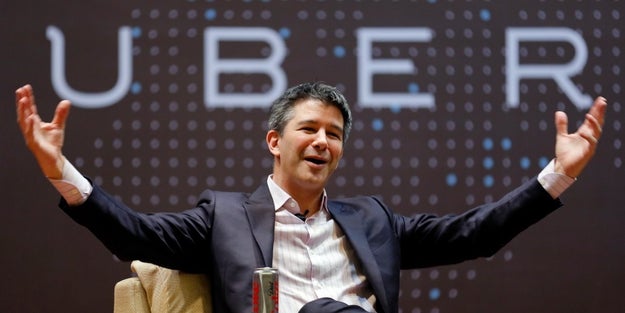
Whether to keep Travis Kalanick as CEO of Uber, amid an ever-expanding controversy, isn’t up to his fellow board members. It’s up to Travis Kalanick.

During a call with reporters on Tuesday, Arianna Huffington, the media entrepreneur who sits on Uber’s board, answered a question about whether the board had considered asking Kalanick to step down as chief executive amid a proliferation of scandals that includes — in no particular order — accusations of systemic sexism, a nasty customer revolt against Kalanick&;s decision to join President Trump’s economic advisory council, allegations of trade secret theft, claims that the company used one of its logistics tools to evade law enforcement, and Kalanick’s embarrassing public admission that he needs to seek “leadership help” and “grow up.”

Huffington’s response was definitive and perfunctory. “It’s not something that’s been addressed,” she replied. “We don’t expect it to come up.”

Uber’s board may profess to have full confidence in Kalanick, but it likely little recourse to do otherwise. Kalanick, cofounder Garrett Camp, and Ryan Graves — the company’s first employee — each hold a significant number of so-called super-voting shares, which carry 10 votes per share, according to sources and Uber’s articles of incorporation.

Together, the trio controls as many as nine of the company&039;s 11 board seats, according to The Information, making the minority of independent directors essentially powerless. If Kalanick were to step down, it would have to be of his own volition. And as Huffington said, that&039;s not something the board expects to come up.

Uber declined comment.

“If he controls the votes to replace the board, it’s pretty unlikely he would be replaced by the board.”

Charles Elson, a professor and director of the University of Delaware’s John L. Weinberg Center for Corporate Governance, said that at private companies like Uber, board members are more like advisers than monitors of behavior.

“Put it this way,” he said. “If he controls the votes to replace the board, it’s pretty unlikely he would be replaced by the board. If they disagree, they just leave. You got the votes, you do what you wish.”

In February, Uber investors Mitch and Freada Kapor wrote in an open letter to Uber’s board that they were “frustrated and disappointed” in the company. “We feel we have hit a dead end in trying to influence the company quietly from the inside,” they wrote.

“Can Travis stay as CEO? I really haven&039;t had any significant discussions with investors in Uber on that subject,” Mitch Kapor told BuzzFeed News earlier this month.

Kapor attributed the lack of discussion on the topic to the idea that Kalanick has proven in his time as Uber’s CEO that he can “revolutionize urban transportation globally.”

“He&039;s already done something that nobody thought he could do. That suggests he has special capabilities,” Kapor told BuzzFeed. “So then the question is, does he get engaged in a sustained way about his self-transformation and a transformation of the culture?”

It&039;s not unheard of for a well-funded Silicon Valley startup to replace its CEO amid scandal. In early 2016, Zenefits, the prominent human resources startup, faced a regulatory crisis so severe that the board moved to oust the founding CEO, Parker Conrad. But the details of that episode help illustrate why such a parting of ways is so unusual.

“Can Travis stay as CEO? I really haven&039;t had any significant discussions with investors in Uber on that subject.”

Like Kalanick at Uber, Conrad had an iron grip on Zenefits. Though he had received funding from powerful venture capitalists, he still controlled three of the four seats on Zenefits&039; board, making it virtually impossible for him to be fired. So even when others at the company recognized that Zenefits faced potentially serious legal and financial trouble, Conrad could dictate the terms of his own departure.

Unlike Uber, Zenefits had a powerful No. 2 executive in David Sacks, who had joined about a year before the scandal erupted, and who led the effort to remove Conrad, according to people familiar with the matter. But Sacks&039;s power was limited, and he had to make a case to Conrad about why the company — and Conrad&039;s sizable stake in it — would be better off without him. Between the time when Conrad verbally agreed to resign and when he actually signed the separation agreement, Sacks feared Conrad might change his mind, according to people familiar with Sacks&039;s thinking.

Conrad, with maximum leverage, was able to secure several sweeteners from Zenefits as conditions of his departure. In addition to keeping his Zenefits shares, he got a $130,000 severance payment and was permitted to keep unvested stock that would vest over the subsequent six months, BuzzFeed News has reported.

Later, Bloomberg News reported that Conrad regretted resigning, underscoring his awareness that the decision to leave was ultimately his alone.

On the conference call with reporters, Huffington outlined the company’s plan to “make Uber the most admired place to work in” and said she is a “big believer in people, leaders, companies being allowed to evolve.”

“I have seen personally Travis’s evolution,” she said. “It’s clear that both Uber and the ride-sharing industry would not be where we are today without Travis.”

Mitch Kapor struck a less conclusive tone as to whether Kalanick, a brash CEO who led the company through its regulatory battles worldwide and to its nearly $70 billion valuation, could bring Uber stability and change its culture.

“I don&039;t think it&039;s impossible,” Mitch Kapor said, but “I think the odds are against it.”

Quelle: <a href="Why Uber’s Board Is Standing By Its CEO“>BuzzFeed

The K8sPort: Engaging Kubernetes Community One Activity at a Time

Editor’s note: Today’s post is by Ryan Quackenbush, Advocacy Programs Manager at Apprenda, showing a new community portal for advocates: the K8sPort. The K8sPort is a hub designed to help you, the Kubernetes community, earn credit for the hard work you’re putting forth in making this one of the most successful open source projects ever. Back at KubeCon Seattle in November, I presented a lightning talk of a preview of K8sPort. This hub, and our intentions in helping to drive this initiative in the community, grew out of a desire to help cultivate an engaged community of Kubernetes advocates. This is done through gamification in a community hub full of different activities called “challenges,” which are activities meant to help direct members of the community to attend various events and meetings, share and provide feedback on important content, answer questions posed on sites like Stack Overflow, and more. By completing these challenges, you collect points and can redeem them for different types of rewards and experiences, examples of which include charitable donations, gift certificates, conference tickets and more. As advocates complete challenges and gain points, they’ll earn performance-related badges, move up in community tiers and participate in a fun community leaderboard. My presentation at KubeCon, simply put, was a call for early signups. Those who’ve been piloting the program have, for the most part, had positive things to say about their experiences.I know I&;m the only one playing with @K8sPort but it may be the most important thing the Kubernetes community has.— Justin Garrison (@rothgar) November 22, 2016“Great way of improving the community and documentation. The gamification of Kubernetes gave me more insight into the stack as well.”     – Jonas Kint, Devops Engineer at Showpad“A great way to engage with the kubernetes project and also help the community. Fun stuff.”      – Kevin Duane, Systems Engineer at The Walt Disney Company“K8sPort seems like an awesome idea for incentivising giving back to the community in a way that will hopefully cause more valuable help from more people than might usually be helping.”     – William Stewart, Site Reliability Engineer at SuperbalistToday I am pleased to announce that the Cloud Native Computing Foundation (CNCF) is making the K8sPort generally available to the entire contributing community! We’ve simplified the signup process by allowing would-be advocates to authenticate and register through the use of their existing GitHub accounts.If you’re a contributing member of the Kubernetes community and you have an active GitHub account tied to the Kubernetes repository at GitHub, you can authenticate using your GitHub credentials and gain access to the K8sPort.Beyond the challenges that get posted regularly, community members will be recognized and compile points for things they’re already doing today. This will be accomplished through the K8sPort’s full integration with GitHub and the core Kubernetes repository. Once you authenticate, you’ll automatically begin earning points and recognition for various contributions — including logging issues, making pull requests, code commits & more.If you’re interested in joining the advocacy hub, please join us at k8sport.org! We hope you’re as excited about what you see as we are to continue to build it and present it to you.For a quick walkthrough on K8sPort authentication and the hub itself, see this quick demo, below.–Ryan Quackenbush, Advocacy Programs Manager, Apprenda
Quelle: kubernetes