Wegen Test von AMD Ryzen: Morddrohungen gegen GamersNexus-Gründer
Wegen eines kritischen Tests des AMD-Prozessors Ryzen 7 1800X erhielt GamersNexus-Gründer Stephen Burke Morddrohungen.
Quelle: Heise Tech News

Wegen eines kritischen Tests des AMD-Prozessors Ryzen 7 1800X erhielt GamersNexus-Gründer Stephen Burke Morddrohungen.
Quelle: Heise Tech News

Zwei Drittel der öffentlich erreichbaren Installation von ownCloud oder dessen Fork Nextcloud sind angreifbar. Ob die eigene Instanz betroffen ist, können Anwender auf einer Website überprüfen.
Quelle: Heise Tech News

Die Bundesrepublik hat sich im "Index für die digitale Wirtschaft und Gesellschaft" der EU-Kommission zwar ganz leicht verbessert, konnte ihren Platz gegenüber stärker aufholenden Mitgliedsstaaten aber nicht verteidigen.
Quelle: Heise Tech News

Fitbit
Fitbit is still the household name in wearables, but there are signs its lead is waning. Despite releasing four new and relatively popular fitness trackers in 2016, lower-than-expected holiday sales meant Fitbit’s global market share decreased in the last quarter of the year.
Now Fitbit is trying to pick up the pace with two new products that go slightly further into health-tracking: a more fitness-focused reboot of its slimmest, most fashionable wristband, the Alta, in addition to new sleep-tracking app features for several of its devices.
The new Alta HR, which customers can preorder today and will start shipping in March, comes with heart rate–tracking technology, as its name suggests. That technology was previously only available on three of the company’s devices: the Charge 2, the Surge, and the Blaze, its smartwatch.
To add heart-tracking to the the ultra-slim Alta, the company shrunk the sensor parts, and in the process made room for a bigger battery that extends the Alta’s life on one charge from five days to seven.

Fitbit
Released in early 2016, the original Alta was one of Fitbit’s best-selling devices for much of the year. Adding heart rate–tracking to the bracelet, which Time praised as “the most beautiful Fitbit ever,” makes it as useful — theoretically — during a morning at the gym as during a night on the town. Now, it can track your heart during calorie-burning workouts, or just your heart rate at ease. The $150 Alta HR is also cheaper than the $250 Surge and $200 Blaze, and comes in black, blue gray, fuschia, and coral, as well as the “special-edition” colors gunmetal and rose gold.
“We’re in a unique position to make wearables not just a nice-to-have but a must-have for anyone looking to maintain their health and fitness,” Melanie Chase, Fitbit’s director of product marketing, told BuzzFeed News.
Whether or not these updates are intriguing enough to hold existing customers’ interest, and attract new ones, is yet to be seen. Some studies suggest wearable devices don’t necessarily help people lose weight, and some people have complained that Fitbit’s heart rate–tracking is inaccurate (a claim Fitbit refutes).
At the same time, the company is trying to extend its reach into an area of life where people aren’t active at all: sleep. “We knew that one of the biggest drivers for purchase in the category is sleep-tracking,” Chase said. “People want more and more insights around sleep.”
Fitbit has plenty of competition: There are all means of apps and gadgets seeking to help snoozers quantify, track, and improve their ZZZs.
So the Fitbit app has a new set of sleep-tracking features. These are different from the features introduced last year, which let all customers set sleep goals, look back on their sleep history, get recommended sleep schedules, and set alarms and bedtime reminders.
Fitbit
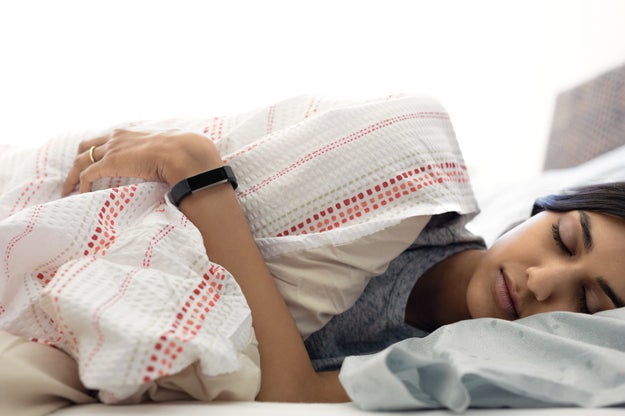
For Alta HR, Blaze, and Charge 2 (though not Surge) owners, there’s a new feature that uses heart rate variability and accelerometer data to break down your snoozing into light sleep, deep sleep, REM, and being awake. (Rival Jawbone previously marketed its advanced trackers as having this feature too.) If you own one of these Fitbits, you can also now get bedtime reminders directly on your wrist instead of your phone.
And if you use your Fitbit to track your sleep, the app can now crunch all the data it’s gathered, including your workouts, and tell you that you shouldn’t sleep in so much on weekends, or that you appear to be more active on the days you sleep more.
If Fitbit can make this information truly useful, people could learn a lot about their bodies during the many hours when they’re deep in slumber. That is, if they don’t rip them off in the middle of the night.
LINK: We Tried Fitbit’s New Smartphone-Friendly Fitness Trackers
Quelle: <a href="Fitbit’s Thinnest Tracker Will Now Track Your Heart Rate, Too“>BuzzFeed

Mit einem System-Update will Apple verhindern, dass sich das iPhone zu einem gezielten Angriff auf Notrufzentralen nutzen lässt. Ein US-Teenager hatte mit einem auf Twitter veröffentlichten Link offenbar über 100.000 911-Notrufe ausgelöst.
Quelle: Heise Tech News

Die Grünen und die AfD nutzen auf ihren Cloud-Servern veraltete Software, die für Angriffe anfällig sind, schreibt der "Spiegel". Und das, obwohl das Bundesamt für Sicherheit in der Informationstechnik Warnungen verschickt hat.
Quelle: Heise Tech News

By Jo Maitland, Blogs and Social Media Lead, Google Cloud
Our annual ritual of inviting thousands of customers, partners, developers, IT pros, industry analysts and press to join us for three days of learning about Google Cloud has arrived. This week we’ll open the doors to Google Cloud Next ’17, and I can tell you, you’re in for a tremendous show.
But instead of sharing what I’m excited about, here’s a sampling of opinion from people in the community who are coming to Next.
Amanda Folson, Develooper Advocate and Community Lead, GitLab
“The market is moving so fast that keeping tabs on it is tough when there’s so much going on. Google popped up overnight and is doing some very innovative work. As far as sessions go, I want to hear what Vint Cerf and Marc Andreessen have to say in their fireside chat on the past and future of enterprise computing. They’ve had a little bit to do with the internet! My company’s focused on orchestration and managing the lifecycle of code, so I’ll be attending sessions on Kubernetes, Docker and anything on DevOps. It’s where everything is headed.”
Krish Subramanian, SVP of Products and Strategy, CloudMunch
“I’m interested in finding out about enterprise companies adopting Google Cloud as well as the traction Google is seeing for machine learning. I want to see what’s in store to attract more devs to the service. Another trend I’m watching closely is serverless — I’ll be interested to learn how Google Cloud Functions stacks up against AWS Lambda.”
David Mytton, Founder and CEO, Server Density
“We’ve been gradually migrating our systems over to GCP from IBM Softlayer. We are big advocates of handing off management of infrastructure to Google’s cloud services instead of wrangling it ourselves. We recently migrated our time series database to Google Cloud Bigtable. I’ll be giving a talk on this migration on March 8. I’m looking forward to meeting other GCP customers and learning about new products. Providing feedback one to one with specific Google teams is also really valuable.”
Alex Williams, Founder and Editor-in-chief, The New Stack
“I am looking forward to learning more about how how Google views the next generation of data centers in the context of software development across multiple cloud infrastructures . . . be they customer infrastructures or those offered by competitors. . . We are curious about the evolution of APIs as they become more important for companies as a way to reach more third-party developers. This larger story about APIs is particularly pertinent when considering new “serverless” style architectures. It’s in this realm that we see the intersection of machine learning and connected systems evolving. We’ll be looking for proof points of this evolution when speaking with Google developers and engineers as well as customers and conference attendees. I am also hoping to get a deeper understanding of the way Google views open source ecosystems.”
Simone Brunozzi, CTO, MosaixSoft
“1) Kubernetes vs. everything else
2) Machine Learning tools”
Weird. Nobody mentioned the open bar and catching up with old friends!
See you there, or on the livestream!
Quelle: Google Cloud Platform

Für kommerzielle Zwecke will IBM in den kommenden Jahren über seine Cloud den Zugriff auf stärkere Quantencomputer anbieten. Angepeilt sind rund 50 Qubit. (Quantencomputer, IBM)
Quelle: Golem

Unter gewissen Voraussetzungen können Angreifern mittels manipulierter SQL-Anfragen Nutzerdaten von WordPress-Webseiten abgreifen.
Quelle: Heise Tech News

Das BSI warnt Organisationen und Parteien vor Schwachstellen in ihren Cloud-Diensten. Viele haben bis heute nicht darauf reagiert. Golem.de konnte entsprechende Warnungen nachvollziehen: Die AfD nutzt ein abgelaufenes Zertifikat für ihre Subdomain, die Grünen sehen einen Dienstleister in der Pflicht. Von Hauke Gierow (Nextloud, Server)
Quelle: Golem






