Warning Signs Abound As Snap Barrels Toward IPO

Snap Inc.

As Snap Inc. heads towards its highly anticipated IPO, new data obtained by BuzzFeed News raises questions about the company’s ability to sustain the sort of growth needed to justify its expected $20 to 25 billion valuation.

The emergence of Snapchat clones copying the app’s key features — most prominently Instagram’s knock off of its Stories feature — appears to have hurt Snap’s growth prospects, according to data from app analytics company App Annie. Though Snapchat is still growing, these clones are hampering growth in key markets like the United States, and potential future markets in Asia.

Snapchat once had a strong lead over Instagram on time-spent-in-app per user on Android devices worldwide. But in the spring of 2016 — before Instagram even copied Stories — it started to slip. As of December 2016, Instagram has not only surpassed Snapchat, but claimed a lead of 25%. That&;s a metric worth noting, because Snap is pitching Wall Street on its ability to maximize average revenue per user, according to Bloomberg. If users spend less time inside Snapchat, the ad supported company stands to make less money per user. As of late last year, Snap was selling major advertisers on the fact that its users spent 25-30 minutes in the app each day.

Snapchat continues to have significant momentum in the United States, but here too its time spent advantage over Instagram is shrinking. In December 2015, before Instagram cloned its popular Stories feature, Snapchat had a 35% lead over Instagram in time spent per user on Android devices in the US, according to App Annie. Instagram debuted its take on Stories in the summer of 2016 and by December, that lead had declined to 20%. A source familiar with the situation said a similar trend is playing out on iOS.

“A large portion of this movement occurred in the second half of 2016 and could have partly been due to the addition of Instagram Stories in August 2016,” App Annie told BuzzFeed News.

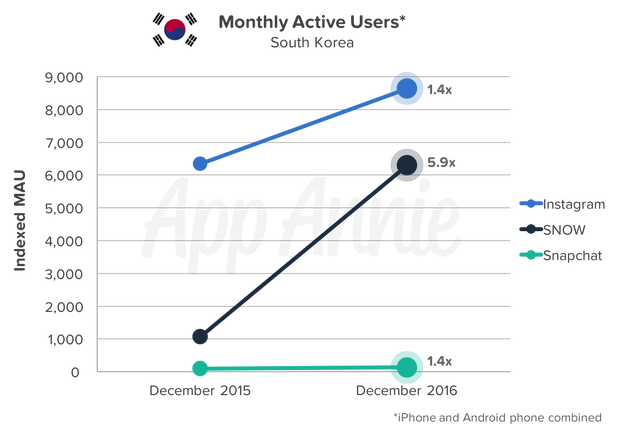
Meanwhile, Snap’s growth prospects in big markets like Asia appear fraught. Like Facebook and Twitter, Snapchat is banned in China. A Snapchat-like app called Snow currently dominates that market and outranks Snap in Japan and South Korea when it comes to monthly active users, according to App Annie data.
App Annie

As BuzzFeed News has previously reported, advertisers have been hesitant to dedicate big budgets to the Snapchat since its reach and data targeting capabilities pale in comparison to Facebook’s. The rampant cloning of key Snapchat features has only made the prospect of breaking through that barrier more daunting.

“Snapchat’s still not taken seriously enough to even be on the level of getting the kind of investment that Instagram is getting,” one advertising agency CEO told BuzzFeed News this week. Asked if Instagram’s clone would mean advertisers would direct dollars there instead of Snapchat, the executive said that “there was never enough money earmarked for Snapchat to move to Instagram.”

As Snapchat battles Instagram and its other clones, Snapchat’s top influencers and brands are reporting declines in Story views, as noted by Techcrunch. Talent managers and advertising executives told BuzzFeed News that they’re seeing declines in views of their stories extending from 20% to as high as 50%.

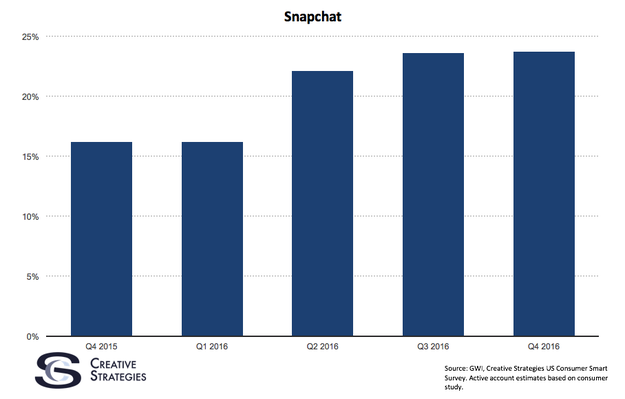
Meanwhile, the overall percentage of internet users watching Snapchat’s live stories has declined as well, falling to 12% in November 2016 from 14% in June 2015, according to UBS. “We think growth has stalled and in particular Instagram including similar features has helped keep people from leaving and going to Snapchat,” Ben Bajarin, principal analyst at Creative Strategies, told BuzzFeed News.

Snap Inc. declined comment.
Creative Strategies

Quelle: <a href="Warning Signs Abound As Snap Barrels Toward IPO“>BuzzFeed

Sheryl Sandberg Explains Why Silicon Valley Won’t Confront Trump

Philippe Wojazer / Reuters

Sheryl Sandberg said that an ongoing dialogue between the tech industry and President Donald Trump is important on Wednesday during a Q&A with Recode’s Kara Swisher at the Watermark Women’s Conference. The half-hour talk was the first time Sandberg has been interviewed since the Women’s March, which drew nearly half a million people to Washington DC to protest in favor of equal rights and against Trump’s policies. The Lean In author was criticized for neither attending nor acknowledging the event. On stage, Sandberg said she was not able to attend because of a “personal obligation,” and then felt guilty. “I just felt bad about not being there. So once I felt bad, I just didn’t feel comfortable posting,” she said. “I think that was a mistake and if I had to do it again, I certainly would post.”

When Swisher asked why tech leaders did not voice their disagreements with Trump during their infamous trip to Trump Tower, Sandberg said, “You know this administration is going to have broad ability to take action on things we care about — jobs, our ability to hire, our ability to grow, everything, all the issues we’re all posting about — and so a dialogue there is important.”

At times Sandberg looked like a shruggie in human form, albeit a chic and professional version, thigh-high boots crossed, lifting her shoulders and holding her palms up when Swisher pressed her on issues like why one of tech’s most famous feminists didn’t attend the Women’s March or if Sandberg would one day run for president (a firm-ish no).

Swisher was clearly skeptical about the effectiveness of working with Trump. Is dialogue working if Trump’s policies all seem to contradict Silicon Valley’s values? “I think it’s early — I can’t sit on this stage and predict (and predict) what will happen,” Sandberg said, seeming flustered. “I have to remain hopeful. I have to remain hopeful. I have to remain [hopeful] looking at this audience of women.”

Sandberg answered the question as though Trump hadn’t yet taken office and issued 18 executive orders. The public, and certainly the audience at the women’s conference, already knew that she opposed Trump’s anti-immigration and anti-abortion policies.

Tech workers, activists, and the tech press are clinging to every line from tech executives, however strategic or meaningless or misleading, because despite its impassioned “public statements” on the immigration order, Silicon Valley has chosen to negotiate with Trump behind-the-scenes. Two of the largest corporations in the world, Facebook and Google, and two of the most revered CEOs in the world, Elon Musk and Travis Kalanick, are still working with Trump.

On stage, Sandberg returned repeatedly to the idea that it is early in the Trump administration, downplaying the frequency and aggression of Trump’s executive orders, as well as the immediate negative impact of both Trump’s appointees and policies. “I think we don’t know what’s going to be effective yet, it’s very early days of the new administration, but we know that the issues for women in leadership are real, and it is about the steps we take as a society, it’s about the public policy. It’s also about the individual steps women take.”

(“She’s good at dancing around a land mine,” one conference staffer told her colleagues after Sandberg’s talk.)

The author of Lean In, who tried to launch a movement around her self-help book, sounded contrite when she explained her absence at the March, which drew nearly half a million people to Washington DC. “I’ve been an active poster — you may have seen, if you’ve been watching — since then,” Sandberg added, referring to carefully worded Facebook posts about the immigration order and the march, both published days after the news.

Sandberg called the march “an incredible showing of support for women,” before segueing to Facebook, where both she and Trump advisor Peter Thiel have seats on the board. “I’m pretty proud of the role Facebook played in this; it’s a great story,” Sandberg said, referring to Teresa Shook, the retired grandmother from Hawaii who helped organize the march with a Facebook post.

The subject of Thiel never came up during the talk, and Sandberg was not available for follow-up questions, but Swisher was direct and steadfast in turning the conversation toward Trump. When Swisher asked Sandberg what actions she would take against the immigration order, beyond public statements, Sandberg replied: “Well, I think democracy is about using your voice and influencing policy.”

Sandberg mentioned the importance of policy a few times, but not in the context of whether she would run for office, a question she’s been asked “at least 400 times, often by me,” said Swisher. “And I have said no, and I’m going to continue to say no,” said Sandberg. “And I’m going to continue not to believe you in any way,” said Swisher.

Quelle: <a href="Sheryl Sandberg Explains Why Silicon Valley Won’t Confront Trump“>BuzzFeed

Amazon API Gateway is now available in the Europe (London) AWS region.

Amazon API Gateway is a fully managed service that makes it easy for developers to create, publish, maintain, monitor, and secure APIs at any scale. With a few clicks in the AWS Management Console, you can create an API that acts as a “front door” for applications to access data, business logic, or functionality from your back-end services, such as workloads running on Amazon Elastic Compute Cloud (Amazon EC2), code running on AWS Lambda, or any Web application. Amazon API Gateway handles all the tasks involved in accepting and processing up to hundreds of thousands of concurrent API calls, including traffic management, authorization and access control, monitoring, and API version management.
Quelle: aws.amazon.com

Gorsuch Might Play Key Role In Cellphone Privacy Issues If Confirmed To The Supreme Court

Chip Somodevilla / Getty Images

WASHINGTON — The Supreme Court is one step closer to a full-nine person bench.

With the possible addition of Neil Gorsuch — a federal appeals court judge nominated by President Trump Tuesday night to fill the vacancy left after the death Antonin Scalia — to its ranks, the Supreme Court could soon consider important cases involving cellphone location data and Americans&; expectations of privacy.

The Fourth Amendment In The Digital Age

Invisible, silent, and almost always by your side, the signals sent and received from your phone can tell a faithful story of your life, perhaps most intimately about all the places you&039;ve been. As courts around the country wrestle with the privacy implications of always-on data collection, experts tell BuzzFeed News that the Supreme Court in the coming years is primed to grapple with the uncertainty around phone location data and the Fourth Amendment.

Elizabeth Goitein, the co-director of the liberty and national security program at New York University Law School told BuzzFeed News that old legal doctrines are falling flat when it comes to protecting our privacy rights on mobile devices — specifically location information.

The Fourth Amendment prohibits unreasonable searches and seizures. But Goitein and other experts point to what&039;s known as the third party doctrine of the Fourth Amendment, which holds that people give up their expectation of privacy when they share information with third parties, like banks or telephone companies.

“That doctrine simply doesn&039;t work in the digital era, in which you can&039;t go 24 hours without sharing highly sensitive information with third parties,” she said.

Several appeals courts have used the third party doctrine in decisions against defendants in which their phone location information was obtained by law enforcement without a warrant.

“It&039;s impossible to go about your daily life in the digital age without leaving a trail of digital breadcrumbs behind you that can reveal some of the most private aspects of your life — even though you never intended to reveal them,” Nathan Freed Wessler, a staff attorney with the American Civil Liberties Union, told BuzzFeed News.

While establishing probable cause is the legal threshold to obtain a warrant, many jurisdictions allow law enforcement to satisfy a lower standard, known as reasonable suspicion, if they request a person&039;s cellphone location information from a mobile provider. Wessler said that the uneven standard creates a patchwork of laws where citizens have fewer protections depending on what state they live in. The Supreme Court, he said, could provide much needed clarity.

In fact, lawyers involved in cellphone location cases in the 4th and 6th Circuits have petitioned the Supreme Court to rule on the issue. Experts say that the high court is likely to review such a case — because of the uncertainty in the federal court system and the national importance of defining privacy rights as technology increasingly shapes our lives.

Others see encryption on the Court&039;s horizon. While Apple and the Justice Department were poised for a high-stakes courtroom showdown last year, over an encrypted iPhone, the FBI was able to get into the device without Apple&039;s help, ending the case, but leaving the larger question of lawful access unresolved.

“We will see technical assistance to decrypt communications or facilitate access find its way to the Court,” Albert Gidari, the director of privacy at Stanford’s Center for Internet and Society, told BuzzFeed News. “Trump spoke to this issue during the campaign, and I think there are a number of cases in the works for the Department of Justice that would be good candidates.”

President Trump&039;s Supreme Court Pick

President Donald Trump announced Neil Gorsuch as his nominee for the Supreme Court Tuesday evening, and said the “image and genius” of the late Justice Antonin Scalia “was in my mind throughout the decision making process.” During his acceptance speech, Gorsuch, who still awaits confirmation by the Senate, offered a window into his judicial thinking.

“I respect … the fact that in our legal order it is for Congress and not the courts to write new laws.” Gorsich said in his acceptance speech. “It is the role of judges to apply, not alter, the work of the people&039;s representatives.”

If Gorsuch is confirmed by the Senate, how might a new justice, in the mold of Scalia, rule on Fourth Amendment cases?

“Judicial decisions on Fourth Amendment rights in the digital age do not break down cleanly along ideological lines,” Wessler said. For instance, in recent years the Court has ruled unanimously in favor of requiring warrants for searches of cell phones and for the GPS tracking of cars. And in 2001, Justice Scalia wrote an opinion requiring police to obtain a warrant before surveilling a home using a thermal-imaging camera. To allow the search without a warrant, he wrote, would “permit police technology to erode the privacy guaranteed by the Fourth Amendment.”

“The framers were not concerned about the internet — that&039;s one way to look at it,” Blake Reid, the director of the Technology Law & Policy Clinic at the University of Colorado told BuzzFeed News. Another approach, he said, could focus on the Fourth Amendment&039;s protections of people&039;s “papers and homes” with an eye on the new ways that police can surveil a person&039;s residence.

While it remains unclear what cases the Court may consider, Goitein said the shifting politics of the Trump era gives urgency to these Fourth Amendment cases. “The privacy threat gets more acute in the atmosphere we have right now, where I think there are those who view the results of the election as a mandate for law enforcement to get tougher than ever.”

Quelle: <a href="Gorsuch Might Play Key Role In Cellphone Privacy Issues If Confirmed To The Supreme Court“>BuzzFeed

A Jury Ordered Facebook To Pay $500 Million In Damages For Copyright Infringement

Glenn Chapman / AFP / Getty Images

A Dallas jury has ruled that Facebook owes $500 million in damages to a Dallas-based game maker that complained its inventions were stolen by Facebook&;s Oculus VR division.

Facebook, which acquired Oculus for $3 billion in 2014, said it plans to appeal the ruling.

ZeniMax claimed in its lawsuit that it had been the first to develop much of the technology used in the Oculus virtual reality headsets, and that one of its former employees, John Carmack, had given it away to Oculus&039;s founder Palmer Luckey. Carmack later became the chief technical officer at Oculus.

ZeniMax sought several billion in damages, claiming Facebook stole its trade secrets.

While the lawsuit is over two tears old, it attracted national attention a few weeks ago when Facebook founder Mark Zuckerberg was put on the stand in a Dallas courtroom. “The idea that Oculus products are based on someone else’s technology is just wrong,” Zuckerberg said in response to questions from a ZeniMax attorney.

The jury, however, concluded that Oculus and its founders Luckey and Brendan Iribe had infringed on ZeniMax&039;s copyrights. The jury further ruled that Carmack had contributed to ZeniMax&039;s infringement. Iribe was recently moved from the head of Facebook&039;s virtual reality group.

The jury ruled against claims that Oculus had stolen trade secrets.

“The heart of this case was about whether Oculus stole ZeniMax&039;s trade secrets, and the jury found decisively in our favor. We&039;re obviously disappointed by a few other aspects of today&039;s verdict, but we are undeterred. Oculus products are built with Oculus technology,” a spokesperson for Facebook&039;s Oculus division said in a statement. “We look forward to filing our appeal and eventually putting this litigation behind us.”

During his testimony, Zuckerberg — whose legal battles over Facebook&039;s origins are now Silicon Valley legend — tried to cast doubt on ZeniMax&039;s claims. “It is pretty common when you announce a big deal or do something that all kinds of people just kind of come out of the woodwork and claim that they just own some portion of the deal,” he said.

Quelle: <a href="A Jury Ordered Facebook To Pay 0 Million In Damages For Copyright Infringement“>BuzzFeed

Services Management using Red Hat CloudForms (Video)

In this short video, we specifically look at service management within Red Hat CloudForms. The demonstration highlights the following platform capabilities:

Self-Service portal with lifecycle, operations management and reporting
Service Catalog presented to end-user consumers
Service Definition, built as stand-alone, or from service composites
Life-cycle status monitoring and notifications
Usage consumption and chargeback reports


Additional information on Red Hat CloudForms can be found on the Red Hat website.
 
Quelle: CloudForms

Services Management using Red Hat CloudForms (Video)

In this short video, we specifically look at service management within Red Hat CloudForms. The demonstration highlights the following platform capabilities:

Self-Service portal with lifecycle, operations management and reporting
Service Catalog presented to end-user consumers
Service Definition, built as stand-alone, or from service composites
Life-cycle status monitoring and notifications
Usage consumption and chargeback reports


Additional information on Red Hat CloudForms can be found on the Red Hat website.
 
Quelle: CloudForms

New in Azure Stream Analytics: Geospatial functions, Custom code and lots more!

Today, we are pleased to announce the roll-out of several compelling capabilities in Azure Stream Analytics. These include native support for geospatial functions, custom code with JavaScript, low latency dashboarding with Power BI and preview of Visual Studio integration and Job diagnostic logs. Additionally, effective today there will be no more ingress data throttling.

Native support for Geospatial functions

Starting today, customers can easily build solutions for scenarios such as connected cars, fleet management, and mobile asset tracking with tremendous ease using Azure Stream Analytics. Developers can now leverage powerful built-in geospatial functions in their stream-processing logic to define geographical areas, and evaluate incoming geospatial data for containment, proximity, overlap, and generate alerts or easily kick-off necessary workflows etc. These geospatial capabilities are in alignment with the GeoJSON specification.

We had more than 100 customers using these Geospatial capabilities in preview, including NASCAR. Established in 1947, NASCAR has grown to become the premier motorsports organization. Currently, NASCAR sanctions more than 1,200 races in more than 30 U.S. states, Canada, Mexico and Europe. NASCAR has been a pioneer in using geospatial capabilities in Azure Stream Analytics.

“We use real-time geospatial analytics with Azure Stream Analytics for analyzing race telemetry during and after the race,” said NASCAR’s Managing Director of Technology Development, Betsy Grider

Custom code with JavaScript user defined functions

With Azure Stream Analytics, customers can now combine the power of JavaScript with the simplicity and pervasiveness of SQL. Historically, Azure Stream Analytics let developers express their real-time query logic using a very simple SQL like language. That said, customers have also been asking us to support more expressive custom code to implement advanced scenarios. Today, in our journey to offer richer custom code support, we are pleased to announce the support for User defined functions using JavaScript in Azure Stream Analytics. With this new feature, customers can now write their custom code in JavaScript, and easily invoke it as part of their real-time stream processing query.

Invoking JavaScript UDF from a Stream Analytics Query

Visual Studio tools for Azure Stream Analytics

To help maximize end-to-end developer productivity across authoring, testing and debugging Stream Analytics jobs, we are rolling out a public preview of Azure Stream Analytics tools for Visual Studio. Local testing on client machines to enable true offline query building and testing experience will be one of the key capabilities that will be available. Additionally, features such as IntelliSense (code-completion), Syntax Highlighting, Error Markers and Source control integrations are designed to offer best in class developer experiences.

Stream Analytics jobs in Visual Studio

Low-latency dashboarding with Power BI

In our quest to continually test the boundaries of performance and latencies to serve our customer needs better, we’ve worked closely with our Power BI engineering team to improve dashboarding experiences for solutions built using Azure Stream Analytics. Azure Stream Analytics jobs can now output to the new Power BI streaming datasets. This will enable rich visual and dynamic dashboards with a lot lower latency than what was possible until now.

Dashboards powered by streaming data from Azure Stream Analytics

Job Diagnostics logs

Building on a series of ongoing investments designed to improve the self-service troubleshooting experience, today we are announcing the preview of Azure Stream Analytics’ integration with Azure Monitoring. This provides customers a systematic way to deal with lost, late or malformed data while enabling efficient mechanisms to investigate errors caused by bad data.

Having immediate access to actual data that causes errors helps customers quickly address problem(s). Users will be able to control how the job acts when errors occur in data, and persist relevant event data and operational metadata (eg. occurrence time and counts) in Azure Storage or Azure Event Hubs. This data can be used for diagnostics and troubleshooting offline. Furthermore, data routed to Azure Storage can be analyzed using the rich visualization and analytics capabilities of Azure Log Analytics.

Key examples of data handling errors include: Data conversion and serialization errors in cases of schema mismatch; Incompatible types and constraints such as allow null, duplicates; Truncation of strings and issues with precision during conversion etc.

Link to Diagnostics logs on Azure portal

Keep the feedback and ideas coming

Azure Stream Analytics team is highly committed to listening to your feedback and let the user voice dictate our future investments. We welcome you to join the conversation and make your voice heard via our UserVoice.

Please visit our pricing page to review the latest pricing.


Quelle: Azure