SDN Mini-Bootcamp
The post SDN Mini-Bootcamp appeared first on Mirantis | Pure Play Open Cloud.
The post SDN Mini-Bootcamp appeared first on Mirantis | Pure Play Open Cloud.
Quelle: Mirantis
The post SDN Mini-Bootcamp appeared first on Mirantis | Pure Play Open Cloud.
The post SDN Mini-Bootcamp appeared first on Mirantis | Pure Play Open Cloud.
Quelle: Mirantis
The post What’s New in OpenStack Ocata appeared first on Mirantis | Pure Play Open Cloud.
The post What&8217;s New in OpenStack Ocata appeared first on Mirantis | Pure Play Open Cloud.
Quelle: Mirantis
This Quick Start automatically deploys a Tableau Server standalone or cluster environment on the AWS Cloud in an hour or less. The Quick Start was created by AWS in partnership with Tableau Software, to integrate solutions and services from both companies.
Quelle: aws.amazon.com

Der Umbau soll in den kommenden drei bis Jahren abgeschlossen sein und über 10.000 Arbeitsplätze schaffen: Bei einem Treffen mit US-Präsident Donald Trump hat Intel-CEO Brian Krzanich die Aufrüstung der Fab 42 in Arizona angekündigt. (Prozessor, Intel)
Quelle: Golem
A new update for StorSimple Virtual Array, version 10.0.10289.0 (Update 0.4) is now available for download. Update 0.4 contains bug fixes and key improvements around file share backup and restore performance. We recommend that you apply this update. The update requires a reboot of the virtual array and can be applied during a maintenance window.
New VHD, VHDX, and VMDK are now available in the Azure portal. Download these images to provision new Update 0.4 devices.
For more information:
About improvements and bug fixes go to StorSimple Virtual Array Update 0.4 release notes.
On install instructions, refer to Install Updates on your StorSimple Virtual Array.
Should you encounter any issues, please contact Microsoft Support.
Quelle: Azure
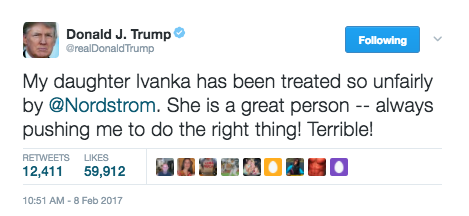
President Donald Trump, unhappy his daughter Ivanka's fashion line was dropped by Nordstrom, lashed out Wednesday at the retailer on Twitter. And on Facebook. And on Instagram.
The multi-platform targeting of an American department store is new territory as far as US presidents go, but not entirely out of the ordinary for Trump, who has often used his social media accounts to fire away at those he believes wronged him.
“My daughter Ivanka has been treated so unfairly by Nordstrom,” the president tweeted. “She is a great person — always pushing me to do the right thing! Terrible&033;”
After posting the initial tweet on his @realDonaldTrump account, Trump reposted the language to Instagram and Facebook, and retweeted it from the @POTUS account, leading some to question if it was ethical for a sitting president to pressure a family business partner.
Trump has used his Instagram to attack opponents in the past, including Jeb Bush and Hillary Clinton. While some imagined Trump might change his approach to social media once he took the presidency, there appears to be no change in his early days in the White House.
Trump is bringing a proven political social media strategy to bear on corporations with whom he&039;s displeased. Only now, instead of Jeb and Hillary, it&039;s Nordstrom and others.
Nordstrom, for its part, tweeted that the decision to drop Ivanka Trump&039;s fashion line was due to “business results.”
Press Secretary Sean Spicer defended Trump&039;s attacks at his press briefing today.
Quelle: <a href="President Trump Is Shaming Nordstrom On Twitter, Facebook, And Instagram“>BuzzFeed

This video highlights the role-based access controls within Red Hat CloudForms and how they can be tied into Microsoft Active Directory, to leverage a company’s existing user and group structure. The goal of the video is to help customers understand how they can integrate CloudForms into their organizational structure with rather minimal setup.
Using this setup, operators can connect existing user and group structures and tie them to CloudForms roles. These roles can be customized and given granular permissions to most elements inside CloudForms.
Users can be granted access from the very top of the organization down to a specific resource (e.g. VM) and anywhere in between. Controls are used to grant users visibility into portions of the UI. For the UI they can see, controls can also be applied as to whether the user can perform the actions or simply view.
At a high level, the following areas are discussed in the video:
How to configure the integration with Active Directory/LDAP
How to map existing groups and users
Walk through role-based access control hierarchy
Additional details on authentication configuration, including LDAP, can be found on the Red Hat CloudForms Documentation.
Quelle: CloudForms

Today we are pleased to announce that partitioned collections have an entry point 75% cheaper than before. Instead of provisioning 10,100 RU/sec as a minimum, you can now provision a partitioned collection at 2,500 RU/sec and scale in increments of 100 RU/sec. Partitioned collections enable you to dynamically scale your provisioning from as low as 2,500 RU/sec to millions of RU/sec with no limit on storage consumption.
DocumentDB billing model
The current Azure DocumentDB billing model gives far more granularity, elasticity, and scale than what S1, S2, and S3 performance levels provided. You no longer need to jump your throughput provisioning from 1,000 RU/sec to 2,500 RU/sec when you just need 1,200 RU/sec. Our goal is to make sure you have full flexibility in optimizing the utilization of your provisioned capacity.
The Azure DocumentDB billing model is very simple:
You pay for the provisioned capacity in increments of 100 request units/second (RU/sec). Each provisioned capacity of 100 RU/sec is billed at an hourly rate.
You pay a flat rate for the storage you consume.
The entry point for DocumentDB is at 400 RU/sec for a single partition. For a free use in a dev/test environment, we recommend the use of the DocumentDB emulator.
Single Partition or Partitioned Collection
You can start with a single partition if you expect your storage needs to be below 10 GB or your throughput needs not to exceed 10K RU/sec. Later on, you can always change to partitioned collections by using the migration tool. For more information about migrating from single-partition to partitioned collections, see Migrating from single-partition to partitioned collections.
However, if you expect a large amount of volume or performance needs, you should start with a partitioned collection. The following table provides an overview of single partition versus partitioned collections.
Performance type
Details
Throughput
Storage
Single partition
User sets throughput in units of 100 RU/sec
400 – 10,000 RU/sec
10 GB
Partitioned collection
User sets throughput in units of 100 RU/sec
2,500 RU/sec – Unlimited
Unlimited
Decreasing your provisioned throughput for partitioned collections
If you already have a partitioned collection, but don’t need the 10,100 RU/sec throughput, you can lower your provisioning through the Azure portal or the SDK. Here is an example to adjust the provisioning level to 2,500 RU/sec.
Through the Azure portal
From your DocumentDB account, click Scale, choose your collection, and then adjust your throughput value.
Through the SDK
//Fetch the resource to be updated
Offer offer = client.CreateOfferQuery()
.Where(r => r.ResourceLink == collection.SelfLink)
.AsEnumerable()
.SingleOrDefault();
// Set the throughput to 2,500 request units per second
offer = new OfferV2(offer, 2500);
//Now persist these changes to the database by replacing the original resource
await client.ReplaceOfferAsync(offer);
If you have additional questions about partitioned collections or going planet-scale with DocumentDB, please reach out to us on the developer forums on Stack Overflow. Also, stay up-to-date on the latest DocumentDB news and features by following us on Twitter @DocumentDB.
Quelle: Azure

Today we’re excited to share the launch the #DockerCon 2017 agenda. With 100+ DockerCon speakers, 60+ breakout sessions, 11 workshops, and hands on labs, we’re confident that you’ll find the right content for your role (Developer, IT Ops, Enterprise) or your level of Docker expertise (Beginner, Intermediate, Advanced).
View the announced schedule and speakers lineup
Announced sessions include:
Use Case
0 to 60 with Docker in 5 Months: How a Traditional Fortune 40 Company Turns on a Dime by Tim Tyler (MetLife)
Activision’s Skypilot: Delivering Amazing Game Experiences through Containerized Pipelines by Tom Shaw (Activision)
Cool Genes: The Search for a Cure Using Genomics, Big Data, and Docker by James Lowey (TGEN)
The Tale of Two Deployments: Greenfield and Monolith Docker at Cornell by Shawn Bower and Brett Haranin (Cornell University)
Taking Docker From Local to Production at Intuit by JanJaap Lahpor (Intuit)
The Use Case track at @dockercon looks great w/ @tomwillfixit @JanJaapLahpor @drizzt51 dockercon Click To Tweet
Using Docker
Docker for Devs by John Zaccone (Ippon Technologies)
Docker for Ops by Scott Couton (Puppet)
Docker for Java Developers by Arun Gupta (Couchbase) and Fabiane Nardon (TailTarget)
Docker for .NET Developers by Michele Bustamonte (Solliance)
Creating Effective Images by Abby Fuller (AWS)
Troubleshooting Tips from a Docker Support Engineer by Jeff Anderson (Docker)
Journey to Docker Production: Evolving Your Infrastructure and Processes by Bret Fisher (Independent DevOps Consultant)
Escape From Your VMs with Image2Docker by Elton Stoneman (Docker) and Jeff Nickoloff (All in Geek Consulting)
Excited about the Using @Docker track @dockercon cc @JohnZaccone @scottcoulton @arungupta…Click To Tweet
Docker Deep Dive – Presented by Docker Engineering
What&8217;s New in Docker by Victor Vieux
Under the Hood with Docker Swarm Mode by Drew Erny and Nishant Totla
Modern Storage Platform for Container Environments by Julien Quintard
Secure Substrate: Least Privilege Container Deployment by Diogo Monica and Riyaz Faizullabhoy
Docker Networking: From Application-Plane to Data-Plane by Madhu Venugopal
Plug-ins: Building, Shipping, Storing, and Running by Anusha Ragunathan and Nandhini Santhanam
Container Publishing through Docker Store by Chinmayee Nirmal and Alfred Landrum
Automation and Collaboration Across Multiple Swarms Using Docker Cloud by Fernando Mayo and Marcus Martins
Making Docker Datacenter (DDC) Work for You by Vivek Saraswat
Everything you need to know in the @Docker Deep Dive track at @dockercon w/ @vieux @diogomonica&8230;Click To Tweet
Black Belt
Monitoring, the Prometheus Way by Julius Volz (Prometheus)
Everything You Thought You Already Knew About Orchestration by Laura Frank (Codeship)
Cilium &8211; Network and Application Security with BPF and XDP (Noiro Networks)
What Have Namespaces Done For You Lately? By Liz Rice (Microscaling Systems)
Securing the Software Supply Chain with TUF and Docker by Justin Cappos (NYU)
Container Performance Analysis by Brendan Gregg (Netflix)
Securing Containers, One Patch at a Time by Michael Crosby (Docker)
Excited about the Black Belt track track at @dockercon w/ @lizrice @juliusvolz @rhein_wein @tgraf__&8230;Click To Tweet
Workshops &8211; Presented by Docker Engineering and Docker Captains
Docker Security
Hands-on Docker for Raspberry Pi
Modernizing Monolithic ASP.NET Applications with Docker
Introduction to Enterprise Docker Operations
Docker Store for Publishers
[Tweet “Check out the new dockercon workshops w/@alexellisuk @EltonStoneman @lilybguo @kristiehow &8220;
Convince your manager
Do you really want to go to DockerCon, but are having a hard time convincing your manager to send you? Have you already explained that sessions, training and hands-on exercises are definitely worth the financial investment and time away from your desk?
Well, fear not! We’ve put together a few more resources and reasons to help convince your manager that DockerCon 2017 on April 17-20, is an invaluable experience you need to attend.
Announcing @dockercon 2017 speakers & sessions dockercon Click To Tweet
The post Announcing the DockerCon speakers and sessions appeared first on Docker Blog.
Quelle: https://blog.docker.com/feed/

In Niedersachsen gibt es für den Einsatz von Bodycams keine Rechtsgrundlage – auch nicht für einen Pilotversuch, meint die Datenschutzbeauftragte.
Quelle: Heise Tech News






