Run longer tests and control test durations with AWS Device Farm

You can now limit the maximum number of device minutes that your AWS Device Farm test runs can use by setting a timeout on each device. You can also request that your maximum timeout be extended beyond the default of 60 minutes, allowing you to run longer workloads on real Android and iOS devices in the AWS Cloud. If execution exceeds your timeout, execution on that device will be forcibly stopped, and partial results will be available if possible.
Quelle: aws.amazon.com

Fuzzing PCI Express: Security in plaintext

By Julia Hansbrough, Software Engineer

Google recently launched GPUs on Google Cloud Platform (GCP), which will allow customers to leverage this hardware for highly parallel workloads. These GPUs are connected to our cloud machines via a variety of PCIe switches, and that required us to have a deep understanding of PCIe security.

Securing PCIe devices requires overcoming some inherent challenges. For instance, GPUs have become far more complex in the past few decades, opening up new avenues for attack. Since GPUs are designed to directly access system memory, and since hardware has historically been considered trusted, it’s difficult to ensure all the settings to keep it contained are set accurately, and difficult to ensure whether such settings even work. And since GPU manufacturers don’t make the source code or binaries available for the GPU’s main processes, we can’t examine those to gain more confidence. You can read more about the challenges presented by the PCI and PCIe specs here.

With the risk of malicious behavior from compromised PCIe devices, Google needed to have a plan for combating these types of attacks, especially in a world of cloud services and publicly available virtual machines. Our approach has been to focus on mitigation: ensuring that compromised PCIe devices can’t jeopardize the security of the rest of the computer.

Fuzzing to the rescue

A key weapon in our arsenal is fuzzing, a testing technique that uses invalid, unexpected or random inputs to expose irregular behavior, such as memory leaks, crashes, or undocumented functionality. The hardware fuzzer we built directly tests the behavior of the PCIe switches used by our cloud GPUs.

After our initial research into the PCIe spec, we prepared a list of edge cases and device behaviors that didn’t have clearly defined outcomes. We wanted to test these behaviors on real hardware, and we also wanted to find out whether real hardware implemented the well defined parts of the spec properly. Hardware bugs are actually quite common, but many security professionals assume their absence, simply trusting the manufacturer. At Google, we want to verify every layer of the stack, including hardware.

Our plan called for a fuzzer that was highly specialized, and designed to be effective against the production configurations we use in our cloud hardware. We use a variety of GPU and switch combinations on our machines, so we set up some programmable network interface controllers (NICs) in similar configurations to simulate GPU memory accesses.

Our fuzzer used those NICs to aggressively hammer the port directly upstream from each NIC, as well as any other accessible ports in the network, with a variety of memory reads and writes. These operations included a mixture of targeted attacks, randomness and “lucky numbers” that tend to cause problems on many hardware architectures. We wanted to detect changes to the configuration of any port as a result of the fuzzing, particularly the port’s secondary and subordinate bus numbers. PCIe networks with Source Validation enabled are governed primarily by these bus numbers, which dictate where packets can and cannot go. Being able to reconfigure a port’s secondary or subordinate bus numbers could give you access to parts of the PCIe network that should be forbidden.

Our security team reviewed any suspicious memory reads or writes to determine if they represent security vulnerabilities, and adjusted either the fuzzer or our PCIe settings accordingly.

We discovered some curiosities. For instance, on one incorrect configuration, some undocumented debug registers on the switch were incorrectly exposed to downstream devices, which we discovered could cause serious malfunctioning of the switch under certain access patterns. If a device can cause out-of-spec behavior in the switch it’s connected to, it may be able to cause insecure routing, which would compromise the entire network. The value of fuzzing is its ability to find vulnerabilities in undocumented and undefined areas, outside the normal set of behaviors and operations defined in the spec. But by the end of the process, we had determined a minimum set of ACS features necessary to securely run GPUs in the cloud.

Let’s check out those memory mappings too

When you make use of a GPU on a local computer through the root OS, it has direct memory access to the computer’s memory. This is very fast and straightforward. However, that model doesn’t work in a virtualized environment like Google Compute Engine.

When a virtual machine is initialized, a set of page tables maps the guest’s physical memory to the host’s physical memory, but the GPU has no way to know about those mappings, and thus will attempt to write to the wrong places. This is where the Input–output memory management unit (IOMMU) comes in. The IOMMU is a page table, translating GPU accesses into DRAM/MMIO reads and writes. It’s implemented in hardware, which reduces the remapping overhead.

This means the IOMMU is performing a pretty delicate operation. It’s mapping its own I/O virtual addresses into host physical addresses. We wanted to verify that the IOMMU was functioning correctly, and ensure that it was enabled any time a device may be running untrusted code, so that there would be no opportunity for unfiltered accesses.

Furthermore, there were features of the IOMMU that we didn’t want, like compatibility interrupts. This is a type of interrupt that exists to support older Intel platforms that lack the interrupt-remapping capabilities that the IOMMU gives you. They’re not necessary for modern hardware, and leaving them enabled allows guests to trigger unexpected MSIs, machine reboots, and host crashes.

The most interesting challenge here is protecting against PCIe’s Address Translation Services (ATS). Using this feature, any device can claim it’s using an address that’s already been translated, and thus bypass IOMMU translation. For trusted devices, this is a useful performance improvement. For untrusted devices, this is a big security threat. ATS could allow a compromised device to ignore the IOMMU and write to places it shouldn’t have access to.

Luckily, there’s an ACS setting that can disable ATS for any given device. Thus, we disabled compatibility interrupts, disabled ATS, and had a separate fuzzer attempt to access memory outside the range specifically mapped to it. After some aggressive testing we determined that the IOMMU worked as advertised and could not be bypassed by a malicious device.

Conclusions

Beyond simply verifying our hardware in a test environment, we wanted to make sure our hardware remains secure in all of production. Misconfigurations are likely the biggest source of major outages in production environments, and it’s a similar story with security vulnerabilities. Since ACS and IOMMU can be enabled or disabled at multiple layers of the stack—potentially varying between kernel versions, the default settings of the device, or other seemingly-minor tweaks—we would be remiss to rely solely on isolated unit tests to verify these settings. So, we developed tooling to monitor the ACS and IOMMU settings in production, so that any misconfiguration of the system could be quickly detected and rolled back.

As much as possible, it’s good practice not to trust hardware without first verifying that it works correctly, and our targeted attacks and robust fuzzing allowed us to settle on a list of ACS settings that allow us to share GPUs with cloud users securely. This has resulted in being able to provide GPUs to our customers with a high degree of confidence in the security of the underlying system. Stay tuned for more posts that detail how we implement security at Google Cloud.
Quelle: Google Cloud Platform

StorSimple Virtual Array available for Cloud Solutions Provider (CSP) partners

StorSimple Virtual Array (VA) is now available for Cloud Solution Provider (CSP) partners. We are enabling CSP partners to resell and own the end-to-end customer lifecycle with direct provisioning, billing, and support of StorSimple VA. CSP partners can deploy StorSimple VA from the Azure Management Portal using Partner Center. The usage of virtual array and Azure storage is metered and billed separately and StorSimple VA deployed by CSP is eligible for wholesale discount under the CSP program. For information on other partner incentives, go to CSP program incentives. Learn more about the StorSimple virtual array and its deployment and go to Customer Support for CSP to learn about partner support model. Join Azure Advisors on Yammer group – StorSimple Partner Advisors to find answers to commonly asked questions.
Quelle: Azure

The Viral Anti-Trump Movement Is Here — And It's A Huge Target

In the 20 days since the inauguration, public acts of opposition to the Trump administration and its supporters have started to go viral. An online consumer movement — DeleteUber — spread so wildly that it may have played a role in Uber’s decision to drop out of the President’s business advisory council. A video of a masked man punching white separatist leader Richard Spencer was transmogrified into thousands of memes. And most significantly, a series of protests, some violent, have been broadcast via smartphone to the social feeds of a rapt nation.

Together, these acts have been taken by media across the political spectrum as the first stirrings of a new kind of mass resistance that leverages the scale and speed of the social internet. Writing in the New York Times, Farhad Manjoo made the case that these events constitute unignorable counterprogramming to a President who has an estranged relationship with the truth:

“…there are crowds on every screen and every feed. The people aren’t saying nice things about [Trump]. And there’s something worse than that, too: They’ve stolen the limelight for themselves.”

It’s a powerful vision: Dissenting citizens empowered by the internet, forcing the nation’s attention on themselves, demanding to be heard. But while moments like these might hearten the opposition to Donald Trump in the short term, they also provide an enormous and permanent target for an equally sophisticated internet movement that supports the American president and is well equipped to use the viral tools of the opposition against individuals.

“One of the great strengths of social networks like Twitter is that they allow communities to be visible that have been invisible,” said Aimée Morrison, a professor of New Media studies at the University of Waterloo. “There’s a winning and losing that comes from greater visibility. There is political power… As a group that’s great, but individual people can become very vulnerable.”

In 2017, the limelight is a strange and lingering thing. Almost as soon as they happen, viral political moments pass through the prisms of unprecedentedly partisan filter bubbles, into the obsessive digital netherworlds of internet investigation and conspiratorial media, where they&;re used and re-used in contexts often dramatically different from the ones from which they came. And, crucially, they leave residue — images, words, video — along the way. The video of, for example, Spencer&039;s assault, now exists in numerous forms and lives in thousands or tens of thousands of different places online. Like any meme, it is everywhere. And now, the anti-anti-Trump internet is rabidly searching for the identity of the masked man who punched Spencer, the subject of a $5000 “bounty” on the right-wing crowd-sourced investigations site WeSearchr.

Last week, another right-wing news site, GotNews, obtained and published the names, ages and hometowns of 231 people arrested during Inauguration Day protests in Washington, DC. Other fringe right-wing news sites followed. And almost immediately, a network of Twitter accounts and white nationalist forums began poring over the information and linking the names to social media accounts, and in some cases outing the arrestees.

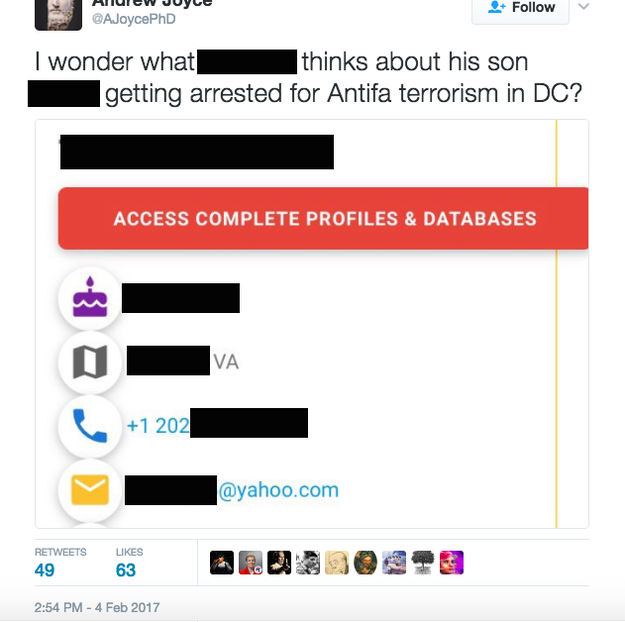
A Virginia man who was arrested at the inauguration and who asked not to be identified told BuzzFeed News that his name and information were posted to Twitter by the white nationalist writer Andrew Joyce. Though Joyce’s account was suspended, the man said someone posted a screenshot of the Tweet to Facebook page of a business he runs out of his home, along with a warning not to patronize it.

“I was afraid to go outside that night,” he said. “I went to smoke a cigarette and I thought, what if someone comes and shoots me?” The man said he has since taken down the Facebook page.

“I was afraid to go outside that night. I went to smoke a cigarette and I thought, what if someone comes and shoots me?”

Charles Johnson, the owner of GotNews and founder of WeSearchr, told BuzzFeed News that the public had a right to know the names of the protestors.

“It&039;s journalism bro,” he wrote in an email. “These are criminals and the public deserves to know who they are. In my opinion it&039;s racist that the mug shots aren&039;t being released. We always get the mug shots of black criminals. Why not hipster rioters from Brooklyn? We have several cash bounties against the antifa and are actively working with federal and local law enforcement to see them brought to justice. It won&039;t be long now.”

The anti-anti-Trump internet hardly limits its efforts to black bloc anti-fascists and overzealous protesters. Last month, immigration activists warned that trolls were monitoring and promoting the popular Twitter hashtag in an effort to catalogue and report undocumented workers.

Acts of political resistance spread on social media, followed by personal retribution: This is a familiar pattern. In 2011, journalists, politicians, and technologists hailed the role that social networks played in toppling a succession of dictators in the Middle East. In the years that followed, the same people watched in despair as revanchist authoritarians scoured the very same social networks to target the activists and organizers who had used them, they thought, to gain their political freedom. The great technological lesson of the Arab Spring was that social platforms are not inherently democratic; rather, they can just as easily oppress people as express their will.

To be sure, the next anti-administration activist the pro-Trump, alt-right internet manages to get thrown in jail will be the first. But it would be a mistake to dismiss the anti-anti-Trump internet as simply conspiracy mongers or attention-seeking opportunists. While the alt-right may not be able to turn out in great numbers to a street protest, they’ve shown themselves since the nascent days of Gamergate to be remarkably adept at fomenting information campaigns against individual and corporate targets, from Brianna Wu and Intel to Comet Ping Pong and John Podesta. (Earlier this week. the alt-right came up with its own answer to : , a response to the site releasing a television expansion of the 2014 campus satire Dear White People, which the Twitter user @BakedAlaska, a hero of the pro-Trump internet said “promotes white genocide.”) Meanwhile, the sheer number of new, Trump-loyal outlets trading in conspiracy and confirmation bias suggests that any and all information surfaced by the same churning engine that produced will be spread further and faster than ever.

And maybe higher. Charles Johnson worked for Steve Bannon, the president’s powerful chief strategist, at Breitbart, and was reported by Forbes to be advising the Trump transition team. While there is no evidence to suggest that the Trump administration is actively monitoring social media campaigns in order to target private individuals, federal law enforcement has used social media as a tool to impose the President’s since-stayed executive order on immigration. Last week, BBC reporter Ali Hamedani announced that a customs agent seized his phone and read his tweets during his detention at Chicago’s O’Hare airport:

It’s a reminder that, for all the excitement that viral Trump resistance has produced on the left, every unit of that virality — whether it’s a face on a Periscope stream, a tweet, or a Facebook group — is a piece of information that can be seized, decontextualized, and ultimately used against the opposition. And that when it comes to social media’s ability to effect change, proximity to power and access to force matter just as much — if not more — than a majority.

Quelle: <a href="The Viral Anti-Trump Movement Is Here — And It&039;s A Huge Target“>BuzzFeed