Is This An Ad? Lady Gaga’s Super Bowl Airbnb

Welcome to “Is This an ?,” a column in which we take a celebrity social media post about a brand or product and find out if they’re getting paid to post about it or what. Because even though the FTC recently came out with rules on this, it’s not always clear. Send a tip for ambiguous tweets or ‘grams to katie@buzzfeed.com.

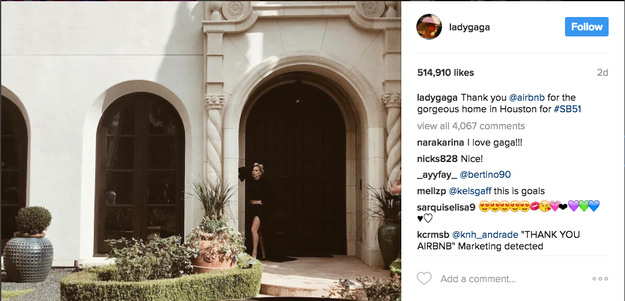
Was this Lady Gaga Instagram an ad for Airbnb?

Was this Lady Gaga Instagram an ad for Airbnb?

instagram.com

THE CASE:

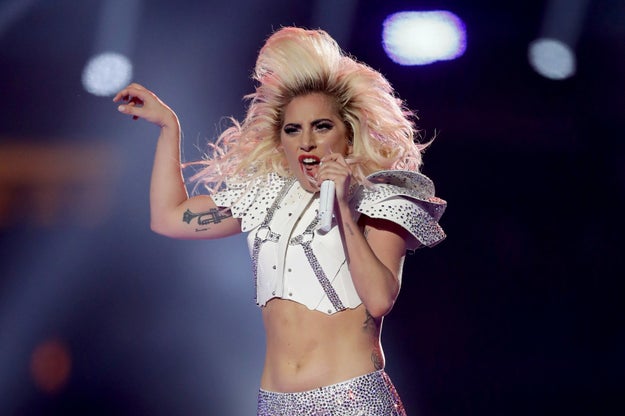
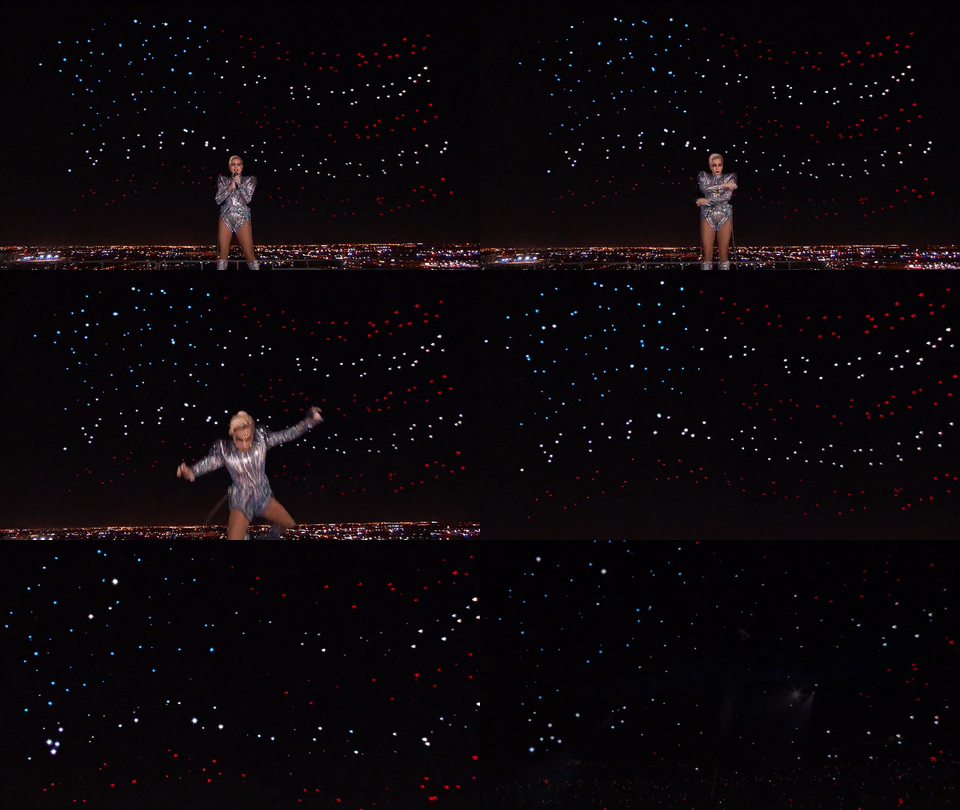
Last weekend, Lady Gaga performed at the Super Bowl in Houston. It was nice, we all had a great time, she jumped off a roof, she didn’t say anything political (or did she???), you know the deal. YAAASS Gaga, etc.

Ronald Martinez / Getty Images

After the Super Bowl, she posted an Instagram of herself in the doorway of a lavish house, with the caption “Thank you @airbnb for the gorgeous home in Houston for

What does that mean? Is that an ad? Before we get into it, let me ask you all your opinion. Because YOUR opinion matters a lot here, almost as much as the truth. The whole golden rule on these kinds of things is whether or not the average person (you) would be able to tell if it’s an ad.

So don’t think too hard. Pretend you’re not reading an article about this. Just imagine you’re scrolling through Instagram. Maybe you’re on the couch watching TV, maybe you’re in bed or class — your normal Instagram viewing sitch. Get into that mindset. Are you there? Ok, good. So you’re scrolling…. and you see this quickly in your feed. You don’t linger on it, you just see it, read the caption, and keep going.

THE EVIDENCE:

The phrase “thank you @airbnb” sounds like it’s proooooobbbably an ad, right? But it’s ambiguous&; When Mindy Kaling recently used that same phrasing for a free mattress, the company ended up asking her to change her wording after I reached out to ask about it. They admitted it sounded ambiguous, and her new caption now reads “thanks @casper for the gift&033;” Saying “thanks for the gorgeous home” doesn’t mean that it was free or a gift – it could just mean she was grateful that Airbnb exists and has such amazing luxurious places. I’ve stayed in some great Airbnbs and I’ve felt that way&033;

But look. I don’t want to yank your chain around too much here. The best evidence is to look to the past: Beyoncé’s Super Bowl Airbnb from last year.

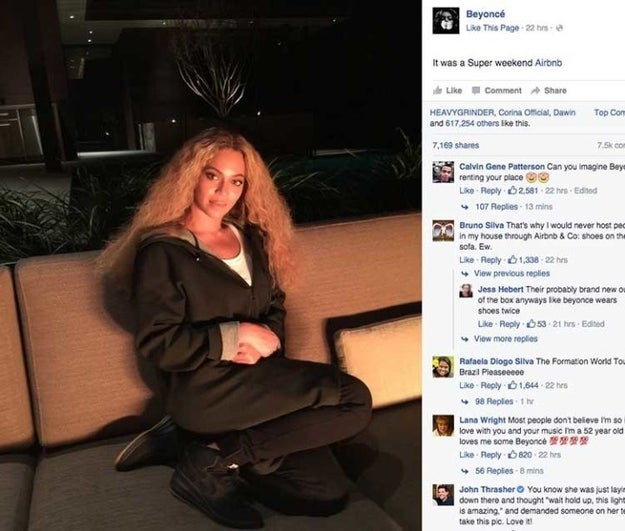
Beyoncé posted to Facebook a photo of herself sitting on the porch of a fancy house, with the caption “It was a Super weekend @airbnb”. At the time, I remember thinking that it was probably NOT an ad – she probably just preferred a private house to a hotel, right? I asked Airbnb to ask if it was an ad, and they wouldn’t really give me a straight answer, but months later did admit that it was a freebie (the home’s owner got paid by Airbnb, and Beyoncé didn’t pay anything).

Airbnb does this not infrequently – Mariah Carey, Kourtney Kardashian, and Kim Kardashian and Kanye West have all gotten “gifted” Airbnb freebies. So we know Airbnb is definitely in the habit of doing this type of celeb , and it’s not a leap to guess that’s what’s happening here.

THE VERDICT:

Airbnb confirmed to BuzzFeed News that just like with Beyoncé, they paid for Lady Gaga’s stay, but did not pay her on top of the free stay.

However, they did not respond to questions about whether or not her Instagram shoutout was an explicit or implicit quid pro quo arrangement. Did they just give it to her and never asked (but secretly hoped) that she might Instagram it? Or was a formal deal that she would create social content for them in exchange for a free stay? This distinction does seem to matter, right? To me, the second scenario feels way more ad-ish than the first.

But not to the Federal Trade Commission.Their stance is that there’s no difference between receiving merchandise (such as a free vacation rental) versus cold hard cash when it comes to social media endorsements. The house was listed for $10,000/night (although the listing is now suspiciously deleted from Airbnb) and she was there at least two nights (we know because she filmed the roof jump at a different night, so at least the day before and the night after. This means Airbnb provided her at least $20,000 worth of free housing, possibly more. So to the FTC, this is for sure an ad.

Was the language she used to indicate it’s an ad up to snuff for the FTC’s guidelines? Ehhh…. Probably not. The whole idea is it should be clear to a normal person whether or not she received a free stay; I don’t think it was totally clear. Saying “thanks for the gift” instead of “thanks for the home” would be more clear, perhaps.

The problem is that there’s an incentive to obscure the ad-iness of celebrity spon posts. An ad is much more effective if it doesn’t look like an ad. That’s the whole point, right? If she wrote “thank you for the free stay ad” it wouldn’t be quite as effective. Airbnb wants us plebes to think that Lady Gaga just loves Airbnb and chooses it over hotels. And Lady Gaga doesn’t want to seem like a craven shill who does Instagram sponcon like a Bachelor contestant.

Ironically, Airbnb is very excited to tell you about the other ad it ran during Super Bowl – a collage of faces of people of different ages and races with the tagline of . The ad was interpreted as being a direct shot at Trump’s immigration policy, especially because Airbnb CEO Brian Chesky had previously tweeted out that the company would offer free lodging to refugees. Or, it could be interpreted as an attempt to save face after a lawsuit alleging that hosts racially discriminated against black and non-white renters.

So what’s the difference? The TV ad was Advertising with a capital A – the kind of noble, artful Advertising that is made by smart creative people and that “starts a conversation” and “tells a story.” A 30-second Super Bowl spot is the pinnacle of that format.

But a Instagram from a celebrity? That’s not cool or prestigious. It’s seen as somewhat tacky, for low-level strivers and bogus products like weight loss tea.

Part of what makes whether we consider this an “ad” so confusing is the fact that the practice of giving free swag to celebrities in hopes that they’ll talk about it goes by a different name: publicity.

Allow me to try a theory here: advertising, with its biggest stage being a sports game, has a very macho, male connotation. Publicity, on the other hand, is for conniving fake women. Advertising’s mascot is Don Draper; publicity has PubLizity from The Kroll show and Lizzie Grubman. The reason Airbnb is happy to discuss its advertising but not its publicity is rooted in sexism.

Comedy Central

Ok, that might be a littttttle bit reaching.

But the difference between how a company views advertising vs publicity and how the FTC views that is perhaps where we run into problems. From the brand’s viewpoint, advertising is something very specific – a TV spot or a print ad made by an outside agency with a set budget and PowerPoints that show the campaign’s effectiveness. PR is more nebulous, often done in-house. Think about the process of making a print ad campaign for Gucci to be in Vogue versus the process of giving a Gucci gown to Nicole Kidman for the SAG Awards. It’s a whole different team of people, a different budget, a different metric for success.

Brands see publicity and advertising as very separate things. I think to a degree, consumers do, too. The FTC’s guidelines don’t really take into account this nuance between ads and PR. I’m slightly sympathetic to the fact that Airbnb doesn’t think it’s doing anything wrong by not complying fully with FTC rules and asking Lady Gaga to have her post be more explicit.

On the other hand, what we know about Airbnb is that it has a somewhat, hmm, how shall I say… loose stance on following government regulations about how it does its business. Airbnb has been embroiled for years in legal and legislative fights with local governments over whether or not its business model should be allowed.

Let’s just say that Airbnb had “A Million Reasons” to not make it a “Bad Romance” with the FTC and shouldn’t have to “Just Dance” around the issue that they gave large gift to Lady Gaga in exchange for her using her “Telephone” to post about it on Instagram and keeping a “Poker Face” about the “Perfect Illusion” that it wasn’t an ad.

NFL

Quelle: <a href="Is This An Ad? Lady Gaga’s Super Bowl Airbnb“>BuzzFeed

Women's March Organizers Met With Jack Dorsey And Sheryl Sandberg

On February 10, behind closed doors in San Francisco, national organizers of the Women&;s March on Washington met with Facebook COO Sheryl Sandberg and other tech executives to discuss the ongoing role of social media in organizing demonstrations over issues like reproductive rights, immigration and civil rights, which some fear could be under threat from Donald Trump&039;s presidency. At a separate meeting earlier in the day, organizers also met Twitter CEO Jack Dorsey.

“We&039;re here to ask, &039;how can tech be a part of the resistance?&039;” said Reshma Saujani, one of the march&039;s national organizers and CEO of the nonprofit Girls Who Code. “We came to talk about what role will they play as we make sure we’re standing up for undocumented immigrants, those affected by the Muslim ban, and other marginalized communities. We felt like we could find allies in the tech community, and we have.”

Jenna Arnold, one of the march&039;s national organizers, said she was thankful that many social media platforms had “generously fast-tracked a lot of the things we needed.” Arnold said that Sandberg and Dorsey were also eager for feedback from the march organizers on how their platforms were helpful.
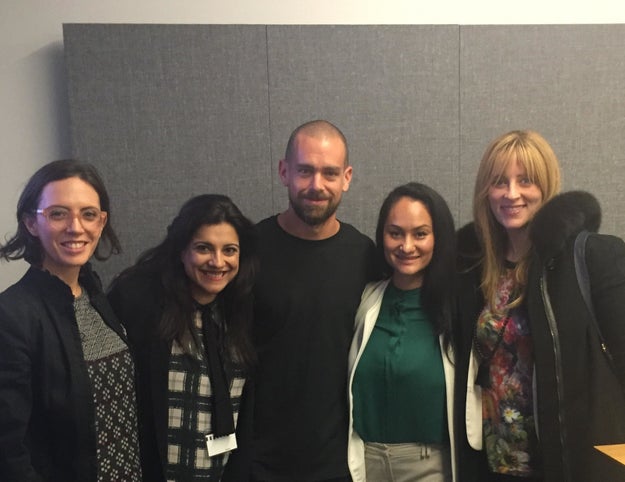
From left: Paola Mendoza, Reshma Saujani, Jack Dorsey, Carmen Perez, and Jenna Arnold.

The Women&039;s March began as a Facebook event, and it continues to use social media, primarily Facebook and Twitter, to disseminate information and issue calls to action, though Carmen Perez, one of the four national co-chairs and executive director of the nonprofit Gathering for Justice, stressed that it must be complemented with face-to-face interaction.

“We&039;re hoping that social media can continue to help us move people, policy, and energy, so we came here to discuss how to improve those partnerships,” Paula Mendoza, artistic director for the Women&039;s March, said.
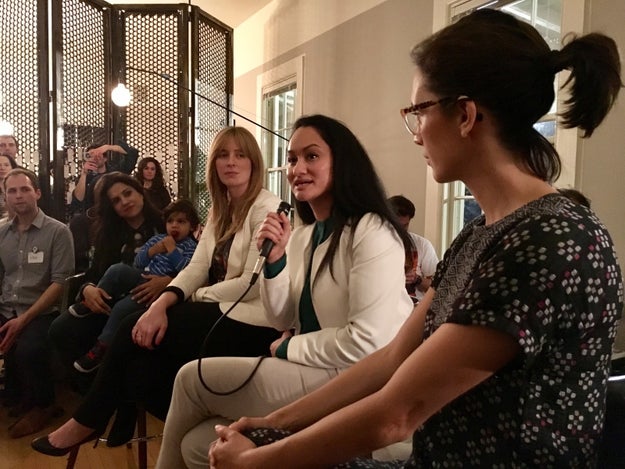
From left: Women&039;s March organizers Reshma Saujani, Jenna Arnold, Carmen Perez, and Paola Mendoza.

Blake Montgomery

The Women&039;s March is in the process of rolling out 10 actions protesters can take during the first 100 days of the Trump administration, some of which will likely involve social media, according to Saujani.

“It would be weird if we weren&039;t using social media to amplify our message, our partners&039; messages, and what everyday women are saying,” Saujani said.
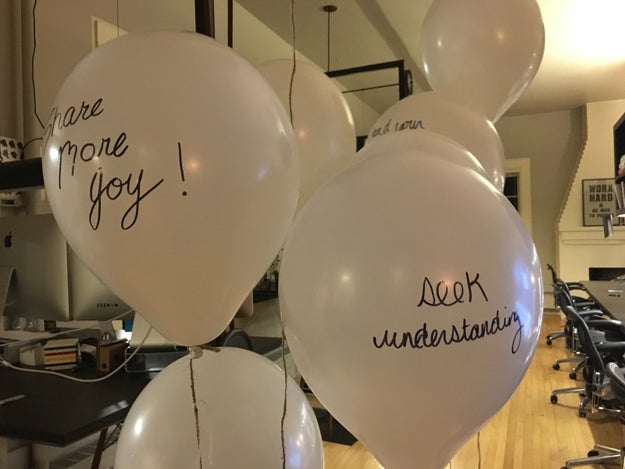
Allison Johnson, Apple&039;s former vice president of worldwide marketing communications, hosted a reception at the chic Presidio offices of her San Francisco marketing agency West along with photographers, painters, filmmakers, and other artists. People at the reception wrote wishes on notecards, dreams on white balloons, and visions of 2020 on long rolls of brown paper. Katie Stanton, former Twitter VP of global media, hosted a luncheon for the organizers and tech industry heads at the same space earlier in the day.

“The Women&039;s March is all about trusted networks,” Johnson said. “I had never met Paola Mendoza before, but when she called last week to say they were coming to San Francisco, I knew we had to host them and that it would be great.”
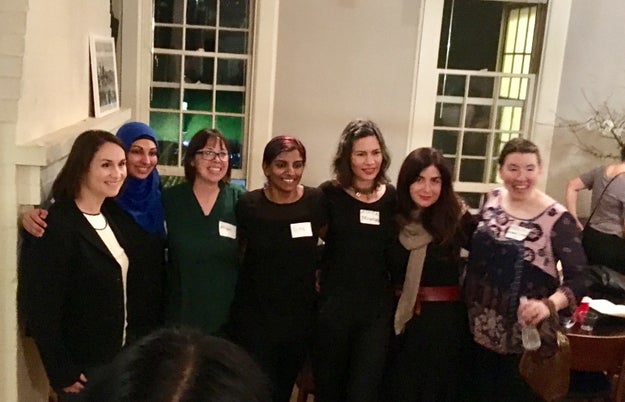
California Women&039;s March organizers.

Blake Montgomery

At the reception, Mendoza announced that the Women&039;s March would call for protests and vigils at Immigrations and Customs Enforcement (ICE) offices in response to recent raids across the country. Perez said her own extended family had been affected by ICE&039;s actions in Los Angeles.

“The Women&039;s March and our continued actions are a reminder that we are powerful,” she said while addressing the crowd. She called on them to protect and support undocumented immigrants.

Sandberg&039;s attendance of President Trump&039;s tech summit and absence from any Women&039;s March has earned her criticism from some women in Silicon Valley. Reshma Saujani, a Women&039;s March national organizer and CEO of the nonprofit Girls Who Code, told BuzzFeed News after their meeting that she believed Sandberg was “an unequivocal advocate for the Women&039;s March. Period.”

According to the organizers, neither the executives they met with nor the companies they lead will be donating money to the Women&039;s March.

“Though we will need money in the future, and it&039;s an easy and obvious ask, we weren&039;t here to ask for that,” Mendoza said. “There are more important things than money at this moment. The Women&039;s March is, after all, only 12 weeks old, and we&039;ve pulled off one of the largest gatherings in human history.”

The reception was a thank you to the city- and state-level organizers of the “sister marches” in California that happened January 21st alongside the titular march on Washington. A number of the California organizers had never been involved in activism before, and several of them met for the first time at the reception, gleefully exchanging differing perspectives on their work together.

The 13 marches across the Golden state boasted roughly 1.1 million protesters, accounting for one in three Americans who participated in the protest , the largest in the nation&039;s history, according to the organizers.

Carolyn Jasik, lead organizer for California, announced at the event that the state&039;s affiliated marches would host a statewide voter registration event on May 13, which would kick off a year&039;s worth of planning and preparation for the 2018 congressional elections.

“It&039;s not enough just to vote in these times,” she said. “You have to be an active voter. That&039;s what we&039;re interested in cultivating.”

As Arnold addressed the crowd and especially the California organizers, she said that their work was a gift because “we don&039;t have a grand solution, though people are looking to us for one.”

When asked what to expect next from the Women&039;s March, Mendoza said that people should look for both short-term planning that reacts to president Trump&039;s executive orders and long-term strategy for actions like the upcoming general strike, date TBD.

“What happened on the 21st didn&039;t stop on the 21st,” Perez said. “It was a catalyst for people to act now.”

Facebook and Twitter have not yet responded to requests for comment.

Quelle: <a href="Women&039;s March Organizers Met With Jack Dorsey And Sheryl Sandberg“>BuzzFeed