Hackers Tried To Break Into DNC Computers Right Before New Year’s Eve

An FBI agent walks past revelers gathered in Times Square on New Year&;s Eve in New York, U.S. December 31, 2016. REUTERS/Stephanie Keith

Stephanie Keith / Reuters

WASHINGTON — The FBI alerted the Democratic National Committee as recently as New Year’s Eve that hackers were once again trying to break into their computer systems, BuzzFeed News has learned.

“There was activity the day after the president issued sanctions [against Russia], looking for ways to get into the servers,” one high-level source familiar with the investigation said.

A US intelligence officer, who requested anonymity as they were not cleared to speak to the press, said that there have been “multiple attempts” to hack into the DNC since the Nov. 8 elections.

“Many of these attempts are not serious… hackers are trying to re-enter the DNC system but as far as we understand their attempts have not been successful,” said the intelligence officer, who had been in contact with the DNC over the attempts.

Neither offered an explanation for who was behind the intrusion attempts or details about the targeted systems.

Crowdstrike, a private cybersecurity firm hired by the DNC to investigate the original breach that saw thousands of emails of top Democratic Party members hacked and then made public, has also been helping the DNC secure their networks against future cyberattacks.

The Obama administration announced sweeping retaliations against Russian diplomats and intelligence officials on Dec. 29 for what the intelligence community says was a widespread influence operation designed to undermine the US election. The Russian effort included accessing the DNC’s system and using Wikileaks to distribute the contents of sensitive emails, according to US intelligence community analysis. The same day the sanctions were announced, the FBI and Department of Homeland Security issued a public report blaming Moscow for cyberattacks against DNC computer systems as far back as 2015. Those cyberattacks, and the subsequent release of stolen DNC emails, crippled the party on the eve of its June convention and rattled Democratic candidate Hillary Clinton’s presidential prospects through November.

The intelligence community’s analysis says the Kremlin’s influence measures were intended to bolster now President-elect Donald Trump’s run for office.

The ongoing FBI investigation into the DNC server hack came under sharp scrutiny this week when BuzzFeed News revealed the Bureau had never independently accessed or analyzed the committee’s hacked servers. The DNC originally said that was because the FBI never asked; the FBI later said it had asked and been rebuffed by DNC officials.

DNC officials tried to downplay the public disagreement Friday to BuzzFeed News, saying it was likely a miscommunication between the two entities.

The FBI investigation into the cyberattacks is ongoing.

Quelle: <a href="Hackers Tried To Break Into DNC Computers Right Before New Year’s Eve“>BuzzFeed

You Can Now Watch 520 Hours Of Trump Speeches In One Place

Mark Wilson / Getty Images

The Internet Archive, a publicly accessible repository of digital records based in San Francisco, has opened the gates to their Trump Archive, which includes nearly 750 televised speeches given by the president-elect.

The collection includes speeches and appearances dating back to 2009; it&;s been closed captioned, so you can search through it using keywords. The Archive plans to keep it updated throughout Trump&039;s presidency.

The Archive wrote in a statement that it “hopes to make it more efficient for the media, researchers, and the public to track Trump’s statements while fact-checking and reporting on the new administration.” Its archive includes 500 videos checked for accuracy by Politifact, the Washington Post, and factcheck.org. The Internet Archive previously built an archive of political TV ads, which lives within its TV News Archive, as does the Trump trove.

It also hopes people will use the archive for “any creative use: comedy, art, documentaries, wherever people’s inspiration takes them.” You can cut clips together using an editor within the archive. The archive&039;s creators call it “Popcorn.”

In the near future, you may see another archive that focuses on Trump&039;s cabinet or Paul Ryan&039;s televised appearances. The Internet Archive is considering building other such databases. It said in a statement, “We consider the Trump Archive to be an experimental model for creating similar archives for other public officials.”

Because the Trump Archive is largely hand-curated from the Internet Archive&039;s trove of 1.3 million television clips, the organization is hoping to collaborate with artificial intelligence companies to more efficiently create searchable databases about public officials by recognizing faces and voices. Around five Internet Archive staff members created the Trump Archive over the course of a week and a half, according to Roger Macdonald, manager of the TV Archive.

Macdonald said the curators focused on fact-checking for the archive because “fact-checking is a great signal that there’s some element of a speech that’s of import to news or in the public interest.” The archive&039;s staff used the same approach when curating its collection of Political TV.

The history of the internet is fragile and a Google search won&039;t always bring up what you need, which makes archives like this one so useful. The Internet Archive&039;s most well-known product, the Wayback Machine, preserves websites even after they are deleted.

Quelle: <a href="You Can Now Watch 520 Hours Of Trump Speeches In One Place“>BuzzFeed

OpenStack Developer Mailing List Digest December 31 – January 6

SuccessBot Says

Dims &; Keystone now has Devstack based functional test with everything running under python3.5.
Tell us yours via IRC channels with message &; <message>&;
All

Time To Retire Nova-docker

nova-docker has lagged behind the last 6 months of nova development.
No longer passes simple CI unit tests.

There are patches to at least get the unit tests work 1 .

If the core team no longer has time for it, perhaps we should just archive it.
People ask about it on openstack-nova about once or twice a year, but it’s not recommended as it’s not maintained.
It’s believed some people are running and hacking on it outside of the community.
The Sun project provides lifecycle management interface for containers that are started in container orchestration engines provided with Magnum.
Nova-lxc driver provides an ability of treating containers like your virtual machines. 2

Not recommended for production use though, but still better maintained than nova-docker 3.

Nova-lxd also provides the ability of treating containers like virtual machines.
Virtuozzo which is supported in Nova via libvirt provides both a virtual machine and OS containers similar to LXC.

These containers have been in production for more than 10 years already.
Well maintained and actually has CI testing.

A proposal to remove it 4 .
Full thread

Community Goals For Pike

A few months ago the community started identifying work for OpenStack-wide goals to “achieve visible common changes, push for basic levels of consistency and user experience, and efficiently improve certain areas where technical debt payments have become to high &8211; across all OpenStack projects.”
First goal defined 5 to remove copies of incubated Oslo code.
Moving forward in Pike:

Collect feedback of our first iteration. What went well and what was challenging?
Etherpad for feedback 6

Goals backlog 7

New goals welcome
Each goal should be achievable in one cycle. If not, it should be broken up.
Some goals might require documentation for how it could be achieved.

Choose goals for Pike

What is really urgent? What can wait for six months?
Who is available and interested in contributing to the goal?

Feedback was also collected at the Barcelona summit 8
Digest of feedback:

Most projects achieved the goal for Ocata, and there was interest in doing it on time.
Some confusion on acknowledging a goal and doing the work.
Some projects slow on the uptake and reviewing the patches.
Each goal should document where the “guides” are, and how to find them for help.
Achieving multiple goals in a single cycle wouldn’t be possible for all team.

The OpenStack Product Working group is also collecting feedback for goals 9
Goals set for Pike:

Split out Tempest plugins 10
Python 3 11

TC agreeements from last meeting:

2 goals might be enough for the Pike cycle.
The deadline to define Pike goals would be Ocata-3 (Jan 23-27 week).

Full thread

POST /api-wg/news

Guidelines current review:

Add guidelines on usage of state vs. status 12
Add guidelines for boolean names 13
Clarify the status values in versions 14
Define pagination guidelines 15
Add API capabilities discovery guideline 16

Full thread

 
Quelle: openstack.org

DNA-Testing Startup Counsyl Lays Off 5% Of Its Workforce

Counsyl&;s founders

Counsyl

DNA-testing startup Counsyl said Friday that is laying off part of its sales team, or about 5% of its workforce.

The 24 salespeople were tasked with promoting the startup&039;s cancer-screening test, which detects your risk for breast, ovarian, colon, and other cancers, to doctors, the company confirmed to BuzzFeed News. The layoffs suggest that sales may have been sluggish.

Counsyl, which has raised more than $100 million from investors that include Peter Thiel&039;s fund, also sells genetic tests for aspiring parents who want to learn if their offspring might be at risk of inheriting diseases, and for pregnant mothers.

Counsyl&039;s existing salesforce will continue to sell the cancer test along with the other tests, the company said, but will “strengthen its focus” on its women&039;s health tests.

Last year, Counsyl laid off 27 employees in sales support, design, marketing, and engineering from what was then a 400-person workforce, as BuzzFeed News reported then.

Counsyl also said Friday that it has screened more than 700,000 patients, identified more than 8,000 couples at risk of passing inherited genetic disorders to their children, and provided over 54,000 genetic counseling sessions to patients.

Quelle: <a href="DNA-Testing Startup Counsyl Lays Off 5% Of Its Workforce“>BuzzFeed

What Note7 Recall? Samsung's Profits Are The Best They've Been In Years

Samsung&;s costly and embarrassing recall of its flagship Galaxy Note7 smartphone last year tarnished the company&039;s reputation, but it hasn&039;t really hurt its bottom line. Samsung&039;s Q4 2016 profits grew nearly 50% from Q4 2015, according to a statement from the company.

Samsung&039;s Q3 profits did take a hit after it was forced to issue a wide-ranging recall of 2.5 million Note7 phones because some were catching fire and exploding. The company lost $25 billion in market share over the debacle — roughly the entire value of Hewlett-Packard. But even that combined with the Q4 recall of 2.8 million of its smart washing machines, which were also exploding, did not seem to have made a dent in Samsung&039;s overall profits.

Samsung is worth $216 billion, according to Forbes, and sells everything from life insurance to semiconductors. It&039;s considered one of the pillars of the South Korean economy. Though mobile phones are one of its most visible products, especially in the West, they are not its only moneymaker.

Professor Jinsuh Lee of Purdue&039;s Krannert School of Management, who previously worked at Samsung Electronics, told BuzzFeed News, “The Note7 is part of the mobile division, but what led to the growth is the semiconductor division. They’re related, but if you’re looking at the whole picture, the mobile division can still have a bad quarter or two while semiconductors can continue to grow.”

“Semiconductors are in high demand now because of the growth of mobile products across the world, especially in China. There are only a handful of companies that can produce them at that scale, Samsung is one of them. They’re getting the major benefit from the market increase.”

Reuters reports that strong sales of chips, data storage products, and smartphone components, as well as a rebound in sales of Samsung&039;s other smartphones boosted the company to its strongest quarter since Q3 2013.

Samsung had another win in 2016: It avoided a costly verdict when the US Supreme Court sided with it over Apple in a lawsuit alleging that Samsung copied elements of the iPhone&039;s design. Apple was suing for $400 million.

Samsung did not immediately respond to request for comment.

Quelle: <a href="What Note7 Recall? Samsung&039;s Profits Are The Best They&039;ve Been In Years“>BuzzFeed

Medium’s “Renewed Focus” Left Some Publishers In The Dark

Via Medium

Like most of its publishers, Kelley Calkins learned of Medium’s decision to lay off staff and upend its ad business via a blog post, with no advance warning.

But unlike the rest of Medium’s publishers, Calkins was — at the moment she learned of the company’s upheaval — in the middle of migrating her site to its platform.

“The timing was just absolutely incredible,” Calkins told BuzzFeed News. “I was scrolling through Twitter and saw [Medium founder and CEO] Ev Williams’ post.” That post, which reportedly caught even some of Medium’s biggest publishing partners by surprise (neither Williams or Medium’s official Twitter account tweeted the blog post), announced the company was laying off 50 employees, closing down its New York and Washington, DC offices, and changing its business strategy. In the post Williams called the ad-supported business model on which Medium relied “a broken system.”

Calkins — a founder of the women’s publication, The Establishment — and her team had been working to launch their site on Medium since July. They&;d been enticed by Medium&039;s sleek design features and the publications the company had wooed to its platform; In the spring of 2016, Medium began hosting popular third-party sites like The Ringer, ThinkProgress, and The Awl. They were dumbfounded by company&039;s announcement. “We read it in this kind of shock,” said Calkins. “There were some expletives involved.”

A person familiar with Medium&039;s operations told BuzzFeed News that the company contacted all partner publishers the day of the announcement — including the Establishment — offering technical support, explanations about the fate of Promoted Stories, and reassurances that its Memberships subscription model is still in place for publishers.

Medium has “renewed its focus,” toward publishers before. The company debuted in 2012 as a sleeker blogging tool, but soon began commissioning stories from name-brand writers. Throughout 2013 and 2014, Medium added a stable of well-respected writers and acquired publications like Matter, which won a National Magazine Award for its long-form work in 2016.

But while well-funded, Williams’ vision for Medium has been largely inconsistent and opaque, leaving employees and content creators struggling to keep up and, in some cases, keep their jobs. In 2015, for example, Williams decided to reconsider Medium’s crucial TTR (total time reading) metric — one of the main ways it paid its writers. At the time the shift was intended to recast Medium as a sort of social network for readers and writers, but writers feared it would lead to layoffs. Not long after the move, Medium paired down its in-house editorial operation significantly. It spun off Matter and ended a number of contracts with writers and publications, including the political cartoon and illustration publication, The Nib, which published a cartoon this morning about Williams&039; announcement.

“We were dubious about going to Medium precisely because of its history of flip-flopping on its strategy,” Calkins said. “But they had a convincing pitch that they were going to bolster the publishing industry, and that commitment was meaningful to me.”

On Wednesday morning, when when it came time for The Establishment to go live on Medium, Calkins found she had trouble reaching typically responsive Medium staffers; they were being briefed on the bad news the company would soon announce. Calkins was contacted by a Medium rep later in the day, but by that time the news that the company was changing its business model was already public. And since the site’s URL was in the process of migrating, The Establishment officially launched on Medium a few hours after Williams’ blog post.

“Some of the Medium staffers who&039;d initially approached us and who we worked with reached out to us personally to say they felt terrible,” Calkins said. “They’d just heard and they&039;d lost their jobs. They were blindsided, too.”

For Calkins and The Establishment, the monetization programs that Medium shuttered were “played an essential role” in negotiations to migrate their site to the platform. “The monetization packages they offered factored in hugely in our decision to migrate,” she said. “It was very appealing that we&039;d have to do nothing or next to nothing to finally get some revenue — we were supposed to have some revenue today through promoted story feature.” Theoretically, The Establishment would have started accumulating revenue as soon as it migrated to Medium&039;s platform, but the program was cut Wednesday.

Not all publishers echoed Calkins&039; disappointment. Sunil Rajaraman, the CEO of The Bold Italic, which migrated last year to Medium, penned a post with the title, “I Migrated My Publishing Property to Medium, and I am Not Freaked Out.” In the post, he denied that publishers were owed any advance warning on the changes. Rajaraman suggested that The Bold Italic never relied on Medium solely for revenue, calling the idea idiotic. “I guess my general lack of shock/surprise at the announcement is that I&039;ve dealt with multiple ad providers in the past,” he told BuzzFeed News. “My view is that any publication that was betting its revenue future on Medium could have had the same result if they bet their publication on any single ad provider that suddenly hit a brick wall.”

Calkins told BuzzFeed News that the decision to leaning on Medium for advertising revenue was a calculated risk, especially given that it&039;s Promoted Stories unit was still in beta. “However, as a small publisher with limited (wo)manpower and resources, the idea that we could start producing revenue on Day 1 with limited effort on our end was incredibly enticing,” she said. “We were also impressed by the high-quality sponsored content campaigns we&039;d seen on Medium (Sofitel&039;s partnership with The Billfold comes to mind) and were thrilled to be able to tap into an established network of advertisers through Medium.”

Perhaps most surprisingly, Calkins and her team say they&039;ve heard very little from Medium since the announcement. Williams wrote in his blog post that Medium was “shifting our resources and attention to defining a new model for writers and creators to be rewarded, based on the value they’re creating for people.” He added that it was “too soon to say exactly what this will look like.”

Calkins and The Establishment are still processing the unexpected news. They are also hoping for more transparency from Williams. But so far, they’re not getting it. “We&039;re still in contact with a point person over there but that&039;s just troubleshooting technical issues,” Calkins said. “We’ve heard nothing officially from the company about the future.”

Quelle: <a href="Medium’s “Renewed Focus” Left Some Publishers In The Dark“>BuzzFeed

The Work Wellness Program Of The Future Will Track Your Sleep

Ipggutenbergukltd / Getty Images

Dan Roberts has been tired for what feels like his whole life. Between depression and anxiety, a packed work schedule, irregular eating habits, and a mind that’s prone to racing when it should be drifting off, the 36-year-old is lucky to get more than four hours of shut eye virtually every weeknight.

So during the day, “every minute feels like an hour,” Roberts told BuzzFeed News. “You feel really sluggish and down, maybe not quite lucid and not quite yourself.” Desperate, he started taking Benadryl. “Before you know it, one becomes two and two becomes three.”

In the fall of 2015, he got reprieve in the form of Sleepio, a research-backed online sleep therapy and coaching platform from the company Big Health. While there’s no shortage of sleep-tracking apps, Sleepio is targeting sleepy workers in particular. Employers like Boston Medical Center — where Roberts is a physical therapy assistant — have started offering it to their workers as a health benefit, much like they might provide gym discounts or medical screenings or on-site fitness classes. In corporate wellness, the next frontier may be your ZZZs.

Employers generally support wellness programs because, the thinking goes, workers who are healthy and active tend to be more productive, miss less work, and incur lower health care costs. Some of these programs track data about their lifestyle and behavior, like weight, smoking habits, and steps.

“Are we setting a precedent for the employer to be present, albeit in virtual form, in the worker’s home?”

But not sleep, at least until recently. Big Health, founded in 2010, deploys Sleepio to 1 million workers at 20 employers, including Boston Medical Center, LinkedIn, Oxford University, the Henry Ford Health System, the United Kingdom’s National Health Service, and Comcast. Aetna offers hundreds of dollars to employees as an incentive to sleep seven hours a night. And Accenture, the strategy and consulting firm, is now providing Sense devices, the sleep-monitoring gadget from the startup Hello, to its employees (it isn&;t privy to any of their data, and participation is voluntary).

In general, though, not every employee may be open to having their sleep tracked by a program associated with their bosses. Sleep is intimate. You can be sleep-deprived from partying until sunrise, which you may not want anyone linked with work to know. Or maybe you’re working into the early hours of the morning, in which case a sleep-tracking work wellness program may feel a little ironic.

For their part, Sleepio says it does not share personally identifiable data with employers, although it does share aggregated, de-identified data about employees on the whole. Aetna doesn’t ask employees to confirm information they provide for the voluntary program, a spokesperson said.

Still, the idea of any employer monitoring its workers’ sleep creeps out Ifeoma Ajunwa, a law professor who studies wellness program-related legal issues at the University of the District of Columbia. “What level of privacy invasions are we willing to accept in the context of employment?” she asked. “Are we setting a precedent for the employer to be present, albeit in virtual form, in the worker’s home?”

But Dr. Lawrence Epstein, assistant medical director of the Division of Sleep and Circadian Disorders at Brigham and Women’s Hospital in Boston, thinks sleep is as valid a health metric to worry about as any other. “We think it’s okay to promote people not smoking cigarettes and not using drugs and alcohol to excess and not being overweight,” he said. Sleep “should be in the same category.”

G-stockstudio / Getty Images

It’s not surprising that employers would be invested in making sure their workers snooze well (off the clock, that is). More than one-quarter of people in the US occasionally don’t get enough sleep, and nearly 10% have chronic insomnia, according to the Centers for Disease Control and Prevention. Not only does insufficient sleep lead to car crashes, machinery accidents, and on-the-job errors, it’s linked with chronic conditions like diabetes, cardiovascular disease, obesity, and depression. Lost time due to sleep deprivation adds up to about 1.23 million missed working days, or $411 billion, a year in the US, according to a report by the RAND Corporation. Close behind is Japan, where lack of sleep leads to 604,000 missed working days per year.

Roberts knew he had to try Sleepio when he filled out an initial questionnaire about his sleep. “It turned out I was the worst-scoring person in the whole building,” he said.

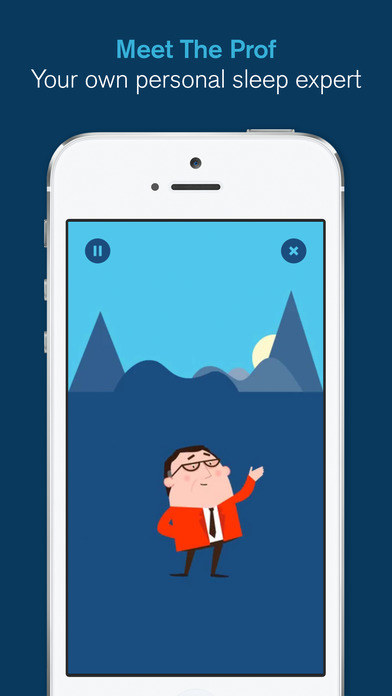
Every day, he’d fill out a Sleepio diary, listing things like what time he wanted to go to bed and what time he’d actually done so. An animated professor in the app offered feedback and taught him to, for example, write down how he was feeling, do muscle-relaxation exercises, and identify what was making his mind race. “It would take you step by step — ‘Is this something that needs to be done now, can it wait until later?’” he said.
Sleepio / Via itunes.apple.com

Roberts was used to forcing himself to lie down for eight or nine miserable hours, although he’d actually only sleep for four or so. But Sleepio suggested that he go to bed only when he was truly tired, so his body would associate that time exclusively with deep, quality sleep. As the weeks ticked by, Roberts gradually improved his sleep in terms of both time— to six hours and 45 minutes — and quality.

Sleepio is designed to deliver what’s known as cognitive behavioral therapy for insomnia. It’s a line of research pioneered by Colin Espie, a sleep medicine professor at the University of Oxford and co-founder of Big Health and Sleepio, where he is now the clinical and scientific director. One of Espie’s studies, for example, tested an early version of Sleepio on adults with insomnia. Eight weeks after the treatment, those who took the online course spent 20% more time in bed asleep, compared to 6% who took a placebo program.

“We formalize all of that knowledge of a world-leading expert, and make it available to everybody by automating it,” Big Health CEO Peter Hames told BuzzFeed News.

Even if employees are open to the idea, accurately tracking sleep and seeing if a sleep therapy is working isn’t straightforward. The scientifically valid way of having your sleep measured involves spending the night in a lab and hooked up to expensive equipment — not exactly normal bedtime circumstances. By contrast, in wellness programs that reward you for your walking activity, Fitbits and pedometers are pretty reliable step-trackers.

One way Sleepio tracks its users is by syncing with sleep-tracking bracelets like Jawbone and Fitbit, but some studies have questioned those devices’ accuracy. Otherwise, the startup relies on people to self-report when they go to bed and wake up. So does Aetna, whose employees can earn $25 for every 20 nights of sleeping seven hours or more for a maximum of $300 each year.

Hello

But other workers may find peaceful slumber to be a reward in and of itself.

In November, Target and Best Buy started selling Sense, a voice-activated, orb-shaped device that sits by your bed and monitors how conducive the room is to sleeping, from its temperature to noise level. And it wirelessly connects to a pillow sensor that tracks your movements. Its maker, Hello, says its gadget is now being used by workers at Accenture, a client of Arianna Huffington’s newly formed corporate wellness company, Thrive Global, in addition to other, unannounced workplaces. (Huffington is the author of The Sleep Revolution and a self-described “sleep evangelist.”)

“The more sleep-deprived an individual is, the more they’re willing to let other people work and coast on the good work of other people,” Matthew Walker, Hello’s chief scientist and director of UC Berkeley’s Sleep and Neuroimaging Laboratory, told BuzzFeed News. “I think finally business is waking up — if you excuse the pun — to the importance of sleep.”

Quelle: <a href="The Work Wellness Program Of The Future Will Track Your Sleep“>BuzzFeed