Introducing Zaius, Google and Rackspace’s open server running IBM POWER9

Posted by John Zipfel, Technical Program Manager

Here at Google Cloud, our goal is to enable our users and customers to be successful with options, high performance and value. We’re committed to open innovation, and look forward to working with industry partners on platform and infrastructure designs.

In fact, earlier this year, we announced that we would collaborate with Rackspace on the development of a new Open Compute Project (OCP) server based on the IBM POWER9 CPU. And we recently announced that we joined the OpenCAPI Consortium in support of the new open standard for a high-speed pathway to improve server performance. Today, we’re excited to share the first spec draft of our new server, Zaius P9 Server, which combines the benefits of IBM POWER9 and OpenCAPI for the OCP community.

Over the past few months, we’ve worked closely with Rackspace, IBM and Ingrasys to learn about the needs of the OCP community and help ensure that Zaius is useful for a broad set of users. With Zaius, Google is building upon the success of the Open Server specification and Barreleye platforms, while contributing the 12 years of experience we’ve gained from designing and deploying servers in our own data centers.

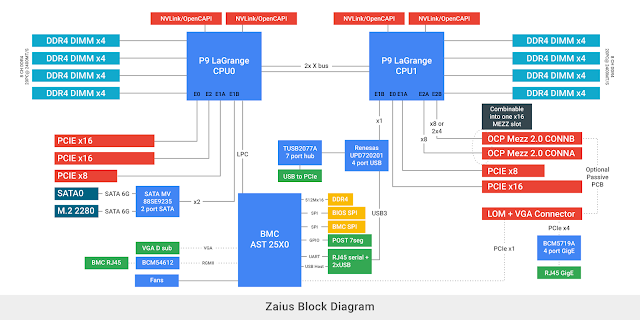
Zaius incorporates many design aspects that are new to Google and unique to OCP: POWER9 was designed to be an advanced accelerated computing platform for scale-out solutions, and will be available for components that use OpenCAPI and PCIE-Gen4 interfaces. The Zaius design brings out all possible PCIe Gen4 and OpenCAPI lanes from the processors to slots and connectors for an unprecedented amount of raw bandwidth compared to prior generation systems. Additionally, the updated package design reduces system complexity and the new microarchitecture provides increased efficiency and performance gains.

Block diagram of Zaius

The specifications
Zaius is a dual-socket platform based on the IBM POWER9 Scale Out CPU. It supports a host of new technologies including DDR4 memory, PCIE Gen4 and the OpenCAPI interface. It’s designed with a highly efficient 48V-POL power system and will be compatible with the 48v Open Rack V2.0 standard. The Zaius BMC software is being developed using Open BMC, the framework for which we’ve released on GitHub. Additionally, Zaius will support a PCIe Gen4 x16 OCP 2.0 mezzanine slot NIC.

We’ve shared these designs with the OCP community for feedback, and will submit them to the OCP Foundation later this year for review. Following this specification, we plan to release elements of the board’s design collateral, including the schematics and layout. If accepted, these standards will continue the goal of promoting 48V architectures. This is a draft specification of a preliminary, untested design, but we’re hoping that an early release will drive collaboration and discussion within the community.

We look forward to a future of heterogeneous architectures within our cloud. And, as we continue our commitment to open innovation, we’ll continue to collaborate with the industry to improve these designs and the product offerings available to our users.
Quelle: Google Cloud Platform

OpenStack Developer Mailing List Digest October 8-14

SuccessBot Says

loquacities: Newton docs are live on docs.openstack.org! Way to go docs team o/
dhellmann: OpenStack Newton is officially released!
tristanC: 6 TC members elected for Ocata [1].
dulek: Cinder gate is now voting on basic rolling upgrades support. One step closer to get assert:supports-rolling-upgrade tag.
More

Thoughts on the TC Election Process

When deciding to run, candidates write a long thoughtful essay on their reasons for wanting to serve on the TC.

It is rare for anyone to ask follow-up question, or to challenge the candidates to explain their position more definitively.
Some people pick by names they are most familiar with and don’t read those candidacy posts.
It is believed that it’s rare for someone who hasn’t been a PTL of a large project to be elected.
An example of implicit bias, blind auditions for musical orchestras radically changing the selection results [2].

Proposal: have candidates self-nominate, but instead of a long candidacy letter, just state their interests in serving.

After nominations close, the election officials will assign each candidate with a  non-identifying label (e.g. random number).
Candidates will post their thoughts and positions and respond to questions from people.
Candidacy essay would be posted in the campaign period, instead of the nomination period. This will exclude biographical information.
Perhaps candidates can forward their responses to election officials, who will post them for the candidates and identify only by candidate number.
The voting form will only list the candidates’ numbers.

Thoughts on the proposal:

Not allowing people to judge peoples’ character introduces a fraud incentive. You can tell friends your number secretly. Their implicit bias will make them think this is morally ok, and make them more likely to vote for you.
It can be important to identify candidates. For some people, there’s a difference in what they say, and what they end up doing when left calling the shots.
Familiarity doesn’t necessarily equal bias. Trust is not bias.
A good example [2] of needing to know the speaker and words came out of the thread. Also a reason why anonymous elections for leaders are a bad idea and favor native English speakers.

We need several things:

Allow time between the nomination and the voting. Some candidates don’t announce until the last day or two. This doesn’t allow much time to get to know them.
How to deal with timezone differences. One candidate may post an answer early and get more reaction.
Reduce the effect of incumbency.

The comparison of orchestra auditions was brought up a couple of cycles ago as well, but could be a bad comparison. The job being asked of people was performing their instrument, and it turns out a lot of things not having to do with performing their instrument were biasing the results.

The job of the TC is:

Putting the best interests of OpenStack at heart.
Be effective in working with a diverse set of folks in our community to get things done.
To find areas of friction and remove them.
Help set the overall direction for the project that community accepts.

Writing a good candidacy email isn’t really good representation of those abilities. It’s the measure of writing a good candidacy email, in English.

Sean Dague hopes that when voters vote in the election that they are taking the reputation of individuals into account.

Look at the work they did across all of OpenStack.
How they got consensus on items.
What efforts they are able to get folks to rally around and move forward.
When they get stuck and get unstuck.
When they ask for help and/or admit they’re out of their element.
How they help new folks.
How they work with long timers.

It’s easy to dismiss it as a popularity contest, however, this is about evaluating the plausible promise that the individuals put forward. Not just ideas they have, but how likely they are to be able to bring them to fruition.

Full thread

API Workgroup News

API usability tests being conducted at the Barcelona summit [3].
Two lively discussions [4]:

Collecting and improving error messages across OpenStack.
Request semantics with regards to GET and body processing.

New guidelines:

Add a warning about JSON expectations [5].

Guidelines currently under review:

Specify time intervals based filtering queries [6].

Full thread

Project Teams Gathering from the Ops Perspective

The first PTG will be held February 20-24 in Atlanta, GA at the downtown Sheraton hotel.
Tickets are $100.
Group rate is $185/night.
Registration will go live in the next couple of weeks.
Horizontal/cross project teams will meet Monday and Tuesday.
Vertical projects will meet Wednesday through Friday.
There’s a lot of great planning happening around the PTG planning, however, it’s going take some time for operators to figure it out.
Tom Fifield gives some notes for the operators:

Check out the diagram on the PTG site [7].

We’re finally acknowledging a release cycle starts with planning. Now we’ll be finalizing a release, while planning another.
This puts the summit at the right place to get feedback and decent ideas from users.

The OpenStack summit is the place the entire community gets together.

The PTG doesn’t mean the summit becomes a marketing thing. The summit can also include:

Pre-spec brainstorming
Feedback with users
Be involved in strategic direction.

Don’t expect Ops at the PTG

The PTG has been designed for space to get stuff done. Unless a user is deep in code, they won’t be there. If you want feedback from users, use the summit.

For ops-focused teams like Kolla, participating at OpenStack summits and Ops mid cycles are essential. Not everyone has to go to every event though. These teams should organize who is going to what events.
If you’re going to the summit in Barcelona, Thierry and Erin from the OpenStack Foundation will be hosting informational presentation on the PTG [8].
Full thread

Next PTL/TC Elections Timeframes

At the last TC meeting, TC members discussed future election period, with consideration of the OpenStack Summit and Project Teams Gathering.
The TC charter which uses “Design Summit” and “Summit” interchangeably is no longer valid and requires change.

There was a focus on limiting the impact change to avoid the need to modify the Foundation bylaws [9].
PTL elections would continue to be organized around development cycle boundaries.
TC elections would continue to be organized relative to OpenStack Summit dates.

Full thread

Running Non-Devstack Jobs in Python Projects

Devstack is the common tool to deploy OpenStack in CI environments.

However, it doesn’t deploy OpenStack in production versus tools like Kolla, Fuel, TripleO, etc.

Things might (and did) break when deploying OpenStack outside of Devstack:

SSL was not tested. Some projects still don’t test with SSL enabled.
IPv6 is not tested everywhere.
Production scenarios with HA (HAproxy and/or Pacemaker) are not tested.

Proposal:

This is not about removing Devstack. The idea is to add more coverage in an interactive way.
Projects like TripleO and Heat have been added as CI jobs in the experimental pipeline.
A draft document about increasing coverage in different projects [10].

Finding a balance between enough testing and overusing infra resources is tricky.

Also anything that’s more complicated than unit tests has > 0% chance of failure.

Another proposal:

Running periodic testing and moving forward reference hashes everyday if tests pass.

Allows deployment tools to move forward automatically.
Quite close to master, but not tightly coupled into every change.
This is pretty much what the OpenStack-Ansible project does for its “integrated build”.

Full thread

 
[1] &; http://lists.openstack.org/pipermail/openstack-dev/2016-October/105299.html
[2] &8211; http://blog.leafe.com/bias/
[3] &8211; https://wiki.openstack.org/wiki/UX#.21
[4] &8211; http://eavesdrop.openstack.org/meetings/api_wg/
[5] &8211; https://review.openstack.org/#/c/364460/
[6] &8211; https://review.openstack.org/#/c/383862/
[7] &8211; https://www.openstack.org/ptg
[8] &8211; https://www.openstack.org/summit/barcelona-2016/summit-schedule/events/17383/project-teams-gathering-101
[9] &8211; https://review.openstack.org/#/c/385951/
[10] &8211; https://docs.google.com/spreadsheets/d/1bLg-uEGrQXyRZ-FuR6pf1WT4XN0-6MrlfqEShI7xMxg/edit#=0
Quelle: openstack.org

What To Do If Comcast Caps Your Internet Data

What To Do If Comcast Caps Your Internet Data

Comcast, the largest Internet provider in the US, is rolling out a one terabyte data cap on internet use for customers in 18 different states on November 1.

Via giphy.com

What does that mean?

If you&;re a Comcast subscriber and you live in one of the states getting the cap (comprehensive list here), you will be limited to 1TB of internet data per month. For some customers, this is actually a boost — Comcast has been slowly rolling out data caps across the US for a while. Some states had a 300GB cap, but they&039;re getting 1TB now, since, according to Ars Technica, some customers were exceeding the lower limit.

What this likely means in the long run is that data caps are officially a part of how Comcast plans to do business. In a world where people are connecting more devices with more and more data-hungry services (Netflix and chill, for example), this could bring the internet service provider in conflict with its subscribers.

Comcast insists 99% of its customers use less than 1TB a month, telling Wired that the average Comcast subscriber uses 75GB per month and that only 10% of its customers even exceeded the previous 300GB cap. There seems to be a group of data 1 percenters: Last year the ISP told Ars Technica that 10% of its subscribers use 80 percent of all the data Comcast provided.

Take those numbers with a grain of salt, though.

Ars also found that the accuracy of Comcast&039;s data meters is widely disputed; some users allege that the meters are off by full terabytes. The FCC also just fined Comcast $2.3 million—the biggest fine to a cable company ever—for charging customers for things they did not buy. In some cases, people declined the specific services they were later billed for. This all suggests Comcast isn&039;t always precise about these kinds of things.

Some see Comcast&039;s expanding data caps as a move against video streaming services like Netflix and Amazon Prime, which have been upping the quality of their videos in recent months. Higher quality video, including 4K video, means more data usage. And Comcast, in direct competition with streaming services, also sells cable set top boxes, though it recently announced a deal that lets subscribers stream Netflix from their set tops.

So even if you&039;re an average internet user, Comcast&039;s data cap has big implications for the future. Back in 2012, experts were predicting that our demand for data would only increase, while the capacity to provide it could plateau. With the proliferation of high-intensity applications like VR, video conferencing, and 4K streaming, it&039;s possible that we&039;ll all be using a terabyte a month soon enough.

TBH, the data cap probably won&039;t affect you right now. But take precautions…

1. Set your Comcast account to remind you.

Know when you&039;re at 50%, 75%, 100%, and 125% of your monthly data usage. Knowledge is power.

1.5. Figure out how much data you typically use.

Use Comcast&039;s data estimator. If you have a Comcast account, view your monthly usage.

via Giphy / Via giphy.com

2. Don&039;t beat yourself up about it.

Comcast allows for two months in a 12-month period to be over the 1TB limit. For the third month, Comcast will charge $10 for an additional 50GB of data, with a price cap of $200 for overages.

3. If you&039;re mad pressed about your data, you can buy more.

You can purchase an unlimited data plan for $50 on top of your current subscription. Otherwise you&039;ll pay overages when you max it out after your two grace months.

Via Giphy / Via giphy.com

4. Watch Comcast&039;s “What Can You Do With a Terabyte?” video.

Note the like to dislike ratio on the video. Note that Comcast has disabled comments. Laugh.

youtube.com / Via youtube.com

5. Recall that in many places, people have no option for Internet service besides Comcast. You can find community in complaining.

Via Giphy / Via giphy.com

The company consistently ranks among the worst across the US in customer satisfaction, so there are plenty of people kvetching along with you, even if it&039;s just in principle. If you&039;re angry about the data cap, you&039;re not alone.

Quelle: <a href="What To Do If Comcast Caps Your Internet Data“>BuzzFeed

AWS Service Catalog is now available in the Europe (Frankfurt) and Asia Pacific (Sydney) regions

AWS Service Catalog allows organizations to create and manage catalogs of IT services that are approved for use on AWS. These IT services can include everything from virtual machine images, servers, software, and databases to complete multi-tier application architectures. AWS Service Catalog allows you to centrally manage commonly deployed IT services, and helps you achieve consistent governance and meet your compliance requirements, while enabling users to quickly deploy only the approved IT services they need. 
Quelle: aws.amazon.com

Use Hosted Git Repositories from AWS CodeCommit with AWS Elastic Beanstalk

You can now create and manage Git repositories hosted by AWS CodeCommit with the Elastic Beanstalk CLI (EB CLI) for your AWS Elastic Beanstalk environments. You can use the CodeCommit repository to store your project code and then deploy it to your Elastic Beanstalk environment. This provides you a convenient and secure place to store and version your Elastic Beanstalk applications.
Quelle: aws.amazon.com

Docker Distributed System Summit videos & podcast episodes

Following LinuxCon Europe in Berlin last week, we organized a first of its kind Docker event called Docker Distributed Systems Summit. This two day event was an opportunity for core Docker engineers and Docker experts from the Docker community to learn, collaborate, problem-solve and hack around the next generation of distributed systems in areas such as orchestration, networking, security and storage.

More specifically, the goal of the summit was to dive deep into Docker’s infrastructure plumbing tools and internals: SwarmKit, InfraKit, Hyperkit, Notary, libnetwork, IPVS, Raft, TUF and provide attendees with the working knowledge of how to leverage these tools while building their own systems.
We’re happy to share with you all the videos recordings, slides and audio files available as episodes!
Youtube playlist

Podcast playlist

All the slides from the summit are available on the official Docker slideshare account.
 
Please join us in giving a big shout out to our awesome speakers for creating and presenting the following projects:
 

InfraKit: A toolkit for creating and managing declarative, self-healing infrastructure

Speaker: Bill Farner and David Chung (Docker)
GitHub repo, Slides, video, podcast and Liveblogging

Heart of the SwarmKit: Store, Topology & Object Model

Speaker: Aaron Lehman, Andrea Luzzardi and Stephen Day (Docker)
GitHub Repo, Slides, video, podcast and Liveblogging

Persistent storage tailored for containers

Speaker: Quentin Hocquet (CTO at Infinit)
GitHub repo, Slides, video, podcast and Liveblogging

Prometheus: Design and Philosophy

Speaker: Julius Volz &; @juliusvolz (Author of Prometheus)
GitHub repo, Slides, video, podcast and Liveblogging

Talking TUF: Securing Software Distribution

Speaker: Justin Cappos (Professor at New York University)
GitHub repo, Slides, video, podcast and Liveblogging

Orchestrating Least Privilege

Speaker: Diogo Monica (Docker)
GitHub Repo, Slides, video, podcast and Liveblogging

Cilium &8211; BPF & XDP for containers

Speaker: Thomas Graf (Principal at Noiro Networks)
GitHub repo, Slides, video, podcast and Liveblogging

Docker Networking: Control Plane and Data Plane

Speaker: Madhu Venugopal and Jana Radhakrishnan (Docker)
GitHub repo, Slides, video, podcast and Liveblogging

Unikernels: the rise of the library hypervisor in MirageOS

Speaker: Anil Madhavapeddy and Martin Lucina (Docker)
GitHub repo, Slides, video, podcast and Liveblogging

 
The Docker team would also like to extend a huge thank you to everyone who attended the Summit in Berlin last week. The event was a success because of the amazing participation and energy of the community.
 

Thanks for this wonderful @docker team! Lot ´s of great ppl, great detailled tech infos, I learn so many things! See you soon! pic.twitter.com/oDrSs6XATH
— Julien Maitrehenry (@jmaitrehenry) October 9, 2016


Great talks, deep-dive content, really enjoyable ppl, Thks @docker 4 t dockersummit Berlin, bye-bye till next year pic.twitter.com/TgitFaieWQ
— grealish (@grealish) October 8, 2016

 
Click to tweet:

Check out the videos, slides and dockercast episodes from the dockersummit sessions last week! Click To Tweet

The post Docker Distributed System Summit videos &; podcast episodes appeared first on Docker Blog.
Quelle: https://blog.docker.com/feed/